Fill out UTMA forms
with AI.
UTMA forms are essential legal documents used under the Uniform Transfers to Minors Act, which provides a simplified way to transfer assets to a minor without the need for a complex and costly legal trust. These forms are critical for parents, grandparents, or guardians who wish to gift securities, real estate, or cash to a child while ensuring the assets are managed by a responsible adult custodian until the minor reaches legal age. By using a UTMA designation, individuals can ensure that a minor's financial future is protected and that assets are distributed according to specific state laws.
By continuing, you acknowledge Instafill's Privacy Policy and agree to get occasional product update and promotional emails.
About UTMA forms
These forms are most commonly used during estate planning or when designating beneficiaries for life insurance policies and investment accounts. For example, a UTMA Beneficiary Designation form allows a policyholder to name a minor as a recipient of funds, with a named custodian overseeing the money. This is particularly useful in situations where a simple inheritance is intended, but the recipient is not yet legally old enough to manage the property themselves. It streamlines the process of transferring wealth across generations while maintaining legal compliance.
Completing these legal documents requires precision to ensure that custodianship is correctly established and that the minor’s rights are protected. Tools like Instafill.ai use AI to fill these forms in under 30 seconds, handling sensitive data accurately and securely to save you time during the planning process. This allows you to focus on your financial goals rather than the complexities of manual paperwork.
Every form on this page can be completed without typing. Instafill is form filling software that reads a PDF and fills it for you — including flat and scanned documents that carry no fillable fields at all.
Forms in This Category
The forms in this category have a median Form Complexity Index of 61/100 (Moderate), measured across 2 forms by field count, input difficulty, length, conditional logic and structure. See how it is calculated.
| Form Name | Pages | FCI | |
|---|---|---|---|
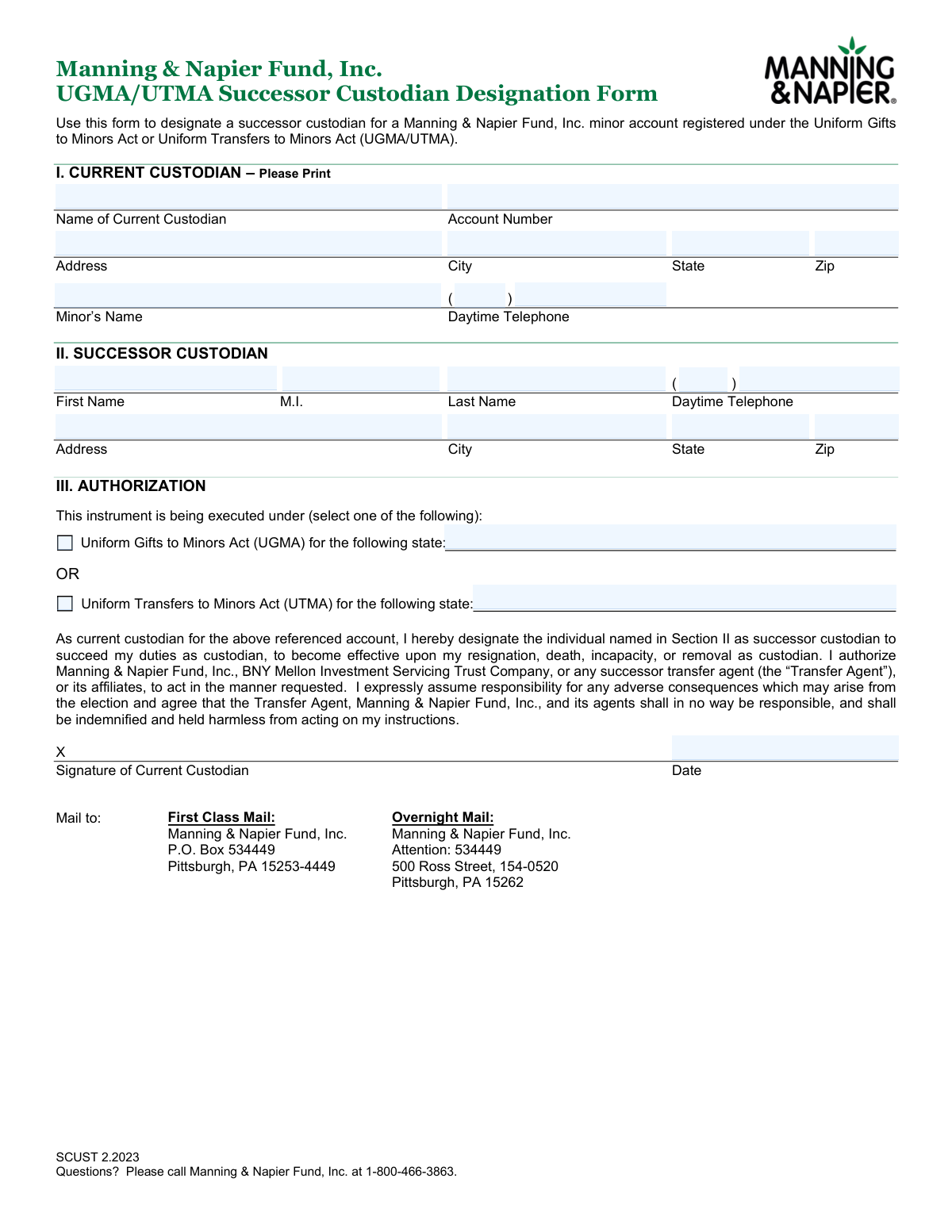
| 1. | Manning & Napier Fund, Inc. UGMA/UTMA Successor Custodian Designation Form | 1 | Basic 31 |
| 2. | UTMA Beneficiary Designation (Uniform Transfers to Minor Act) | 1 | Moderate 61 |
- Enterprise-grade security & data encryption
- 99%+ accuracy powered by AI
- 1,000+ forms from all industries
- Complete forms in under 60 seconds
How to Choose the Right Form
The Uniform Transfers to Minors Act (UTMA) provides a streamlined way to gift assets to a minor without the administrative burden of a formal trust. Choosing the right documentation is essential to ensure funds are managed correctly until the minor reaches adulthood.
When to Use the UTMA Beneficiary Designation
The primary form in this category is the UTMA Beneficiary Designation (Uniform Transfers to Minor Act). You should select this form if you are looking to:
- Designate a Custodian: Appoint an adult or financial institution to manage assets (like life insurance or brokerage funds) on behalf of a minor.
- Avoid Probate and Trust Fees: If the asset value doesn't justify the legal costs of setting up a formal trust, this form provides a legally recognized alternative.
- Transfer Liquid Assets: It is most commonly used for life insurance proceeds, cash, or securities.
Key Factors for Your Selection
When completing your UTMA Beneficiary Designation, keep the following in mind to ensure the document meets your specific needs:
- State-Specific Age of Majority: UTMA rules vary by state. Depending on your jurisdiction, the minor may receive full control of the assets at age 18, 21, or 25. Verify your state's specific age requirement before finalizing the form.
- Irrevocability: Once the transfer is made via this designation, it is generally irrevocable. Ensure you are certain about the transfer before finalizing the document.
- Successor Custodians: It is often wise to name a successor custodian within the form to ensure there is no gap in management if the primary custodian is unable to serve.
Why Use Instafill.ai?
Managing financial transitions for minors requires precision. By using Instafill.ai to complete your UTMA Beneficiary Designation, you can ensure all fields are accurately addressed. Our AI tools can also take static PDF versions of these state-specific forms and make them interactive, saving you time and reducing errors during the estate planning process.
Form Comparison
| Form | Purpose | Key Participants | Primary Use Case |
|---|---|---|---|
| UTMA Beneficiary Designation (Uniform Transfers to Minor Act) | Designates a custodian to manage assets for a minor beneficiary. | Asset owners naming a minor as a primary or contingent beneficiary. | Transferring life insurance or investment funds without a formal trust. |
Tips for UTMA forms
The custodian is responsible for managing the assets until the minor reaches the age of majority. Choose someone you trust to make sound financial decisions, as they will have legal control over the funds and a fiduciary duty to act in the minor's best interest.
While UTMA is a uniform act, the age at which a minor receives full control of the assets varies by state, typically between 18 and 25. Before finalizing the form, confirm the specific age requirements in your jurisdiction to ensure the transfer aligns with your long-term goals.
AI-powered tools like Instafill.ai can complete UTMA forms in under 30 seconds with high accuracy, significantly reducing manual data entry errors. Your sensitive financial and personal data stays secure during the process, providing a fast and reliable way to handle multiple designations.
It is a best practice to name a successor custodian in the event the primary custodian is unable or unwilling to serve. This simple addition prevents legal delays and ensures a smooth transition of asset management without the need for court intervention.
Financial institutions require precise legal names and Social Security Numbers to properly identify the beneficiary and report tax information. Even a minor typo can lead to significant administrative hurdles when the minor eventually attempts to claim the assets.
Once the form is completed, ensure that the financial institution holding the assets receives an original or certified copy. Keep a digital backup for your own records to help resolve any future disputes regarding the designation or the timing of the transfer.
Frequently Asked Questions
This form is used to transfer assets like life insurance proceeds or investment funds to a minor under the Uniform Transfers to Minors Act. It allows an adult to name a custodian who will manage the assets for the child's benefit without the need for a complex and expensive legal trust.
A UTMA arrangement involves three main parties: the donor who provides the asset, the minor beneficiary who legally owns the asset, and the custodian. The custodian is the adult responsible for managing the funds and making financial decisions until the minor reaches the legal age of majority.
Yes, you can use AI tools like Instafill.ai to complete UTMA forms efficiently. The AI can accurately extract relevant data from your supporting documents and place it directly into the form fields, ensuring the designation is clear and error-free.
Using AI-powered services, most UTMA forms can be completed in under 30 seconds. The technology automates the data entry process, which is significantly faster than manually typing in names, addresses, and account details.
UTMA forms are commonly used for a wide variety of assets, including cash, stocks, bonds, and life insurance policies. Because the act is flexible, it can also cover real estate and other types of tangible personal property depending on the specific state's regulations.
The age at which the minor takes control is determined by state law, typically occurring between the ages of 18 and 21. In some jurisdictions, the donor may specify a later age, such as 25, for the termination of the custodianship and the full transfer of funds.
No, transfers made under the Uniform Transfers to Minors Act are generally considered irrevocable gifts. Once the form is processed and the assets are moved into the UTMA account, they legally belong to the minor and cannot be taken back by the donor.
The completed and signed form should be submitted directly to the financial institution, brokerage, or insurance company that holds the assets. It is important to keep a copy for your records and ensure the designated custodian is aware of their appointment.
A UTMA form is a simpler, statutory method of transferring wealth to a minor that does not require a customized trust document drafted by an attorney. While it is easier to set up, it offers less flexibility than a formal trust regarding how and when the funds are distributed.
If a minor is named as a beneficiary without a designated custodian, the court may be required to appoint a legal guardian to manage the assets. This process can be time-consuming and costly, making the UTMA form a preferred way to streamline the transfer.
Glossary
- Form Complexity Index
- Instafill’s 0–100 measure of how much effort a form takes to complete, calculated deterministically from the form’s own structure rather than estimated. It combines the number of fillable fields (the largest factor), how difficult those fields are to complete based on their type, the number of pages that contain fields, the amount of conditional “fill-only-if” logic, and how many sections the form is divided into, then adds modifiers for tables and repeating lists, bundled instruction pages, and dense page layouts. A higher score means the form is harder to fill out by hand. The forms in this category have a median Form Complexity Index of 61/100 (Moderate). See exactly how it is calculated.
- Custodian
- The adult or financial institution responsible for managing and investing the assets in the UTMA account until the minor reaches the legal age of majority.
- Beneficiary
- The minor for whom the UTMA account is established and who is the legal owner of the assets, even though they do not have control over them yet.
- Age of Majority
- The age at which the minor legally gains control over the UTMA assets, which is typically 18 or 21 depending on the specific laws of the state where the account was created.
- Irrevocable Gift
- A permanent transfer of assets into the UTMA account that cannot be taken back or canceled by the donor once the transfer is complete.
- Successor Custodian
- A backup person named in the document to take over management of the account if the original custodian dies, resigns, or becomes unable to fulfill their duties.
- Fiduciary Duty
- The legal requirement for a custodian to act solely in the minor's best interest and manage the account's assets prudently.
- UGMA
- The Uniform Gifts to Minors Act, an older version of the UTMA that is more limited in the types of property it can hold, such as only allowing cash and securities.
- Legal Representative
- A person, such as a parent or court-appointed guardian, who is authorized to act on behalf of the minor in legal matters concerning the UTMA account.