Fill out Vanguard Charitable forms
with AI.
Vanguard Charitable forms are essential tools for individuals and organizations looking to manage their philanthropic activities through a donor-advised fund. These documents facilitate the process of making irrevocable contributions, such as transferring mutual funds, stocks, or cash, into a charitable account. By providing a structured way to document these transfers, these forms ensure that donors receive proper tax substantiation while clearly defining how their assets should be invested and distributed to various non-profit causes.
By continuing, you acknowledge Instafill's Privacy Policy and agree to get occasional product update and promotional emails.
About Vanguard Charitable forms
Donors and financial planners typically use these forms when establishing new accounts or during year-end tax planning when maximizing charitable deductions is a priority. Whether you are initiating a 'Make a contribution' request or managing existing fund assets, ensuring every field is completed correctly is vital for avoiding processing delays. Because these documents often require specific financial details and personal information, precision is necessary to maintain the integrity of your philanthropic strategy.
Managing these requirements doesn't have to be a manual burden. Tools like Instafill.ai use AI to fill these forms in under 30 seconds, handling the data accurately and securely. This approach simplifies the administrative side of giving, allowing you to focus more on the impact of your donations rather than the paperwork involved in the transfer process.
Every form on this page can be completed without typing. Instafill is form filling software that reads a PDF and fills it for you — including flat and scanned documents that carry no fillable fields at all.
Forms in This Category
The forms in this category have a median Form Complexity Index of 64/100 (Complex), measured across 2 forms by field count, input difficulty, length, conditional logic and structure. See how it is calculated.
| Form Name | Pages | FCI | |
|---|---|---|---|
| 1. | Make a contribution - Vanguard Charitable | 1 | Moderate 58 |
| 2. | Vanguard Charitable Open a Philanthropic Account | 1 | Complex 64 |
- Enterprise-grade security & data encryption
- 99%+ accuracy powered by AI
- 1,000+ forms from all industries
- Complete forms in under 60 seconds
How to Choose the Right Form
Navigating the requirements of a donor-advised fund (DAF) requires precision, especially when documenting the transfer of high-value assets. Whether you are a long-time philanthropist or setting up a new account, selecting the correct paperwork ensures your contributions are processed efficiently and your tax benefits are secured.
Funding Your Philanthropic Account
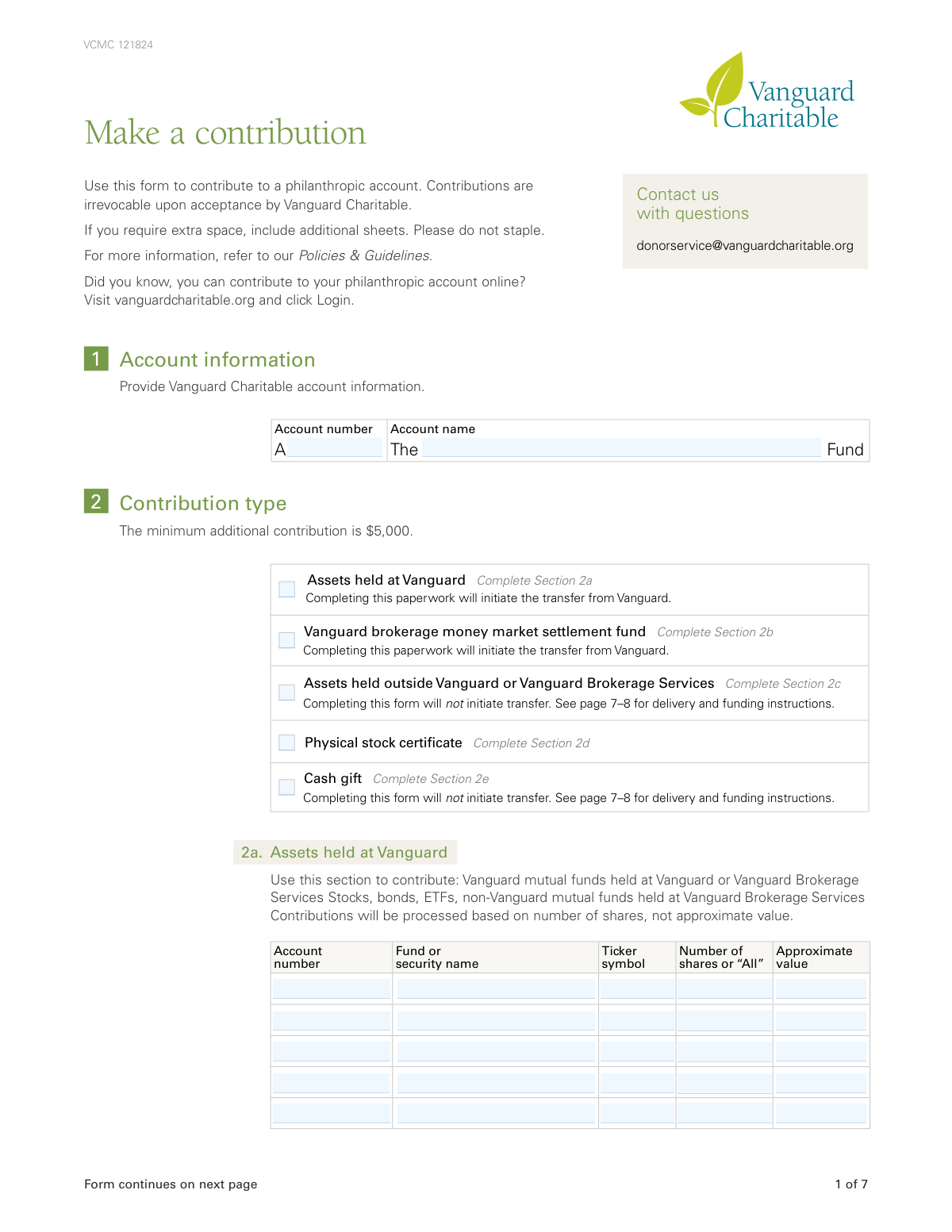
Currently, the primary document in this category is the Make a contribution - Vanguard Charitable form. This is the essential starting point for any donor looking to move assets into their philanthropic account. You should select this form if your goal is to:
- Initiate Irrevocable Transfers: Use this form when you are ready to move assets—such as cash, mutual fund shares, stocks, or bonds—permanently into the control of Vanguard Charitable.
- Secure Tax Substantiation: This form provides the necessary paper trail for the IRS, confirming the date and value of your gift so you can claim the appropriate charitable tax deduction.
- Direct Investment Proceeds: Beyond the transfer itself, this document allows you to specify how the liquidated proceeds should be allocated among various investment pools to grow your charitable impact over time.
When to Use This Form
While many charitable actions can be managed through online portals, the Make a contribution - Vanguard Charitable form is specifically required for formal asset transfers that originate from outside brokerage accounts or personal bank holdings. It is the correct choice for:
- Initial Account Funding: If you are opening a new donor-advised fund and making your first qualifying gift.
- Year-End Giving: When you need to ensure a contribution is recorded within a specific tax year.
- Complex Asset Gifts: When moving securities rather than simple cash transfers.
Using an AI-powered tool like Instafill.ai to complete this form helps ensure that account numbers and asset tickers are entered accurately, reducing the risk of processing delays during critical tax windows.
Form Comparison
| Form | Purpose | Who Files It | When to Use |
|---|---|---|---|
| Make a contribution - Vanguard Charitable | To document irrevocable transfers of assets like cash or stocks into a philanthropic account. | Individual donors or organizations contributing assets to their Vanguard Charitable account. | When transferring assets for tax substantiation and directing how proceeds are invested. |
Tips for Vanguard Charitable forms
Always double-check your donor-advised fund account number to ensure the contribution is credited to the correct philanthropic account. Accuracy in your investment allocation instructions is also crucial, as these directions determine how your assets will be managed once the contribution is liquidated.
When contributing stocks, bonds, or mutual funds, ensure you provide the exact ticker symbols and the specific number of shares. This precision prevents delays in the asset transfer process and ensures Vanguard Charitable can identify the correct holdings in your brokerage account.
Remember that contributions to a Vanguard Charitable account are irrevocable, meaning they cannot be returned once the transfer is initiated. Review all figures and asset choices carefully to ensure the donation aligns with your financial planning and tax strategy for the year.
AI-powered tools like Instafill.ai can complete these complex charitable forms in under 30 seconds with high accuracy. Your sensitive financial data stays secure during the process, providing a fast and reliable way to manage your giving without the manual data entry.
Maintain a dedicated digital folder for all your submitted contribution forms to simplify your year-end tax preparation. These documents serve as vital records for the IRS to substantiate the timing and value of your irrevocable charitable gifts.
The information on your Vanguard Charitable form must match the instructions you provide to your delivering financial institution. Discrepancies between these two sets of documents can cause significant delays in the processing of your asset transfer.
Frequently Asked Questions
These forms are designed to facilitate and document the transfer of assets into a donor-advised fund. They ensure that contributions are legally recognized as irrevocable gifts, which is necessary for tax substantiation and proper asset management within the philanthropic account.
Individual donors, families, or corporate entities looking to fund a donor-advised fund with Vanguard Charitable should use these forms. They are essential for anyone wanting to move cash, stocks, or other securities into their philanthropic account for charitable purposes.
These forms typically cover a wide range of assets, including cash, mutual fund shares, publicly traded stocks, and bonds. For more complex assets like private equity or real estate, additional documentation or specialized procedures may be required by the organization.
Yes, AI-powered tools like Instafill.ai can be used to fill out Vanguard Charitable forms by accurately extracting data from your source documents and placing it directly into the form fields. This technology simplifies the process of managing philanthropic paperwork by reducing manual data entry.
Using AI tools like Instafill.ai, most Vanguard Charitable forms can be completed in under 30 seconds. The AI quickly parses your financial or personal information and populates the PDF accurately, making the donation process much more efficient than manual typing.
A formal form is required to provide clear instructions on how the donated assets should be invested within the donor-advised fund. It also serves as a legal record of the transfer, which is vital for claiming charitable tax deductions with the IRS and maintaining accurate account history.
Yes, once a contribution is made to a Vanguard Charitable account using these forms, it is generally considered an irrevocable gift to a 501(c)(3) public charity. This means the donor gives up legal ownership of the assets in exchange for immediate tax benefits and future grant-making privileges.
You will generally need your Vanguard Charitable account number, detailed information about the assets being transferred (such as ticker symbols or CUSIP numbers), and the total value or number of shares. You may also need to provide specific delivery instructions for your brokerage firm to initiate the transfer.
Completed forms are usually submitted directly to Vanguard Charitable via their secure online portal, mail, or fax. It is important to follow the specific submission instructions provided on the form to ensure timely processing and to avoid delays in your asset transfer.
These specific forms are for making contributions into your Vanguard Charitable account. To recommend a grant from your account to another non-profit organization, you would typically use a separate grant recommendation form or the online donor dashboard.
Glossary
- Form Complexity Index
- Instafill’s 0–100 measure of how much effort a form takes to complete, calculated deterministically from the form’s own structure rather than estimated. It combines the number of fillable fields (the largest factor), how difficult those fields are to complete based on their type, the number of pages that contain fields, the amount of conditional “fill-only-if” logic, and how many sections the form is divided into, then adds modifiers for tables and repeating lists, bundled instruction pages, and dense page layouts. A higher score means the form is harder to fill out by hand. The forms in this category have a median Form Complexity Index of 64/100 (Complex). See exactly how it is calculated.
- Donor-Advised Fund (DAF)
- A private fund managed by a public charity that allows donors to make a charitable contribution, receive an immediate tax deduction, and then recommend grants from the fund over time.
- Irrevocable
- A legal status indicating that once assets are transferred to Vanguard Charitable, they become the property of the charity and cannot be returned to the donor.
- Medallion Signature Guarantee
- A specific certification stamp provided by a financial institution that verifies the authenticity of a signature for the transfer of securities like stocks or bonds.
- CUSIP Number
- A unique nine-digit identification code assigned to North American stocks and bonds used to ensure the correct assets are identified during the contribution process.
- Cost Basis
- The original value or purchase price of an asset, which is required on contribution forms to help determine the tax impact of donating appreciated securities.
- Tax Substantiation
- The formal documentation and record-keeping required by the IRS to prove a charitable contribution was made in order to claim a tax deduction.
- Investment Pool
- A selection of underlying funds where your contributions are held and managed according to your chosen strategy until you recommend a grant to a specific charity.
- Successor
- An individual or organization designated by the account holder to take over the management of the philanthropic account after the original donor passes away.