Fill out vendor forms
with AI.
Vendor forms represent the essential documentation required to establish and maintain professional relationships between organizations and their third-party suppliers. These business forms are the backbone of procurement and accounts payable departments, ensuring that all regulatory, tax, and compliance requirements are met before services begin or payments are issued. From purchasing forms that authorize new orders to complex disclosure statements, this category of paperwork helps maintain transparency and accountability across the supply chain for both private companies and government agencies.
By continuing, you acknowledge Instafill's Privacy Policy and agree to get occasional product update and promotional emails.
About vendor forms
These forms are typically needed by contractors, service providers, and administrative staff during the onboarding process or when business details change. For example, a provider working with the State of California might need to complete a DS 1891 Applicant/Vendor Disclosure Statement to satisfy regional center requirements, while property management teams often use specific change forms to update tax IDs and contact information. Because these documents often require precise data and legal certifications, accuracy is paramount to avoid payment delays or compliance issues. Managing this administrative overhead can be streamlined with modern technology; tools like Instafill.ai use AI to accurately complete these vendor forms in under 30 seconds, handling sensitive business data securely while saving significant time for busy professionals.
Every form on this page can be completed without typing. Instafill is form filling software that reads a PDF and fills it for you — including flat and scanned documents that carry no fillable fields at all.
Forms in This Category
The forms in this category have a median Form Complexity Index of 42/100 (Basic), measured across 3 forms by field count, input difficulty, length, conditional logic and structure. See how it is calculated.
| Form Name | Pages | FCI | |
|---|---|---|---|
| 1. | Change of Vendor Form | 1 | Basic 29 |
| 2. | DS 1891, Applicant/Vendor Disclosure Statement (State of California Department of Developmental Services) | 4 | Moderate 58 |
| 3. | Vendor Data Form | 1 | Basic 42 |
- Enterprise-grade security & data encryption
- 99%+ accuracy powered by AI
- 1,000+ forms from all industries
- Complete forms in under 60 seconds
How to Choose the Right Form
Navigating procurement and accounts payable requirements often requires specific documentation depending on your industry or the specific entity you are doing business with. In this category, the forms serve distinct purposes ranging from state-mandated regulatory compliance to internal corporate administrative updates.
Compliance for California Social Services
If you are an applicant or an existing provider seeking to work with a regional center under the California Department of Developmental Services, you must use the DS 1891, Applicant/Vendor Disclosure Statement.
- Purpose: This is a legal disclosure regarding ownership, control interests, and potential exclusions from state or federal programs.
- When to use: Use this during the initial vendorization process or whenever the regional center requests an updated disclosure. It is critical for maintaining your status as an authorized service provider in the State of California.
Property Management and Operational Updates
For businesses working within the real estate or property management sector—specifically with Harbor Group—the administrative requirements are focused on payment logistics and internal registration.
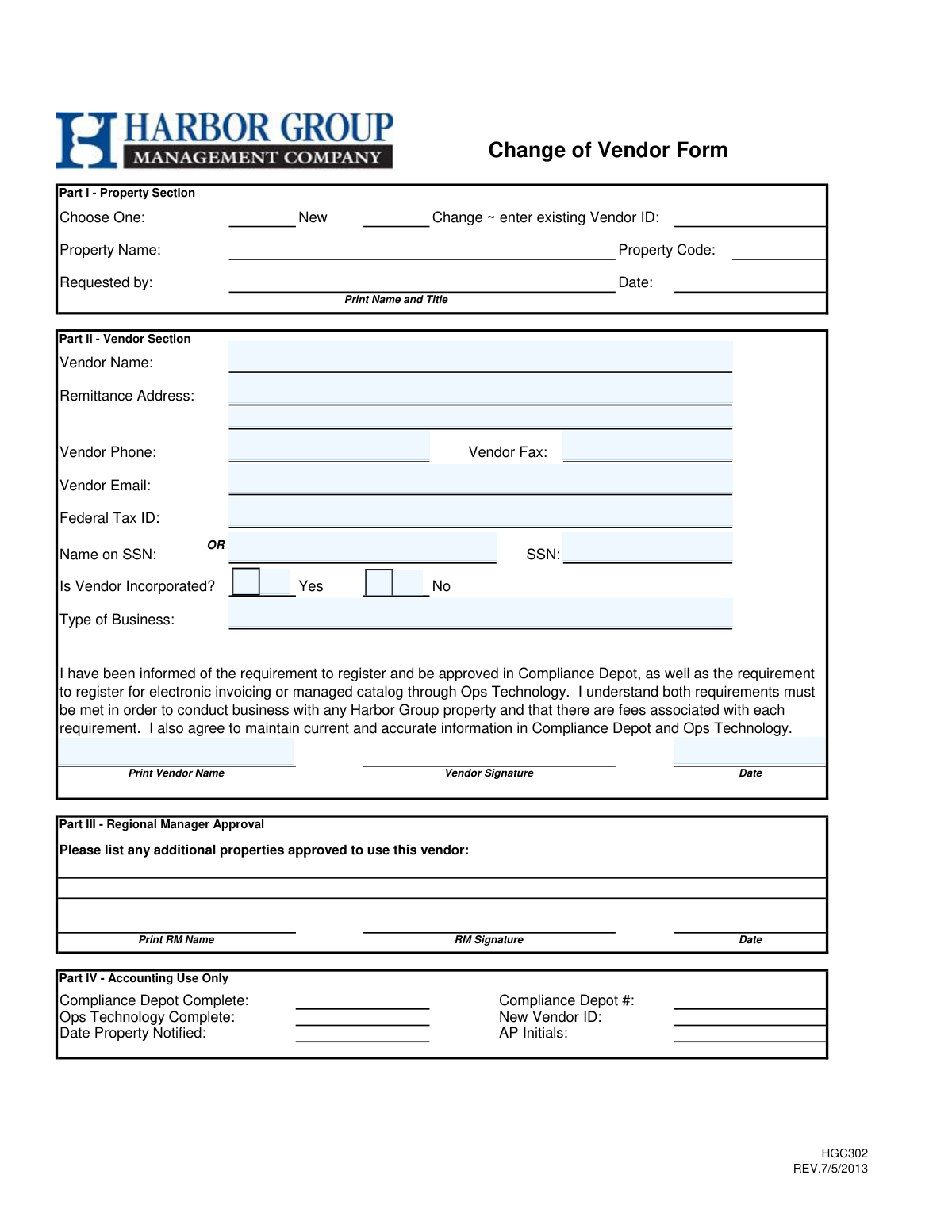
- Change of Vendor Form (HGC302): This form is essential if you need to register as a new vendor or update existing information (such as contact details, tax identification numbers, or bank info) within the Harbor Group property management system.
- Key Focus: It ensures that invoicing procedures are followed correctly and that the management company has current tax records on file for accounts payable.
Quick Selection Tips
To find the right document quickly, identify your primary goal:
- Government Compliance: If you are reporting related-party relationships or subcontractor information to a state agency, choose the DS 1891.
- Business Registration: If you are a contractor or supplier updating your billing address or tax ID for a property manager, use the Change of Vendor Form.
- Legal Disclosures: If you are certifying information under penalty of perjury regarding business transactions, the DS 1891 is the appropriate legal instrument.
Form Comparison
| Form | Primary Purpose | Issuing Entity | Key Information Required |
|---|---|---|---|
| DS 1891, Applicant/Vendor Disclosure Statement | Discloses ownership and legal compliance for California regional center vendorization. | State of California Department of Developmental Services. | Ownership interests, managing employee details, and state/federal legal exclusion status. |
| Change of Vendor Form | Registers new vendors or updates existing records in property management systems. | Harbor Group property management and internal departments. | Vendor contact information, tax identification numbers, and invoicing procedure acknowledgment. |
Tips for vendor forms
Many vendor forms, particularly for state agencies, require detailed information about managing employees and ownership interests. Omitting these details or failing to report changes within the required window can lead to a denial of enrollment or termination of your vendor status.
When providing your Tax Identification Number (TIN) or business name, ensure it matches exactly with your IRS records. Inconsistent data between your vendor form and tax documents can cause significant delays in accounts payable processing and payment cycles.
Procurement forms often require attachments such as proof of insurance, business licenses, or subcontractor agreements. Organizing these documents in a dedicated digital folder allows you to quickly upload or reference them while completing complex disclosure statements.
AI-powered tools like Instafill.ai can complete these vendor forms in under 30 seconds with high accuracy, ensuring no fields are missed. Your data stays secure during the process, making it a practical time-saver for businesses managing multiple procurement or registration documents.
Internal vendor forms often include specific invoicing requirements and compliance acknowledgments. Failing to follow these procedures can result in rejected invoices or delayed payments, so pay close attention to the submission instructions provided by the purchasing entity.
Instead of waiting for a renewal request, update your vendor information immediately when your contact details or banking information changes. This prevents communication gaps and ensures that your business remains in good standing with regional centers or management groups.
Disclosure forms often require a signature from a person with the legal authority to bind the company. Ensure the signer is a registered officer or authorized managing employee to avoid the form being rejected as invalid for lack of authority.
Frequently Asked Questions
Vendor forms are used by organizations to officially register, vet, and manage their relationships with third-party suppliers and service providers. They collect essential data such as tax identification numbers, business ownership details, and contact information to ensure compliance with internal procurement policies and external legal regulations.
These forms are usually completed by business owners, independent contractors, or authorized representatives of a company seeking to provide goods or services. In some cases, such as California's DS 1891, the form must be signed by individuals with ownership or control interests to certify the accuracy of the disclosure.
A Change of Vendor form should be used whenever there is a modification to an existing vendor's profile, such as a change in business name, tax status, or banking information. It is also used to register a new vendor within a property management or corporate system to ensure that accounts payable processes remain accurate.
Government agencies require disclosure statements to identify potential conflicts of interest, related-party relationships, and to ensure that the vendor is not excluded from state or federal programs. This transparency is necessary to protect public funds and maintain the integrity of the procurement process.
Yes, AI tools like Instafill.ai can be used to fill out complex vendor forms in under 30 seconds. The AI accurately extracts data from your source documents and places it into the correct fields on the PDF, reducing the manual effort required for procurement paperwork.
While manual entry can take 15 to 30 minutes depending on the complexity of the disclosures, using AI-powered services allows you to complete these forms in less than a minute. These tools ensure high accuracy by automating the data entry process directly from your business records.
Submitting incomplete or inaccurate forms can lead to the immediate denial of your vendor application or the termination of an existing contract. Since many of these documents are signed under penalty of perjury, providing false information can also result in legal repercussions or exclusion from future business opportunities.
Commonly required attachments include a W-9 form for tax purposes, proof of professional liability insurance, and relevant business licenses. Depending on the specific form, you may also need to provide a list of subcontractors or significant business transactions involving your company.
Submission instructions vary by organization; government forms are typically sent to a specific state department or regional center, while private business forms are submitted to the procurement or accounts payable department. Always check the form's header or the accompanying instructions for the correct email, portal, or physical address.
Generally, yes, most organizations require any individual or entity receiving payment to be registered in their system, regardless of whether the service is recurring or a one-time event. This ensures that the organization can properly report payments to tax authorities and maintain a clear audit trail.
Glossary
- Form Complexity Index
- Instafill’s 0–100 measure of how much effort a form takes to complete, calculated deterministically from the form’s own structure rather than estimated. It combines the number of fillable fields (the largest factor), how difficult those fields are to complete based on their type, the number of pages that contain fields, the amount of conditional “fill-only-if” logic, and how many sections the form is divided into, then adds modifiers for tables and repeating lists, bundled instruction pages, and dense page layouts. A higher score means the form is harder to fill out by hand. The forms in this category have a median Form Complexity Index of 42/100 (Basic). See exactly how it is calculated.
- Vendorization
- The formal process of being vetted and approved as an authorized provider of goods or services to a specific organization or government agency.
- Procurement
- The strategic process of sourcing, negotiating, and acquiring goods, services, or works from an external source, often involving complex bidding and approval workflows.
- Accounts Payable (AP)
- The department or accounting entry representing a company's obligation to pay off a short-term debt to its creditors or suppliers.
- Taxpayer Identification Number (TIN)
- A unique identifier used by the IRS or other tax authorities for businesses and individuals, which can include an EIN (Employer Identification Number) or SSN.
- Regional Center
- In the context of California's developmental services, these are nonprofit corporations that coordinate services and support for individuals with developmental disabilities.
- Managing Employee
- An individual, such as a general manager, business manager, or administrator, who exercises operational or managerial control over a portion of a business's daily activities.
- Exclusion List
- A database of individuals or entities that are legally barred from participating in government-funded programs or contracts due to past fraud or regulatory violations.
- Remittance Address
- The specific mailing address designated by a vendor where they wish to receive payments, which is often different from their physical office or billing address.