Fill out wastewater discharge forms
with AI.
Wastewater discharge forms are essential regulatory documents used to manage and monitor the release of industrial and commercial liquid waste into public sewer systems and natural water bodies. These forms play a critical role in environmental protection by ensuring that all discharges meet specific safety and pretreatment standards before they enter municipal infrastructure. By documenting the volume and chemical composition of waste, these forms help prevent local ecosystems from being compromised and ensure that water treatment facilities can operate effectively.
By continuing, you acknowledge Instafill's Privacy Policy and agree to get occasional product update and promotional emails.
About wastewater discharge forms
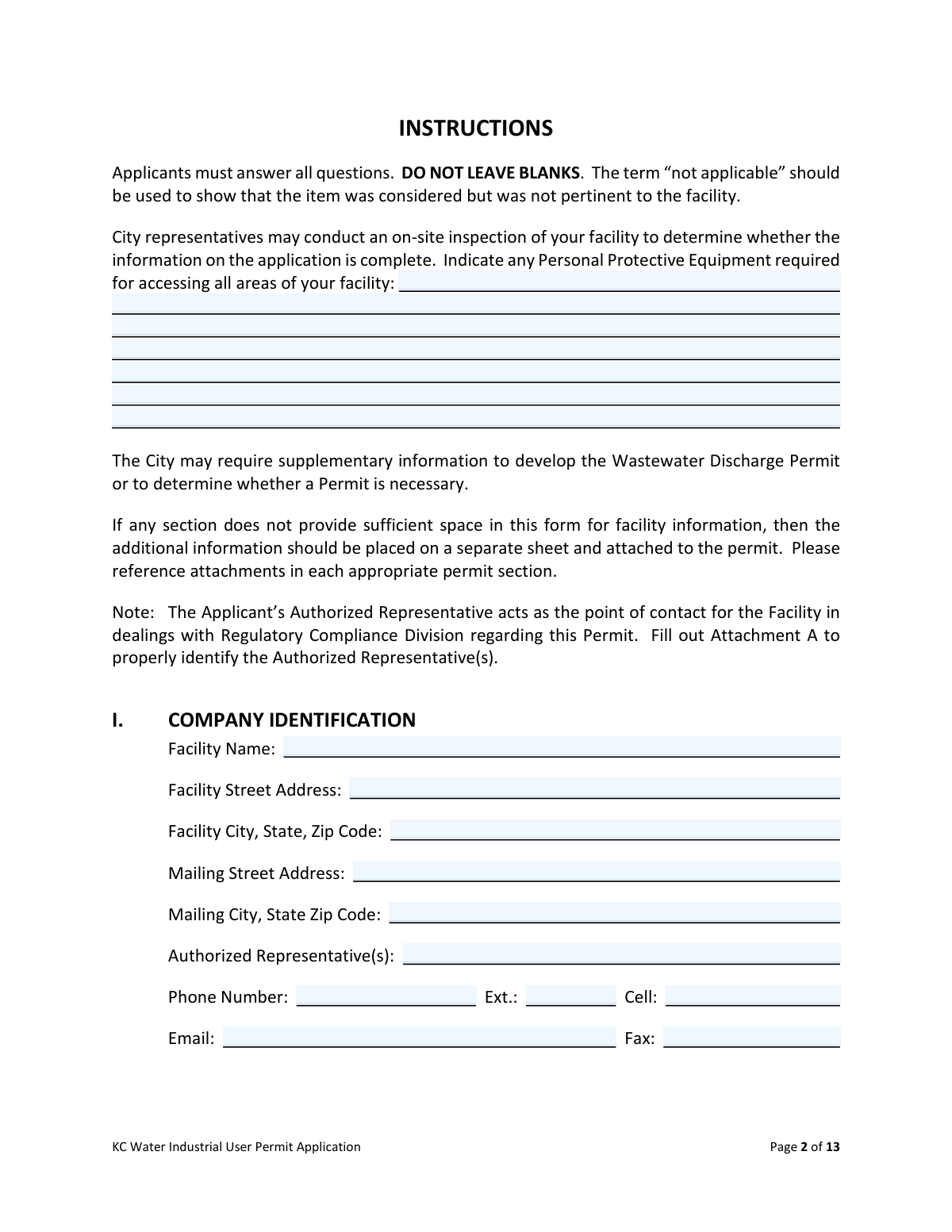
Typically, these forms are required by facility managers, environmental compliance officers, and business owners in sectors such as manufacturing, chemical processing, and industrial food production. You will likely encounter these documents when applying for a new discharge permit, renewing an existing authorization, or providing mandatory periodic reports to local utilities. For instance, the KC Water Industrial User Wastewater Discharge Permit Application is a common requirement for businesses operating within municipal limits that must prove their waste stream won't damage the public sewer system.
Completing these technical documents accurately is vital for maintaining legal compliance and avoiding potential fines. Tools like Instafill.ai use AI to fill these forms in under 30 seconds, handling complex data accurately and securely to simplify the administrative side of environmental management. This approach allows professionals to focus on their operational responsibilities while ensuring their regulatory paperwork is handled efficiently.
Every form on this page can be completed without typing. Instafill is form filling software that reads a PDF and fills it for you — including flat and scanned documents that carry no fillable fields at all.
Forms in This Category
The forms in this category have a median Form Complexity Index of 70/100 (Complex), measured across 1 forms by field count, input difficulty, length, conditional logic and structure. See how it is calculated.
| Form Name | Pages | FCI | |
|---|---|---|---|
| 1. | KC Water Industrial User Wastewater Discharge Permit Application | 11 | Complex 70 |
- Enterprise-grade security & data encryption
- 99%+ accuracy powered by AI
- 1,000+ forms from all industries
- Complete forms in under 60 seconds
How to Choose the Right Form
Identifying Your Jurisdiction and Needs
Wastewater discharge regulations are highly localized. Choosing the right form depends primarily on your business location and the volume of waste your facility produces. If your operations are based within the municipal limits of Kansas City, Missouri, you must comply with the specific requirements set by the local water department to protect the city's treatment infrastructure.
Industrial vs. General Discharge
Most businesses only require standard sewer connections. However, industrial facilities that process chemicals, food, or manufactured goods often produce byproduct water that requires pre-treatment or specific monitoring.
- Industrial Users: If your facility is classified as an industrial user, the KC Water Industrial User Wastewater Discharge Permit Application is the essential document for your compliance file. This form allows you to request permission to discharge process wastewater into the public sewer system.
- Compliance Updates: This form is also used when an existing facility undergoes significant changes in production or if a current permit is nearing its expiration date.
Why Use the KC Water Application?
The KC Water Industrial User Wastewater Discharge Permit Application is comprehensive, requiring detailed information regarding your facility’s water usage, chemical storage, and the specific characteristics of your discharge. It is the primary tool used by city regulators to ensure that industrial waste does not damage the environment or the local sewer system.
Streamlining the Process with AI
Filling out technical environmental permits can be time-consuming. When you select the KC Water Industrial User Wastewater Discharge Permit Application on our platform, you can use Instafill.ai to transform the static PDF into a smart, fillable document. Our AI-powered tools help you navigate the complex fields, ensuring that your technical data is entered accurately and that you meet all regulatory disclosure requirements for Kansas City, Missouri.
Form Comparison
| Form | Purpose | Who Files It | Key Requirements |
|---|---|---|---|
| KC Water Industrial User Wastewater Discharge Permit Application | To obtain or renew legal permission for industrial wastewater discharge into public sewers. | Industrial facilities operating within the city limits of Kansas City, Missouri. | Facility details, industrial process descriptions, water usage data, and chemical storage information. |
Tips for wastewater discharge forms
Ensure all wastewater volume estimates are based on accurate meter readings or verified production data rather than rough guesses. Inconsistent flow numbers can delay permit approval or lead to incorrect billing and unnecessary compliance monitoring requirements.
Failing to disclose specific chemicals used in your industrial processes is a common oversight that can lead to permit rejection. Provide detailed descriptions of all substances that could potentially enter the discharge stream to ensure full regulatory transparency.
AI-powered tools like Instafill.ai can complete these technical forms in under 30 seconds with high accuracy by mapping your facility data directly to the fields. Your sensitive industrial data stays secure during the process, making it a reliable way to handle high-stakes regulatory paperwork.
If your facility utilizes grease traps, oil-water separators, or pH neutralization systems, include clear operational diagrams and maintenance logs. This helps regulators understand exactly how you are mitigating contaminants before they reach the public sewer system.
Accurately mark the location of all discharge points and internal floor drains on your facility site map. Clearly identifying where wastewater enters the system ensures that inspectors can locate the correct monitoring stations without administrative confusion.
Regulatory agencies often require you to produce copies of your original permit application during routine inspections or renewals. Storing a digital copy of every submitted form ensures you are always prepared for an audit and can quickly reference past discharge data.
Industrial discharge permits typically must be signed by a high-level executive or a designated manager with legal signing authority. Submitting a form signed by an unauthorized staff member is a frequent reason for applications being returned as incomplete.
Frequently Asked Questions
Industrial facilities, commercial businesses, and manufacturing plants that discharge non-domestic wastewater into the public sewer system typically need these permits. This ensures that the waste being introduced into the city's infrastructure does not interfere with treatment processes or damage the environment.
Permits are required to ensure compliance with local, state, and federal environmental regulations, such as the Clean Water Act. They help municipal authorities monitor the volume and composition of pollutants to prevent hazardous materials from entering the ecosystem.
Most applications require details about the facility's production processes, the volume of water used, and a list of chemicals or pollutants present in the discharge. You may also need to provide site maps and descriptions of any existing pretreatment systems.
A facility should submit a new application or update an existing one whenever there is a significant change in production volume, a shift in the chemicals used, or a change in ownership. Regular renewals are also typically required every few years depending on local utility policies.
Yes, you can fill out wastewater discharge forms using AI tools like Instafill.ai. These tools can accurately extract data from your business records and place it directly into the relevant fields of the permit application, ensuring high accuracy.
Using AI-powered services like Instafill.ai, these forms can often be completed in under 30 seconds. The technology streamlines the process by automatically populating the document from source files, significantly reducing manual data entry time.
Completed forms are generally submitted to the local municipal water department or the public works utility responsible for wastewater management in your specific jurisdiction. For example, industrial users in Kansas City submit their applications directly to KC Water.
Discharging industrial waste without a valid permit can lead to significant fines, legal action, or the suspension of water and sewer services. Maintaining an active and accurate permit is essential for ongoing business operations and regulatory compliance.
An industrial user is generally defined as any non-residential source that introduces pollutants into a publicly owned treatment works. If your business processes involve chemicals, heavy manufacturing, or large-scale food preparation, you likely fall into this category.
If you have a static or non-interactive PDF version of a discharge form, AI services can convert it into a fillable digital document. This makes it easier for teams to collaborate on the application and store digital records of their environmental submissions.
Glossary
- Form Complexity Index
- Instafill’s 0–100 measure of how much effort a form takes to complete, calculated deterministically from the form’s own structure rather than estimated. It combines the number of fillable fields (the largest factor), how difficult those fields are to complete based on their type, the number of pages that contain fields, the amount of conditional “fill-only-if” logic, and how many sections the form is divided into, then adds modifiers for tables and repeating lists, bundled instruction pages, and dense page layouts. A higher score means the form is harder to fill out by hand. The forms in this category have a median Form Complexity Index of 70/100 (Complex). See exactly how it is calculated.
- POTW (Publicly Owned Treatment Works)
- A municipal facility, such as the KC Water system, designed to collect and treat wastewater from domestic and industrial sources before releasing it back into the environment.
- Pretreatment
- The process of reducing, eliminating, or altering pollutants in industrial wastewater before it is discharged into a public sewer system to protect the treatment plant.
- Effluent
- The liquid waste or sewage, treated or untreated, that flows out of an industrial facility and into the public sewer system.
- BOD (Biochemical Oxygen Demand)
- A measurement of the amount of dissolved oxygen needed by microorganisms to break down organic material in wastewater, used to determine the 'strength' of the waste.
- TSS (Total Suspended Solids)
- The measure of particles that are suspended in wastewater, which must be monitored to ensure they do not clog or damage the city's sewage infrastructure.
- SIC/NAICS Codes
- Standardized numerical codes used to classify a business's primary industrial activity, which helps regulators determine which specific discharge rules apply to that facility.
- Categorical Pretreatment Standards
- Specific federal regulations and pollutant limits established by the EPA for particular industrial sectors, such as metal finishing or chemical manufacturing.
- Slug Discharge
- Any sudden or non-routine discharge of wastewater that is significantly different in volume or concentration from the facility's normal flow, often requiring immediate reporting.