Fill out wire transfer forms
with AI.
Wire transfer forms are essential financial documents used to authorize the electronic movement of funds between institutions. Unlike standard ACH transfers, wire transfers are often reserved for high-value transactions, international payments, or urgent settlements where speed and security are paramount. These forms serve as a formal legal instruction to a financial institution, ensuring that money is moved accurately from the sender's account to the correct recipient bank. Because they involve large sums and irreversible actions, maintaining an accurate paper trail is a critical part of the banking process.
By continuing, you acknowledge Instafill's Privacy Policy and agree to get occasional product update and promotional emails.
About wire transfer forms
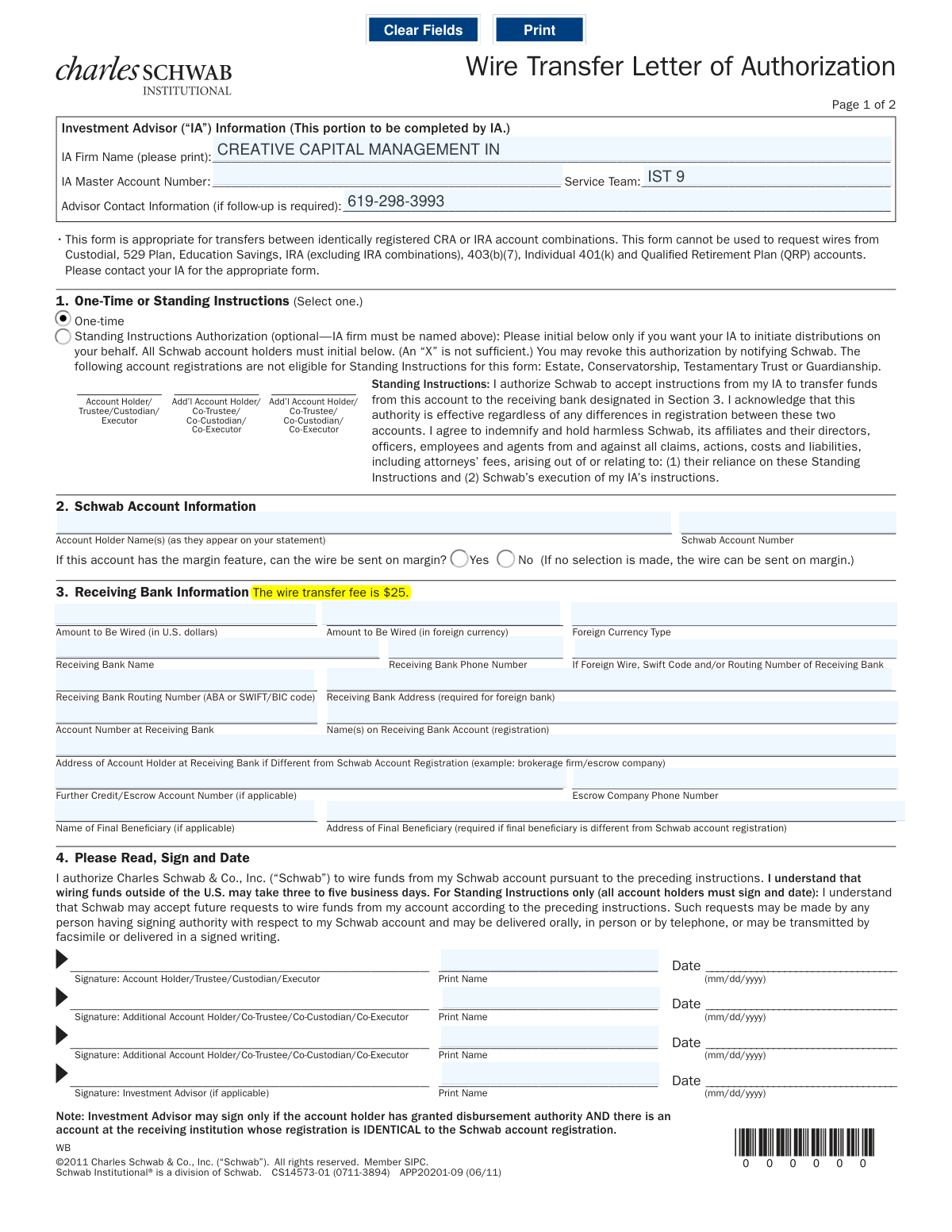
These forms are typically required by individuals and businesses managing significant assets or making major purchases, such as real estate closings, tuition payments, or corporate invoices. For instance, clients of major brokerages often use a Charles Schwab Wire Transfer Letter of Authorization to move capital out of investment accounts for personal or professional use. Precision is vital when completing these documents, as a single digit error in a routing or account number can lead to significant delays or rejected transfers.
Manually entering sensitive financial data into static PDFs is often a tedious and error-prone process. Tools like Instafill.ai use AI to fill these forms in under 30 seconds, handling the data accurately and securely to help prevent common clerical mistakes. This automation makes it easier to manage financial paperwork quickly, ensuring your funds move to their destination without unnecessary administrative friction.
Every form on this page can be completed without typing. Instafill is form filling software that reads a PDF and fills it for you — including flat and scanned documents that carry no fillable fields at all.
Forms in This Category
The forms in this category have a median Form Complexity Index of 37/100 (Basic), measured across 2 forms by field count, input difficulty, length, conditional logic and structure. See how it is calculated.
| Form Name | Pages | FCI | |
|---|---|---|---|
| 1. | Charles Schwab Wire Transfer Letter of Authorization | 1 | – |
| 2. | Funds Transfer Service Enrollment Form | 1 | Basic 37 |
- Enterprise-grade security & data encryption
- 99%+ accuracy powered by AI
- 1,000+ forms from all industries
- Complete forms in under 60 seconds
How to Choose the Right Form
Choosing the right wire transfer form depends entirely on which financial institution holds your funds and the nature of your transaction. While wire transfers are a standard banking procedure, each brokerage has specific requirements to ensure the security of your capital. For clients of Charles Schwab, the process is streamlined into a single, comprehensive document.
For Charles Schwab Account Holders
If you are looking to move funds from your brokerage or retirement account to another bank, you will need the Charles Schwab Wire Transfer Letter of Authorization. This is the primary legal document required by the firm to verify your identity and provide the necessary instructions for the movement of cash. Using the correct firm-specific form is essential, as general bank forms will not be accepted by Schwab’s back-office processing team.
One-Time vs. Recurring Transfers
The Charles Schwab Wire Transfer Letter of Authorization is versatile and can be used for two distinct scenarios:
- One-Time Transfers: Select this option when you need to send a specific amount to a domestic or international bank for a single transaction, such as a real estate closing or a large investment purchase.
- Standing Instructions: If you frequently move money to the same recipient, you can use this form to set up "standing instructions." This allows you to authorize future transfers via a simple phone call or online request without needing to fill out a new form for every subsequent transaction.
What You Will Need
Before you begin, ensure you have the following details ready to avoid processing delays:
- Your 8-digit Schwab account number.
- The receiving bank’s name and ABA routing number (or SWIFT/BIC for international wires).
- The recipient’s name and account number.
Why Use Instafill for Banking Forms
Financial forms can be tedious and often come in non-fillable formats. By using Instafill.ai, you can process the Charles Schwab Wire Transfer Letter of Authorization quickly. Our AI helps you map the fields accurately, ensuring that your sensitive financial data is placed correctly, which reduces the risk of administrative errors that could cause your wire transfer to be rejected.
Form Comparison
| Form | Purpose | Transfer Options | Required Information |
|---|---|---|---|
| Charles Schwab Wire Transfer Letter of Authorization | Authorizes Schwab to move funds from a brokerage account to a receiving bank. | Supports both one-time transactions and permanent standing instructions for recurring transfers. | Requires destination bank routing numbers, account details, and the account holder's signature. |
Tips for wire transfer forms
Even a single digit error in the recipient's bank information can lead to delayed transfers or funds being returned. Always verify the ABA routing number for domestic wires or the SWIFT/BIC code for international transfers before finalizing the form.
If you plan to send money to the same recipient regularly, use the standing instructions section of the form. This eliminates the need to fill out a new authorization for every transaction, saving you significant time in the long run.
AI-powered tools like Instafill.ai can complete wire transfer forms in under 30 seconds with high accuracy, ensuring all required fields are addressed. Your sensitive financial data remains secure during the process, making it a reliable way to handle high-stakes banking paperwork.
Banks often reject wire transfers if the recipient's name on the form does not exactly match the name on the receiving account. Avoid using nicknames or abbreviations to ensure the funds are credited to the correct person or entity without manual intervention.
Before submitting your letter of authorization, check your account's daily wire transfer limits to ensure the requested amount doesn't exceed them. If the transfer is large, you may need to provide additional documentation or seek a limit increase from your financial institution.
Always save a completed copy of your wire authorization for your personal financial records. This serves as a vital reference point if you need to track the status of the funds or reconcile your account statements at the end of the month.
Frequently Asked Questions
A wire transfer letter of authorization is a formal legal document that instructs a financial institution, such as Charles Schwab, to move funds from your account to another bank. This document serves as a verified record of your request and ensures that the bank has the necessary details to process the transaction securely.
These forms are used by individuals or business account holders who need to send significant sums of money domestically or internationally. They are essential for transactions where security and a clear paper trail are required, such as real estate closings or large business payments.
You will generally need to provide your account number, the recipient's full name, their bank account number, and the receiving bank's routing number or SWIFT/BIC code. Some forms may also ask for a specific reason for the transfer to comply with anti-money laundering regulations.
Yes, AI tools like Instafill.ai can be used to fill out these forms by accurately extracting relevant data from your source documents and placing it into the correct fields. These tools can also convert static or non-fillable PDF versions of banking forms into interactive, digital documents for easier completion.
Using AI-powered automation, these forms can be completed in under 30 seconds. The technology streamlines the data entry process, ensuring that all financial details are captured accurately without the need for manual typing.
Many wire transfer forms, including those from Charles Schwab, allow you to set up standing instructions for recurring transfers. This is helpful for regular payments to the same recipient, as it authorizes the bank to process future transfers without requiring a new form every time.
Once the form is filled out and signed, it is usually submitted directly to your financial institution. Depending on the bank's requirements, you may be able to upload it through a secure online portal, fax it, or mail it to their processing center.
Most financial institutions require a signature to verify the identity of the account holder and authorize the movement of funds. While many banks now accept digital or electronic signatures, you should check with your specific institution to see if they require a wet-ink signature for certain transaction types.
Wire transfers are typically processed in real-time or on the same day and are often used for high-value or urgent transactions. ACH transfers are usually processed in batches and can take one to three business days, making wire transfers the preferred choice for time-sensitive financial moves.
Yes, international wires often require a SWIFT/BIC code or an IBAN (International Bank Account Number) instead of a standard domestic routing number. The wire transfer form will typically have dedicated sections to ensure all international banking standards are met.
To avoid delays, ensure that all account numbers and routing codes are double-checked for accuracy. Using digital tools to fill out the form can help prevent legibility issues that often occur with handwritten documents, leading to faster verification by the bank.
Glossary
- Form Complexity Index
- Instafill’s 0–100 measure of how much effort a form takes to complete, calculated deterministically from the form’s own structure rather than estimated. It combines the number of fillable fields (the largest factor), how difficult those fields are to complete based on their type, the number of pages that contain fields, the amount of conditional “fill-only-if” logic, and how many sections the form is divided into, then adds modifiers for tables and repeating lists, bundled instruction pages, and dense page layouts. A higher score means the form is harder to fill out by hand. The forms in this category have a median Form Complexity Index of 37/100 (Basic). See exactly how it is calculated.
- ABA Routing Number
- A nine-digit code used to identify a specific financial institution in the United States during domestic wire transfers.
- SWIFT/BIC Code
- An 8 to 11 character identification code used to uniquely identify banks and financial institutions globally for international wire transfers.
- Beneficiary
- The final recipient of the funds being transferred, which can be an individual person or a business entity.
- Standing Instructions
- A pre-authorized agreement that allows a bank to process future or recurring wire transfers automatically based on previously provided details.
- IBAN (International Bank Account Number)
- An internationally agreed-upon system of identifying bank accounts across national borders to reduce errors in cross-border transactions.
- Medallion Signature Guarantee
- A specific certification stamp provided by a financial institution that authenticates a signature for the transfer of high-value securities or funds.
- Correspondent Bank
- An intermediary financial institution that processes a wire transfer on behalf of another bank when a direct relationship between the sending and receiving banks does not exist.
- Third-Party Transfer
- A wire transfer where the sender moves funds to an account owned by someone else, rather than another account owned by the same person.