Fill out beneficiary nomination forms
with AI.
Beneficiary nomination forms are essential legal documents used to specify who should receive your financial assets, such as superannuation or insurance payouts, in the event of your death. These forms ensure that your hard-earned savings are distributed according to your specific wishes rather than being left to the discretion of a trustee or determined by default legal frameworks. By clearly naming individuals or legal representatives, you provide financial security for your loved ones and help minimize potential legal disputes or administrative delays during an already difficult time.
By continuing, you acknowledge Instafill's Privacy Policy and agree to get occasional product update and promotional emails.
About beneficiary nomination forms
These forms are typically required by anyone participating in superannuation funds, life insurance policies, or pension schemes. Whether you are starting a new job, experiencing a major life event like marriage or the birth of a child, or simply reviewing your overall estate plan, keeping these nominations up to date is a critical responsibility. For example, members of funds like Vanguard Super use these documents to make binding or non-binding nominations, providing legal certainty for how their death benefits are handled. Tools like Instafill.ai use AI to fill these forms in under 30 seconds, ensuring your data is handled accurately and securely without the manual hassle of traditional PDF editing.
Every form on this page can be completed without typing. Instafill is form filling software that reads a PDF and fills it for you — including flat and scanned documents that carry no fillable fields at all.
Forms in This Category
The forms in this category have a median Form Complexity Index of 60/100 (Moderate), measured across 1 forms by field count, input difficulty, length, conditional logic and structure. See how it is calculated.
| Form Name | Pages | FCI | |
|---|---|---|---|
| 1. | Vanguard Super Nominate or cancel a beneficiary | 1 | Moderate 60 |
- Enterprise-grade security & data encryption
- 99%+ accuracy powered by AI
- 1,000+ forms from all industries
- Complete forms in under 60 seconds
How to Choose the Right Form
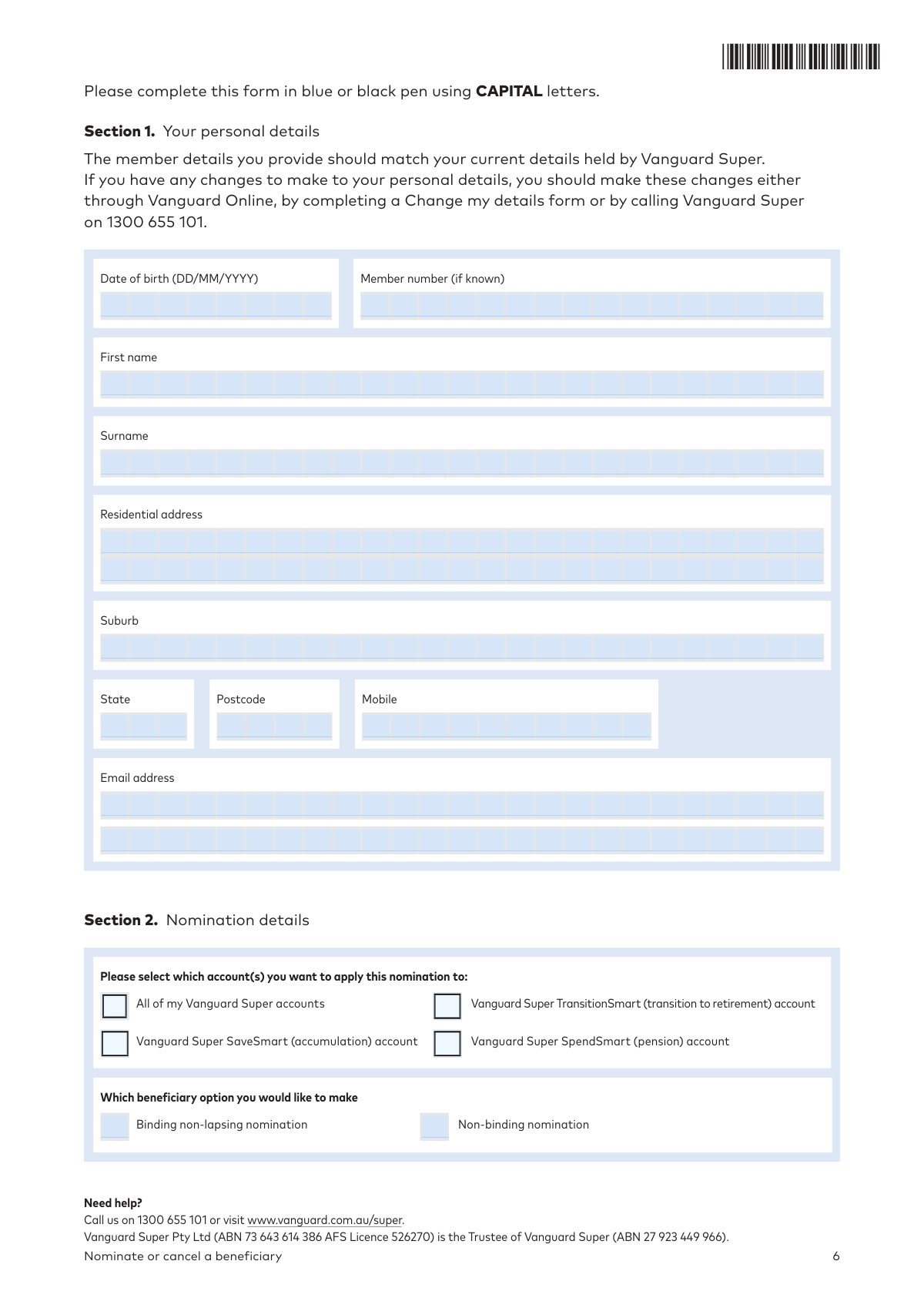
Choosing the right way to protect your legacy within your superannuation account is critical. For members of Vanguard Super, the Vanguard Super Nominate or cancel a beneficiary form is the essential document used to direct the Trustee on how to distribute your death benefits. Unlike a standard will, superannuation assets are managed by the fund's Trustee, making this specific form a vital part of your estate planning.
Understanding Your Nomination Options
When using this form, your primary choice involves the legal weight of your nomination. You should choose your path based on how much control you want over the final outcome:
- Binding Non-Lapsing Nomination: Choose this if you want a legally binding direction that does not expire. It ensures the Trustee must follow your instructions, provided the nomination is valid. This is often preferred for those with specific, fixed estate planning needs.
- Non-Binding (Preferred) Nomination: Select this if you want to provide a "suggestion" to the Trustee. They will use your preference as a guide but retain the discretion to ensure the benefit is distributed fairly among your legal dependents or personal representative.
When to Select This Form
The Vanguard Super Nominate or cancel a beneficiary form is the correct choice for several distinct scenarios:
- Initial Setup: If you have recently joined Vanguard Super and have not yet designated where your funds should go.
- Updating Following Life Events: If you need to change your beneficiaries following a marriage, divorce, or the birth of a child to ensure your records remain current.
- Removing Instructions: If you wish to cancel an existing nomination and return to the Trustee’s default distribution rules.
By using Instafill.ai, you can quickly complete the Vanguard Super Nominate or cancel a beneficiary form digitally, ensuring all required fields are addressed so your nomination is processed accurately by the fund.
Form Comparison
| Form | Purpose | Nomination Types | Who Files It | When to Use |
|---|---|---|---|---|
| Vanguard Super Nominate or cancel a beneficiary | Directs the Trustee on how to distribute superannuation death benefits. | Supports both non-binding preferences and legally binding non-lapsing directions. | Vanguard Super members wishing to manage their death benefit instructions. | When joining the fund or updating beneficiaries after life events. |
Tips for beneficiary nomination forms
A binding nomination legally compels the trustee to follow your instructions, whereas a non-binding nomination serves only as a guide for their decision. Carefully choose the option that provides the level of legal certainty you require for your estate planning.
Most beneficiary forms require signatures from two witnesses who are not named as beneficiaries in the document. Failing to have independent witnesses sign and date the form simultaneously can render the entire nomination invalid.
AI-powered tools like Instafill.ai can complete these forms in under 30 seconds with high accuracy, ensuring all data is placed in the correct fields. Your data stays secure during the process, providing a fast and safe way to manage your superannuation paperwork.
If you are splitting benefits among multiple people, double-check that the assigned percentages add up to exactly 100%. Even a 1% discrepancy can result in the form being rejected by the trustee, requiring a full resubmission.
It is best practice to update your beneficiary forms after significant life changes such as marriage, divorce, or the birth of a child. Keeping these documents current ensures your assets are distributed according to your most recent intentions rather than outdated records.
Avoid using nicknames or shortened versions of names when identifying your beneficiaries. Using full legal names as they appear on government-issued identification prevents identity confusion and delays during the benefit distribution process.
Frequently Asked Questions
A beneficiary nomination form is a legal document used to instruct a fund trustee on who should receive your account balance or death benefits in the event of your passing. It ensures that your assets are distributed according to your preferences rather than being determined solely by the trustee's discretion.
Completing this form provides clarity and security for your loved ones during a difficult time. Without a valid nomination, the trustee of the fund may have to decide how to distribute your benefits based on legal guidelines, which might not align with your personal wishes.
A binding nomination legally compels the trustee to pay your benefits to the person you've named, provided the nomination is valid. A non-binding nomination acts as a guide, giving the trustee the final say while considering your expressed preferences and current circumstances.
Generally, you can nominate your spouse, children, or someone with whom you have an interdependency relationship. You can also nominate your legal personal representative, which allows the benefits to be distributed as part of your estate according to your will.
Yes, AI tools like Instafill.ai can be used to fill out these forms in under 30 seconds by accurately extracting data from your source documents. This technology ensures that even non-fillable PDF versions are converted into interactive forms, reducing the risk of manual entry errors.
Using AI-powered services, the process of populating a beneficiary nomination form typically takes less than a minute. The AI identifies the required fields and maps your information directly into the document, making the process much faster than traditional manual typing.
It is recommended to review and update your nomination whenever you experience a significant life event, such as marriage, divorce, or the birth of a child. Regularly checking your nominations every few years ensures they remain relevant and legally sound.
Yes, most binding nominations require the form to be signed in the presence of two witnesses who are not named as beneficiaries in the document. Non-binding nominations often have simpler requirements, but it is essential to check the specific instructions provided by the fund.
If no beneficiary is nominated, the fund trustee will typically follow a standard legal process to identify your dependents or legal personal representative. This can lead to delays in the distribution of funds and may result in the benefits being paid to individuals you did not intend to prioritize.
Most funds allow you to cancel an existing nomination at any time by submitting a specific cancellation request or a new form. If you cancel a nomination without providing a new one, your account will revert to having no nomination, and the trustee will exercise their discretion upon your death.
Glossary
- Form Complexity Index
- Instafill’s 0–100 measure of how much effort a form takes to complete, calculated deterministically from the form’s own structure rather than estimated. It combines the number of fillable fields (the largest factor), how difficult those fields are to complete based on their type, the number of pages that contain fields, the amount of conditional “fill-only-if” logic, and how many sections the form is divided into, then adds modifiers for tables and repeating lists, bundled instruction pages, and dense page layouts. A higher score means the form is harder to fill out by hand. The forms in this category have a median Form Complexity Index of 60/100 (Moderate). See exactly how it is calculated.
- Superannuation
- A compulsory system of placing a percentage of your income into a fund to support your financial needs in retirement, commonly referred to as 'super'.
- Binding Nomination
- A legally valid instruction that requires the fund Trustee to pay your death benefit to your nominated beneficiaries in the exact proportions you specify.
- Non-Binding Nomination
- A formal expression of your preference for who should receive your benefits, which the Trustee will consider but is not legally forced to follow.
- Trustee
- The person or entity responsible for managing the superannuation fund and ensuring death benefits are distributed according to the law and fund rules.
- Dependant
- A person who relies on you for financial support; for superannuation purposes, this usually includes a spouse, child, or someone in an interdependency relationship.
- Legal Personal Representative (LPR)
- The executor or administrator of your estate who is responsible for distributing your assets according to your will after you pass away.
- Interdependency Relationship
- A relationship between two people who live together and provide each other with financial, domestic, and personal support, regardless of marital status.
- Death Benefit
- The total amount of money, including your account balance and any applicable insurance, that is paid out from your super fund upon your death.