Fill out benefit payment forms
with AI.
Benefit payment forms serve as the essential administrative link between accumulated assets and actual income. This category covers a variety of documents used to authorize and structure the distribution of funds from retirement plans, pension accounts, and insurance contracts. Properly completing these forms is a critical step in financial management, as they dictate how and when you receive your money, ensuring that distributions align with both your personal financial goals and relevant tax regulations.
By continuing, you acknowledge Instafill's Privacy Policy and agree to get occasional product update and promotional emails.
About benefit payment forms
These forms are typically required by individuals who are transitioning into retirement, separating from an employer, or reaching an age where they must begin accessing their savings. For instance, a participant might need to establish a schedule for recurring distributions from a 401(k) or 403(b) plan, or they may choose to authorize interest-only payments to preserve their principal balance while generating cash flow. Because these documents often involve complex financial elections, accuracy is paramount to avoid processing delays or unintended tax consequences.
Navigating this paperwork can be time-consuming, but tools like Instafill.ai use AI to fill these forms in under 30 seconds while ensuring data is handled accurately and securely. This approach allows you to finalize your payment arrangements quickly and move forward with your financial planning without the burden of manual data entry.
Every form on this page can be completed without typing. Instafill is form filling software that reads a PDF and fills it for you — including flat and scanned documents that carry no fillable fields at all.
Forms in This Category
| Form Name | Pages | FCI | |
|---|---|---|---|
| 1. | Fidelity NetBenefits Distribution - Recurring Payments | 1 | – |
| 2. | Form F7381, Authorization of Interest-Only Payments (Non ERISA) | 1 | – |
- Enterprise-grade security & data encryption
- 99%+ accuracy powered by AI
- 1,000+ forms from all industries
- Complete forms in under 60 seconds
How to Choose the Right Form
Choosing the right benefit payment form depends primarily on your retirement plan provider and your specific income strategy. Whether you want to draw down your balance or simply live off the interest, selecting the correct document ensures your payments are processed without delay.
For Scheduled Retirement Income (Fidelity)
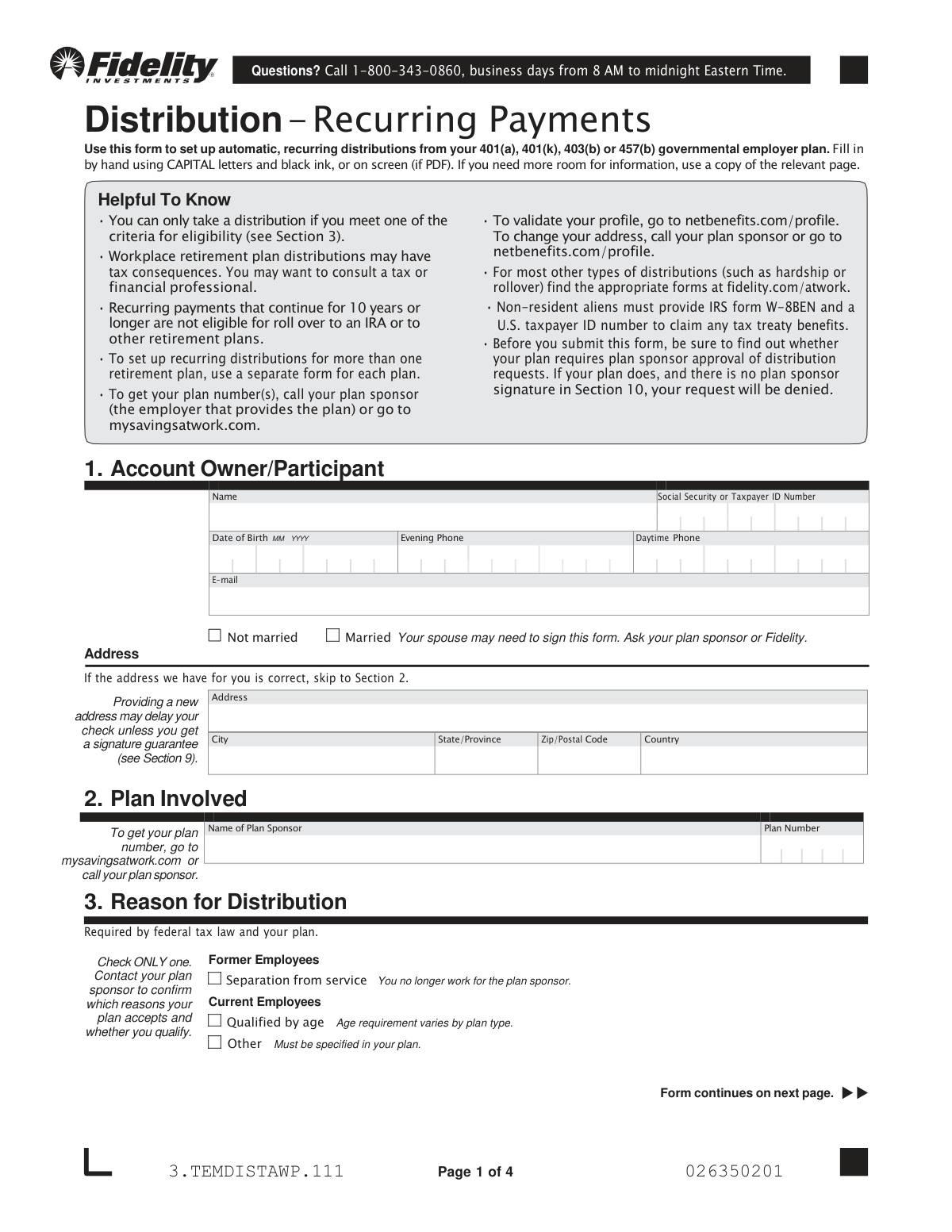
If you have a 401(a), 401(k), 403(b), or 457(b) governmental employer plan managed through Fidelity, you will likely need the Fidelity NetBenefits Distribution - Recurring Payments form. This is the standard choice for participants who:
- Have separated from service or reached the required age for distributions.
- Want to set up an automatic, recurring schedule for receiving funds rather than a one-time withdrawal.
- Need a predictable income stream from their retirement savings balance to cover monthly expenses.
For Preserving Principal (TIAA Traditional)
If your retirement strategy involves keeping your initial investment intact while receiving only the earnings, look for Form F7381, Authorization of Interest-Only Payments (Non ERISA). This TIAA-specific document is designed for account holders who:
- Hold a TIAA Traditional accumulation in a non-ERISA plan.
- Wish to establish an Interest-Only Option contract to generate cash flow.
- Want to receive interest payments while preserving the underlying principal for a later date or for beneficiaries, typically before reaching the age for Required Minimum Distributions (RMDs).
Quick Selection Tips
To find the right form quickly, consider these two factors:
- Who is your provider? Fidelity users should select the NetBenefits Distribution form, while TIAA account holders will require Form F7381.
- What is your payment goal? If you want regular installments that draw from your total balance, use the Fidelity form. If you want to receive *only* the interest earned to keep your principal untouched, the TIAA Authorization of Interest-Only Payments is the correct choice.
Using Instafill.ai, you can complete either of these forms digitally, ensuring all required fields are accurate before submission to your financial institution.
Form Comparison
| Form | Purpose | Eligible Plans | Payment Structure | Primary Advantage |
|---|---|---|---|---|
| Fidelity NetBenefits Distribution - Recurring Payments | Establishes a schedule for automatic, recurring distributions from employer-sponsored retirement accounts. | 401(a), 401(k), 403(b), and 457(b) governmental employer plans. | Regular recurring income payments drawn from the total retirement savings balance. | Automates retirement income for those who have met eligibility or age criteria. |
| Form F7381, Authorization of Interest-Only Payments (Non ERISA) | Authorizes a contract to receive only the interest earned on TIAA accumulations. | TIAA Traditional (Non-ERISA) accumulation accounts and specific interest-bearing contracts. | Payments consisting strictly of earned interest while the principal remains untouched. | Generates steady cash flow while preserving the principal balance for future needs. |
Tips for benefit payment forms
Benefit payment forms often require routing and account numbers for recurring transfers. A single digit error can delay your payments by weeks, so always verify your bank details against a voided check or your banking app before submitting the form.
Many benefit distributions are subject to income tax. Ensure you indicate how much tax you want withheld from each payment to avoid a surprise tax bill or potential underpayment penalties when you file your annual returns.
Before setting up recurring distributions or interest-only options, verify that you meet specific plan requirements such as age thresholds or separation from service. Submitting forms without meeting these criteria can lead to immediate rejection by the plan administrator.
Managing complex financial paperwork is significantly faster with AI-powered tools like Instafill.ai, which can complete these forms in under 30 seconds with high accuracy. Your sensitive data stays secure during the process, providing a safe and efficient way to handle multiple benefit documents.
Always save a completed copy of your distribution or interest-only request for your personal records. This helps you track the start dates of your payments and provides a necessary reference if you need to modify your payment schedule or frequency later.
When choosing between monthly, quarterly, or annual distributions, consider your existing budget and bill cycles. Selecting the right frequency during the initial setup prevents the need for frequent administrative changes to your retirement plan later on.
Whenever you change how benefits are paid out, it is a best practice to review your current beneficiary designations. Ensuring your records are up to date helps guarantee that any remaining funds are handled according to your wishes without legal delays.
Frequently Asked Questions
Benefit payment forms are used to request and schedule the distribution of funds from retirement or investment accounts. They allow plan participants to specify how much money they want to receive, the frequency of those payments, and the destination for the funds.
These forms are usually completed by individuals who have reached retirement age or have separated from their employer and wish to begin receiving income from their 401(k), 403(b), or other retirement plans. They are essential for transitioning from the accumulation phase of retirement planning to the distribution phase.
The choice depends on your financial goals, such as whether you need a fixed recurring amount or prefer to receive only the interest while preserving your principal. For example, a recurring payment form sets up a steady income stream, while an interest-only option allows you to keep your initial investment intact while receiving earned interest.
A recurring distribution typically involves withdrawing a set dollar amount or percentage of your total balance on a regular schedule. In contrast, an interest-only payment option distributes only the interest earned on the account balance, leaving the original principal untouched.
Yes, benefit payment forms can be filled out efficiently using AI-powered tools like Instafill.ai. These tools can accurately extract data from your source documents and place it directly into the correct fields of the PDF, reducing the risk of manual entry errors.
Using AI technology, you can complete complex benefit payment forms in under 30 seconds. This significantly speeds up the process compared to manual typing, especially for forms requiring detailed account and personal information.
Completed forms should generally be submitted directly to the financial institution managing your plan, such as Fidelity or TIAA. Many institutions allow for digital uploads through their secure portals, though some may still require physical mail or fax depending on the specific plan requirements.
You will generally need your plan account number, Social Security number, and bank routing and account numbers for direct deposit. If the distribution is related to a specific life event, you may also need documentation confirming your separation from service or age eligibility.
Most distributions from retirement accounts are considered taxable income and may be subject to federal and state tax withholding. These forms typically include a section where you can specify the percentage of tax you want withheld from each payment to avoid a large bill at the end of the year.
Most financial institutions allow you to modify or cancel your distribution schedule at any time by submitting a new authorization form or updating your preferences online. It is important to review your plan's specific terms regarding how much notice is required to implement changes.
Glossary
- Distribution
- The process of withdrawing money from a retirement account, which can be taken as a single lump sum or through a series of scheduled payments.
- ERISA (Employee Retirement Income Security Act)
- A federal law that sets minimum standards for retirement plans in private industry; forms labeled 'Non-ERISA' apply to plans not governed by these specific federal protections.
- Required Minimum Distribution (RMD)
- The minimum amount the IRS mandates you withdraw from your retirement accounts annually once you reach a specific age, typically 72 or 73.
- Recurring Payments
- An automated schedule of distributions where funds are sent from a retirement account to the holder at set intervals, such as monthly, quarterly, or annually.
- Separation from Service
- The formal termination of employment through retirement, resignation, or discharge, which usually serves as a qualifying event to begin receiving benefit payments.
- Interest-Only Option
- A distribution method where the account holder receives only the interest earned on their account balance, allowing the original invested amount to remain intact.
- Principal
- The original sum of money contributed to a retirement account, distinct from the interest or investment growth that the account has earned over time.
- 403(b) and 457(b) Plans
- Tax-advantaged retirement savings plans available for public school employees, certain non-profits, and state or local government employees.