Fill out BWC forms
with AI.
The Ohio Bureau of Workers' Compensation (BWC) forms are essential documents for managing workplace injury claims and insurance benefits. These forms provide a structured way for employers, injured workers, and medical providers to communicate critical information regarding workplace accidents or occupational diseases. Properly completing these documents is vital because they serve as the foundation for determining eligibility, processing medical reimbursements, and ensuring that injured employees receive the necessary support to recover and return to work.
By continuing, you acknowledge Instafill's Privacy Policy and agree to get occasional product update and promotional emails.
About BWC forms
Typically, these forms are required by business owners navigating insurance compliance, healthcare professionals providing medical evidence, and employees seeking compensation for lost wages or medical expenses. Whether you are filing a Request for Medical Information or coordinating treatment plans, the accuracy of the data provided is paramount. Delays in claim processing often stem from incomplete or incorrectly filed paperwork, making it crucial to handle these documents with precision during what is often a stressful time for both the claimant and the employer.
Managing this administrative burden can be time-consuming, but tools like Instafill.ai use AI to fill these forms in under 30 seconds while ensuring data is handled accurately and securely. By automating the data entry process, stakeholders can focus more on recovery and workplace safety rather than manual paperwork.
Every form on this page can be completed without typing. Instafill is form filling software that reads a PDF and fills it for you — including flat and scanned documents that carry no fillable fields at all.
Forms in This Category
The forms in this category have a median Form Complexity Index of 48/100 (Moderate), measured across 1 forms by field count, input difficulty, length, conditional logic and structure. See how it is calculated.
| Form Name | Pages | FCI | |
|---|---|---|---|
| 1. | Form BWC-1141, Request for Medical Information | 1 | Moderate 48 |
- Enterprise-grade security & data encryption
- 99%+ accuracy powered by AI
- 1,000+ forms from all industries
- Complete forms in under 60 seconds
How to Choose the Right Form
Navigating the Ohio Bureau of Workers’ Compensation (BWC) system requires precise documentation to ensure claims are processed without delay. Whether you are an injured worker, an employer, or a medical provider, selecting the correct form is the first step in the adjudication process.
Requesting Medical Evidence
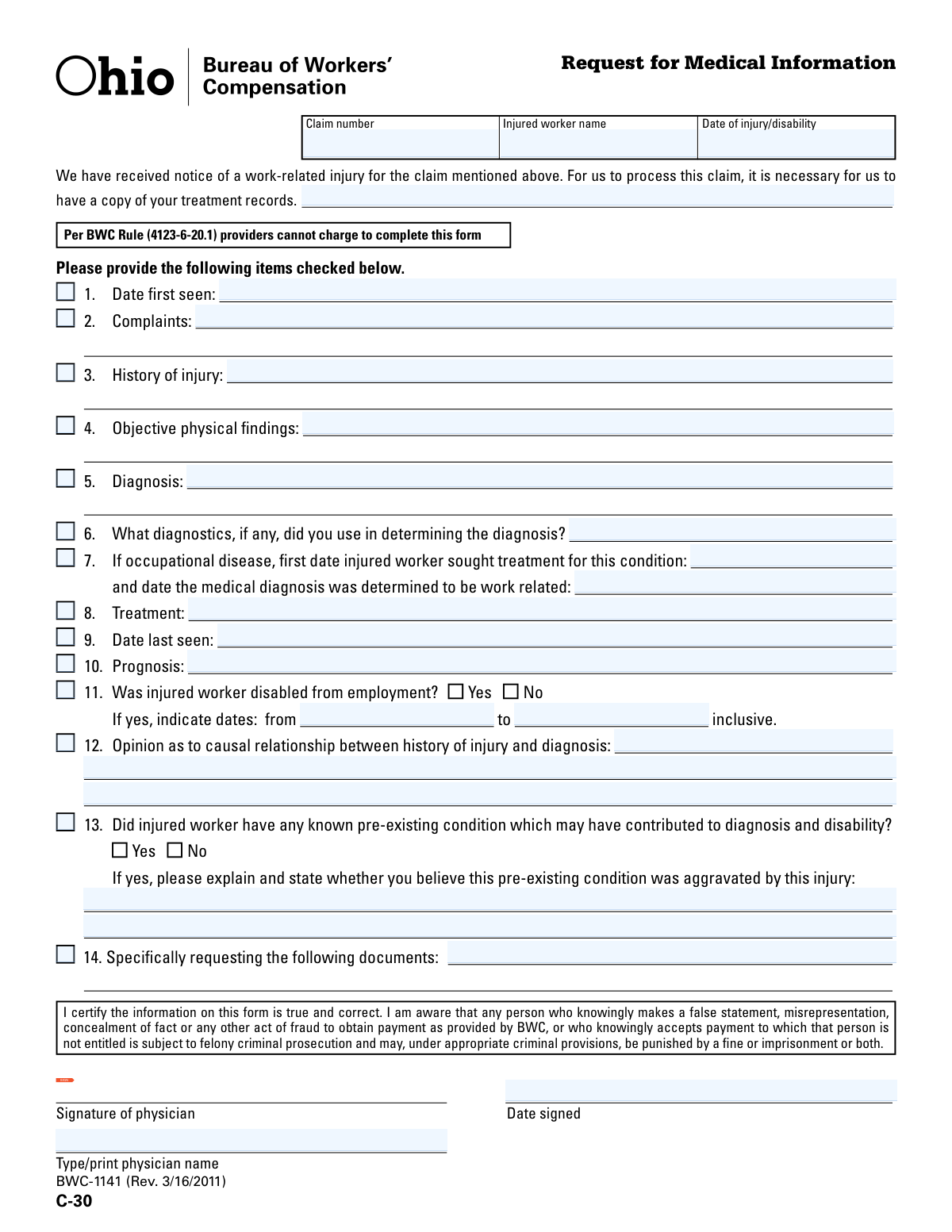
If your primary goal is to provide or obtain clinical substantiation for a workers' compensation claim, you will likely need Form BWC-1141 (Request for Medical Information). Also referred to as the C-30, this document is the standard tool used to collect professional medical opinions regarding a work-related injury or occupational disease.
You should choose Form BWC-1141 if:
- You are a Healthcare Provider: You need to submit a formal diagnosis, treatment plan, or causality statement to the BWC regarding a patient's workplace injury.
- You are an Injured Worker: Your claim is currently under review, and the BWC has requested additional medical records from your physician to prove the injury is work-related.
- You are an Employer or MCO: You need to facilitate the gathering of specific medical details to better manage the claim or assess the employee's readiness to return to work.
Why This Form Matters
The Form BWC-1141 acts as the bridge between clinical treatment and legal claim approval. It provides the BWC with the necessary data—such as diagnosis codes and treatment history—to determine if a claim should be allowed or if benefits should continue. Because it requires detailed professional input, accuracy is paramount to avoid claim denials.
Streamlining Your Submission
Filling out BWC paperwork manually can lead to errors that stall your benefits. Using Instafill.ai allows you to complete Form BWC-1141 digitally. Our AI-powered tools help ensure that every field is addressed accurately, and we can even convert static PDF versions into interactive, fillable documents to save you time in the clinic or office.
Form Comparison
| Form | Purpose | Who Completes It | Key Information Included |
|---|---|---|---|
| Form BWC-1141, Request for Medical Information | Provides medical records and professional opinions to help adjudicate workers' compensation claims. | Healthcare providers treating employees for work-related injuries or occupational diseases. | Diagnosis, treatment plans, and professional opinions on injury causality. |
Tips for BWC forms
Double-check the claim number on every page of your BWC forms. An incorrect or missing number is the most common reason for significant processing delays or misfiled medical documentation within the workers' compensation system.
Before submitting a C-30 or other medical request forms, ensure the healthcare provider has officially signed and dated the document. Unsigned forms are typically rejected by insurance adjusters, requiring you to restart the process and delaying potential benefits.
AI-powered tools like Instafill.ai can complete these complex BWC forms in under 30 seconds with high accuracy. This technology ensures your sensitive data stays secure during the process, making it a vital time-saver for those managing multiple insurance claim forms.
Always save a copy of every form submitted to the Bureau of Workers' Compensation. Having an organized digital record allows you to quickly reference previous treatments or professional opinions if the BWC requests clarification or if a form is lost in transit.
When filling out medical request forms, ensure the diagnosis and treatment descriptions align exactly with the provider's official notes. Discrepancies between your form entries and the medical records can trigger unnecessary investigations or claim denials.
Submit BWC forms as soon as possible following a medical evaluation. Delaying the submission of medical information can stall the adjudication process and negatively impact the timing of insurance claim payouts and treatment approvals.
Frequently Asked Questions
BWC forms are official documents used by the Bureau of Workers' Compensation to manage insurance claims related to workplace injuries or illnesses. They facilitate communication between injured workers, employers, and healthcare providers to ensure benefits and medical treatments are processed correctly.
In most cases, healthcare providers or attending physicians complete medical request forms like the BWC-1141. These forms provide the clinical evidence, such as specific diagnoses and treatment plans, necessary for the Bureau to evaluate and adjudicate a workers' compensation claim.
The specific form you need depends on your role in the claim process and the type of information requested by the Bureau. For example, if the BWC requires detailed clinical records or a professional opinion on an injury's causality, the BWC-1141 (Request for Medical Information) is the standard document used.
Yes, AI tools like Instafill.ai can be used to fill out BWC forms in under 30 seconds. These tools accurately extract relevant data from your source documents, such as medical records or incident reports, and place them directly into the appropriate fields on the form.
Completed forms are typically submitted through the official Bureau of Workers' Compensation website via their secure online portal. Depending on the specific instructions for the claim, they may also be sent via mail or fax to the regional service office handling the case.
The BWC-1141, also known as the C-30, is essential because it provides the Bureau with the professional medical opinions needed to link an injury to a workplace incident. Without this detailed medical information, the BWC cannot accurately process claims for benefits or medical reimbursement.
While manual data entry can be time-consuming, using AI-powered services like Instafill.ai allows users to complete these forms in less than 30 seconds. The AI automates the process by identifying and placing data from your existing files into the correct form fields.
Generally, you will need the injured worker's claim number, contact information, and specific details regarding the injury or occupational disease. Medical forms specifically require clinical findings, treatment history, and the signature of an authorized healthcare provider.
The Bureau often sets specific timeframes for the submission of requested medical information to prevent delays in claim adjudication. It is important to submit documentation promptly to ensure that benefit payments or medical authorizations are not interrupted.
Many older or scanned BWC forms are static PDFs that do not allow for easy typing. AI-driven platforms like Instafill.ai can convert these non-fillable versions into interactive forms, making it simple to complete, sign, and save them digitally.
Glossary
- Form Complexity Index
- Instafill’s 0–100 measure of how much effort a form takes to complete, calculated deterministically from the form’s own structure rather than estimated. It combines the number of fillable fields (the largest factor), how difficult those fields are to complete based on their type, the number of pages that contain fields, the amount of conditional “fill-only-if” logic, and how many sections the form is divided into, then adds modifiers for tables and repeating lists, bundled instruction pages, and dense page layouts. A higher score means the form is harder to fill out by hand. The forms in this category have a median Form Complexity Index of 48/100 (Moderate). See exactly how it is calculated.
- BWC
- The Bureau of Workers' Compensation, the state-run agency responsible for administering insurance and medical benefits for employees injured on the job.
- Claimant
- The injured employee who has filed a claim for benefits or medical coverage following a workplace accident or occupational illness.
- MCO (Managed Care Organization)
- A private organization contracted by the BWC to manage medical treatment, coordinate care, and process medical bills for injured workers.
- Adjudication
- The formal legal process of reviewing a claim and medical evidence to make an official decision regarding the approval or denial of benefits.
- Causality
- The medical determination of whether a specific injury or health condition was directly caused by the workplace incident described in the claim.
- Occupational Disease
- A health condition or illness that develops over time due to exposure to harmful factors or environments inherent in a specific trade or workplace.
- MMI (Maximum Medical Improvement)
- A clinical status indicating that an injured worker's condition has stabilized and no further functional recovery is expected, even with additional medical treatment.
- ICD Code
- A standardized alphanumeric code used by healthcare providers on forms to identify specific diagnoses and medical conditions for billing and tracking.