Fill out California insurance forms
with AI.
California's insurance landscape is highly regulated, requiring specific documentation for providers, policyholders, and businesses to remain compliant. These forms serve as the official bridge between healthcare professionals and insurance carriers, ensuring that credentials, service agreements, and network participation requests are handled formally. Whether you are dealing with state-specific health insurance requirements or carrier-specific documentation like Blue Shield forms, accuracy is critical to avoid administrative delays or potential coverage gaps.
By continuing, you acknowledge Instafill's Privacy Policy and agree to get occasional product update and promotional emails.
About California insurance forms
Typically, these forms are utilized by medical practitioners, healthcare facility administrators, and insurance brokers who need to establish or maintain professional relationships with major California insurers. For instance, providers looking to expand their patient base often need to submit a Network Participation Letter of Intent to join a specific carrier's network. In a fast-paced healthcare environment, managing these administrative requirements can be time-consuming, especially when dealing with complex demographic data and specialty certifications across multiple service regions.
To streamline this administrative burden, tools like Instafill.ai use AI to fill these California insurance forms in under 30 seconds while ensuring data is handled accurately and securely. By automating the data entry process, professionals can focus on patient care and business operations rather than manual paperwork. This approach significantly reduces the risk of clerical errors that could otherwise stall the credentialing or application process.
Every form on this page can be completed without typing. Instafill is form filling software that reads a PDF and fills it for you — including flat and scanned documents that carry no fillable fields at all.
Forms in This Category
The forms in this category have a median Form Complexity Index of 61/100 (Moderate), measured across 5 forms by field count, input difficulty, length, conditional logic and structure. See how it is calculated.
| Form Name | Pages | FCI | |
|---|---|---|---|
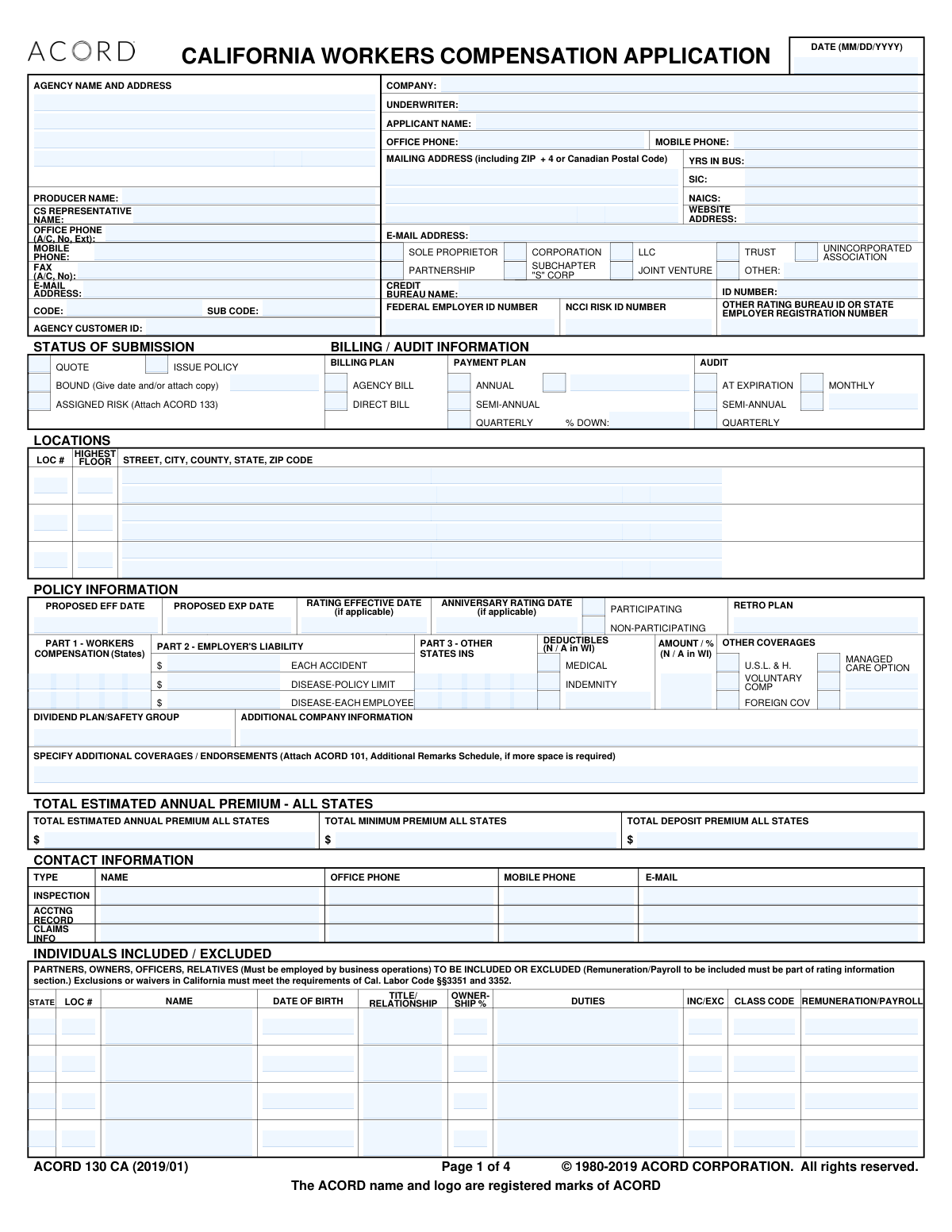
| 1. | ACORD 130 CA, California Workers Compensation Application | 4 | Complex 67 |
| 2. | ACORD 137 CA, Commercial Auto Application - California | 3 | Moderate 61 |
| 3. | ACORD 138 CA (2016/02), California Garage and Dealers Coverages / Limits Section | 1 | Moderate 59 |
| 4. | ACORD 50 CA (2004/07), California Insurance Identification Card | 1 | Basic 33 |
| 5. | Blue Shield of California Network Participation Letter of Intent | 2 | Moderate 62 |
- Enterprise-grade security & data encryption
- 99%+ accuracy powered by AI
- 1,000+ forms from all industries
- Complete forms in under 60 seconds
How to Choose the Right Form
Navigating the landscape of California insurance forms requires understanding whether you are acting as a policyholder or a healthcare provider. While many forms in this category relate to claims or coverage, the primary document currently available is focused on network expansion and provider relations.
For Healthcare Providers and Medical Groups
If your goal is to begin the process of becoming an "in-network" provider with one of the state's largest insurers, you will need the Blue Shield of California Network Participation Letter of Intent. This form serves as the formal gateway for both individual practitioners and multi-specialty medical groups to express interest in joining the Blue Shield network.
Identifying the Correct Use Case
You should choose the Blue Shield of California Network Participation Letter of Intent if:
- You are an individual provider: You are looking to establish a direct contract to see Blue Shield members.
- You represent a healthcare group: You are submitting on behalf of a practice or facility to determine if your specialty or location meets current network needs.
- You are expanding services: You are already in-network but are adding a new specialty or service area that requires separate notification.
Essential Information for the Form
When filling out this specific document on Instafill.ai, ensure you have your demographic data, National Provider Identifier (NPI), and specific service location details ready. The form is designed to capture your specialty and geographic footprint, which Blue Shield uses to assess network adequacy in your specific region of California. Accuracy here is vital to ensure the network management team can properly evaluate your application.
Important Considerations
It is important to note that submitting the Blue Shield of California Network Participation Letter of Intent is the preliminary step. It does not constitute a binding contract or guarantee acceptance into the network. However, using an AI-powered tool to ensure the form is legible and complete can prevent delays in the initial review process, helping you move more quickly toward the formal credentialing phase.
Form Comparison
| Form | Purpose | Who Files It | Key Information |
|---|---|---|---|
| Blue Shield of California Network Participation Letter of Intent | Formally expresses interest in joining the Blue Shield of California provider network. | Individual healthcare practitioners or medical groups seeking to provide insured services. | Includes demographic data, medical specialty, and the specific region of service. |
Tips for California insurance forms
Before starting, ensure you have your National Provider Identifier (NPI) and Tax Identification Number (TIN) ready. Accuracy in these specific fields is critical for California insurance networks to process your application correctly and avoid administrative delays.
California insurance networks are often divided by specific regions, counties, or plan types. Clearly specify which service areas you intend to cover to avoid having your intent letter rejected for being too vague or incorrectly assigned to the wrong regional department.
AI-powered tools like Instafill.ai can complete these complex insurance forms in under 30 seconds with high accuracy. Your sensitive professional data stays secure during the process, providing a massive time-saver for healthcare providers dealing with multiple network applications.
Many California health insurance forms require detailed information about your medical specialty and current board certifications. Ensure these sections are filled out completely to demonstrate your eligibility for specific provider panels and to speed up the credentialing review.
Always save a completed copy of your submitted forms for your internal credentialing files. Having a digital record of exactly what was submitted to Blue Shield or other insurers helps resolve any future discrepancies during the contracting or onboarding phase.
If you are submitting forms for a group practice, ensure that the practice name, address, and contact information are identical on every document. Inconsistent data is a common reason for California insurers to flag and return applications for clarification.
Frequently Asked Questions
California insurance forms cover a wide range of administrative tasks, including provider network applications, claims processing, and policy updates. These documents ensure that insurance carriers like Blue Shield of California have accurate data to manage their healthcare networks and member services.
Healthcare providers, including individual practitioners and medical groups, use this form to express interest in joining the Blue Shield of California network. It serves as an initial screening tool to determine if the provider meets the specific needs and eligibility requirements for a given region.
No, submitting a Letter of Intent is simply the first step in the application process. It allows the insurance company to evaluate your practice's demographics and specialties before proceeding with a formal credentialing and contracting phase.
Most forms require basic demographic details, National Provider Identifier (NPI) numbers, tax identification information, and specific details regarding your medical specialty. You may also need to provide information about the geographic area where you intend to offer services.
Yes, you can fill out California insurance forms using AI. AI tools like Instafill.ai can accurately extract data from your source documents and place it into the correct fields on the form in under 30 seconds.
Processing times for insurance forms vary depending on the carrier and the complexity of the request. Generally, once a letter of intent is received, the insurance company will review it to see if there is a current need for your specialty in their network before inviting you to the next stage.
Yes, the forms in this category are designed for both solo practitioners and larger medical groups or facilities. The documentation allows you to specify whether you are applying as an individual or on behalf of an entire healthcare organization.
After submission, the insurance carrier typically reviews the document to ensure all required fields are complete. If your practice aligns with their network needs, they will follow up with detailed credentialing instructions or a formal contract offer.
When using automated systems, the process is significantly faster than manual entry. Tools like Instafill.ai can complete these forms in under 30 seconds by mapping your professional data directly onto the PDF.
Completed forms are usually submitted directly to the insurance carrier's provider relations department via their online portal, email, or fax. Always check the specific instructions provided on the form or the carrier's official website for the most current submission address.
While some forms are intended for new applicants, others are used to update existing records or expand service areas. If you are already in the network, you should verify if a Letter of Intent is the correct document for your specific administrative change.
Usually, the initial Letter of Intent does not require full credentialing files, but it does require enough detail to verify your professional standing. Full documentation, such as medical licenses and board certifications, is typically requested later in the formal credentialing process.
Glossary
- Form Complexity Index
- Instafill’s 0–100 measure of how much effort a form takes to complete, calculated deterministically from the form’s own structure rather than estimated. It combines the number of fillable fields (the largest factor), how difficult those fields are to complete based on their type, the number of pages that contain fields, the amount of conditional “fill-only-if” logic, and how many sections the form is divided into, then adds modifiers for tables and repeating lists, bundled instruction pages, and dense page layouts. A higher score means the form is harder to fill out by hand. The forms in this category have a median Form Complexity Index of 61/100 (Moderate). See exactly how it is calculated.
- Network Participation
- The status of a healthcare provider or facility that has formally contracted with an insurance company to provide services to its members at negotiated rates.
- Letter of Intent (LOI)
- A preliminary document used by healthcare providers to formally express interest in joining an insurance network, initiating the evaluation process.
- NPI (National Provider Identifier)
- A unique 10-digit identification number issued to healthcare providers in the United States, required for all administrative and financial transactions.
- Credentialing
- The formal process of verifying a provider's qualifications, including their medical license, education, and professional history, to ensure they meet safety and quality standards.
- Provider Network
- The specific group of doctors, hospitals, and specialists that an insurance company has contracted with to provide care to its policyholders.
- TIN (Tax Identification Number)
- A nine-digit number used for tax purposes and billing, which can be an Employer Identification Number (EIN) for groups or a Social Security Number for individuals.
- Specialty
- The specific branch of medicine or healthcare service in which a provider has advanced training and is certified to practice.
- Effective Date
- The calendar date on which a provider's participation in an insurance network officially begins and they can start billing for covered services.