Fill out California legal forms
with AI.
California legal forms — particularly those issued by the Judicial Council — are the standardized documents courts require for a wide range of civil proceedings, from landlord-tenant disputes to family law matters. These forms ensure that cases are processed consistently and that all parties meet the procedural requirements set by California law. Getting them right is essential: missing information, incorrect dates, or improper service documentation can delay your case or result in a filing being rejected.
By continuing, you acknowledge Instafill's Privacy Policy and agree to get occasional product update and promotional emails.
About California legal forms
This category focuses on forms commonly used in unlawful detainer (eviction) proceedings, which are among the most time-sensitive cases in California's civil court system. Landlords, tenants, and their attorneys regularly need these forms to move a case forward — for example, the UD-150 is used to formally request that the court schedule a trial date once the initial filing and appearance requirements have been satisfied. Whether you're a property owner trying to regain possession of a rental unit or a tenant responding to an eviction action, filing the correct form on time can make a significant difference in the outcome.
Because unlawful detainer cases operate under strict statutory timelines, accuracy and speed matter. Tools like Instafill.ai use AI to help users complete these forms in under 30 seconds, reducing the risk of errors and making the process far more manageable for people navigating the court system without legal representation.
Every form on this page can be completed without typing. Instafill is form filling software that reads a PDF and fills it for you — including flat and scanned documents that carry no fillable fields at all.
Forms in This Category
The forms in this category have a median Form Complexity Index of 46/100 (Moderate), measured across 10 forms by field count, input difficulty, length, conditional logic and structure. See how it is calculated.
| Form Name | Pages | FCI | |
|---|---|---|---|
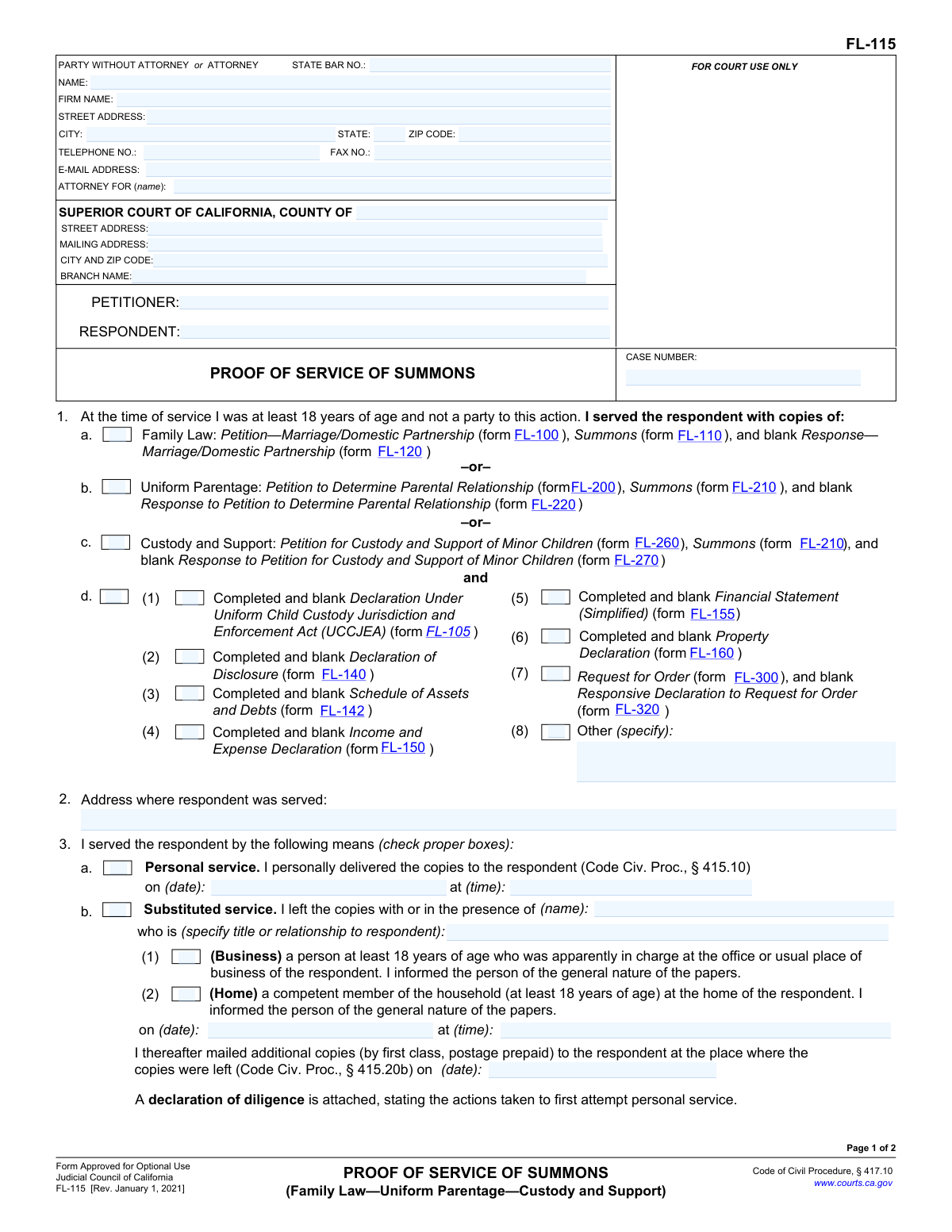
| 1. | Form FL-115, Proof of Service of Summons (Family Law—Uniform Parentage—Custody and Support) | 1 | Moderate 46 |
| 2. | Form FL-140, Declaration of Disclosure (Family Law) | 1 | Basic 34 |
| 3. | Form FL-141, Declaration Regarding Service of Declaration of Disclosure and Income and Expense Declaration | 1 | Basic 43 |
| 4. | Form FL-145, Form Interrogatories—Family Law | 1 | Basic 30 |
| 5. | Form FL-160, Property Declaration (Family Law) | 1 | Complex 68 |
| 6. | Form FL-180, Judgment (Family Law) | 1 | Complex 68 |
| 7. | Form FL-190, Notice of Entry of Judgment (Family Law—Uniform Parentage—Custody and Support) | 1 | Basic 31 |
| 8. | Form FL-191, Child Support Case Registry Form | 1 | Moderate 47 |
| 9. | Form FL-195, Income Withholding for Support | 1 | Moderate 50 |
| 10. | Form FL-341(E), Joint Legal Custody Attachment | 1 | Basic 35 |
- Enterprise-grade security & data encryption
- 99%+ accuracy powered by AI
- 1,000+ forms from all industries
- Complete forms in under 60 seconds
How to Choose the Right Form
If you've landed on this page looking for California court forms related to eviction or unlawful detainer proceedings, here's what you need to know to find the right form quickly.
Requesting a Trial Date in an Unlawful Detainer Case
If your case is already in motion — meaning the defendant has been served or has appeared — and you need the court to schedule a trial, Judicial Council of California Form UD-150 (Request/Counter-Request to Set Case for Trial—Unlawful Detainer) is the form you need.
Use UD-150 if you are:
- A plaintiff (landlord) who wants to move the case forward to trial after proper service
- A defendant (tenant) who wants to file a counter-request to set the case for trial on your own timeline
- Any party who needs to formally notify the court of scheduling preferences, jury requests, or unavailable dates
Key information this form captures:
- Whether possession of the premises is still at issue
- The address of the rental property
- Whether a jury trial is being requested
- Estimated length of trial
- Dates when you are unavailable
- Proof of Service by Mail to confirm other parties were notified
Things to Keep in Mind
- Filing UD-150 helps ensure your case is placed on the court's trial calendar within California's strict statutory timelines for unlawful detainer cases.
- Both plaintiffs and defendants can use this same form — the title reflects both a "request" and a "counter-request."
- If you have a non-fillable PDF version of UD-150, you can use Instafill.ai to convert it into an interactive form and complete it accurately with AI assistance.
Since this category currently features UD-150, it is best suited for parties who are already mid-process in an unlawful detainer case and need to advance to the trial stage.
Form Comparison
| Form | Purpose | Who Files It | When to Use |
|---|---|---|---|
| Judicial Council of California Form UD-150, Request/Counter-Request to Set Case for Trial—Unlawful Detainer | Request court to schedule unlawful detainer case for trial | Plaintiff or defendant in an unlawful detainer case | After service/appearance requirements are met in eviction case |
Tips for California legal forms
One of the most critical questions on unlawful detainer forms like UD-150 is whether possession of the premises is still at issue. If the tenant has already vacated, this changes what the court needs to schedule and prioritize. Double-check the current status of the property before you submit to avoid delays or having your request returned.
California courts schedule unlawful detainer trials quickly, so failing to note your unavailable dates on the request form can result in a trial date you cannot attend. Include all known conflicts — attorney vacations, witness schedules, or prior court commitments — at the time of filing. It is much harder to reschedule a trial date after it has been set.
Both plaintiffs and defendants have the right to request a jury trial in an unlawful detainer case, but this decision should be made before filing the UD-150. Requesting a jury affects scheduling, court fees, and trial length estimates, all of which must be accurately reflected on the form. Consult with an attorney if you are unsure whether a jury trial is the right strategy for your situation.
The Proof of Service by Mail section on unlawful detainer forms is legally significant — it documents that all other parties received notice of your trial request. Errors here, such as wrong addresses or missing signatures, can invalidate your filing. Make sure the person completing the proof of service is not a party to the case, as California rules typically require a third-party server.
AI-powered tools like Instafill.ai can complete California judicial council forms like the UD-150 in under 30 seconds with high accuracy, reducing the risk of errors that could slow down your case. Your data stays secure throughout the process, making it a safe option even for sensitive legal matters. This is especially useful when you are managing multiple filings or working under tight statutory timelines.
The Judicial Council of California periodically updates its official forms, and courts may reject outdated versions. Always download the most current version of any California court form directly from the official Judicial Council website or a trusted legal platform before filling it out. Check the revision date printed at the bottom of the form to confirm you have the latest edition.
When the form asks for an estimated trial length, be honest and thorough — underestimating can result in the court running out of time mid-trial, causing costly continuances. Consider the number of witnesses, documents to be introduced, and complexity of the dispute when making your estimate. Courts appreciate accurate projections and it helps your case proceed without unnecessary interruptions.
Frequently Asked Questions
California legal forms are official documents used in state court proceedings, many of which are created and maintained by the Judicial Council of California. The Judicial Council standardizes these forms to ensure consistency across all California courts, covering areas such as evictions, family law, civil litigation, and more.
An unlawful detainer is the legal term for an eviction lawsuit in California, typically filed by a landlord against a tenant who has remained on the property without legal right. These cases move quickly through the court system and involve specific procedural forms, such as the UD-150, to keep the case on track toward trial.
The UD-150 form is used by either the plaintiff (usually the landlord) or the defendant (usually the tenant) in a California unlawful detainer case to request that the court schedule the matter for trial. Either party can also file a counter-request if the other side has already submitted a request to set the trial date.
The UD-150 is typically filed after service and appearance requirements have been met in the unlawful detainer case, signaling that the parties are ready to proceed to trial. Filing it promptly helps ensure the case is placed on the court's trial calendar within California's statutory timelines for eviction proceedings.
Unlawful detainer forms are filed with the Superior Court in the county where the rental property is located. You should check your local court's website or clerk's office for specific filing instructions, accepted methods (in-person, mail, or e-filing), and any applicable filing fees.
While you are not required to have an attorney to file Judicial Council forms in California, legal matters like unlawful detainer cases can be complex, and consulting one is often advisable. Many self-represented litigants do file these forms on their own, and court self-help centers can provide general guidance.
Before completing the UD-150, you should have the case number, the address of the rental premises, the names and addresses of all parties, your available and unavailable dates for trial, and an estimate of how long the trial will take. You will also need to indicate whether possession of the property is still at issue and whether you are requesting a jury trial.
The Proof of Service by Mail section documents that a copy of the UD-150 was mailed to all other parties in the case, which is a required procedural step. Proper service ensures that all parties receive notice of the trial request and helps prevent delays or challenges to the scheduling process.
Yes, AI-powered tools like Instafill.ai can fill out California Judicial Council forms, including the UD-150, in under 30 seconds by accurately extracting and placing data from your source documents. This reduces the risk of errors and speeds up the preparation process, whether you're working with a fillable PDF or a non-fillable version that needs to be converted.
Manually completing the UD-150 can take anywhere from 10 to 30 minutes depending on your familiarity with the form. Using an AI-assisted service like Instafill.ai, the form can be completed in under 30 seconds by automatically extracting relevant information from your documents and populating the correct fields.
Judicial Council forms are standardized and accepted statewide, but some counties may have additional local forms or supplemental requirements. It is always a good idea to check with your specific county's Superior Court to confirm whether any local rules or additional documents apply to your case.
Official Judicial Council forms can be downloaded for free from the California Courts website at courts.ca.gov. Many forms are available as fillable PDFs, though some older versions may require conversion to an interactive format before they can be completed digitally.
Glossary
- Form Complexity Index
- Instafill’s 0–100 measure of how much effort a form takes to complete, calculated deterministically from the form’s own structure rather than estimated. It combines the number of fillable fields (the largest factor), how difficult those fields are to complete based on their type, the number of pages that contain fields, the amount of conditional “fill-only-if” logic, and how many sections the form is divided into, then adds modifiers for tables and repeating lists, bundled instruction pages, and dense page layouts. A higher score means the form is harder to fill out by hand. The forms in this category have a median Form Complexity Index of 46/100 (Moderate). See exactly how it is calculated.
- Unlawful Detainer (UD)
- A legal proceeding in California used by a landlord to evict a tenant who remains on the property without the right to do so, such as after failing to pay rent or violating lease terms. It is a fast-track court process with shorter deadlines than most civil cases.
- Judicial Council of California
- The policymaking body for California's court system, responsible for creating and approving standardized court forms used statewide. Forms bearing the 'JC' or form codes like 'UD-150' are official Judicial Council forms.
- Counter-Request
- A response filed by the opposing party (usually the defendant/tenant) to a request already submitted by the other side, asking the court to schedule the trial on terms favorable to them, such as different dates.
- Proof of Service by Mail
- A declaration included in or attached to a court filing that certifies a copy of the document was mailed to all other parties in the case. California courts require this to confirm proper legal notice was given.
- Possession at Issue
- A term used in unlawful detainer cases indicating that the right to physically occupy the rental property is still being contested in court. If possession is no longer at issue (e.g., the tenant has already vacated), the case may proceed on other grounds such as unpaid rent.
- Trial Setting
- The court process of scheduling a specific date and time for a case to be heard before a judge or jury. In unlawful detainer cases, California law requires the trial to be set within strict statutory timeframes after a request is filed.
- Jury Trial Request
- A formal demand by either the plaintiff or defendant to have their case decided by a jury of peers rather than by a judge alone (a 'bench trial'). This must typically be requested in advance and may affect trial scheduling.
- Plaintiff / Defendant (UD Context)
- In an unlawful detainer case, the plaintiff is typically the landlord or property owner filing to regain possession, while the defendant is the tenant or occupant being asked to vacate. Either party may file form UD-150.