Fill out child placement forms
with AI.
Child placement forms are essential legal documents designed to manage and track the movement of children within the foster care, kinship, or adoption systems. These forms ensure that every transition a child makes is documented, legally compliant, and overseen by the necessary state authorities. By maintaining a clear record of where a child is residing and who is responsible for their care, these documents play a critical role in safeguarding the child’s well-being and ensuring they receive the support services they are entitled to.
By continuing, you acknowledge Instafill's Privacy Policy and agree to get occasional product update and promotional emails.
About child placement forms
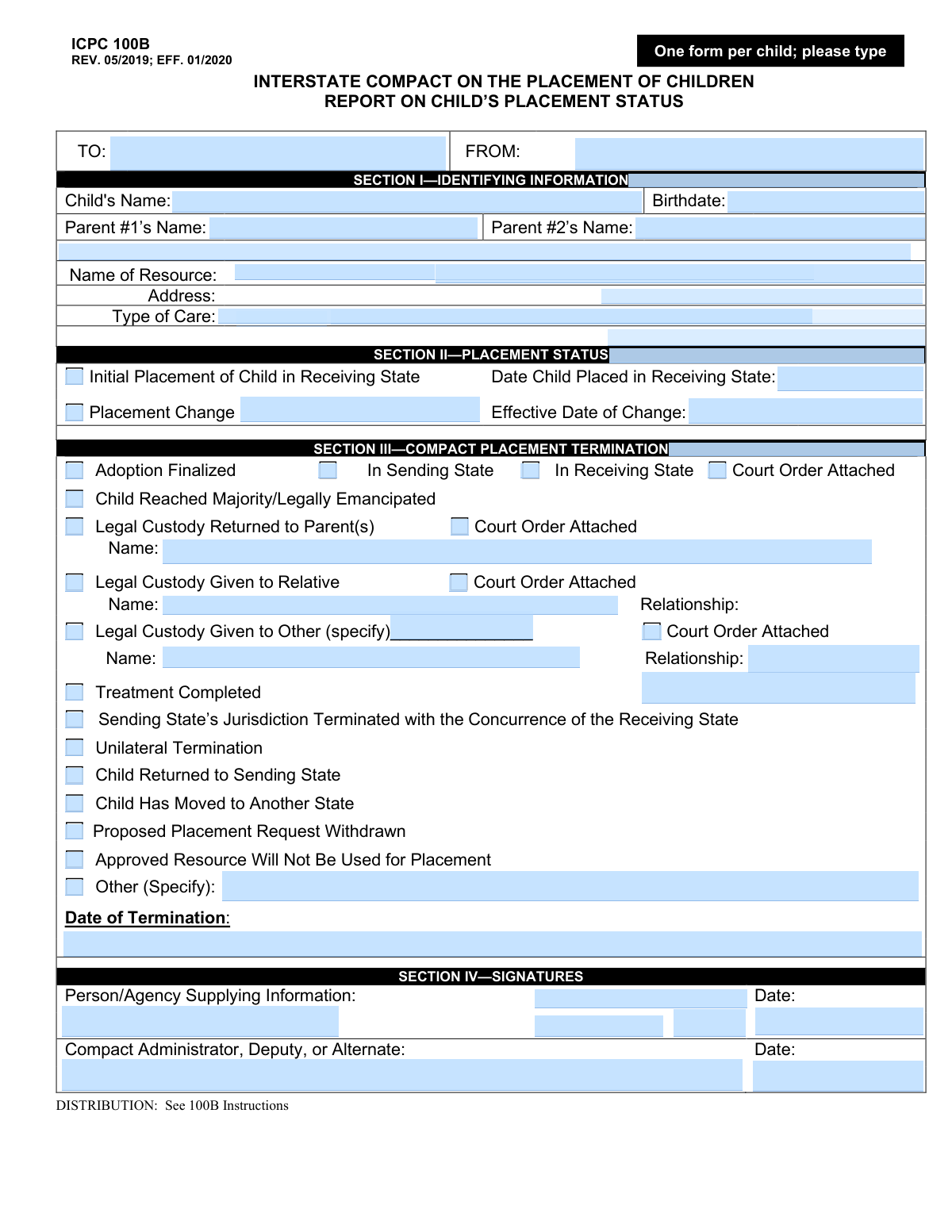
Typically, these forms are utilized by social workers, case managers, and legal representatives who are navigating complex child welfare scenarios, particularly those involving interstate moves. For example, documents like the ICPC 100B are used to report on a child’s placement status when they are moved across state lines under the Interstate Compact on the Placement of Children. These forms notify both the sending and receiving states of initial placements, changes in living arrangements, or the eventual termination of the compact’s jurisdiction.
Completing this paperwork manually can be a significant administrative burden for child welfare professionals who need to prioritize direct care. Tools like Instafill.ai use AI to fill these forms in under 30 seconds, handling sensitive data accurately and securely to streamline the reporting process.
Every form on this page can be completed without typing. Instafill is form filling software that reads a PDF and fills it for you — including flat and scanned documents that carry no fillable fields at all.
Forms in This Category
The forms in this category have a median Form Complexity Index of 66/100 (Complex), measured across 2 forms by field count, input difficulty, length, conditional logic and structure. See how it is calculated.
- Enterprise-grade security & data encryption
- 99%+ accuracy powered by AI
- 1,000+ forms from all industries
- Complete forms in under 60 seconds
How to Choose the Right Form
Navigating the legalities of interstate child placement requires precise documentation to ensure the safety and legal protection of the children involved. The Interstate Compact on the Placement of Children (ICPC) governs these movements, and having the correct status report is essential for compliance between state agencies.
Reporting on Placement Status
If you are a caseworker, social worker, or legal representative managing a case where a child is moving across state lines, the primary document you will need from this category is the ICPC 100B (Interstate Compact on the Placement of Children Report on Child’s Placement Status). While other forms handle the initial request for placement, the 100B is the standard tool used to track the actual movement and status changes of the child.
When to Use the ICPC 100B
You should select the ICPC 100B if your current task involves any of the following milestones in a child's placement journey:
- Confirming Initial Placement: Choose this form once a child has officially arrived at their new placement in the receiving state. This notifies both the sending and receiving state offices that the placement is active.
- Updating Placement Changes: If the child moves to a different home or facility within the receiving state, the ICPC 100B must be updated to reflect the new address and caregiver information.
- Terminating Jurisdiction: This form is required to officially close a case. Select it when a child is legally adopted, reaches the age of majority, returns to the sending state, or when the court terminates jurisdiction for other legal reasons.
Ensuring Accuracy with AI
Given the high stakes of child welfare, errors on the ICPC 100B can lead to administrative delays or legal complications. Using Instafill.ai to complete this form allows you to transform standard PDFs into interactive, AI-assisted documents, ensuring that every field—from the Compact Administrator’s details to the specific type of placement—is filled out clearly and accurately.
Form Comparison
| Form | Primary Purpose | Who Files It | Triggering Events |
|---|---|---|---|
| ICPC 100B, Interstate Compact on the Placement of Children Report on Child’s Placement Status | Reports initial placement, status changes, or termination of jurisdiction in interstate cases. | Child welfare agencies or caseworkers in the sending state. | Upon initial placement, placement changes, or closing a compact case. |
Tips for child placement forms
Ensure the dates entered for the start or end of a placement match the physical move exactly. These dates are critical for legal jurisdiction and determining which state agency is responsible for the child's welfare and financial support.
Child placement often involves both a sending and a receiving state. Double-check that all information provided aligns with the records of both jurisdictions to prevent administrative delays or conflicting status updates.
Whether a placement is being finalized through adoption or a child is returning to their home state, file the necessary status reports promptly. Delays in reporting can lead to confusion regarding the child’s legal residency and case management responsibilities.
Using AI-powered tools like Instafill.ai allows you to complete complex child placement forms in under 30 seconds with high accuracy. Your sensitive data stays secure throughout the process, making it a reliable choice for social workers and agencies managing multiple interstate documents.
Keep digital and physical copies of every form submitted, along with confirmation receipts from state agencies. This organization is vital for future court hearings or if any questions arise regarding the placement timeline during case reviews.
Ensure that all case-specific identification numbers are consistent across all forms within the placement file. A single digit error in a case number can result in the form being rejected or filed incorrectly in the state’s database, stalling the placement process.
Frequently Asked Questions
These forms are used to manage and track the movement of children across state lines for foster care or adoption. They ensure that children are placed in safe, approved environments and that legal jurisdiction is clearly defined between the sending and receiving states.
Typically, caseworkers from public child welfare agencies or private licensed adoption agencies are responsible for completing these forms. They use them to notify state authorities about the child's current living situation and any changes to their legal status.
This report is required at several key milestones: when a child is initially placed in a new state, when there is a change in the placement facility or home, or when the Interstate Compact jurisdiction is being terminated. Filing promptly ensures that both states have accurate records of the child's whereabouts.
Yes, modern AI tools like Instafill.ai can process child placement forms by extracting data from source documents and populating the fields automatically. This technology ensures that complex legal forms are completed accurately without the need for manual data entry.
Using AI-powered platforms, you can fill out these forms in under 30 seconds. The AI accurately extracts necessary data from your uploaded source documents and places it directly into the correct fields on the PDF.
A placement request is used to ask for permission to move a child to another state, while the status report (such as the 100B) is used to confirm that the placement has actually occurred or changed. Both are essential components of the legal process for interstate child placement.
Completed forms are generally submitted to the Interstate Compact on the Placement of Children (ICPC) office in both the sending state and the receiving state. Local agency protocols may vary, so it is important to follow the specific submission workflow provided by your organization.
The form requires identifying information for the child, the name and address of the placement resource, the date the placement began, and the reason for the status update. It also includes sections for the signature of the authorized agency representative and the date of the action.
No, these specific forms are designed for interstate placements, meaning moves between states within the United States. International placements involve different legal frameworks and distinct sets of documentation handled by federal and international authorities.
Reporting termination is crucial because it officially ends the legal responsibility of the sending state and the oversight role of the receiving state under the compact. This usually occurs when a child is legally adopted, reaches the age of majority, or returns to their home state.
Generally, the ICPC and its associated forms are not required for short-term social visits. However, they are mandatory for any situation intended as a placement, such as foster care, pre-adoptive placement, or residential treatment.
Glossary
- Form Complexity Index
- Instafill’s 0–100 measure of how much effort a form takes to complete, calculated deterministically from the form’s own structure rather than estimated. It combines the number of fillable fields (the largest factor), how difficult those fields are to complete based on their type, the number of pages that contain fields, the amount of conditional “fill-only-if” logic, and how many sections the form is divided into, then adds modifiers for tables and repeating lists, bundled instruction pages, and dense page layouts. A higher score means the form is harder to fill out by hand. The forms in this category have a median Form Complexity Index of 66/100 (Complex). See exactly how it is calculated.
- ICPC (Interstate Compact on the Placement of Children)
- A legally binding agreement between all 50 states that establishes uniform procedures for placing children across state lines to ensure they are safe and protected.
- Sending Agency
- The person, court, or social service department that initiates the out-of-state placement and maintains legal and financial responsibility for the child.
- Receiving State
- The state where a child is being sent for placement; this state is responsible for conducting home studies and supervising the child's care once they arrive.
- Termination of Jurisdiction
- The official point at which the sending state’s legal authority over the child ends, typically occurring upon adoption, legal guardianship, or the child reaching adulthood.
- Compact Administrator
- The designated official in each state who is responsible for overseeing ICPC processes and ensuring all legal requirements are met for interstate placements.
- Placement Status
- The current living arrangement of the child, which must be updated on Form 100B whenever the child moves, the placement is finalized, or the case is closed.
- Supervising Agency
- The organization in the receiving state that provides direct oversight of the child's placement and submits progress reports back to the sending agency.
- Home Study
- A comprehensive screening and assessment of a prospective caregiver's home and background to determine if they are suitable to provide a safe environment for the child.