Fill out civil action forms
with AI.
Civil action forms are the essential building blocks of the legal system, used to initiate lawsuits, respond to complaints, and manage the procedural requirements of a case. These documents, which include various AO forms and federal court forms, provide a standardized way for parties to communicate with the court and each other. Whether you are filing a summons to notify a defendant of a lawsuit or consenting to have a magistrate judge oversee your proceedings, these forms ensure that the legal process remains organized and that all parties' rights are protected under the law.
By continuing, you acknowledge Instafill's Privacy Policy and agree to get occasional product update and promotional emails.
About civil action forms
These forms are typically required by legal professionals, small business owners, and individuals representing themselves in court. They are used in a variety of situations, ranging from high-stakes federal litigation to localized matters like limited civil cases. For instance, documents like the AO 440 Summons are fundamental for starting a civil action, while petitions like the APP-151 allow for the review of specific trial court decisions. Navigating the requirements of federal and state courts can be complex, and ensuring that every field is completed accurately is vital to avoid procedural delays or dismissals.
Completing these documents manually can be a time-consuming and error-prone process. Tools like Instafill.ai use AI to fill these civil action forms in under 30 seconds, handling the data accurately and securely to streamline your legal preparation.
Every form on this page can be completed without typing. Instafill is form filling software that reads a PDF and fills it for you — including flat and scanned documents that carry no fillable fields at all.
Forms in This Category
The forms in this category have a median Form Complexity Index of 36/100 (Basic), measured across 13 forms by field count, input difficulty, length, conditional logic and structure. See how it is calculated.
- Enterprise-grade security & data encryption
- 99%+ accuracy powered by AI
- 1,000+ forms from all industries
- Complete forms in under 60 seconds
How to Choose the Right Form
Navigating civil litigation requires the correct documentation to ensure your case moves forward without procedural delays. Depending on whether you are initiating a lawsuit in federal court, managing the jurisdiction of your case, or seeking a review of a state court decision, you will need one of the following forms:
Initiating a Federal Civil Lawsuit
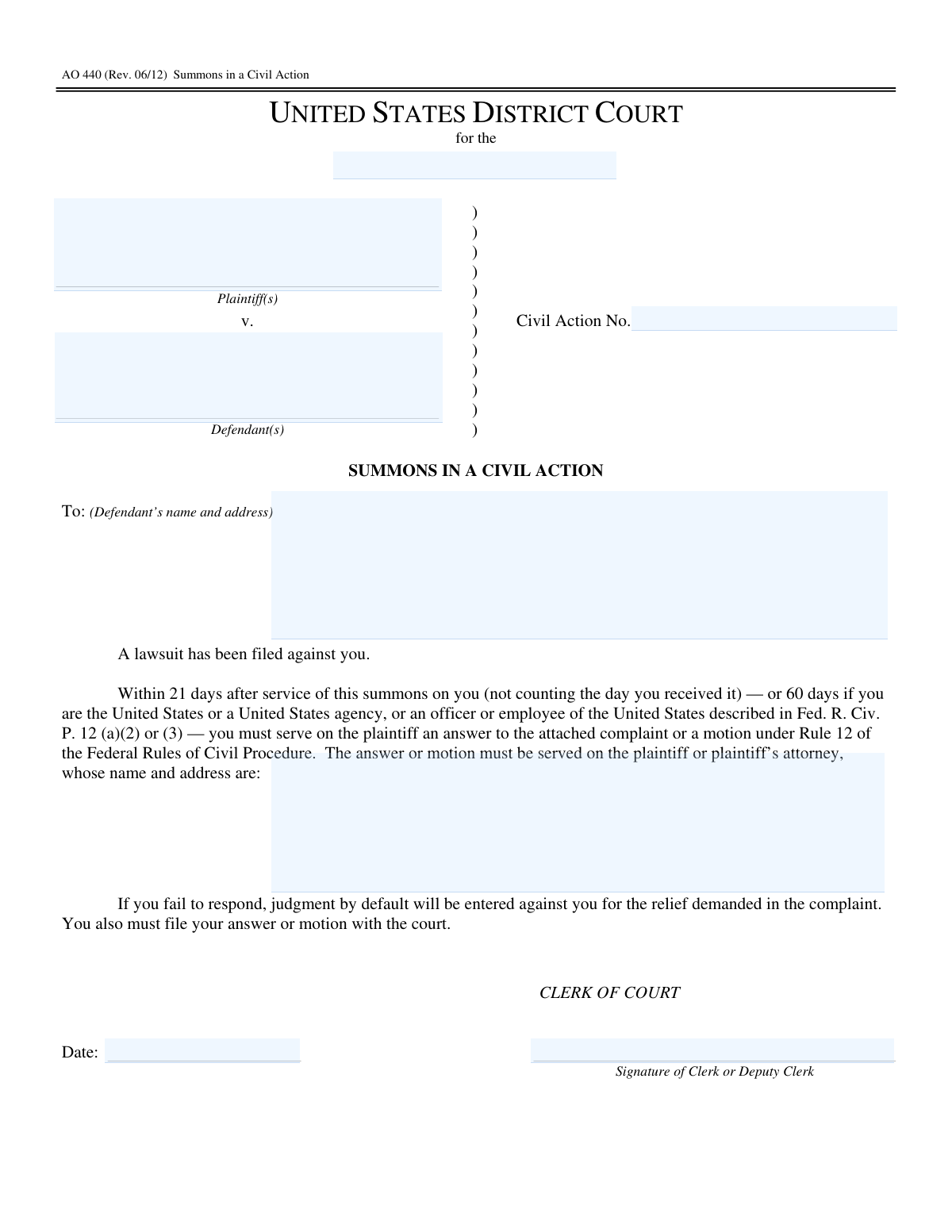
If you are starting a new case in a United States District Court, the most critical document is Form AO 440, Summons in a Civil Action. This form is used to formally notify defendants that a lawsuit has been filed against them. It outlines their legal obligation to respond within a set timeframe to prevent a default judgment. Proper service of this summons is a fundamental requirement for the legal process to proceed.
Managing Court Jurisdiction and Efficiency
Once a federal case is underway, the parties may decide to streamline the process by opting for a magistrate judge rather than a district judge. In this scenario, use Form AO 85, Notice, Consent, and Reference of a Civil Action to a Magistrate Judge. This form confirms that all parties voluntarily agree to let a magistrate judge handle all proceedings, including the final trial and judgment, which can often lead to a more efficient resolution.
Seeking Appellate Review (California)
If your case is within the California court system and involves a misdemeanor, infraction, or limited civil matter, you may need to challenge a trial court’s decision through a writ. Use Form APP-151, Petition for Writ (Misdemeanor, Infraction, or Limited Civil Case) when a standard appeal is unavailable or insufficient. This petition requests that an appellate division intervene to correct a judicial error or prevent irreparable harm.
Filling Out Your Forms with Instafill.ai
Accuracy is vital in legal filings. Instafill.ai simplifies the process by using AI to help you fill out these complex documents quickly. Whether you are dealing with federal AO forms or state-specific petitions like APP-151, our platform can convert static PDFs into interactive, fillable documents to save you time and ensure professional results.
Form Comparison
| Form | Primary Purpose | Jurisdiction | When to Use |
|---|---|---|---|
| AO 440, Summons in a Civil Action | Formally notifies defendants of a lawsuit and their obligation to respond. | Federal (U.S. District Court) | Upon filing a complaint to initiate the legal process. |
| Form AO 85, Notice, Consent, and Reference of a Civil Action to a Magistrate Judge | Allows parties to consent to a magistrate judge for all proceedings. | Federal (U.S. District Court) | When parties voluntarily agree to a magistrate judge's jurisdiction. |
| Form APP-151, Petition for Writ (Misdemeanor, Infraction, or Limited Civil Case) | Requests appellate review of a trial court's specific action or decision. | State (California Appellate Division) | When standard appeals are unavailable or insufficient for correcting errors. |
Tips for civil action forms
Ensure the names of all plaintiffs and defendants match your primary complaint or petition exactly. Inconsistent spelling or incorrect addresses on documents like the AO 440 Summons can cause significant delays in service or lead to legal challenges regarding proper notice.
Federal AO forms and state-specific forms like the APP-151 serve very different court levels. Always double-check your case number and specific court location to ensure you are not filing federal forms in a state court or vice versa.
When utilizing Form AO 85, remember that all parties must typically provide consent for a case to be referred to a magistrate judge. Discussing this option with opposing counsel early can prevent procedural delays and help streamline your trial schedule.
Civil actions are governed by rigid timelines, particularly for petitions like the APP-151 or responding to a summons. Missing a filing deadline can result in a waiver of your legal rights or an immediate default judgment against you.
Managing multiple civil filings can be overwhelming, but AI-powered tools like Instafill.ai can complete these forms in under 30 seconds with high accuracy. Your data stays secure during the process, providing a practical and fast solution for legal professionals and self-represented litigants alike.
Filing a form like the AO 440 with the court clerk is only the initial step. You must still ensure the defendant is formally served according to the specific rules of civil procedure, as filing the document alone does not satisfy the legal requirement for notice.
Keep digital copies of every form you submit, ideally including the court's 'filed' stamp or electronic receipt. This organized documentation is vital if a dispute arises regarding when a document was received or the specific contents of your filing.
Frequently Asked Questions
Civil action forms are standardized legal documents used to initiate, manage, or respond to lawsuits within the court system. They ensure that all necessary information is presented to the court and opposing parties in a consistent format, covering actions like notifying defendants, consenting to specific judges, or requesting appellate reviews.
These forms are used by plaintiffs who are starting a lawsuit, defendants who must respond to a claim, and their respective legal counsel. Some forms, such as those regarding magistrate judge jurisdiction, may require the signatures and consent of all parties involved in the litigation.
Yes, AI tools like Instafill.ai can be used to fill out civil action forms accurately by extracting data from your source documents and placing it directly into the required fields. This technology can even transform non-fillable PDF court forms into interactive documents that are much easier to complete.
While manual entry can be time-consuming and prone to errors, using AI-powered services can allow you to complete these forms in under 30 seconds. The AI quickly maps information from your existing files to the correct boxes on the court form, ensuring high accuracy and speed.
The filing location depends on the court handling your case; federal forms (AO forms) are generally submitted to the Clerk’s Office of the relevant U.S. District Court. State-specific forms, such as those for California limited civil cases, must be filed with the specific local court or appellate division where the case is active.
A summons, like Form AO 440, is a notice used at the beginning of a case to inform a defendant they are being sued and must respond. A petition for a writ, such as Form APP-151, is typically filed later to ask a higher court to review a specific decision or action taken by a lower court when a standard appeal is not sufficient.
Parties often choose to have a magistrate judge handle their case because it can result in a more flexible schedule and a faster path to trial. By filing Form AO 85, both sides agree to waive their right to a district judge, allowing the magistrate judge to conduct all proceedings and enter a final judgment.
If a summons is not properly served according to the court's rules, the case may be delayed or even dismissed for lack of proper notice. Ensuring that forms like the AO 440 are filled out accurately and served in compliance with legal requirements is essential for the case to move forward.
Generally, no; AO forms are designed specifically for use in the United States District Courts (the federal system). State courts have their own specific sets of forms and procedural rules that must be followed, although the general concepts of summons and petitions remain similar across jurisdictions.
A petition for a writ is used in urgent or specific circumstances where a standard appeal is unavailable or would not provide an adequate remedy. It is a request for the court to issue an extraordinary order to correct a judicial error or to prevent immediate harm to a party's rights.
While individuals are permitted to represent themselves (pro se) and fill out these forms, the legal implications of the information provided are significant. Many users use automated tools to handle the technical aspect of form completion, but consulting with a legal professional is recommended to ensure your rights are fully protected.
Glossary
- Form Complexity Index
- Instafill’s 0–100 measure of how much effort a form takes to complete, calculated deterministically from the form’s own structure rather than estimated. It combines the number of fillable fields (the largest factor), how difficult those fields are to complete based on their type, the number of pages that contain fields, the amount of conditional “fill-only-if” logic, and how many sections the form is divided into, then adds modifiers for tables and repeating lists, bundled instruction pages, and dense page layouts. A higher score means the form is harder to fill out by hand. The forms in this category have a median Form Complexity Index of 36/100 (Basic). See exactly how it is calculated.
- Summons
- A formal notice issued by a court that informs a defendant they are being sued and must respond to the complaint within a specific timeframe.
- Default Judgment
- A binding court ruling issued in favor of the plaintiff when a defendant fails to respond to a summons or appear in court as required.
- AO Forms
- Standardized legal documents created by the Administrative Office of the United States Courts for use in federal district and appellate courts.
- Magistrate Judge
- A federal judicial officer who can handle certain court proceedings and, with the consent of all parties, preside over an entire civil trial and issue a final judgment.
- Writ
- A formal written order from a higher court directing a lower court or official to take a specific action, often used when a standard appeal is not an option.
- Petitioner
- The party who files a formal request or petition with the court, typically used in appellate divisions or when seeking a writ.
- Limited Civil Case
- A type of civil lawsuit where the amount of money in dispute is below a specific threshold, often $25,000, and is subject to simplified legal procedures.
- Consent and Reference
- The process where both parties in a civil action voluntarily agree to have their case transferred to a magistrate judge for all proceedings, including trial.