Fill out Colorado DMV forms
with AI.
Colorado DMV forms are essential for managing vehicle ownership, registration, and tax obligations within the state. These documents ensure that every vehicle transaction, from private sales to dealership acquisitions, is properly recorded with the Department of Revenue. Accurate documentation is critical for establishing legal ownership and ensuring that all necessary state and local taxes are accounted for, preventing potential legal issues or delays in titling and registration.
By continuing, you acknowledge Instafill's Privacy Policy and agree to get occasional product update and promotional emails.
About Colorado DMV forms
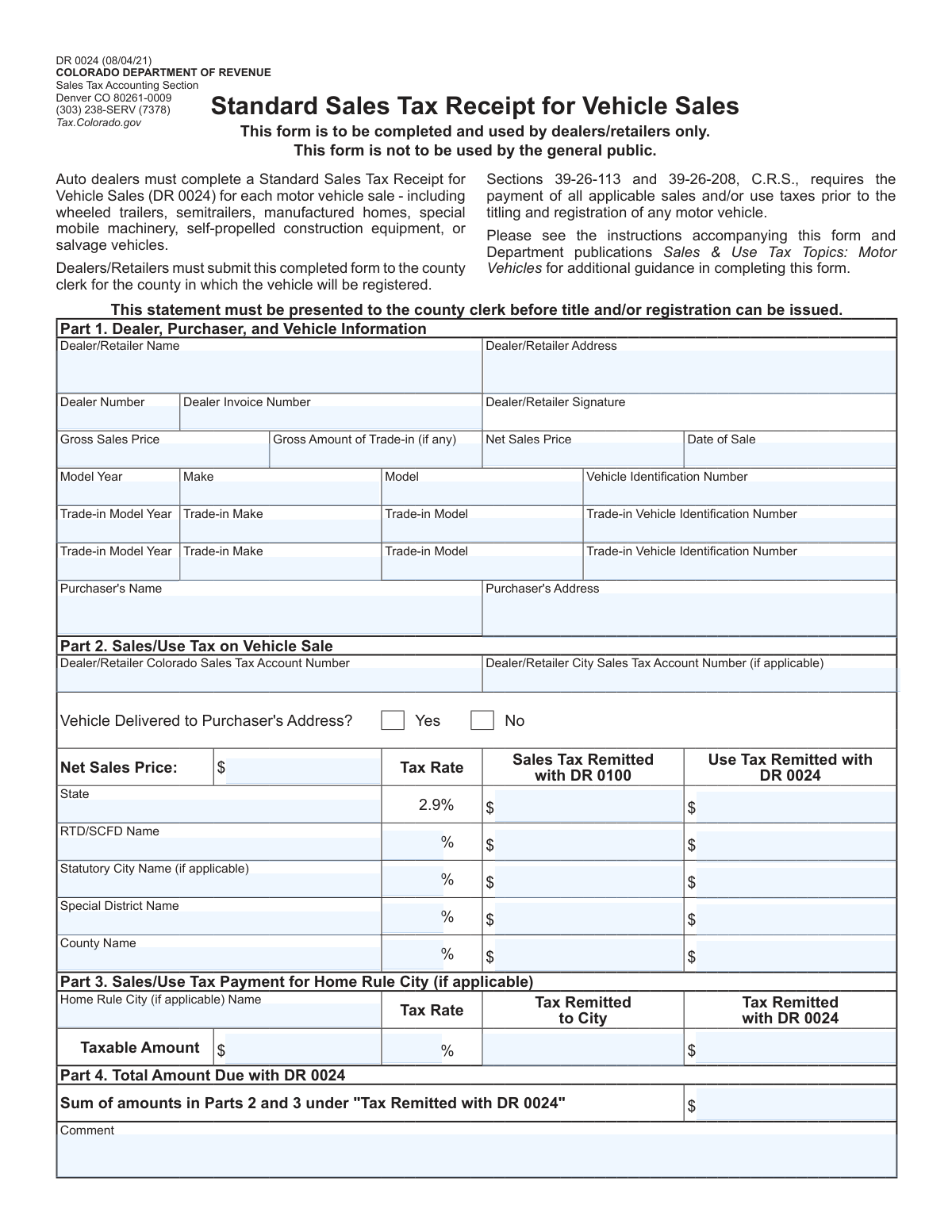
These forms are typically required by auto dealers, private sellers, and individual buyers during the transfer of vehicle titles. For instance, documenting the specific sales tax collected at the point of sale is a mandatory requirement for anyone processing a vehicle transaction in Colorado. Whether you are a dealer managing high-volume sales or an individual navigating a one-time purchase, having the correct paperwork, such as the Standard Sales Tax Receipt (DR 0024), is necessary to comply with state regulations and finalize the registration process at the local DMV office.
Navigating state requirements can often feel like a tedious hurdle, but tools like Instafill.ai use AI to fill these forms in under 30 seconds while ensuring data is handled accurately and securely. This practical approach saves time and reduces the risk of manual errors, making it easier to complete your motor vehicle filings efficiently and move on with your day.
Every form on this page can be completed without typing. Instafill is form filling software that reads a PDF and fills it for you — including flat and scanned documents that carry no fillable fields at all.
Forms in This Category
The forms in this category have a median Form Complexity Index of 56/100 (Moderate), measured across 1 forms by field count, input difficulty, length, conditional logic and structure. See how it is calculated.
| Form Name | Pages | FCI | |
|---|---|---|---|
| 1. | Form DR 0024, Standard Sales Tax Receipt for Vehicle Sales | 1 | Moderate 56 |
- Enterprise-grade security & data encryption
- 99%+ accuracy powered by AI
- 1,000+ forms from all industries
- Complete forms in under 60 seconds
How to Choose the Right Form
Documenting Vehicle Sales and Taxes
Navigating Colorado DMV and Department of Revenue requirements is essential for legal vehicle transfers. The primary document in this category is Form DR 0024 (Standard Sales Tax Receipt for Vehicle Sales). This document is the standard for recording sales and ensuring that all applicable taxes are calculated correctly before a vehicle is registered.
When to Use Form DR 0024
You should select Form DR 0024 if your transaction meets the following criteria:
- You are a Licensed Auto Dealer: This form is mandatory for dealers in Colorado. It acts as the official receipt and tax breakdown for every motor vehicle sold.
- Calculating Sales or Use Tax: If you need to determine the specific state, county, and local taxes owed on a vehicle purchase, this form provides the necessary framework for those calculations.
- Prerequisite for Titling: Buyers cannot title or register a vehicle in Colorado without proof that the sales tax has been addressed. Form DR 0024 provides this proof to the DMV.
Ensuring Accuracy for Registration
When filling out your Colorado motor vehicle forms, accuracy is paramount to avoid delays at the DMV office. Before you begin using our AI-powered filler for Form DR 0024, ensure you have the following details ready:
- Vehicle Specifics: You will need the VIN, year, make, and model.
- Financial Details: Have the final purchase price and any trade-in credits clearly documented.
- Jurisdictional Data: Because Colorado taxes vary by city and county, ensure you know the specific tax rates for the buyer's address.
By using Form DR 0024, you ensure that the financial aspect of the vehicle sale is transparent and compliant with Colorado state law, making the registration process much smoother for the end consumer.
Form Comparison
| Form | Purpose | Who Files It | When to Use |
|---|---|---|---|
| Form DR 0024, Standard Sales Tax Receipt for Vehicle Sales | Documents vehicle sales and calculates state, county, and local sales or use taxes. | Licensed motor vehicle dealers in Colorado during the sale of a vehicle. | At the time of sale to facilitate vehicle titling and registration processes. |
Tips for Colorado DMV forms
Ensure the Vehicle Identification Number (VIN) and purchase price match the bill of sale exactly. Discrepancies between the DR 0024 and other title documents can lead to significant processing delays at the DMV.
Colorado sales tax varies significantly based on the buyer's residence and the point of sale. Use the most current tax rate charts to ensure state, county, and special district taxes are calculated correctly to avoid underpayment issues.
AI-powered tools like Instafill.ai can complete these Colorado forms in under 30 seconds with high accuracy. Your data stays secure during the process, providing a practical and time-saving solution for professionals dealing with multiple vehicle sales.
Ensure the dealership’s name, address, and Colorado sales tax license number are printed consistently across all documents. This helps the Department of Revenue track transactions easily and ensures taxes are credited to the correct accounts.
Handwritten forms are frequently rejected if figures are difficult to read or if manual corrections are made with white-out. Typing data directly into a digital form ensures every field is legible and professional for state auditors.
The buyer requires a completed DR 0024 to register their vehicle and obtain a title. Always provide a clear copy to the purchaser while keeping a secondary copy for your dealership's permanent tax records.
Be aware of whether the transaction requires sales tax or use tax based on where the vehicle will be registered. Correctly identifying the tax type prevents the buyer from being charged incorrectly during the registration process.
Frequently Asked Questions
These forms are used to document the sale of vehicles and ensure that all applicable state, county, and municipal sales or use taxes are calculated and collected. They serve as an essential record for both the Department of Revenue and the buyer to ensure the vehicle can be legally titled.
Licensed motor vehicle dealers are typically responsible for completing forms like the DR 0024 to certify the taxes collected at the time of sale. For private party transactions, the buyer and seller usually document the sale through a Bill of Sale, and taxes are handled directly at the DMV during registration.
Most vehicle-related forms, including sales tax receipts and title applications, are submitted to the County Clerk and Recorder’s office in the county where the vehicle owner lives. Some forms may also be processed electronically by dealerships through state-integrated systems.
Yes, AI tools like Instafill.ai can be used to fill out these forms in under 30 seconds. The technology accurately extracts data from your purchase agreements or source documents and places it directly into the required fields on the PDF form.
Completing these forms manually can be time-consuming, but using an AI-powered platform allows you to finish the process in less than a minute. This ensures that data like VIN numbers and tax calculations are transferred accurately without manual typing errors.
This form acts as the official receipt for sales tax paid to a dealer. The County Clerk requires this documentation to verify that all local and state tax obligations have been met before they will issue a permanent title or registration for the vehicle.
You will generally need the Vehicle Identification Number (VIN), the purchase price, the date of sale, and the specific tax jurisdictions for the buyer's address. The form must detail the specific percentages and totals for state, county, city, and any special district taxes.
Yes, most motor vehicles that are required to be titled and registered in Colorado, including trailers, motorcycles, and motor homes, require standard sales tax documentation. The specific tax rates applied will depend on the type of vehicle and the location of the sale.
If the tax documentation is missing or incorrect, the County Clerk may refuse to register the vehicle. This can lead to late fees, penalties, or the requirement to pay the tax again out-of-pocket if you cannot prove it was paid to the dealer.
If you buy a vehicle from an out-of-state dealer, they may not use Colorado-specific forms, but you will still need to provide a similar breakdown of taxes paid. If the out-of-state dealer did not collect Colorado taxes, you will likely be required to pay them at your local DMV office.
Glossary
- Form Complexity Index
- Instafill’s 0–100 measure of how much effort a form takes to complete, calculated deterministically from the form’s own structure rather than estimated. It combines the number of fillable fields (the largest factor), how difficult those fields are to complete based on their type, the number of pages that contain fields, the amount of conditional “fill-only-if” logic, and how many sections the form is divided into, then adds modifiers for tables and repeating lists, bundled instruction pages, and dense page layouts. A higher score means the form is harder to fill out by hand. The forms in this category have a median Form Complexity Index of 56/100 (Moderate). See exactly how it is calculated.
- DR 0024
- The Standard Sales Tax Receipt for Vehicle Sales, a mandatory Colorado form used by dealers to certify that the correct sales tax was collected during a vehicle transaction.
- Trade-in Allowance
- The value of a used vehicle traded to a dealer, which is subtracted from the purchase price of the new vehicle to reduce the total amount of sales tax owed.
- VIN (Vehicle Identification Number)
- A unique 17-character code used to identify a specific motor vehicle, required on all DMV and Department of Revenue tax forms.
- Use Tax
- A tax similar to sales tax that is paid when a vehicle is purchased from an out-of-state dealer or in a jurisdiction where sales tax was not collected at the time of purchase.
- County Clerk and Recorder
- The local government office where Colorado residents must submit their vehicle title applications, registrations, and sales tax receipts.
- Lienholder
- A financial institution or individual that has a legal claim on a vehicle until the loan used to purchase it is paid in full.
- Situs
- The specific location where a vehicle is primarily kept or where the owner resides, used to determine the applicable local and district tax rates.
- Department of Revenue (DOR)
- The state agency responsible for collecting taxes and overseeing the Division of Motor Vehicles in Colorado.