Fill out Colorado OBH forms
with AI.
The Colorado Office of Behavioral Health (OBH) forms represent a critical set of regulatory documents designed to maintain high standards across the state’s mental health and substance use disorder services. These forms serve as the primary communication bridge between licensed service providers and state oversight bodies, ensuring that all behavioral health activities comply with Colorado law. By standardizing how information is reported and tracked, these documents help ensure that patient safety and service quality remain a top priority for the state's healthcare infrastructure.
By continuing, you acknowledge Instafill's Privacy Policy and agree to get occasional product update and promotional emails.
About Colorado OBH forms
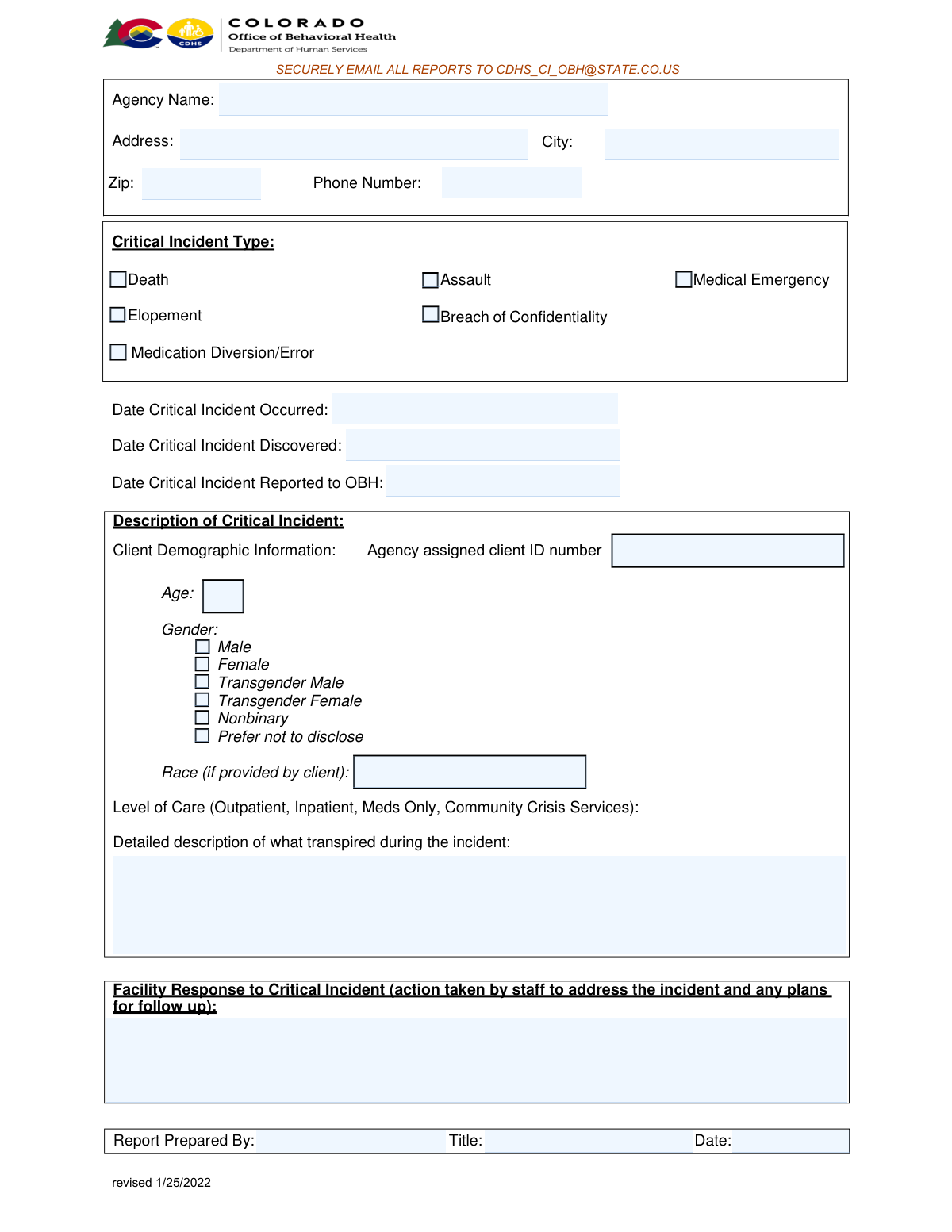
These forms are primarily used by behavioral health agencies, clinical administrators, and healthcare providers operating within Colorado. They are required in various professional scenarios, ranging from routine licensing updates to mandatory reporting after specific events. For instance, documents like the OBH Critical Incident Report are essential for facilities to provide detailed accounts of significant occurrences involving clients, ensuring that the Office of Behavioral Health can provide necessary oversight and response actions. Navigating these requirements is a standard part of operating a compliant healthcare facility in the state.
Completing these administrative tasks accurately is vital for regulatory compliance, but it can often be a time-consuming process for busy clinical staff. Tools like Instafill.ai use AI to fill these forms in under 30 seconds, handling data with high accuracy and security to streamline the reporting workflow. This allows providers to focus more on direct client care while ensuring that all state-mandated documentation is completed professionally and efficiently.
Every form on this page can be completed without typing. Instafill is form filling software that reads a PDF and fills it for you — including flat and scanned documents that carry no fillable fields at all.
Forms in This Category
The forms in this category have a median Form Complexity Index of 33/100 (Basic), measured across 1 forms by field count, input difficulty, length, conditional logic and structure. See how it is calculated.
| Form Name | Pages | FCI | |
|---|---|---|---|
| 1. | Colorado OBH Critical Incident Report | 1 | Basic 33 |
- Enterprise-grade security & data encryption
- 99%+ accuracy powered by AI
- 1,000+ forms from all industries
- Complete forms in under 60 seconds
How to Choose the Right Form
Navigating the regulatory landscape of the Colorado Office of Behavioral Health (OBH) requires precise documentation and timely reporting. While this category currently focuses on incident management, understanding when and how to file these reports is essential for maintaining your agency's licensure and ensuring client safety.
Reporting Critical Incidents
The primary document in this category is the Colorado OBH Critical Incident Report. This is a mandatory reporting tool for all behavioral health agencies operating within the state. You should select this form if your facility has experienced a significant event that requires state oversight.
Use the Colorado OBH Critical Incident Report if you need to document:
- Client Safety Events: Any incident involving the death of a client, serious physical injury, or medical emergencies that occur on-site or under the supervision of the agency.
- Operational Disruptions: Events that significantly impact the facility's ability to provide care, such as fires, natural disasters, or major infrastructure failures.
- Medication Errors: Serious incidents involving the administration or distribution of medication that could lead to adverse health outcomes.
- Legal or Law Enforcement Involvement: Situations where law enforcement was called to the facility or incidents involving legal issues related directly to a client’s care.
Who Should Use This Form?
This form is designed specifically for administrators, compliance officers, and clinical directors at Colorado-licensed behavioral health facilities. Because the Colorado OBH Critical Incident Report requires detailed accounts of the facility's response and the specific actions taken to mitigate future risks, it should be completed by staff members with direct knowledge of the event and the agency's internal protocols.
Efficiency and Compliance
Reporting deadlines for critical incidents are often strict, requiring a quick turnaround to stay in compliance with state regulations. Completing the Colorado OBH Critical Incident Report through Instafill.ai helps ensure that all mandatory fields are addressed accurately, reducing the risk of follow-up inquiries from the OBH. Our AI tools can also help you convert static PDF versions into interactive forms, making it easier to maintain your facility's digital records.
Form Comparison
| Form | Purpose | Reporting Entities | Filing Trigger |
|---|---|---|---|
| Colorado OBH Critical Incident Report | Mandatory reporting of critical incidents involving clients for OBH oversight and response. | Licensed or contracted behavioral health agencies and facilities operating within Colorado. | Immediately after a critical incident occurs to document details and facility actions. |
Tips for Colorado OBH forms
Accuracy is vital when reporting critical incidents to the Colorado Office of Behavioral Health. Double-check the exact date, time, and sequence of events to ensure the report provides a clear, factual narrative of the incident and the facility's response.
For agencies managing frequent reporting requirements, AI-powered tools like Instafill.ai can complete these forms in under 30 seconds with high accuracy. Your data stays secure during the process, making it a practical and time-saving solution for busy behavioral health professionals.
Incomplete forms are a primary cause of reporting delays or follow-up inquiries from the OBH. Review the entire document to ensure that client identification numbers and facility details are fully filled out before final submission.
When detailing incidents, ensure you are following HIPAA guidelines and facility protocols regarding client privacy. Only include the specific clinical information required by the OBH to maintain compliance with both state and federal privacy laws.
Use objective language when describing the incident and the facility's subsequent actions. Avoid speculative language and focus on observable facts and the specific steps taken by staff to mitigate the situation and ensure client safety.
Always keep a digital or physical copy of every submitted Critical Incident Report for your facility's internal records. This ensures you have a clear reference point for future audits, quality improvement meetings, or follow-up investigations by state authorities.
Before sending the form, confirm the current preferred submission method for the Colorado Office of Behavioral Health. Submission requirements can change, so checking the latest portal or contact instructions prevents documentation from being lost or delayed.
Frequently Asked Questions
Colorado Office of Behavioral Health (OBH) forms are primarily used by licensed behavioral health providers to report incidents, track client data, and maintain regulatory compliance. These documents ensure that the state can monitor the quality of care and safety within mental health and substance use disorder treatment facilities.
Any behavioral health agency or facility licensed or designated by the state of Colorado is generally required to use these forms. This includes substance use treatment centers, community mental health centers, and psychiatric hospitals that fall under state oversight.
Critical Incident Reports are usually required to be filed within a specific, short timeframe, often within 24 hours of the incident or discovery. Timely submission is crucial for ensuring that the regulatory authorities can provide proper oversight and response to serious events.
Yes, you can use AI tools like Instafill.ai to complete Colorado OBH forms quickly and accurately. These tools can extract relevant data from your internal records or source documents and place it directly into the PDF fields, reducing the risk of manual entry errors.
Using AI-powered services, it is possible to fill out these forms in under 30 seconds. By automating the data extraction and placement process, providers can save significant time compared to traditional manual typing or handwriting.
Incidents that typically require reporting include client deaths, serious injuries, allegations of abuse or neglect, medication errors, and significant property damage. These reports help the state identify trends and ensure that facilities are taking appropriate corrective actions.
Completed forms are generally submitted directly to the Colorado Behavioral Health Administration (BHA) or the specific department via their designated secure portal or email address. It is important to follow the specific submission instructions provided on the form or through official state communication channels.
Yes, because these forms contain sensitive client information, they must be handled in compliance with HIPAA and other state privacy laws. When filling or submitting these documents online, it is essential to use secure platforms that protect the confidentiality of protected health information (PHI).
Facilities are typically required to maintain copies of all submitted reports as part of their administrative and clinical records. These records are often reviewed during state licensing inspections or audits to ensure ongoing compliance with safety standards.
The Office of Behavioral Health (OBH) has transitioned much of its oversight to the newly formed Behavioral Health Administration (BHA). While many forms still reference OBH, they are now managed under the broader BHA framework designed to streamline behavioral health services across the state.
Glossary
- Form Complexity Index
- Instafill’s 0–100 measure of how much effort a form takes to complete, calculated deterministically from the form’s own structure rather than estimated. It combines the number of fillable fields (the largest factor), how difficult those fields are to complete based on their type, the number of pages that contain fields, the amount of conditional “fill-only-if” logic, and how many sections the form is divided into, then adds modifiers for tables and repeating lists, bundled instruction pages, and dense page layouts. A higher score means the form is harder to fill out by hand. The forms in this category have a median Form Complexity Index of 33/100 (Basic). See exactly how it is calculated.
- OBH (Office of Behavioral Health)
- The Colorado state agency previously responsible for overseeing and regulating public behavioral health services, now transitioned into the Behavioral Health Administration (BHA).
- Critical Incident
- An unexpected occurrence involving a client that results in serious injury, death, or significant risk, which must be reported to state authorities for oversight.
- BHA (Behavioral Health Administration)
- The cabinet-level agency in Colorado that replaced the Office of Behavioral Health to streamline mental health and substance use disorder services across the state.
- Mandatory Reporting
- A legal obligation for behavioral health providers and facilities to submit specific documentation to state regulators when certain incidents or risks occur.
- PHI (Protected Health Information)
- Any individually identifiable health data, such as names or medical histories, that is protected by federal law and must be handled with strict confidentiality.
- Corrective Action Plan (CAP)
- A formal document describing the steps a facility will take to address the root causes of a critical incident and prevent it from happening again.
- Sentinel Event
- A specific type of critical incident that results in an unanticipated death or major permanent loss of function not related to the natural course of the client's illness.
- ASAM Levels of Care
- A set of guidelines used to define the intensity of treatment services provided to clients, often cited in reports to provide context for where an incident occurred.