Fill out Connecticut DMV forms
with AI.
Connecticut DMV forms are essential for anyone looking to establish or maintain driving privileges within the state. These documents serve as the official record for the Department of Motor Vehicles, ensuring that all drivers meet the legal, medical, and safety standards required to operate a vehicle. Whether you are a new resident transferring an out-of-state license or a first-time driver starting the journey toward a permit, these forms are the mandatory gateway to legal compliance on Connecticut roads.
By continuing, you acknowledge Instafill's Privacy Policy and agree to get occasional product update and promotional emails.
About Connecticut DMV forms
This category primarily serves teenagers applying for their first learner permit, adult residents renewing their credentials, and individuals needing to update their personal information with the state. Common scenarios include submitting driver license forms like the R-229 to begin the licensing process, which requires detailed personal history and parental consent for minors. Navigating Connecticut state forms can often feel overwhelming due to the precision required for medical certifications and driving history disclosures.
To simplify this process, tools like Instafill.ai use AI to fill these forms in under 30 seconds, ensuring data is handled accurately and securely. This digital approach eliminates the manual effort of drafting responses and helps prevent common errors that could otherwise delay your application at the DMV office.
Every form on this page can be completed without typing. Instafill is form filling software that reads a PDF and fills it for you — including flat and scanned documents that carry no fillable fields at all.
Forms in This Category
The forms in this category have a median Form Complexity Index of 44/100 (Basic), measured across 1 forms by field count, input difficulty, length, conditional logic and structure. See how it is calculated.
| Form Name | Pages | FCI | |
|---|---|---|---|
| 1. | State of Connecticut Form R-229, Application for a Non-Commercial Learner Permit and/or Driver License | 1 | Basic 44 |
- Enterprise-grade security & data encryption
- 99%+ accuracy powered by AI
- 1,000+ forms from all industries
- Complete forms in under 60 seconds
How to Choose the Right Form
Navigating the Connecticut Department of Motor Vehicles (DMV) requires the right paperwork to ensure your application is processed without delays. Whether you are a first-time driver or a new resident, the forms in this category are designed to help you secure legal driving privileges in the Constitution State.
Applying for a License or Permit
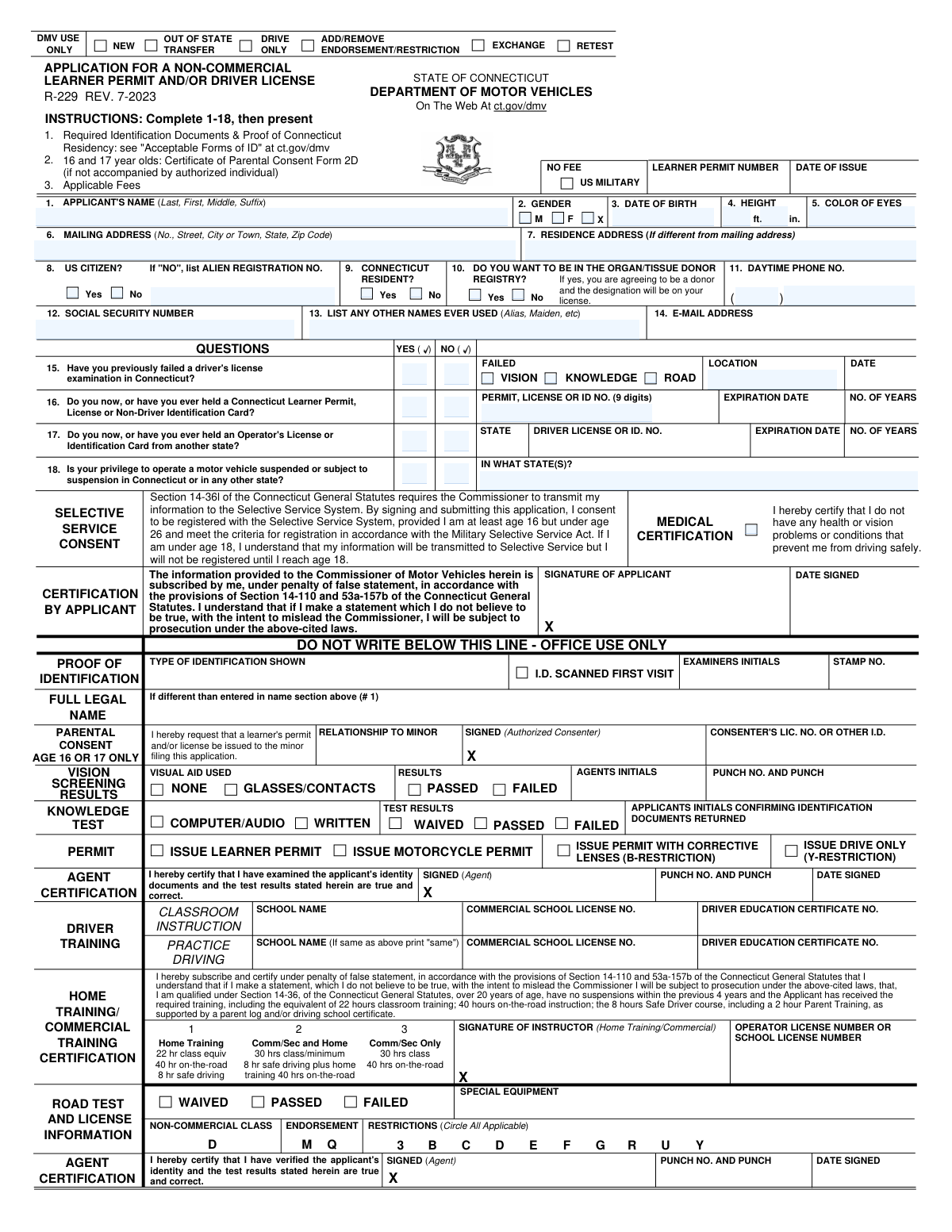
If your goal is to legally operate a standard passenger vehicle, the primary document you need is the State of Connecticut Form R-229, Application for a Non-Commercial Learner Permit and/or Driver License. This is the standard application used for several different milestones:
- New Drivers: Use this form if you are applying for your very first learner's permit.
- License Applicants: This form is required when you are ready to transition from a permit to a full non-commercial driver's license.
- Minors: If the applicant is under 18, Form R-229 includes the necessary sections for parental or guardian consent, which is a legal requirement in Connecticut.
What to Have Ready
When filling out Form R-229, ensure you have the following information prepared to avoid mistakes:
- Personal Identification: Full legal name, date of birth, and Social Security Number.
- Driving History: Details regarding any previous licenses held in other states or countries.
- Medical Certification: You will need to answer basic health questions to ensure you are fit to operate a motor vehicle.
- Parental Consent: As mentioned, if you are under 18, a parent or legal guardian must sign the designated section.
Why Use Instafill.ai for CT DMV Forms?
DMV forms can be complex and often come as static PDFs that are difficult to edit. By using Instafill.ai, you can convert the State of Connecticut Form R-229 into an interactive, fillable format. Our AI-powered tools help you populate your data accurately, reducing the risk of your application being rejected due to illegible handwriting or missing fields.
Form Comparison
| Form | Primary Purpose | Target Applicant | Key Sections |
|---|---|---|---|
| State of Connecticut Form R-229, Application for a Non-Commercial Learner Permit and/or Driver License | Applying for a new non-commercial driver license or learner permit in Connecticut. | Individuals seeking their first license or permit, including minors requiring parental consent. | Personal information, driving history, medical certification, and parental authorization for minors. |
Tips for Connecticut DMV forms
Ensure your name, date of birth, and Social Security number exactly match your primary identification documents. Any discrepancy between your form and your birth certificate or passport can lead to immediate rejection during your DMV appointment.
Before starting your application, have your proof of residency and identity documents on hand. Knowing exactly which documents you will bring to the DMV helps you accurately complete sections regarding legal status and physical address history.
If the applicant is under the age of 18, the parental consent section must be fully completed and signed by a legal guardian. Forgetting this section is a common mistake that requires a complete restart of the application process.
AI-powered tools like Instafill.ai can complete these Connecticut DMV forms in under 30 seconds with high accuracy. This technology streamlines the data entry process while ensuring your sensitive data stays secure during the entire process.
Be thorough when answering medical history or certification questions on driver license applications. Providing incomplete or vague information regarding vision or health conditions can result in significant processing delays or requests for additional medical evaluations.
The Connecticut DMV periodically updates their official forms to reflect new state regulations. Always ensure you are using the most recent version of Form R-229 to prevent the form from being deemed invalid upon arrival at the DMV office.
Frequently Asked Questions
This form is intended for individuals applying for a new non-commercial learner permit or a standard driver license in the state of Connecticut. It is the primary application used by the DMV to collect personal details, driving history, and necessary certifications for new drivers.
The application process allows the DMV to verify an applicant's identity, residency, and eligibility to begin driver training. By completing the R-229 form, applicants initiate the legal process required to obtain a permit, which is a prerequisite for a full driver license.
Yes, AI tools like Instafill.ai can automatically fill out Connecticut DMV forms in under 30 seconds. These tools accurately extract data from your source documents and place it into the correct fields on the PDF, reducing the risk of manual entry errors.
When submitting driver license or permit forms, you generally need to provide proof of identity, Social Security number, and Connecticut residency. Requirements may vary based on whether you are applying for a standard or REAL ID-compliant credential.
While manual entry can take 15 to 20 minutes, using an AI-powered service like Instafill.ai allows you to complete the entire form in less than 30 seconds. The AI handles the data mapping and entry, ensuring a much faster and more efficient experience.
Yes, for applicants under the age of 18, a parent or legal guardian must provide consent on the application form. The Connecticut DMV requires this authorization to process learner permit and driver license requests for underage individuals.
Most standard driver license applications include a section for medical self-certification or questions regarding physical conditions that might affect driving ability. In some cases, a separate medical report from a physician may be requested if specific health issues are disclosed.
Completed forms are typically brought to a local DMV office or a designated partner location during your scheduled appointment. It is important to check the current DMV guidelines to see if certain forms can be uploaded through their online portal prior to your visit.
If you are using a digital tool or AI service, you can easily edit the fields before finalizing the document. If you have already printed or submitted the form and realize there is an error, you may need to complete a new version to ensure the records are accurate.
No, the R-229 form is specifically for non-commercial learner permits and driver licenses. Commercial drivers must use different sets of forms and meet specific federal and state requirements tailored to heavy vehicle operation.
Glossary
- Form Complexity Index
- Instafill’s 0–100 measure of how much effort a form takes to complete, calculated deterministically from the form’s own structure rather than estimated. It combines the number of fillable fields (the largest factor), how difficult those fields are to complete based on their type, the number of pages that contain fields, the amount of conditional “fill-only-if” logic, and how many sections the form is divided into, then adds modifiers for tables and repeating lists, bundled instruction pages, and dense page layouts. A higher score means the form is harder to fill out by hand. The forms in this category have a median Form Complexity Index of 44/100 (Basic). See exactly how it is calculated.
- Learner Permit
- A temporary document that allows a person to practice driving on public roads while under the supervision of a licensed adult driver.
- Non-Commercial License
- A standard driver’s license, often referred to as a Class D license, used for operating personal passenger vehicles rather than large commercial trucks.
- REAL ID
- A federally compliant form of identification that meets specific security standards required for boarding domestic flights and entering certain federal buildings.
- Secondary Identification
- Supporting documents, such as a social security card or utility bill, used to verify an applicant's identity and residency in addition to primary ID like a passport.
- Medical Certification
- A section of the DMV application where the applicant must disclose any physical or mental conditions that could impact their ability to safely operate a motor vehicle.
- Parental Consent
- The legal authorization required from a parent or legal guardian for any applicant under the age of 18 to apply for a permit or license.
- Vision Screening
- A mandatory eye exam conducted by the DMV to ensure an applicant meets the minimum visual requirements for safe driving.
- Organ and Tissue Donor Registry
- A voluntary enrollment program where applicants can choose to have their consent for organ donation indicated on their driver's license.