Fill out CRA forms
with AI.
This category focuses on the essential documentation required for managing Personal Choice Retirement Accounts (PCRA), which are vital for investors seeking greater control over their retirement savings. These forms facilitate the transition from a standard employer-sponsored plan to a self-directed brokerage window, allowing for a more diverse range of investment options such as specific mutual funds and ETFs. Proper completion of these documents is crucial for ensuring that your retirement strategy is both legally compliant and perfectly aligned with your long-term financial objectives.
By continuing, you acknowledge Instafill's Privacy Policy and agree to get occasional product update and promotional emails.
About CRA forms
Typically, these forms are needed by plan participants who want to take a hands-on approach to their asset allocation. Whether you are establishing a new brokerage account or authorizing trading permissions through a Limited Power of Attorney (LPOA), these documents act as the bridge between your primary retirement plan and your independent investment choices. Managing this paperwork correctly is a critical step for any knowledgeable investor looking to maximize the flexibility of their retirement portfolio within their employer's plan framework.
Completing complex financial paperwork can often be a tedious hurdle, but tools like Instafill.ai use AI to fill these forms in under 30 seconds. This approach handles your data accurately and securely, providing a practical way to save time and reduce the risk of manual entry errors during the account setup process.
Every form on this page can be completed without typing. Instafill is form filling software that reads a PDF and fills it for you — including flat and scanned documents that carry no fillable fields at all.
Forms in This Category
The forms in this category have a median Form Complexity Index of 68/100 (Complex), measured across 3 forms by field count, input difficulty, length, conditional logic and structure. See how it is calculated.
| Form Name | Pages | FCI | |
|---|---|---|---|
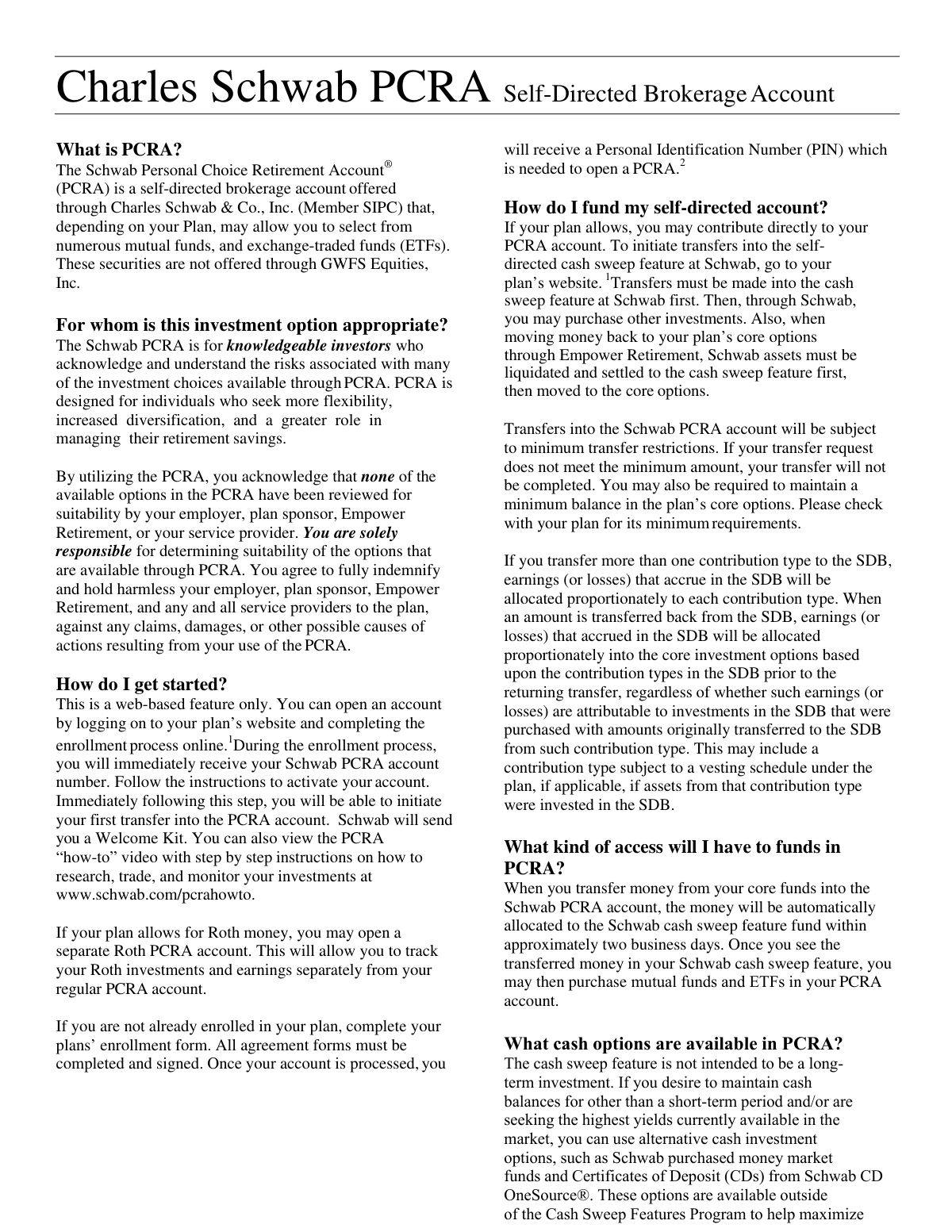
| 1. | Charles Schwab PCRA Self-Directed Brokerage Account | 1 | – |
| 2. | Form T101, Statement of Resource Expenses | 4 | Complex 68 |
| 3. | Schwab Personal Choice Retirement Account® (PCRA) Limited Power of Attorney (LPOA) Form For a Participant | 1 | – |
- Enterprise-grade security & data encryption
- 99%+ accuracy powered by AI
- 1,000+ forms from all industries
- Complete forms in under 60 seconds
How to Choose the Right Form
Navigating retirement account paperwork can be complex, especially when moving beyond standard plan options into a self-directed brokerage window. If you are looking to manage your investments through Charles Schwab’s Personal Choice Retirement Account (PCRA), you will need specific documentation to get started. Use the guide below to identify which document matches your current stage of the setup process.
Setting Up Your Account
If you are a knowledgeable investor looking for more control over your retirement portfolio, start with the Charles Schwab PCRA Self-Directed Brokerage Account application. This is the primary document required to establish your account. Choose this form if:
- You want to invest in a wide range of securities, such as mutual funds and ETFs, that are not available in your standard employer-sponsored plan.
- You are ready to open a new brokerage window within your existing retirement plan to gain greater investment flexibility.
Authorizing Trading Activity
Opening the account is only the first step. To actually execute trades within that account, you must establish the legal authority to do so. Use the Schwab Personal Choice Retirement Account® (PCRA) Limited Power of Attorney (LPOA) Form For a Participant if:
- You have already initiated the account opening process and need to grant yourself the specific authority to place trade orders.
- Your retirement plan requires a formal LPOA to enable the self-directed functionality of the brokerage window.
- You need to finalize the administrative setup to ensure your trade orders are legally recognized and processed by the brokerage.
Quick Summary
- Select the PCRA Self-Directed Brokerage Account form if you are just beginning the process of expanding your investment options beyond your plan's basic menu.
- Select the LPOA Form For a Participant if your account is in the process of being established and you specifically need to authorize trading permissions to manage the assets yourself.
By using Instafill.ai, you can quickly complete these PDFs and convert non-fillable versions into interactive forms, ensuring your retirement setup is handled accurately and efficiently.
Form Comparison
| Form | Primary Purpose | Key Action Enabled | Usage Scenario |
|---|---|---|---|
| Charles Schwab PCRA Self-Directed Brokerage Account | Establishes a self-directed brokerage account within an employer-sponsored retirement plan. | Provides access to mutual funds, ETFs, and other non-standard investment options. | Used when an investor wants more control over their retirement portfolio. |
| Schwab Personal Choice Retirement Account® (PCRA) Limited Power of Attorney (LPOA) Form For a Participant | Authorizes the plan participant to execute trades within their specific PCRA. | Legally allows the individual to place buy and sell orders independently. | Required during the account setup process to activate trading capabilities. |
Tips for CRA forms
Before filling out Schwab PCRA forms, confirm that your employer-sponsored retirement plan supports a self-directed brokerage window. Reviewing your Summary Plan Description (SPD) ensures you understand any specific restrictions or additional requirements mandated by your employer before you begin the application process.
The Limited Power of Attorney (LPOA) form is essential for granting yourself the authority to execute trades within the brokerage window. Without a correctly filed LPOA, your account may be opened, but you will be unable to manage your investments or place trade orders until the document is processed.
Managing complex financial paperwork is significantly easier with modern technology. AI-powered tools like Instafill.ai can complete these forms in under 30 seconds with high accuracy, ensuring your financial data stays secure while saving you the frustration of manual data entry for multiple documents.
One of the most common mistakes is providing incorrect retirement plan identifiers or participant account numbers. Double-check these numbers against your latest retirement plan statement to prevent administrative delays in linking your new brokerage account to your existing retirement funds.
Financial institutions like Charles Schwab have strict requirements for how forms are signed and dated. Ensure every required signature field is completed clearly to avoid the form being rejected, which is a frequent cause of delay for first-time applicants setting up a self-directed account.
Always save a copy of your completed PCRA and LPOA forms before submitting them to your plan administrator or Schwab. Having these records easily accessible allows you to quickly resolve any discrepancies regarding your trading authority or account setup in the future.
Frequently Asked Questions
Schwab Personal Choice Retirement Account (PCRA) forms are used by employees to set up and manage a self-directed brokerage window within their existing employer-sponsored retirement plan. These documents allow participants to move a portion of their retirement savings into an account that offers a wider range of investment options, such as stocks, bonds, and ETFs.
The LPOA form is required for retirement plan participants who wish to grant themselves the authority to place trade orders within their self-directed brokerage account. This document is a standard part of the account opening process and ensures that the brokerage has the legal authorization to execute trades on the participant's behalf.
While these are not tax return forms like a T1 or 1040, they are critical for maintaining the tax-advantaged status of your retirement investments. Correct completion of these forms ensures that your self-directed investments remain within the umbrella of your qualified retirement plan.
You should use these forms if your employer-sponsored retirement plan offers a brokerage window through Charles Schwab and you want more control over your investment selections. Consult your plan administrator or Summary Plan Description to confirm that a PCRA is an available option for your specific plan.
Yes, you can fill out these forms using AI tools like Instafill.ai, which can accurately extract data from your source documents and place it into the correct fields. This technology allows you to complete complex financial forms in under 30 seconds while reducing the risk of manual entry errors.
When using manual entry, these forms can take a significant amount of time to complete accurately, but AI-powered services like Instafill.ai can finish the process in under 30 seconds. The AI automates the data placement, making the digital completion of brokerage paperwork much more efficient.
You will generally need your employer's plan ID, your social security or tax identification number, and your current employment details. The forms also require you to acknowledge specific investment risks and provide your contact information for account communications.
Completed forms are typically submitted directly to Charles Schwab or through your employer's benefits portal, depending on your plan's specific requirements. Some plans allow for electronic submission, while others may require you to print and mail the signed documents.
No, these forms are for account setup and general trading authorization. Once the account is established and the Limited Power of Attorney is on file, you can typically trade within the account through the brokerage's online platform without filing additional forms for each transaction.
Yes, the PCRA application is used to establish the brokerage account itself, while the Limited Power of Attorney (LPOA) form specifically grants the authority to execute trades. Most participants will need to complete both forms concurrently to fully activate their self-directed retirement trading capabilities.
Glossary
- Form Complexity Index
- Instafill’s 0–100 measure of how much effort a form takes to complete, calculated deterministically from the form’s own structure rather than estimated. It combines the number of fillable fields (the largest factor), how difficult those fields are to complete based on their type, the number of pages that contain fields, the amount of conditional “fill-only-if” logic, and how many sections the form is divided into, then adds modifiers for tables and repeating lists, bundled instruction pages, and dense page layouts. A higher score means the form is harder to fill out by hand. The forms in this category have a median Form Complexity Index of 68/100 (Complex). See exactly how it is calculated.
- PCRA
- Stands for Personal Choice Retirement Account, a self-directed brokerage account that allows retirement plan participants to access a broader range of investment options than those available in their standard plan menu.
- Self-Directed Brokerage Account (SDBA)
- An investment account that gives the holder full control over buying and selling specific securities, such as individual stocks and bonds, rather than relying on a pre-selected list of mutual funds.
- Limited Power of Attorney (LPOA)
- A legal authorization that grants a designated person the right to perform specific actions, such as executing trades, on behalf of the account owner without granting full control over the funds.
- Brokerage Window
- A feature within an employer-sponsored retirement plan that provides a portal for participants to invest in assets outside of the plan's core investment options.
- Participant
- The individual employee or member who is enrolled in a retirement plan and owns the specific account being managed or modified.
- Trading Authorization
- The formal permission required by financial institutions to allow an individual to place orders for the purchase or sale of securities within a brokerage account.
- Qualified Retirement Plan
- An employer-established plan, such as a 401(k) or 403(b), that meets specific tax code requirements and provides tax-deferred or tax-free growth for retirement savings.
- ETF (Exchange-Traded Fund)
- A type of pooled investment security that operates much like a mutual fund but can be bought and sold on a stock exchange throughout the day.