Fill out donor-advised fund forms
with AI.
Donor-advised funds (DAFs) serve as a powerful vehicle for strategic philanthropy, allowing individuals and organizations to manage their charitable giving with the same rigor as their investment portfolios. The forms in this category are essential for establishing and managing these accounts, enabling donors to make irrevocable contributions, claim immediate tax deductions, and recommend grants to their favorite causes over time. By centralizing these documents, donors can more easily navigate the administrative requirements of major providers like Fidelity Charitable or Vanguard Charitable.
By continuing, you acknowledge Instafill's Privacy Policy and agree to get occasional product update and promotional emails.
About donor-advised fund forms
These forms are typically used by high-net-worth individuals, corporate entities, and financial advisors who are looking to formalize a giving strategy or transition assets into a dedicated philanthropic account. Whether you are an organization setting up a corporate giving program or a private donor enrolling in an investment advisor program, these documents require precise financial information and clear designations of authority. Ensuring these forms are completed correctly is vital for maintaining the tax-exempt status of the contributions and fulfilling long-term succession plans.
Completing complex financial paperwork can be a significant administrative hurdle, but tools like Instafill.ai use AI to fill these forms accurately and securely in under 30 seconds. This streamlined approach minimizes manual data entry, allowing you to focus on the impact of your charitable giving rather than the logistics of the application process.
Every form on this page can be completed without typing. Instafill is form filling software that reads a PDF and fills it for you — including flat and scanned documents that carry no fillable fields at all.
Forms in This Category
The forms in this category have a median Form Complexity Index of 64/100 (Complex), measured across 3 forms by field count, input difficulty, length, conditional logic and structure. See how it is calculated.
| Form Name | Pages | FCI | |
|---|---|---|---|
| 1. | Fidelity Charitable Investment Advisor Program Application | 1 | Complex 64 |
| 2. | Organizational Giving Account® Application | 1 | Complex 63 |
| 3. | Vanguard Charitable Open a Philanthropic Account | 1 | Complex 64 |
- Enterprise-grade security & data encryption
- 99%+ accuracy powered by AI
- 1,000+ forms from all industries
- Complete forms in under 60 seconds
How to Choose the Right Form
Navigating donor-advised fund (DAF) paperwork depends on whether you are establishing a new account or seeking to change how your existing charitable assets are managed. Use the following guide to identify the correct document for your philanthropic goals.
Starting a New Charitable Fund
If you are ready to make an irrevocable contribution to start a new fund, your choice depends on the provider and the type of donor:
- For Individuals or Organizations (Vanguard): The Vanguard Charitable Open a Philanthropic Account form is the primary document for setting up a new DAF with Vanguard. It covers everything from naming account advisors to selecting your initial investment options.
- For Corporate or Business Entities (Fidelity): If you are representing a business rather than an individual, use the Organizational Giving Account® Application. This form is tailored for corporate philanthropy, allowing entities to manage tax-deductible contributions and grant recommendations through Fidelity Charitable.
Managing Assets with a Professional Advisor
Some donors prefer to have their personal financial advisor oversee the investments within their DAF rather than using the standard investment pools provided by the sponsor.
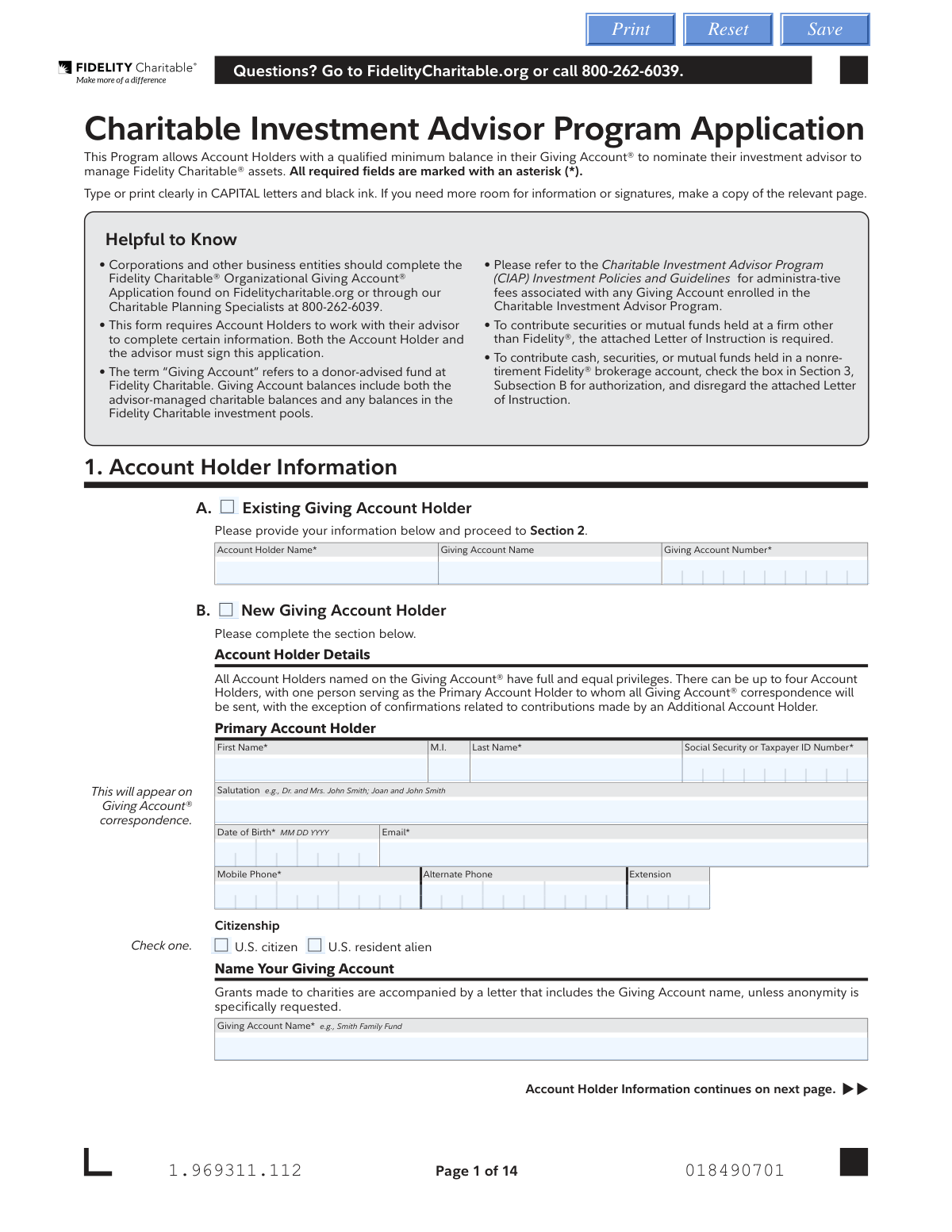
- Fidelity Charitable Investment Advisor Program Application: Choose this form if you already have a Fidelity Giving Account® and wish to enroll in the Charitable Investment Advisor Program (CIAP). This application authorizes your personal advisor to manage the assets held within your charitable account.
Key Considerations for Selection
- Provider Preference: Ensure the form matches your chosen sponsor (Fidelity vs. Vanguard), as these accounts are not interchangeable.
- Entity Type: Distinguish between personal accounts and corporate accounts; using the Organizational Giving Account® Application is mandatory for business-led giving.
- Management Style: Only use the Investment Advisor Program form if you have a qualified advisor ready to take over the portfolio management; otherwise, the standard account opening forms will default to automated investment pools.
Form Comparison
| Form | Primary Purpose | Eligible Applicant | Key Requirement |
|---|---|---|---|
| Fidelity Charitable Investment Advisor Program Application | Authorize a personal investment advisor to manage assets within a Giving Account. | Existing Fidelity Charitable donors and their professional investment advisors. | Detailed advisor credentials and existing Giving Account identification. |
| Organizational Giving Account® Application | Establish a corporate-owned donor-advised fund for business-led charitable giving. | Business entities such as corporations, LLCs, or partnerships. | Entity tax identification number and authorization from organizational leadership. |
| Vanguard Charitable Open a Philanthropic Account | Create a new donor-advised fund for tax-deductible charitable contributions. | Individuals, families, or organizations seeking to start a DAF. | An irrevocable initial contribution and selection of investment options. |
Tips for donor-advised fund forms
To open a donor-advised fund account, you will need Social Security numbers for individuals or Employer Identification Numbers (EIN) for organizations. Having these documents ready prevents mid-application delays and ensures your tax-deductible contributions are correctly attributed from the start.
Most DAF forms require you to name a successor or a charitable beneficiary who will manage the funds after your lifetime. Deciding whether you want to appoint family members or a specific charity before you start filling out the form ensures a smoother setup process and long-term clarity.
DAF applications usually ask you to select an investment pool for your donated assets. Consider whether you plan to grant the money out immediately or grow it over decades, as this will dictate whether you choose conservative or growth-oriented investment strategies on the form.
Be careful when listing roles on the application, as account holders often have legal control while authorized advisors may only have recommendation privileges. Clearly defining these roles on the form prevents future administrative hurdles when it comes time to recommend grants to your favorite charities.
Managing multiple DAF applications for different sponsors can be time-consuming and repetitive. AI-powered tools like Instafill.ai can complete these forms in under 30 seconds with high accuracy, ensuring your sensitive data stays secure during the process.
If you are opening an Organizational Giving Account, ensure you have the corporate resolutions or bylaws that authorize specific individuals to sign on behalf of the company. Attaching or referencing these documents correctly avoids the common mistake of application rejection due to insufficient authority.
Frequently Asked Questions
A donor-advised fund (DAF) is a specialized financial account administered by a 501(c)(3) organization to manage charitable donations on behalf of individuals or families. These forms are necessary to legally establish the account, define advisory privileges, and specify how the donated assets should be invested before they are eventually granted to charities.
If you are acting on behalf of a business, you should use the Organizational Giving Account Application. This specific document is designed for corporate philanthropy, allowing entities to make irrevocable contributions and manage grants over time under the organization's name rather than an individual's name.
Yes, certain providers offer specific programs for this purpose, such as the Fidelity Charitable Investment Advisor Program. You would need to complete a specific application to nominate your personal financial advisor to manage the assets within your giving account, provided they meet the institution's eligibility requirements.
You will generally need your personal or organizational tax identification numbers, bank account details for funding, and the contact information for any named advisors or successors. If you are opening an organizational account, you may also need legal documentation proving the entity's status and identifying authorized signers.
The choice often depends on your existing financial relationships and the specific investment options or fee structures offered by each provider. Both organizations provide robust platforms, but you should review their individual program guidelines to see which aligns better with your long-term philanthropic goals and minimum contribution requirements.
Yes, you can use AI tools like Instafill.ai to complete these complex donor-advised fund forms efficiently. These tools can accurately extract data from your source documents and place it into the correct fields, ensuring that the application is consistent and professional.
Manually filling out these applications can take a significant amount of time due to the detailed financial and personal information required. However, using AI-powered services can reduce this time to under 30 seconds by automating the data entry process and converting non-fillable PDFs into interactive forms.
Completed forms are typically submitted directly to the charitable sponsor via their secure online portals, mail, or fax. Always check the specific instructions provided by the organization (such as Fidelity or Vanguard) for the most current submission address or digital upload link.
Most donor-advised fund applications require an initial irrevocable contribution to activate the account. The forms usually include a section where you specify the amount and type of assets—such as cash or securities—that you are transferring to establish the fund.
Yes, most DAF providers allow you to update your account details, including named advisors and succession plans, after the account is open. While the initial application sets the foundation, you can usually submit maintenance forms or use the provider's online dashboard to make adjustments as your charitable vision evolves.
Glossary
- Form Complexity Index
- Instafill’s 0–100 measure of how much effort a form takes to complete, calculated deterministically from the form’s own structure rather than estimated. It combines the number of fillable fields (the largest factor), how difficult those fields are to complete based on their type, the number of pages that contain fields, the amount of conditional “fill-only-if” logic, and how many sections the form is divided into, then adds modifiers for tables and repeating lists, bundled instruction pages, and dense page layouts. A higher score means the form is harder to fill out by hand. The forms in this category have a median Form Complexity Index of 64/100 (Complex). See exactly how it is calculated.
- Donor-Advised Fund (DAF)
- A private fund managed by a sponsoring organization that allows donors to make charitable contributions, receive immediate tax benefits, and recommend grants to charities over time.
- Irrevocable Contribution
- A donation of cash or assets that cannot be taken back or refunded once it is given to the sponsoring organization.
- Grant Recommendation
- The process by which an account holder suggests that a specific amount of money from their fund be sent to a qualified charitable organization.
- Sponsoring Organization
- A public charity that oversees the administration, investment, and legal compliance of donor-advised funds, such as Fidelity Charitable or Vanguard Charitable.
- Succession Plan
- A formal designation that determines who will take over the management of the fund or how the remaining assets will be distributed after the donor's death or incapacity.
- Investment Advisor Program
- An arrangement that allows a donor to appoint their own professional financial advisor to manage the investment of the assets held within their charitable account.
- 501(c)(3) Organization
- A nonprofit entity recognized by the IRS as tax-exempt and eligible to receive grants from a donor-advised fund.
- Philanthropic Account
- A specific name used by some institutions to describe their donor-advised fund accounts used for managing charitable assets.