Fill out entity account forms
with AI.
Entity account forms are the standard documentation required for legal structures—such as corporations, LLCs, trusts, and partnerships—to establish financial relationships with brokerage firms, banks, or investment advisors. Unlike individual accounts, entity accounts require detailed disclosures regarding the legal status of the organization, tax identification numbers, and regulatory compliance. These forms are critical because they define the legal framework under which an organization manages its assets, ensuring that all transactions are authorized and reported correctly to tax authorities.
By continuing, you acknowledge Instafill's Privacy Policy and agree to get occasional product update and promotional emails.
About entity account forms
These forms are typically used by business owners, corporate officers, trustees, and legal representatives when opening new investment or brokerage accounts. Whether you are setting up a Fidelity Advisor Entity Account or establishing a brokerage relationship with First Republic Securities, the process involves verifying the identity of the entity and its authorized signers. This documentation is essential during initial business setup, after a corporate restructuring, or when diversifying a trust's investment portfolio. Because these forms often require cross-referencing complex legal documents, accuracy is paramount to avoid delays in account activation.
Managing the paperwork for multiple legal entities can be time-consuming and prone to manual entry errors. Tools like Instafill.ai use AI to fill these entity account forms in under 30 seconds, ensuring that data is handled accurately and securely while streamlining the onboarding process. This allows financial professionals and business administrators to focus on strategy rather than the repetitive task of manual data entry.
Every form on this page can be completed without typing. Instafill is form filling software that reads a PDF and fills it for you — including flat and scanned documents that carry no fillable fields at all.
Forms in This Category
The forms in this category have a median Form Complexity Index of 64/100 (Complex), measured across 2 forms by field count, input difficulty, length, conditional logic and structure. See how it is calculated.
| Form Name | Pages | FCI | |
|---|---|---|---|
| 1. | Fidelity Advisor Entity New Account Application | 1 | Complex 64 |
| 2. | First Republic Securities Company, LLC Entity Account Application (FRSC 778 E 7/19) | 1 | Complex 63 |
- Enterprise-grade security & data encryption
- 99%+ accuracy powered by AI
- 1,000+ forms from all industries
- Complete forms in under 60 seconds
How to Choose the Right Form
Choosing the right entity account form depends primarily on the financial institution you are partnering with and the specific legal structure of your organization. These forms are essential for corporations, trusts, and partnerships to establish investment or brokerage accounts while ensuring compliance with federal regulations.
By Financial Institution
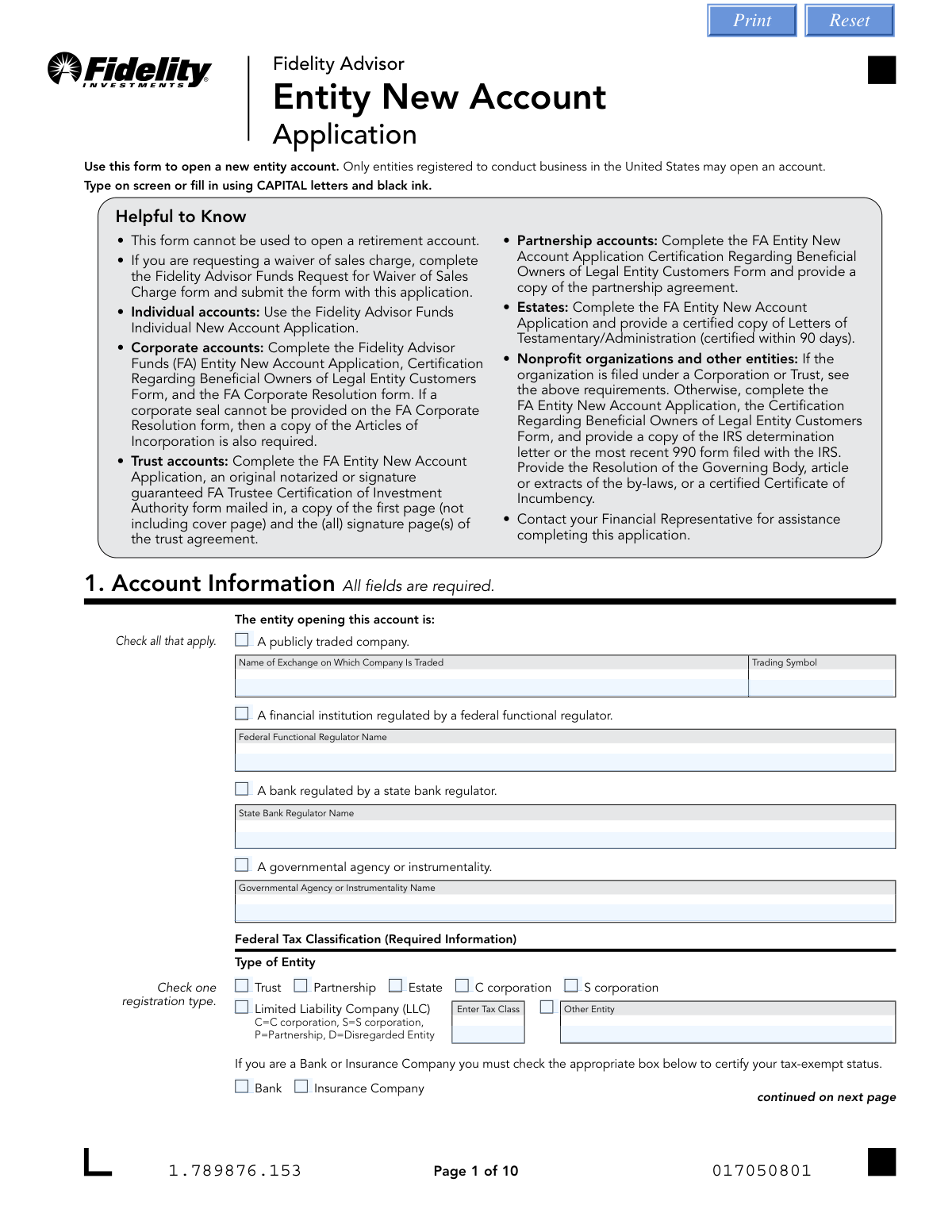
- Fidelity Advisor: If you are opening an investment account through Fidelity, you should use the Fidelity Advisor Entity New Account Application. This is a comprehensive document required for legal entities registered in the United States. It is designed to gather essential information regarding the entity's tax status, initial investment instructions, and the identification of authorized signers.
- First Republic Securities: If you are seeking to open a brokerage account with First Republic, select the First Republic Securities Company, LLC Entity Account Application (FRSC 778 E 7/19). This form is specifically tailored for First Republic’s compliance requirements and captures the personal details of all individuals authorized to manage the entity’s assets.
By Entity Structure
- Corporations and LLCs: Both the Fidelity Advisor Entity New Account Application and the First Republic Securities Company (FRSC 778 E 7/19) form are suitable for these business structures. Your choice will be dictated by which institution is hosting your brokerage services.
- Trusts and Partnerships: The Fidelity Advisor Entity New Account Application is frequently used for these specific legal arrangements, providing clear sections for defining the roles of trustees or partners and outlining how the account should be established.
Tips for a Smooth Application
To complete these forms efficiently using Instafill.ai, ensure you have the following information ready:
- Tax Identification: Have your Entity Tax ID (EIN) or relevant Social Security numbers for trusts.
- Authorized Signers: Gather the legal names, addresses, and identification details for everyone authorized to act on behalf of the entity.
- Funding Details: Be prepared to specify your initial investment amounts and the source of funds.
Form Comparison
| Form | Financial Institution | Eligible Entities | Key Requirements | Primary Purpose |
|---|---|---|---|---|
| Fidelity Advisor Entity New Account Application | Fidelity Advisor | US-registered corporations, partnerships, and trusts | Tax status, authorized signers, and initial investment instructions | Opening a new investment account for US legal entities |
| Fidelity Advisor Entity New Account Application | Fidelity Advisor | Corporations, trusts, and partnerships | Definition of authorized individuals and investment instructions | Establishing account management and compliance for legal entities |
| First Republic Securities Company, LLC Entity Account Application (FRSC 778 E 7/19) | First Republic Securities Company | Corporations, LLCs, and partnerships | Tax status and personal details of all authorized signers | Applying for a brokerage account for a legal entity |
Tips for entity account forms
Always double-check your Employer Identification Number (EIN) or relevant tax ID before entering it into the form. Inaccurate tax information is one of the most common reasons for application rejection and can lead to significant delays in account activation.
Entity account forms require personal details, such as Social Security numbers and residential addresses, for every person authorized to manage the account. Having this data organized beforehand prevents the need to stop and start the application process repeatedly.
Ensure the entity name and address on the application exactly match your articles of incorporation, trust agreement, or partnership papers. Any discrepancy between the form and your official legal registration can trigger additional verification requests from the financial institution.
Most institutions require you to disclose beneficial owners who hold a 25% or greater stake in the entity. Be ready to provide identification documents and personal details for these individuals to comply with federal anti-money laundering regulations.
Filling out complex financial documents can be tedious, but AI-powered tools like Instafill.ai can complete these forms in under 30 seconds with high accuracy. This is a real time-saver for businesses managing multiple accounts, and your sensitive data stays secure during the entire process.
Some entity forms require specific signatures from a corporate secretary or may even need to be notarized, especially for trusts or non-profits. Reviewing the signature page first allows you to coordinate with other stakeholders or a notary before you finish the rest of the paperwork.
Ensure you select the correct legal structure on the form, such as an S-Corp, LLC, or Limited Partnership. Choosing the wrong category can affect how the account is taxed and which supplemental documents the brokerage will require from you.
Frequently Asked Questions
Entity account forms are legal documents used by non-individual organizations, such as corporations, LLCs, partnerships, or trusts, to establish a professional relationship with a financial institution. These forms collect vital data regarding the organization's legal structure, tax identification, and the individuals authorized to manage the assets.
Any legal entity that is not a natural person generally needs these specific applications rather than standard personal account forms. This includes for-profit corporations, non-profit organizations, limited liability companies, general or limited partnerships, and various types of legal trusts.
While requirements vary by institution, you will usually need to provide your Employer Identification Number (EIN) and formation documents like Articles of Incorporation or a Trust Agreement. Additionally, most banks and brokerages require identification documents for all control persons and beneficial owners of the entity.
These forms are designed to satisfy federal regulatory requirements, including Know Your Customer (KYC) and Anti-Money Laundering (AML) laws. By collecting this data, financial institutions verify the legitimacy of the business and ensure that the individuals acting on behalf of the entity have the proper legal authority.
Yes, modern AI tools like Instafill.ai can process these complex applications by automatically extracting data from your existing corporate documents and placing it directly into the form fields. This technology ensures high accuracy and reduces the manual effort typically associated with long financial applications.
Using AI-powered platforms can significantly speed up the process, often allowing users to complete an entire entity account application in under 30 seconds. This is achieved by the AI instantly identifying relevant information from source documents and populating the PDF accurately.
Generally, the person signing must be a legally recognized representative of the organization, such as a corporate officer, a managing member of an LLC, or a trustee. The application will usually require a Certificate of Incumbency or a similar document to prove the signer has the authority to bind the entity to the agreement.
The correct form depends entirely on the financial institution where you intend to open the account, such as Fidelity or First Republic. Each brokerage or bank has its own proprietary application that must be used to ensure their specific compliance and internal processing standards are met.
Yes, although the specific fields may differ, both banks and brokerage firms use entity account applications to register non-individual clients. The forms in this category are primarily focused on investment and brokerage services for legal entities.
Once submitted, the financial institution's compliance department reviews the application and supporting documentation to verify the entity's standing. If approved, the account is established, and you will receive instructions on how to fund the account and begin managing your assets.
Glossary
- Form Complexity Index
- Instafill’s 0–100 measure of how much effort a form takes to complete, calculated deterministically from the form’s own structure rather than estimated. It combines the number of fillable fields (the largest factor), how difficult those fields are to complete based on their type, the number of pages that contain fields, the amount of conditional “fill-only-if” logic, and how many sections the form is divided into, then adds modifiers for tables and repeating lists, bundled instruction pages, and dense page layouts. A higher score means the form is harder to fill out by hand. The forms in this category have a median Form Complexity Index of 64/100 (Complex). See exactly how it is calculated.
- Legal Entity
- A business or organization, such as a corporation, LLC, partnership, or trust, that has its own legal rights and responsibilities separate from its owners.
- EIN (Employer Identification Number)
- A unique nine-digit number assigned by the IRS to identify a business entity for tax filing and reporting purposes.
- Authorized Signer
- An individual who has been granted the legal authority by an entity to execute transactions and sign official documents on the account's behalf.
- Beneficial Owner
- An individual who directly or indirectly owns a significant percentage (typically 25% or more) of the equity interests in a legal entity.
- Control Person
- A high-level individual with significant responsibility to manage or direct the entity, such as a Chief Executive Officer, President, or Managing Member.
- FATCA (Foreign Account Tax Compliance Act)
- A federal law requiring financial institutions to report information about accounts held by U.S. taxpayers or foreign entities with substantial U.S. ownership.
- TIN (Taxpayer Identification Number)
- A generic term for identification numbers used by the IRS; for entities, this is almost always the Employer Identification Number (EIN).
- CIP (Customer Identification Program)
- A set of procedures required by federal law that financial institutions must follow to verify the identity of any person or entity seeking to open an account.