Fill out German court forms
with AI.
German court forms are essential instruments used within the judicial system to initiate legal actions, enforce judgments, or respond to litigation. Regulated by the Zivilprozessordnung (ZPO), these documents ensure that legal procedures are followed correctly and that the rights of all parties are protected. For instance, forms such as the Pfändungs- und Überweisungsbeschluss are critical for creditors seeking to recover outstanding debts through the garnishment of wages or bank accounts. Navigating these documents requires high precision, as even minor errors can lead to significant delays in the enforcement of legal rights or the processing of court orders.
By continuing, you acknowledge Instafill's Privacy Policy and agree to get occasional product update and promotional emails.
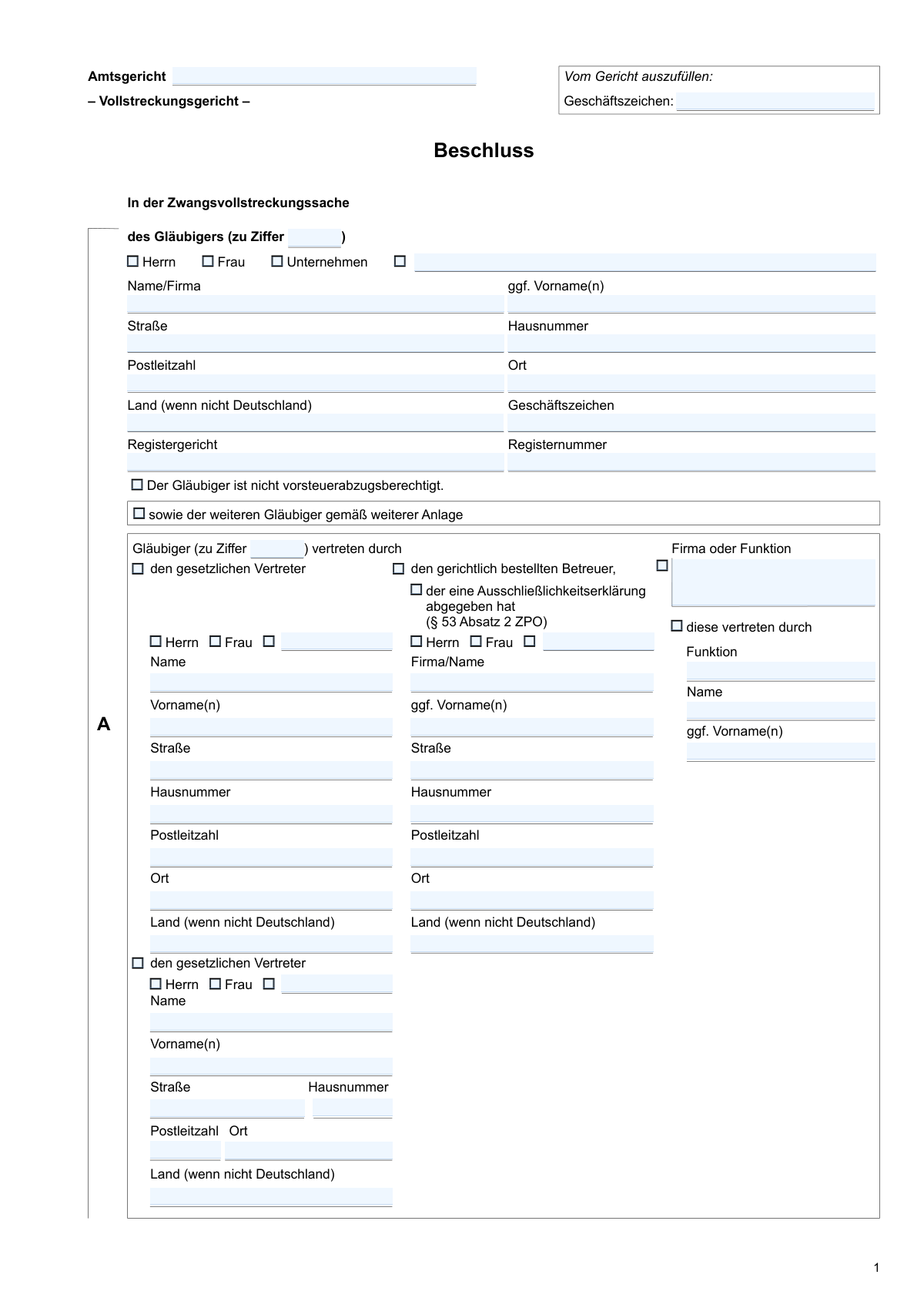
About German court forms
These forms are typically required by legal professionals, business owners, and individuals involved in civil disputes within the German legal system. Whether you are managing enforcement proceedings to collect unpaid invoices or responding to a court directive, these documents provide the formal framework necessary to interact with the Amtsgericht (local court). Because these forms often involve complex statutory references and require detailed data regarding creditors, debtors, and third-party entities like employers or banks, they can be time-consuming to complete manually. Tools like Instafill.ai use AI to fill these forms in under 30 seconds, ensuring data is handled accurately and securely while streamlining the administrative side of legal compliance.
Every form on this page can be completed without typing. Instafill is form filling software that reads a PDF and fills it for you — including flat and scanned documents that carry no fillable fields at all.
Forms in This Category
The forms in this category have a median Form Complexity Index of 77/100 (Complex), measured across 1 forms by field count, input difficulty, length, conditional logic and structure. See how it is calculated.
| Form Name | Pages | FCI | |
|---|---|---|---|
| 1. | Pfändungs- und Überweisungsbeschluss (Garnishment and Transfer Order) – German Civil Enforcement Court Form | 9 | Complex 77 |
- Enterprise-grade security & data encryption
- 99%+ accuracy powered by AI
- 1,000+ forms from all industries
- Complete forms in under 60 seconds
How to Choose the Right Form
Navigating the German legal system requires extreme precision, particularly when dealing with the enforcement court (*Vollstreckungsgericht*). In this category, you will find the essential documentation required to legally recover debts through the German civil court system.
Debt Enforcement and Asset Seizure
When a debtor fails to pay despite a legal judgment, you must utilize specific court-approved forms to satisfy your claims. The primary document used for this process is:
- Pfändungs- und Überweisungsbeschluss (Garnishment and Transfer Order): This is the standard, comprehensive form used under the German Code of Civil Procedure (*Zivilprozessordnung* or ZPO). It is the mandatory tool for creditors who wish to legally "freeze" and then claim assets belonging to the debtor that are currently held by third parties.
When to Use This Form
You should select the Pfändungs- und Überweisungsbeschluss if your enforcement strategy involves any of the following:
- Wage Garnishment: To redirect a portion of the debtor’s salary directly from their employer to you.
- Bank Account Seizure: To garnish funds currently held in the debtor’s private or business bank accounts.
- Claims Against Third Parties: To claim insurance payouts, savings, or social security benefits that are owed to the debtor.
Ensuring Legal Validity
The Pfändungs- und Überweisungsbeschluss is a highly technical document that incorporates complex legal provisions, such as exemption limits and maintenance obligations under §§ 829, 835, and 850 ZPO. Because the *Amtsgericht* (local court) will reject forms containing errors or missing information about the Third-party Debtor (*Drittschuldner*), precision is vital.
Using Instafill.ai allows you to navigate these complexities by turning the dense, multi-page PDF into a manageable, interactive process. This ensures that all parties—the creditor, debtor, and third-party debtor—are correctly identified and that the legal citations required for a successful enforcement are properly included.
Form Comparison
| Form | Purpose | Who Files It | Targeted Assets | Legal Basis |
|---|---|---|---|---|
| Pfändungs- und Überweisungsbeschluss (Garnishment and Transfer Order) – German Civil Enforcement Court Form | Orders garnishment of debtor financial claims to satisfy outstanding debt via court order. | Creditors seeking to enforce a judgment against a debtor's third-party assets. | Wages, bank accounts, savings, insurance policies, and social security benefits. | German Civil Procedure Code (ZPO) sections 829, 835, and 850. |
Tips for German court forms
German court forms are strictly formal; any discrepancy in the names or addresses of the creditor, debtor, or third-party debtor (Drittschuldner) can cause the court to reject the application. Double-check official records to ensure legal entities are named exactly as they appear in the commercial register to avoid costly delays.
When targeting bank accounts or wages, it is crucial to identify the correct headquarters or designated service address of the third-party debtor. Providing the wrong branch information for a large bank or a subsidiary can lead to the unsuccessful service of the garnishment order, requiring a restart of the process.
Utilizing AI-powered tools like Instafill.ai allows you to complete complex German legal forms in under 30 seconds with high accuracy. This technology streamlines the data entry process for detailed enforcement documents while ensuring your sensitive data stays secure and private throughout the process.
When filling out garnishment orders, you must respect the legal exemption limits (Pfändungsfreigrenzen) that protect the debtor's basic subsistence. Be sure to correctly note any known maintenance obligations (Unterhaltspflichten) to ensure the requested garnishment amount complies with the Zivilprozessordnung (ZPO).
Before starting the form, ensure you have the original enforceable title (Vollstreckungstitel) and proof of service ready. Most German courts require these physical or certified copies to be submitted alongside the completed form to validate the legal basis of your debt claim.
Since court enforcement can take time, keeping digital copies of all submitted forms and court correspondence is essential for tracking your claim's progress. Organized records help you respond quickly if the court requests additional information or if you need to file follow-up motions regarding the enforcement.
Frequently Asked Questions
German court forms are standardized documents used to initiate legal processes like debt recovery or asset garnishment under the Zivilprozessordnung (ZPO). They ensure that legal requests are submitted in a format recognized by the Amtsgericht (local court) to protect the rights of both creditors and debtors.
The Amtsgericht (local court) serving as the Vollstreckungsgericht (enforcement court) is typically responsible for these matters. Usually, the court located in the district where the debtor resides or has their habitual abode handles the application and issuance of the order.
This form is required by creditors who have a legally binding title against a debtor and wish to seize assets held by a third party, such as an employer or a bank. It is a critical legal step to ensure that funds are officially transferred from the third-party debtor to the creditor to satisfy a debt.
Yes, AI tools like Instafill.ai can fill out complex German court forms in under 30 seconds. The AI accurately extracts data from your source documents and places it into the correct fields, ensuring the document is completed with high precision while maintaining legal formatting.
While manual completion of detailed legal forms can take significant time and research, using an AI-powered service reduces the process to less than a minute. Platforms like Instafill.ai can process and populate a Pfändungs- und Überweisungsbeschluss almost instantly, allowing for faster review and submission.
Generally, you must provide a valid enforcement title, such as a final judgment (Urteil) or a court order (Vollstreckungsbescheid). Additionally, proof that the title has been served to the debtor and an enforcement clause (Vollstreckungsklausel) are typically required by the court for the application to be valid.
A third-party debtor is an entity that owes money or assets to the primary debtor, such as a bank holding an account or an employer paying wages. The court form notifies these entities that they are legally prohibited from paying the debtor and must instead divert funds to the creditor.
Yes, German law includes provisions under the ZPO that set exemption limits (Pfändungsfreigrenzen) to ensure the debtor retains enough income for basic living expenses. The forms include specific sections to account for maintenance obligations and other statutory protections that the enforcement court must verify.
Completed forms should be submitted to the local court (Amtsgericht) that has jurisdiction over the debtor's place of residence. Many courts now allow for electronic submission through specialized legal mailboxes, though physical submission via post to the court's registry remains a standard option.
Once approved, the court issues the order, which is then served to the third-party debtor by a bailiff. This legally binds the third party to withhold the specified funds from the debtor and transfer them directly to the creditor to resolve the outstanding claim.
These forms are specifically designed for monetary claims that have already been verified by a court or another authorized body. They are commonly used for unpaid invoices, rent arrears, or child support payments once a legal judgment or enforcement title has been obtained.
Using standardized forms is mandatory for many enforcement actions to ensure all statutory requirements and mandatory fields are addressed. Courts may reject applications that do not use the prescribed templates, as these documents contain essential legal references required for the court's review.
Glossary
- Form Complexity Index
- Instafill’s 0–100 measure of how much effort a form takes to complete, calculated deterministically from the form’s own structure rather than estimated. It combines the number of fillable fields (the largest factor), how difficult those fields are to complete based on their type, the number of pages that contain fields, the amount of conditional “fill-only-if” logic, and how many sections the form is divided into, then adds modifiers for tables and repeating lists, bundled instruction pages, and dense page layouts. A higher score means the form is harder to fill out by hand. The forms in this category have a median Form Complexity Index of 77/100 (Complex). See exactly how it is calculated.
- Pfändungs- und Überweisungsbeschluss (PfüB)
- A court order that allows a creditor to seize a debtor's financial assets, such as bank accounts or wages, to satisfy an outstanding debt.
- Drittschuldner
- A third-party debtor, typically a bank or employer, who is legally required to pay the seized funds directly to the creditor instead of the debtor.
- Vollstreckungsgericht
- The enforcement court, usually a department of the local court (Amtsgericht), that is responsible for issuing and overseeing debt collection orders.
- Zivilprozessordnung (ZPO)
- The German Code of Civil Procedure, which provides the legal framework and rules for how civil lawsuits and enforcement actions are conducted.
- Vollstreckungstitel
- A legal document, such as a court judgment or order, that serves as the official proof of a claim and is required before enforcement can begin.
- Pfändungsfreigrenze
- The statutory exemption limit that protects a portion of the debtor's income from being seized to ensure they can cover basic living costs.
- Pfändungsschutzkonto (P-Konto)
- A special type of bank account that provides automatic protection for a basic monthly allowance against garnishment actions.
- Zustellung
- The formal service of process, where the court order is officially delivered to the debtor and third-party debtor to make the garnishment legally effective.