Fill out healthcare payment forms
with AI.
Healthcare payment forms are essential administrative tools used to manage the financial interactions between healthcare providers and government or private insurance entities. These documents, such as the Electronic Funds Transfer (EFT) Authorization Agreement, ensure that reimbursements for medical services are handled accurately and securely. By formalizing the relationship between a provider's bank account and the payer, these forms minimize the risk of payment delays and clerical errors, allowing medical practices to maintain a steady and predictable cash flow.
By continuing, you acknowledge Instafill's Privacy Policy and agree to get occasional product update and promotional emails.
About healthcare payment forms
These forms are typically required by clinics, sole proprietors, and Accountable Care Organizations (ACOs) during the Medicare enrollment process or when updating existing financial information. Whether you are setting up a new practice or changing your banking institution, submitting accurate data is critical to avoid disruptions in Medicare shared savings or direct reimbursements. Because these documents require specific details—including taxpayer identification numbers and verified bank letterhead—precision is vital to prevent application rejection and ensure compliance with federal regulations.
Managing this paperwork can be time-consuming for busy medical administrators and providers. Tools like Instafill.ai use AI to fill these healthcare payment forms in under 30 seconds, handling sensitive data accurately and securely to streamline the enrollment process. This allows healthcare professionals to spend less time on administrative data entry and more time focusing on patient care.
Every form on this page can be completed without typing. Instafill is form filling software that reads a PDF and fills it for you — including flat and scanned documents that carry no fillable fields at all.
Forms in This Category
The forms in this category have a median Form Complexity Index of 39/100 (Basic), measured across 3 forms by field count, input difficulty, length, conditional logic and structure. See how it is calculated.
- Enterprise-grade security & data encryption
- 99%+ accuracy powered by AI
- 1,000+ forms from all industries
- Complete forms in under 60 seconds
How to Choose the Right Form
Navigating Medicare reimbursement requirements can be complex, but choosing the right version of the CMS-588 form ensures your Electronic Funds Transfer (EFT) is processed without delay. All forms in this category are designed to facilitate direct deposits from the Centers for Medicare & Medicaid Services (CMS), but they apply to different provider types and stages of the application process.
Standard Medicare Providers and Suppliers
If you are an individual practitioner, a medical group, or a sole proprietor, you should use the Form CMS-588, Electronic Funds Transfer (EFT) Authorization Agreement. This is the standard document required to authorize CMS to deposit payments directly into your designated bank account. You will need this form when:
- Enrolling in Medicare for the first time.
- Changing the bank account where your reimbursements are sent.
- Terminating an existing EFT authorization.
Preparation and Submission Verification
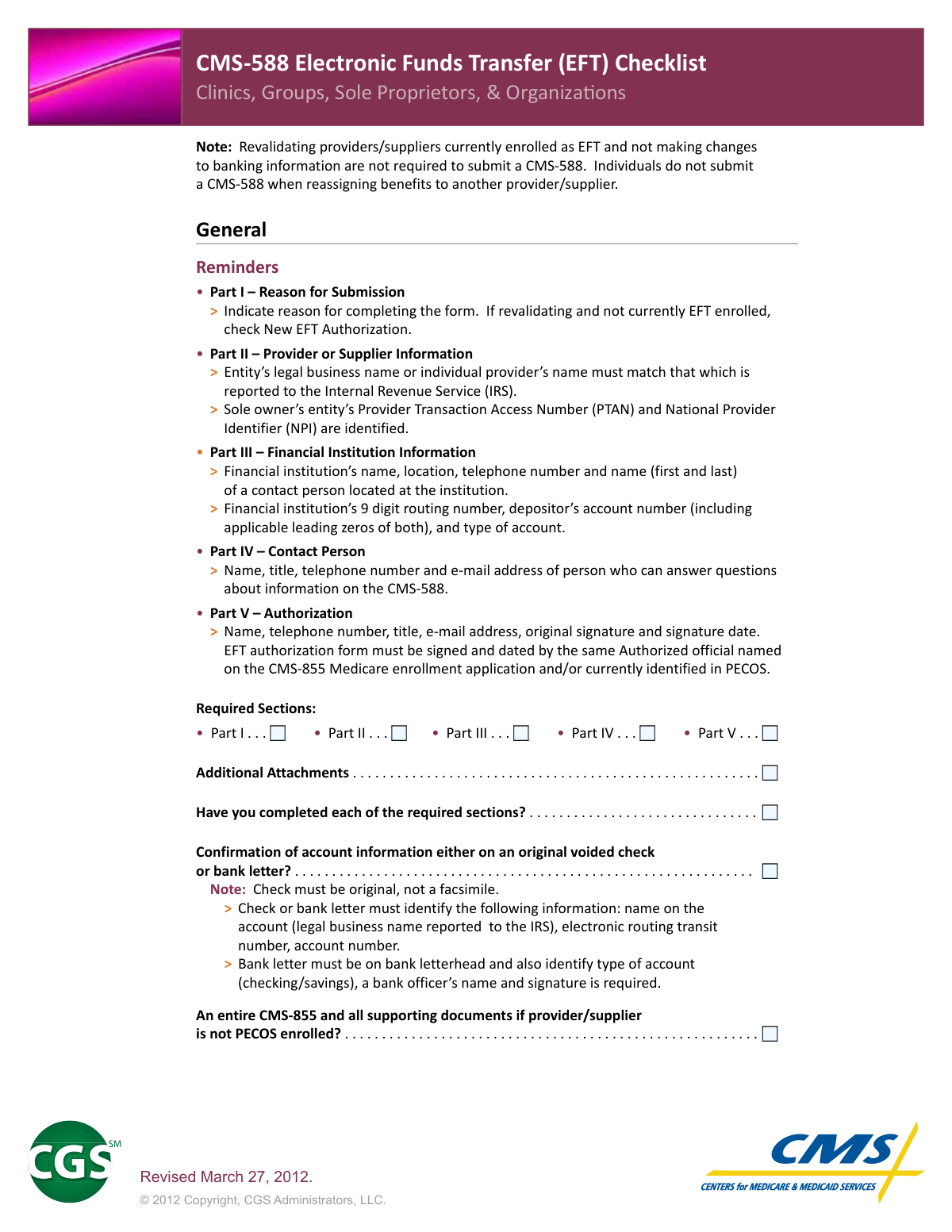
To avoid common filing errors that can lead to payment interruptions, consult the CMS-588 Electronic Funds Transfer (EFT) Authorization Agreement Checklist. This is not the authorization form itself, but a vital administrative tool. It helps you verify that you have included necessary supporting documents—such as an original voided check or a formal bank letter—and ensures that the person signing the form matches the authorized official listed on your CMS-855 enrollment application or within the PECOS system.
Accountable Care Organizations (ACOs)
Organizations participating in Medicare shared savings programs have specific reporting requirements. If you are representing an ACO, you must use the Form CMS-588, Electronic Funds Transfer (EFT) Authorization Agreement for Accountable Care Organizations. This version is specifically tailored to collect legal entity information and taxpayer identification numbers unique to the ACO structure, ensuring shared savings payments are distributed to the correct financial institution.
By selecting the form that matches your organizational structure and using the checklist for accuracy, you can streamline your healthcare payment setup and ensure consistent cash flow.
Form Comparison
| Form | Purpose | Targeted Users | Key Requirements |
|---|---|---|---|
| CMS-588 Electronic Funds Transfer (EFT) Authorization Agreement Checklist | Ensures all documentation is complete before submitting the EFT authorization form. | Medicare providers and suppliers preparing their initial or updated EFT enrollment. | Signed authorization, voided check or bank letter, and accurate provider information. |
| Form CMS-588, Electronic Funds Transfer (EFT) Authorization Agreement | Authorizes direct deposit of Medicare reimbursements into a provider's bank account. | Individual practitioners, medical clinics, and healthcare organizations enrolling with Medicare. | Bank account details, taxpayer identification number, and signature from authorized official. |
| Form CMS-588, Electronic Funds Transfer (EFT) Authorization Agreement for Accountable Care Organizations | Facilitates electronic payment of shared savings to Accountable Care Organizations. | Legal entities recognized as Accountable Care Organizations in Medicare programs. | ACO legal name, tax identification, and financial institution routing information. |
Tips for healthcare payment forms
Ensure the routing and account numbers on your form match your financial institution's records exactly. Even a single digit error can lead to significant delays in receiving Medicare reimbursements or cause payments to be rejected by the bank.
Always attach an original voided check or a formal bank letter on official letterhead to verify your account details. CMS will typically reject authorization agreements that lack these specific proofs of account ownership and validity.
The person signing the CMS-588 must be the authorized official already listed on your CMS-855 application or within the PECOS system. Discrepancies between the signer and the official record on file are a leading cause of form rejection.
AI-powered tools like Instafill.ai can complete these complex healthcare payment forms in under 30 seconds with high accuracy. The platform ensures your sensitive financial data stays secure while significantly reducing the manual effort required for multiple provider filings.
Ensure the Taxpayer Identification Number (TIN) provided matches the legal business name exactly as it is registered with the IRS. Inconsistencies between your tax records and your Medicare enrollment profile can trigger manual reviews and lengthy payment holds.
When filling out forms for Accountable Care Organizations (ACOs), clearly indicate if the payment is for shared savings or a Chain Home Office. Selecting the correct designation ensures that funds are routed to the proper legal entity without administrative confusion.
Frequently Asked Questions
Healthcare payment forms are used to establish or update electronic payment methods between medical providers and payers like Medicare. These forms ensure that reimbursements for services are deposited directly and securely into a provider's designated bank account via Electronic Funds Transfer (EFT).
Any healthcare provider, supplier, or organization enrolling in Medicare or changing their financial details must complete these forms. This includes individual practitioners, medical clinics, and specialized entities like Accountable Care Organizations (ACOs).
Most individual providers and medical groups should use the standard CMS-588 Electronic Funds Transfer Authorization Agreement. However, organizations participating specifically in Medicare shared savings programs should use the version tailored for Accountable Care Organizations (ACOs).
Most healthcare payment forms require either an original voided check or an official bank letter on the institution's letterhead. This documentation is necessary to verify the routing and account numbers to prevent errors in electronic deposits.
Yes, you can use AI tools to complete these forms more efficiently. AI services like Instafill.ai can accurately extract data from your source documents and place it into the correct fields on CMS forms in under 30 seconds.
Yes, CMS generally requires all providers and suppliers to receive payments via Electronic Funds Transfer (EFT) as part of the enrollment process. This requirement is intended to streamline the reimbursement process and reduce the administrative costs associated with paper checks.
If you change your financial institution or account number, you must submit a new CMS-588 form to update your records. Failing to update this information promptly can lead to delayed or missed Medicare reimbursements.
Once completed and signed by an authorized official, these forms are typically mailed to your specific Medicare Administrative Contractor (MAC). The MAC is responsible for processing the enrollment information and coordinating with CMS to update your payment profile.
While manual entry can be tedious, using AI-powered tools can significantly speed up the process. Platforms like Instafill.ai can complete the form extraction and placement process in less than 30 seconds, ensuring high accuracy for critical financial data.
The checklist helps ensure that providers include all necessary information and attachments before submission. Using the checklist reduces the likelihood of the form being rejected by the Medicare Administrative Contractor due to missing signatures or incorrect bank documentation.
Glossary
- Form Complexity Index
- Instafill’s 0–100 measure of how much effort a form takes to complete, calculated deterministically from the form’s own structure rather than estimated. It combines the number of fillable fields (the largest factor), how difficult those fields are to complete based on their type, the number of pages that contain fields, the amount of conditional “fill-only-if” logic, and how many sections the form is divided into, then adds modifiers for tables and repeating lists, bundled instruction pages, and dense page layouts. A higher score means the form is harder to fill out by hand. The forms in this category have a median Form Complexity Index of 39/100 (Basic). See exactly how it is calculated.
- CMS (Centers for Medicare & Medicaid Services)
- The federal agency within the U.S. Department of Health and Human Services that administers the Medicare program and works in partnership with state governments to administer Medicaid.
- EFT (Electronic Funds Transfer)
- The digital transfer of money from one bank account to another, used by Medicare to deposit reimbursements directly into a healthcare provider's account instead of mailing a paper check.
- PECOS (Provider Enrollment, Chain, and Ownership System)
- The official online Medicare enrollment system where providers must be registered before they can submit EFT authorization forms or other enrollment changes.
- ACO (Accountable Care Organization)
- A group of doctors, hospitals, and other health care providers who coordinate care for Medicare patients and may receive shared savings payments through specific CMS programs.
- Authorized Official
- An individual, such as a CEO or CFO, who has the legal authority to sign documents and legally bind a healthcare organization to the terms of the Medicare program.
- NPI (National Provider Identifier)
- A unique 10-digit identification number issued to healthcare providers in the United States, which must be included on all payment and enrollment forms.
- TIN (Taxpayer Identification Number)
- A unique number, such as an Employer Identification Number (EIN), used by the IRS and CMS to identify a business entity for tax and payment purposes.
- Chain Home Office
- A centralized administrative office that manages multiple healthcare facilities and is often authorized to receive consolidated Medicare payments on their behalf.