Fill out incident report forms
with AI.
Incident report forms are essential documentation tools used across healthcare, social services, and behavioral health sectors to record unexpected events. These documents serve as a formal record of any occurrence that could potentially cause harm to clients, staff, or visitors. Whether it’s a Colorado OBH Critical Incident Report or a general healthcare CIR, these behavioral health forms are vital for maintaining regulatory compliance, ensuring transparency, and facilitating thorough investigations. By documenting these events accurately, organizations can identify safety gaps and implement corrective actions to improve the quality of care.
By continuing, you acknowledge Instafill's Privacy Policy and agree to get occasional product update and promotional emails.
About incident report forms
Typically, administrators, clinicians, and support staff in behavioral health agencies or medical facilities are responsible for completing these reports immediately following an event. Timeliness is often a legal or licensing requirement, making the accuracy of the data critical. In high-pressure environments, the administrative burden of manual entry can be significant. Tools like Instafill.ai use AI to fill these forms in under 30 seconds, ensuring that sensitive data is handled accurately and securely while allowing staff to return their focus to client care.
Every form on this page can be completed without typing. Instafill is form filling software that reads a PDF and fills it for you — including flat and scanned documents that carry no fillable fields at all.
Forms in This Category
The forms in this category have a median Form Complexity Index of 47/100 (Moderate), measured across 3 forms by field count, input difficulty, length, conditional logic and structure. See how it is calculated.
| Form Name | Pages | FCI | |
|---|---|---|---|
| 1. | Colorado OBH Critical Incident Report | 1 | Basic 33 |
| 2. | Critical Incident Report | 2 | Moderate 47 |
| 3. | Out-of-Home Care Provider Incident Report | 4 | Complex 78 |
- Enterprise-grade security & data encryption
- 99%+ accuracy powered by AI
- 1,000+ forms from all industries
- Complete forms in under 60 seconds
How to Choose the Right Form
Selecting the correct incident report form is essential for maintaining compliance with regulatory standards and ensuring high levels of patient safety. Within this category, your choice depends primarily on your geographic location and the specific oversight body governing your facility.
For Colorado-Based Behavioral Health Agencies
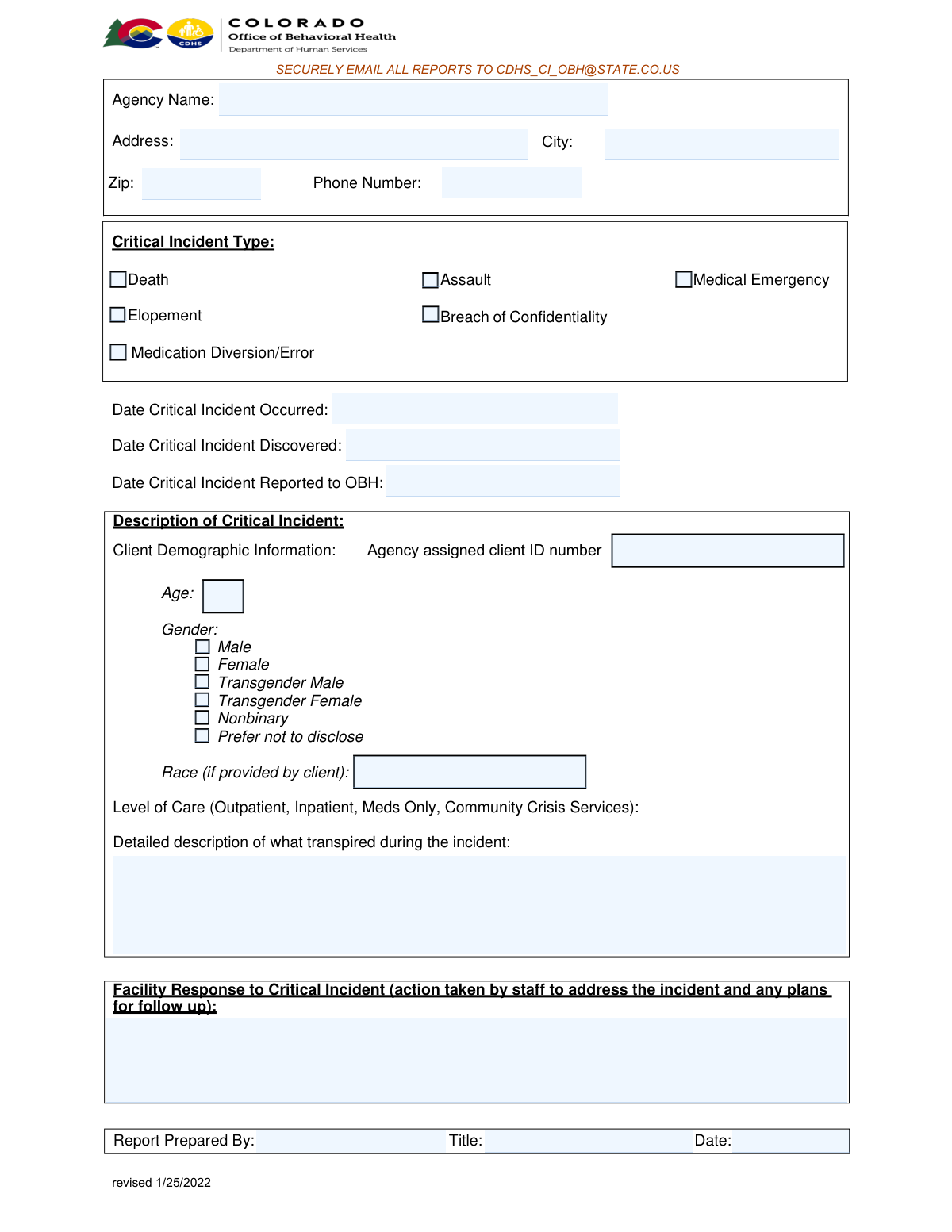
If you are a provider or agency operating within the state of Colorado, you should utilize the Colorado OBH Critical Incident Report. This form is specifically mandated by the Office of Behavioral Health (OBH) for reporting significant events involving clients. It is designed to meet state-specific oversight requirements by detailing the incident, the facility’s immediate response, and client-specific data. Using this form ensures you are in compliance with Colorado’s mandatory reporting laws for behavioral health services.
For General Healthcare and Social Service Providers
For organizations outside of Colorado or those operating in broader healthcare sectors—such as assisted living, community social services, or general medical clinics—the standard Critical Incident Report is the appropriate choice. This form is a versatile tool used to:
- Document Unexpected Events: Record any incident that causes or has the potential to cause harm to staff, visitors, or patients.
- Facilitate Investigations: Provide a clear paper trail for internal root-cause analysis and corrective action planning.
- Maintain Transparency: Meet general accreditation and safety standards required by insurance providers and healthcare boards.
Quick Selection Tips
- Check Your License: If your license is issued by the Colorado OBH, the Colorado OBH Critical Incident Report is non-negotiable.
- Define the Scope: For internal safety tracking or general facility management where a state-specific form isn't provided, use the general Critical Incident Report.
- Prioritize Speed: In critical situations, reporting speed is vital. Both forms can be processed through Instafill.ai to ensure that mandatory details are captured accurately and submitted within required timeframes.
Form Comparison
| Form | Scope & Jurisdiction | Primary Purpose | Affected Parties |
|---|---|---|---|
| Colorado OBH Critical Incident Report | Specific to behavioral health agencies operating within the state of Colorado. | Mandatory reporting to the Office of Behavioral Health for state oversight. | Clients receiving behavioral health services from licensed Colorado facilities. |
| Critical Incident Report | General usage across healthcare, social services, and various workplace environments. | Documenting unexpected events to improve safety and meet broad regulatory requirements. | Staff, visitors, or members involved in an incident or potential harm. |
Tips for incident report forms
When documenting behavioral health incidents, stick strictly to what was seen and heard rather than making subjective assumptions about a client's intent. Using neutral, descriptive language ensures the report remains professional and holds up during regulatory reviews or internal investigations.
Critical incidents often have narrow reporting windows required by state agencies or oversight boards. Completing these forms as soon as the environment is stabilized ensures that details are fresh in your mind and that you meet mandatory filing deadlines.
Incident reports often contain sensitive health information that must be handled with care to remain compliant with privacy standards. Always use secure platforms for digital filing and ensure that only necessary identifiers are included as per the form's specific instructions.
It is essential to document not just the incident itself, but also the interventions and safety measures taken immediately afterward. Clearly outlining the corrective actions taken demonstrates a proactive approach to client safety and helps satisfy oversight requirements.
AI-powered tools like Instafill.ai can complete these complex incident reports in under 30 seconds with high accuracy. Your data stays secure during the process, providing a practical and efficient way to handle paperwork during high-stress situations where time is critical.
If multiple staff members witnessed an incident, verify that the basic facts like time, location, and involved parties are consistent across all reports. Discrepancies in these foundational details can lead to unnecessary delays or further questioning during the audit process.
Frequently Asked Questions
Incident report forms are used to document unexpected events, accidents, or near-misses that occur within a facility or during service delivery. They provide a factual record for internal review, risk management, and regulatory compliance to help prevent future occurrences and ensure safety.
Generally, the staff member who witnessed the incident or was first on the scene is responsible for initiating the report. In behavioral health settings, this report is often reviewed by a supervisor or clinical director before it is submitted to the relevant state or local oversight agency.
Most organizations and regulatory bodies require incident reports to be completed as soon as possible, often within 24 hours of the event. Prompt filing ensures that the details recorded are accurate and allows for immediate corrective actions to be taken if necessary.
Critical incidents typically include events such as medical emergencies, medication errors, physical injuries, unauthorized absences, or any situation that compromises the safety of clients or staff. Specific agencies, like the Colorado Office of Behavioral Health, have detailed lists of reportable events that must be documented.
Yes, you can fill out these forms using AI-powered tools like Instafill.ai. These tools can accurately extract data from your source notes or clinical records and place it directly into the PDF fields, ensuring the report is consistent and professional.
Using AI technology, most incident report forms can be completed in under 30 seconds. This significantly reduces the administrative burden on staff, allowing them to focus more on client care rather than manual paperwork.
Completed Colorado OBH forms must be submitted to the state's Office of Behavioral Health according to their specific reporting protocols. Agencies usually have a designated portal or secure email address for these mandatory regulatory submissions.
These forms generally require the date, time, and location of the incident, a detailed description of what happened, the names of involved individuals, and the immediate actions taken by staff. They also often include a section for follow-up plans and signatures from reporting parties.
Yes, incident reports can serve as vital documentation in legal proceedings, insurance claims, or state audits. Because they are formal records of an event, it is crucial that the information provided is objective, factual, and free of personal opinions or hearsay.
Automated tools like Instafill.ai help maintain compliance by ensuring that no mandatory fields are missed and that data is transcribed accurately from original records. This reduces the risk of errors that could lead to regulatory citations or delays in incident investigations.
Glossary
- Form Complexity Index
- Instafill’s 0–100 measure of how much effort a form takes to complete, calculated deterministically from the form’s own structure rather than estimated. It combines the number of fillable fields (the largest factor), how difficult those fields are to complete based on their type, the number of pages that contain fields, the amount of conditional “fill-only-if” logic, and how many sections the form is divided into, then adds modifiers for tables and repeating lists, bundled instruction pages, and dense page layouts. A higher score means the form is harder to fill out by hand. The forms in this category have a median Form Complexity Index of 47/100 (Moderate). See exactly how it is calculated.
- Critical Incident
- An unexpected event involving a client or staff member that results in, or has the potential to cause, serious physical or psychological harm.
- CIR (Critical Incident Report)
- A formal document used to record details of a significant event for regulatory compliance, transparency, and internal investigation.
- OBH (Office of Behavioral Health)
- The state agency responsible for the oversight and regulation of mental health and substance use services, specifically in Colorado.
- Corrective Action Plan
- A written strategy outlining the specific steps an agency will take to address safety gaps and prevent a similar incident from happening again.
- Mandatory Reporting
- The legal obligation for healthcare professionals and agencies to report certain types of incidents, such as abuse or serious injury, to state authorities.
- Sentinel Event
- A critical incident that results in death, permanent harm, or severe temporary harm, often requiring immediate notification and specialized review.
- Root Cause Analysis (RCA)
- A systematic process used to identify the underlying factors that contributed to an incident rather than focusing only on the immediate cause.
- Behavioral Health
- A field of healthcare that focuses on the connection between behaviors and the health of the mind and body, including mental health and substance use disorders.