Fill out John Hancock forms
with AI.
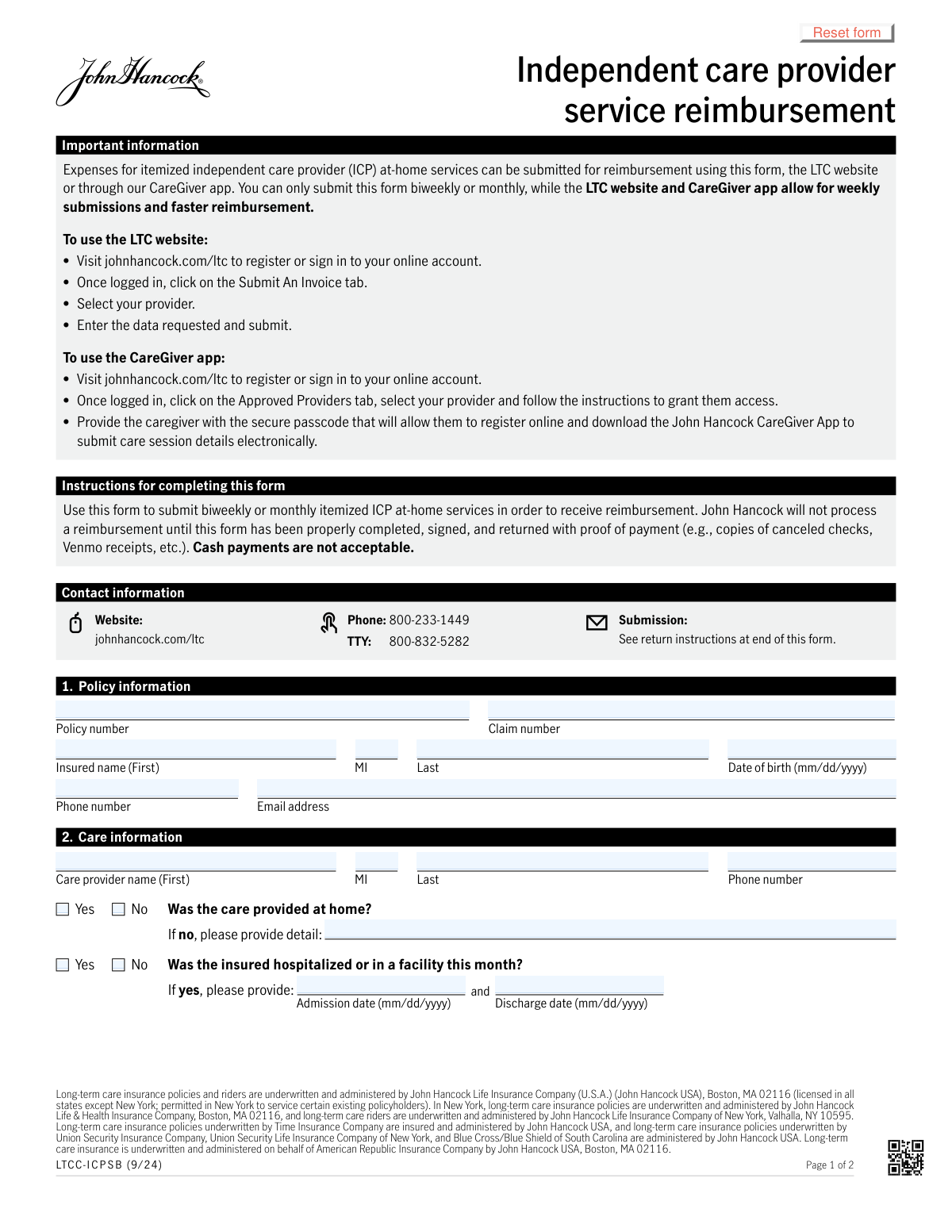
John Hancock is a major provider of life insurance and long-term care solutions, and their documentation is essential for policyholders looking to access and manage their benefits. These forms primarily focus on long-term care insurance, facilitating the reimbursement process for professional healthcare services. Navigating these documents correctly is vital for ensuring that financial claims are processed without unnecessary delays, especially when policyholders are managing complex health needs.
By continuing, you acknowledge Instafill's Privacy Policy and agree to get occasional product update and promotional emails.
About John Hancock forms
Typically, these forms are used by policyholders, family members, or designated caregivers who are coordinating the logistics of professional care. Whether you are submitting a claim for an independent care provider or requesting reimbursement for specific home-based services, accuracy is paramount. These documents often require detailed itemized lists of services, provider credentials, and specific dates of care, which can be a significant administrative burden during stressful health-related situations.
To simplify this process, tools like Instafill.ai use AI to fill these forms in under 30 seconds while ensuring all data is handled accurately and securely. By automating the data entry for your reimbursement requests, you can reduce the risk of manual errors and focus more on caregiving rather than paperwork.
Every form on this page can be completed without typing. Instafill is form filling software that reads a PDF and fills it for you — including flat and scanned documents that carry no fillable fields at all.
Forms in This Category
The forms in this category have a median Form Complexity Index of 70/100 (Complex), measured across 2 forms by field count, input difficulty, length, conditional logic and structure. See how it is calculated.
| Form Name | Pages | FCI | |
|---|---|---|---|
| 1. | John Hancock Independent Care Provider Service Reimbursement | 2 | Complex 70 |
| 2. | John Hancock Independent Care Provider Service Reimbursement | 2 | Complex 66 |
- Enterprise-grade security & data encryption
- 99%+ accuracy powered by AI
- 1,000+ forms from all industries
- Complete forms in under 60 seconds
How to Choose the Right Form
Navigating long-term care insurance claims can be complex, but choosing the right documentation is the first step toward a successful reimbursement. The John Hancock forms in this category are specifically designed for policyholders who receive care from individuals rather than large healthcare agencies.
When to Use the Independent Care Provider Form
You should select the John Hancock Independent Care Provider Service Reimbursement form if you are managing your own care team. This document is the standard requirement for:
- Independent Caregivers: Use this when your provider is a private individual and not an employee of a home health agency.
- Out-of-Pocket Reimbursement: This form is necessary to recoup costs for services already paid for under your long-term care policy.
- Detailed Service Tracking: If you need to submit a line-item breakdown of daily activities such as bathing, dressing, or meal preparation, the John Hancock Independent Care Provider Service Reimbursement form provides the necessary structure.
Key Requirements for a Successful Claim
To avoid delays in processing your health insurance forms, ensure you have the following information ready before you begin filling out the John Hancock Independent Care Provider Service Reimbursement form:
- Policyholder Information: Your full legal name and specific John Hancock policy number.
- Provider Credentials: The caregiver’s contact details and their Social Security or Tax ID number.
- Itemized Service Logs: A clear record of dates, specific hours worked, and the total charges for each session.
Streamlining the Process
Accuracy is critical when submitting long-term care forms to John Hancock. Using Instafill.ai, you can quickly convert the John Hancock Independent Care Provider Service Reimbursement PDF into a fillable format. This ensures your service dates and provider details are legible and professional, significantly reducing the likelihood of your claim being returned for clarification or manual errors.
Tips for John Hancock forms
AI-powered tools like Instafill.ai can complete these John Hancock forms in under 30 seconds with high accuracy. This is a significant time-saver for caregivers and policyholders managing recurring claims, and your personal data stays secure throughout the automated process.
To avoid claim denials, ensure every service date and time matches your provider's records exactly. John Hancock requires precise itemization, so keeping a daily log makes filling out the reimbursement form much simpler and more accurate.
Ensure your independent caregiver's contact information and tax identification numbers are current and legible. Incorrect or outdated provider details are a leading cause of processing delays for long-term care insurance claims.
Always verify that your John Hancock policy number is correctly entered on every page of the submission. Even a single transposed digit can lead to the form being rejected or associated with the wrong account, stalling your payment.
Ensure the independent provider signs the form in the designated area to certify the services rendered. Unsigned or illegible signatures often result in the form being returned, which can delay your reimbursement by several weeks.
Before sending your forms to John Hancock, save a digital or physical copy for your own records. Having a backup allows you to quickly reference specific service dates if the insurance company has follow-up questions regarding your reimbursement.
Frequently Asked Questions
These forms are used by policyholders to request payment for care services covered under their long-term care insurance policy. Specifically, they allow individuals to seek reimbursement for expenses incurred when hiring independent care providers for at-home assistance.
An independent care provider is typically an individual who is not employed by a home health agency but provides authorized care services directly to the policyholder. This can include personal care assistants or private nurses, depending on the specific terms of your John Hancock policy.
You will generally need your policy number, the provider's social security or tax identification number, and a detailed log of the services provided. This includes specific dates, hours worked, and the total charges for each session of care.
Yes, AI tools like Instafill.ai can be used to fill out these forms in under 30 seconds. The AI accurately extracts data from your source documents, such as provider invoices or timesheets, and places it directly into the correct fields on the PDF.
Manually filling out detailed reimbursement logs can take 15 to 30 minutes, but using an AI-powered service reduces this to less than a minute. These services can also convert flat, non-fillable PDFs into interactive forms to make the process smoother.
Yes, John Hancock typically requires itemized invoices or timesheets signed by both the policyholder and the care provider to verify the services rendered. These supporting documents should clearly match the dates and amounts listed on the reimbursement form.
Completed forms and supporting documentation are usually submitted to the John Hancock Long-Term Care claims department via mail, fax, or their online portal. It is important to check the specific submission instructions provided on the form or in your policy documents to ensure timely processing.
While both fall under insurance, long-term care forms specifically deal with chronic care and daily living assistance, whereas health insurance forms usually cover medical treatments and hospital stays. The forms in this category are primarily focused on the reimbursement of long-term care expenses.
Errors or missing information can lead to delays in claim processing or a denial of reimbursement. Using automated tools can help minimize manual entry errors by ensuring that data from your invoices is accurately transcribed onto the form.
Generally, reimbursement forms are filed for specific periods, such as a single calendar month or a specific set of weeks. It is best to follow the frequency recommended by John Hancock in your policy guide to ensure a consistent flow of reimbursement payments.
Glossary
- Form Complexity Index
- Instafill’s 0–100 measure of how much effort a form takes to complete, calculated deterministically from the form’s own structure rather than estimated. It combines the number of fillable fields (the largest factor), how difficult those fields are to complete based on their type, the number of pages that contain fields, the amount of conditional “fill-only-if” logic, and how many sections the form is divided into, then adds modifiers for tables and repeating lists, bundled instruction pages, and dense page layouts. A higher score means the form is harder to fill out by hand. The forms in this category have a median Form Complexity Index of 70/100 (Complex). See exactly how it is calculated.
- Long-Term Care (LTC) Insurance
- A type of insurance policy designed to cover the costs of services that assist individuals with chronic illnesses or disabilities over an extended period.
- Independent Care Provider (ICP)
- An individual caregiver who is not employed by a home health agency but is hired directly by the policyholder to provide personal care services.
- Activities of Daily Living (ADLs)
- Basic self-care tasks such as bathing, dressing, eating, and transferring that are used as benchmarks to determine a policyholder's eligibility for benefits.
- Elimination Period
- A specified number of days at the start of a claim during which the policyholder pays for care out-of-pocket before insurance reimbursements begin.
- Plan of Care
- A formal document developed by a medical professional that outlines the specific services and frequency of care required to treat a patient's condition.
- Itemized Statement
- A detailed record of services provided that includes specific dates, hours worked, and the hourly or daily rate charged by the caregiver.
- Reimbursement Model
- A payment system where the policyholder pays the care provider first and then submits a claim to the insurance company to be paid back for covered expenses.
- Policyholder
- The individual who owns the insurance contract and is typically the person entitled to receive benefit payments for covered services.