Fill out out-of-network forms
with AI.
Out-of-network forms are critical administrative documents used when a patient receives care from a provider or facility that does not have a contract with their health insurance plan. These forms ensure that both patients and insurers are aware of the financial implications and medical necessity of seeking care outside the established network. They are essential for maintaining transparency regarding out-of-pocket costs and for securing payment for services that might otherwise be denied or significantly more expensive for the member.
By continuing, you acknowledge Instafill's Privacy Policy and agree to get occasional product update and promotional emails.
About out-of-network forms
Healthcare providers, clinic administrators, and patients typically encounter these documents during referrals or when specialized care is unavailable within a network. For instance, a physician might use a Referral Disclosure Form to inform a patient about potential costs, or a provider might submit a Pre-Authorization and Exception Request Form to justify why a specific out-of-network specialist is required for a patient’s unique medical condition. Proper documentation is vital for cases involving a Transition of Care or a Single Case Agreement, where continuity of treatment is the primary goal.
Completing these forms accurately is time-sensitive, as clerical errors can lead to claim denials or delayed treatment authorizations. Tools like Instafill.ai use AI to fill these forms in under 30 seconds, ensuring data is handled accurately and securely. This automation serves as a practical time-saver, allowing medical staff to focus more on patient care rather than navigating repetitive insurance paperwork.
Every form on this page can be completed without typing. Instafill is form filling software that reads a PDF and fills it for you — including flat and scanned documents that carry no fillable fields at all.
Forms in This Category
The forms in this category have a median Form Complexity Index of 65/100 (Complex), measured across 2 forms by field count, input difficulty, length, conditional logic and structure. See how it is calculated.
| Form Name | Pages | FCI | |
|---|---|---|---|
| 1. | Cigna Out-of-Network Referral Disclosure Form | 2 | Basic 34 |
| 2. | Out-of-Network Pre-Authorization and Exception Request Form | 2 | Complex 65 |
- Enterprise-grade security & data encryption
- 99%+ accuracy powered by AI
- 1,000+ forms from all industries
- Complete forms in under 60 seconds
How to Choose the Right Form
Navigating medical care outside of your insurance network requires specific documentation to ensure both financial transparency and coverage approval. Choosing the right form depends on whether you are disclosing costs to a patient or requesting a coverage exception from the insurer.
For Physicians Referring Cigna Patients
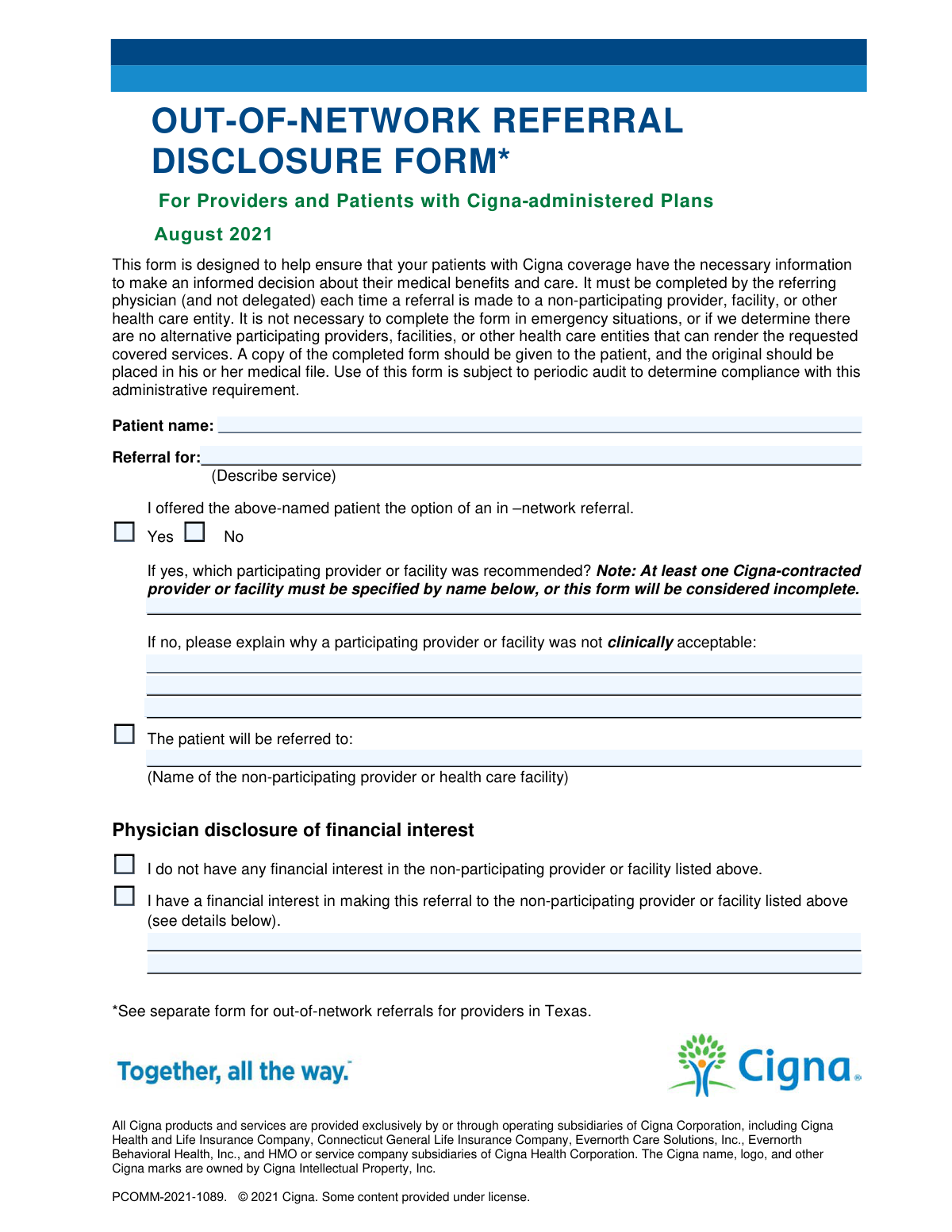
If you are a medical provider referring a patient with a Cigna-administered health plan to a non-participating specialist or facility, you must use the Cigna Out-of-Network Referral Disclosure Form. This is a regulatory and transparency document used to:
- Inform the patient that they may face higher out-of-pocket costs.
- Document that the patient was offered an in-network alternative before proceeding.
- Disclose any financial interest the referring physician has in the out-of-network facility.
Requesting Coverage Approvals and Exceptions
When a patient needs the insurance company to pay for services provided by a non-participating provider, the Out-of-Network Pre-Authorization and Exception Request Form is the standard requirement. This form is used by providers to request utilization management review for scenarios such as:
- Transition of Care: Continuing a course of treatment with a provider who is no longer in-network.
- Benefit Level Exceptions: Requesting that an out-of-network service be covered at the in-network benefit level because no qualified in-network provider is available.
- Single Case Agreements: Negotiating a one-time coverage arrangement for specialized procedures.
Ensuring a Successful Submission
To avoid delays in care or reimbursement, ensure that your Out-of-Network Pre-Authorization and Exception Request Form includes specific clinical details. You will need accurate ICD diagnosis codes, CPT/HCPCS procedure codes, and the Tax ID/NPI of the servicing facility. If the request is time-sensitive, be sure to complete the provider attestation section to qualify for an urgent determination.
Form Comparison
| Form | Primary Purpose | Key Information Required | Who Submits |
|---|---|---|---|
| Cigna Out-of-Network Referral Disclosure Form | Discloses potential higher costs and physician financial interests to patients. | Patient signature and documentation of offered in-network alternatives. | Referring physician for Cigna health plan members. |
| Out-of-Network Pre-Authorization and Exception Request Form | Requests clinical authorization or exceptions for services from non-participating providers. | Clinical justification, CPT/HCPCS codes, and provider Tax ID/NPI. | Requesting or servicing healthcare providers and facilities. |
| Out-of-Network Pre-Authorization and Exception Request Form | Requests benefit level exceptions or continuity of care for members. | Diagnosis codes, procedure units, and urgent request provider attestations. | Healthcare providers seeking coverage for out-of-network services. |
Tips for out-of-network forms
Always double-check the National Provider Identifier (NPI) and Tax ID for both the requesting and servicing providers. Incorrect identifiers are a leading cause of claim denials and processing delays for out-of-network requests.
When requesting an exception or pre-authorization, include specific procedure (CPT) and diagnosis (ICD) codes. Attach supporting clinical records or a written justification to explain why an in-network provider cannot meet the patient's specific medical needs.
AI-powered tools like Instafill.ai can complete these complex out-of-network forms in under 30 seconds with high accuracy. Your data stays secure during the process, providing a practical way to manage multiple forms without manual data entry errors.
For referral disclosure forms, ensure the patient clearly understands the potential for higher out-of-pocket costs before they sign. Documenting that in-network alternatives were offered protects both the provider and the patient from future billing disputes.
Clearly identify whether your request is for a Transition of Care, a Single Case Agreement, or a Benefit Level Exception. Selecting the correct category ensures the health plan routes your request to the appropriate department for faster review.
Only mark a request as 'Urgent' if it meets the specific clinical criteria where a delay could seriously jeopardize the patient's health. Ensure a provider attestation is included to avoid the request being downgraded to standard processing time.
Frequently Asked Questions
These forms are essential documents used when a patient seeks medical services from a provider or facility that does not have a contract with their insurance plan. They ensure the insurance company is notified of the care, authorizations are obtained, and patients are informed of potential higher costs before services are rendered.
While the patient is ultimately responsible for ensuring their insurance company receives the necessary paperwork, these forms are usually completed by the referring physician or the out-of-network provider. They require specific clinical data, such as CPT codes and NPI numbers, that only a medical professional can accurately provide.
This form should be submitted well in advance of scheduled services if you need to see a specialist who is not in your network. It is used to request that the insurance company cover the services at an in-network rate due to specific reasons like continuity of care or a lack of qualified in-network providers in your area.
This form serves as a consumer protection document required when a Cigna-participating doctor refers a patient to an out-of-network provider. It confirms the patient has been notified of potential higher out-of-pocket costs and documents that they were offered an in-network alternative before choosing the non-participating provider.
Yes, AI tools like Instafill.ai can fill out these forms in under 30 seconds by accurately extracting and placing data from source documents like medical records or provider IDs. This technology can also turn static PDF documents into interactive, fillable versions to simplify the submission process for medical offices.
Using traditional methods, manually entering complex medical codes and provider details can take 15 to 20 minutes. With AI-powered services like Instafill.ai, the process is streamlined to under 30 seconds, ensuring high accuracy by pulling data directly from your uploaded files into the correct fields.
You will generally need the patient's insurance ID, the requesting and servicing providers' Tax IDs and NPI numbers, and specific clinical details. This includes ICD diagnosis codes and CPT or HCPCS procedure codes that describe the intended treatment or consultation.
A Single Case Agreement (SCA) is a contract between an insurance company and an out-of-network provider for a specific patient's care. It is often requested via an Exception Request Form when a patient has a unique medical need that cannot be met by any current in-network providers.
Incomplete forms can lead to significant delays in care or the outright denial of coverage for the services rendered. Insurance carriers require specific clinical justifications and provider identifiers to process authorizations, so accuracy is critical to avoid unexpected medical bills.
Completed forms are typically faxed or uploaded to the insurance carrier's provider portal or utilization management department. You should check the specific instructions on the form itself or contact the member services number on the back of the insurance card for the correct submission address.
Yes, many exception request forms include a section for 'Urgent' or 'Expedited' review. In these cases, a provider must attest that a standard review timeframe could seriously jeopardize the patient’s life, health, or ability to regain maximum function, prompting a faster decision from the insurer.
Glossary
- Form Complexity Index
- Instafill’s 0–100 measure of how much effort a form takes to complete, calculated deterministically from the form’s own structure rather than estimated. It combines the number of fillable fields (the largest factor), how difficult those fields are to complete based on their type, the number of pages that contain fields, the amount of conditional “fill-only-if” logic, and how many sections the form is divided into, then adds modifiers for tables and repeating lists, bundled instruction pages, and dense page layouts. A higher score means the form is harder to fill out by hand. The forms in this category have a median Form Complexity Index of 65/100 (Complex). See exactly how it is calculated.
- Pre-Authorization
- A requirement by a health insurance plan for a patient or provider to obtain approval before receiving specific medical services to ensure they are medically necessary.
- Out-of-Network (OON)
- Healthcare providers or facilities that do not have a contract with your insurance company, typically resulting in higher costs for the patient.
- CPT Code (Current Procedural Terminology)
- A standardized five-digit numeric code used to describe specific medical, surgical, and diagnostic services provided to a patient.
- ICD Diagnosis Code
- A system of alphanumeric codes used by healthcare providers to classify and report every diagnosis, symptom, and cause of death.
- NPI (National Provider Identifier)
- A unique 10-digit identification number assigned to healthcare providers in the United States to standardize administrative and financial transactions.
- Single Case Agreement (SCA)
- A specialized contract between an insurance company and an out-of-network provider that allows a patient to receive care at in-network cost-sharing rates for a specific instance.
- Transition of Care
- A temporary benefit that allows a new enrollee to continue treatment with an out-of-network provider at in-network coverage levels for a set period of time.
- Benefit Level Exception
- A request for the insurance company to process a claim at the in-network benefit level because an appropriate in-network provider was not available.