Fill out patient health forms
with AI.
Patient health forms are the backbone of medical administration and patient care coordination, serving as essential legal and clinical bridges between patients, healthcare providers, and insurance companies. These documents ensure that sensitive health information is shared only with authorized parties and that specific medical treatments receive the necessary insurance approvals. Whether it is protecting privacy through disclosure authorizations or justifying the medical necessity of specialized therapies, these forms are critical for maintaining the continuity of care and ensuring regulatory compliance under privacy laws like HIPAA.
By continuing, you acknowledge Instafill's Privacy Policy and agree to get occasional product update and promotional emails.
About patient health forms
Typically, these forms are required by patients seeking to transfer medical records, as well as healthcare providers and clinical staff managing complex treatment authorizations. For example, families may need to submit detailed ABA treatment requests for behavioral health services, while individuals often require authorization forms to release records for legal or insurance purposes. Navigating these documents is often a time-sensitive task, as delays in paperwork can lead to postponed treatments or administrative bottlenecks for both the patient and the clinic.
Completing these multi-section documents manually is often a repetitive and error-prone process that takes away from actual patient care. Tools like Instafill.ai use AI to fill these forms in under 30 seconds, handling sensitive health data accurately and securely to save time. This technology streamlines the administrative burden, allowing for a more efficient healthcare experience without the frustration of manual data entry.
Every form on this page can be completed without typing. Instafill is form filling software that reads a PDF and fills it for you — including flat and scanned documents that carry no fillable fields at all.
Forms in This Category
The forms in this category have a median Form Complexity Index of 58/100 (Moderate), measured across 4 forms by field count, input difficulty, length, conditional logic and structure. See how it is calculated.
- Enterprise-grade security & data encryption
- 99%+ accuracy powered by AI
- 1,000+ forms from all industries
- Complete forms in under 60 seconds
How to Choose the Right Form
Sharing or Releasing Medical Records
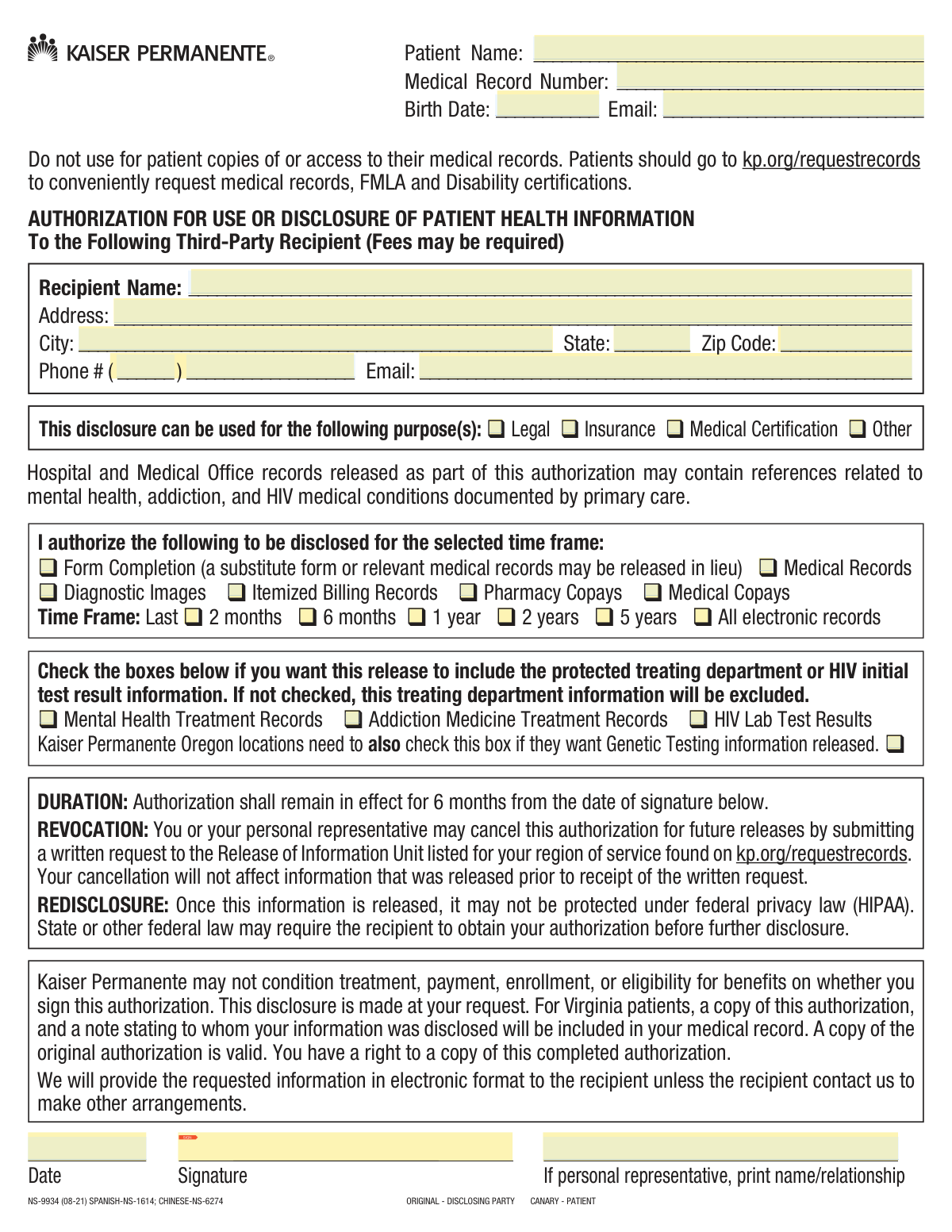
If you need to transfer your medical history to a new provider, a lawyer, or an insurance company, you require a formal disclosure authorization. The Kaiser Permanente Authorization for Use or Disclosure of Patient Health Information (Form NS-9934) is the specific document used by Kaiser members to legally grant permission for their records to be shared with third parties. This form is essential for maintaining HIPAA compliance during legal cases, insurance claims, or personal record-keeping.
Behavioral Health and ABA Therapy Precertification
For those seeking authorization for Applied Behavior Analysis (ABA) therapy, the forms on this page are designed to facilitate the medical necessity review process for Aetna and its associated health plans (including Innovation Health, Allina Health | Aetna, and Banner | Aetna). Selecting the right one depends on the specific requirements of the insurer and the level of clinical detail needed:
- Form BHVH, Outpatient Behavioral Health – ABA Treatment Request: This is a standard request form used to seek precertification for outpatient ABA services. It is designed to streamline the adjudication process by providing the insurer with basic necessary patient and provider information.
- Outpatient Behavioral Health (BH) – ABA Treatment Request: Required Information for Precertification (GR-69017-4): This is a more comprehensive, multi-section document. Notably, this form is set to replace prior ABA precertification documents effective January 1, 2026. It requires highly detailed clinical information, including supervising provider credentials, CPT codes, and specific treatment hours to support a medical necessity review.
Quick Selection Summary
- For Kaiser Permanente patients: Use the Authorization for Use or Disclosure of Patient Health Information to release records to third parties.
- For Aetna-affiliated providers: Use Form BHVH for standard ABA requests, or switch to the GR-69017-4 form to comply with the latest clinical documentation standards and upcoming 2026 requirements.
With Instafill.ai, you can quickly convert these complex PDFs into fillable forms, using AI to help complete clinical details accurately and efficiently.
Form Comparison
| Form | Primary Purpose | Provider / Network | Key Information Required |
|---|---|---|---|
| Kaiser Permanente Authorization for Use or Disclosure of Patient Health Information | Authorizes the sharing of medical records with third-party recipients like lawyers or insurers. | Kaiser Permanente | Patient identity, specific records to release, and recipient contact information. |
| Form BHVH, Outpatient Behavioral Health – ABA Treatment Request | Requests precertification for outpatient Applied Behavior Analysis (ABA) treatment services. | Aetna and associated health plans | Member demographics, provider credentials, and requested treatment hours. |
| Outpatient Behavioral Health (BH) – ABA Treatment Request: Required Information for Precertification (GR-69017-4) | Mandatory precertification for ABA therapy, replacing older documentation starting January 2026. | Aetna and affiliated health networks | Clinical diagnostic data, CPT codes, and detailed outpatient treatment plans. |
Tips for patient health forms
Ensure that the patient's full legal name, date of birth, and insurance member ID match your medical records exactly. Even minor discrepancies in these basic fields are the leading cause of processing delays or rejected health authorizations.
When completing disclosure forms like the Kaiser NS-9934, clearly specify the date range and types of records to be shared. This ensures compliance with HIPAA regulations and prevents the unnecessary release of sensitive information not relevant to the request.
Behavioral health forms require precise clinical data, including CPT codes and supervising provider credentials. Having these details organized beforehand prevents the need to pause and search through medical charts while filling out complex multi-page documents.
AI-powered tools like Instafill.ai can complete these health forms in under 30 seconds with high accuracy. Your data stays secure during the process, providing a massive time-saving benefit for providers or patients managing multiple sets of paperwork.
Always save a copy of your completed form before submitting it to a provider or insurance company. Having a digital record is essential for tracking the status of a claim and serves as vital evidence if you need to appeal a medical necessity decision.
Insurance carriers frequently update their precertification requirements, such as the transition to the Aetna GR-69017-4. Always ensure you are using the most recent version of a form to avoid administrative denials and ensure timely access to treatment.
Frequently Asked Questions
Patient health forms are documents used to manage medical records, authorize the sharing of private health information, or request specific treatments from insurance providers. They ensure that healthcare interactions are documented and that patient privacy is protected according to legal standards like HIPAA.
Generally, the patient or their legal guardian must sign an authorization form to permit a healthcare provider to release medical records to a third party. This is a common requirement for legal proceedings, insurance claims, or when transferring care to a new specialist or facility.
The correct form usually depends on your specific insurance provider and the date of service. For instance, some plans require specific precertification documents like the BHVH or the newer GR-69017-4 form to authorize Applied Behavior Analysis (ABA) therapy for members diagnosed with Autism Spectrum Disorder.
While patient demographic information is required, treatment request forms are typically completed by the attending provider or a clinical supervisor. They must provide detailed clinical data, diagnostic information, and specific CPT codes to justify the medical necessity of the treatment being requested.
Precertification is a process where an insurance company reviews a proposed treatment plan to determine if it is covered under the member's plan and meets medical necessity guidelines. Submitting the correct forms helps avoid unexpected out-of-pocket costs and ensures that the provider is authorized to begin the requested therapy.
Yes, AI-powered tools can significantly simplify the process of completing complex medical paperwork. Platforms like Instafill.ai use AI to accurately extract data from source documents and place it into the required fields of patient health forms without manual typing.
When using automated tools like Instafill.ai, most patient health forms can be completed in under 30 seconds. This technology eliminates the need for manual data entry, which reduces the risk of errors and speeds up the overall submission process for both patients and providers.
Once the form is signed and completed, it should be submitted directly to the medical records department of the healthcare organization that currently holds the records. Many organizations allow for digital submission through a patient portal, though some may require a secure fax or a physical copy.
Yes, forms like the Kaiser Permanente Authorization are specifically designed to comply with the Health Insurance Portability and Accountability Act (HIPAA). These documents ensure that sensitive health information is only shared with authorized parties for legitimate legal, medical, or insurance purposes.
These forms usually require the patient’s specific diagnosis, the requested number of treatment hours per week, and the credentials of the supervising provider. Clinical documentation supporting the progress or need for therapy is also a standard requirement for a successful medical necessity review.
No, most health forms are specific to a particular insurance carrier or healthcare system. It is important to use the exact form required by your specific provider, such as Aetna or Kaiser Permanente, to ensure your request or authorization is processed without being rejected for using the wrong document.
Incomplete forms often lead to significant processing delays or the automatic denial of treatment requests and record releases. Ensuring every required field is filled accurately—either manually or by using an AI tool to map data—is essential for a smooth administrative experience.
Glossary
- Form Complexity Index
- Instafill’s 0–100 measure of how much effort a form takes to complete, calculated deterministically from the form’s own structure rather than estimated. It combines the number of fillable fields (the largest factor), how difficult those fields are to complete based on their type, the number of pages that contain fields, the amount of conditional “fill-only-if” logic, and how many sections the form is divided into, then adds modifiers for tables and repeating lists, bundled instruction pages, and dense page layouts. A higher score means the form is harder to fill out by hand. The forms in this category have a median Form Complexity Index of 58/100 (Moderate). See exactly how it is calculated.
- HIPAA
- The Health Insurance Portability and Accountability Act, a federal law that establishes national standards to protect sensitive patient health information from being disclosed without consent.
- PHI (Protected Health Information)
- Any individually identifiable health information, including medical history, test results, and insurance details, that is protected by federal privacy regulations.
- Precertification
- The process of obtaining formal approval from a health insurance plan before a specific medical service or treatment is provided to ensure it will be covered.
- CPT Codes (Current Procedural Terminology)
- A standardized set of five-digit codes used by healthcare providers to report medical, surgical, and diagnostic procedures to insurance companies for billing.
- Medical Necessity
- A clinical justification required by insurers to prove that a specific treatment or service is essential and appropriate for the diagnosis or treatment of a patient's condition.
- ABA (Applied Behavior Analysis)
- A type of therapy focused on improving specific behaviors and communication skills, frequently utilized in the treatment of Autism Spectrum Disorder.
- Adjudication
- The process used by health insurance carriers to review and determine the outcome of a claim or treatment request based on the patient's policy benefits.
- Disclosure
- The act of releasing, transferring, or providing access to a patient's medical records to an outside individual or organization.