Fill out state attorney general forms
with AI.
State Attorney General forms are essential legal instruments that allow individuals and businesses to communicate directly with their state's highest law enforcement office. These documents serve as the primary gateway for reporting unlawful business practices, seeking consumer protection, or addressing public safety concerns. By providing a formal structure for grievances and inquiries, these forms ensure that the Attorney General's office receives the specific details necessary to investigate claims, mediate disputes, or initiate legal action on behalf of the public interest.
By continuing, you acknowledge Instafill's Privacy Policy and agree to get occasional product update and promotional emails.
About state attorney general forms
Most people encounter these forms when they have been victims of fraud, deceptive marketing, or unfair trade practices. Whether you are filing a consumer complaint against a local contractor or reporting a telemarketing violation, these documents are vital for triggering state oversight. They are also frequently used by organizations and legal professionals who need to comply with state regulations or report corporate misconduct. Because these forms often require detailed accounts of events and personal information, accuracy is paramount to ensure the state can process the request effectively.
Navigating the complexities of official state documentation doesn't have to be a manual burden. Tools like Instafill.ai use AI to fill these forms in under 30 seconds, handling your data accurately and securely to streamline the submission process. This allows you to focus on the details of your case while the technology handles the formatting and data entry required by the Office of the Attorney General.
Every form on this page can be completed without typing. Instafill is form filling software that reads a PDF and fills it for you — including flat and scanned documents that carry no fillable fields at all.
Forms in This Category
The forms in this category have a median Form Complexity Index of 50/100 (Moderate), measured across 1 forms by field count, input difficulty, length, conditional logic and structure. See how it is calculated.
| Form Name | Pages | FCI | |
|---|---|---|---|
| 1. | Consumer Complaint Form - Office of the Arizona Attorney General | 2 | Moderate 50 |
- Enterprise-grade security & data encryption
- 99%+ accuracy powered by AI
- 1,000+ forms from all industries
- Complete forms in under 60 seconds
How to Choose the Right Form
Selecting the correct legal document is essential when seeking assistance from a state's highest legal office. State Attorney General forms are typically designed to protect citizens from fraud, scams, and unfair business practices by providing a formal channel for reporting grievances.
Arizona Consumer Protection
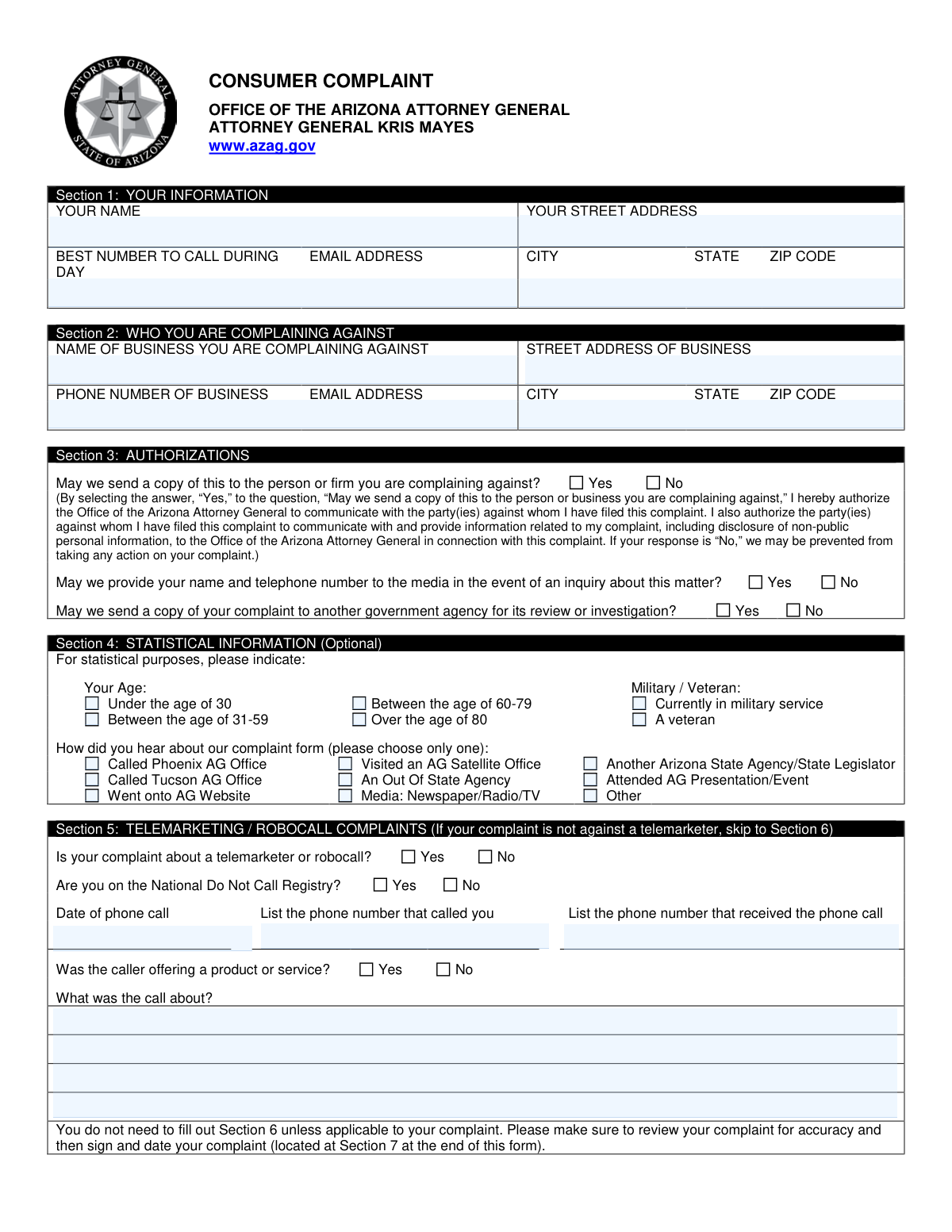
If you are a resident of Arizona or have engaged with a business operating within the state, the Consumer Complaint Form - Office of the Arizona Attorney General is your primary resource. You should choose this form if you are facing issues such as:
- Unfair Trade Practices: This includes "bait and switch" advertising, price gouging, or misrepresentation of the quality of goods and services.
- Telemarketing and Scams: Use this form to report fraudulent phone calls, illegal robocalls, lottery scams, or violations of consumer privacy laws.
- Mediation Requests: If you have reached an impasse with a merchant, filing this form allows the Attorney General’s office to act as an informal mediator to help resolve the dispute without the immediate need for private litigation.
Determining Jurisdiction
Before filling out the Consumer Complaint Form - Office of the Arizona Attorney General, confirm that the dispute falls within the office's jurisdiction. The Arizona AG generally handles matters where the consumer resides in Arizona, the business is located or registered in the state, or the deceptive transaction occurred within state lines. If your dispute involves a business with no ties to Arizona, you should look for the equivalent form for the state where the business is headquartered.
Preparing Your Filing
To ensure your complaint is processed effectively, have your supporting documentation ready before you begin. This includes digital copies of invoices, contracts, and any written communication with the business. Using Instafill.ai, you can quickly populate the Consumer Complaint Form with these details, ensuring that your narrative is clear and your evidence is properly referenced for the investigators.
Tips for state attorney general forms
Before filling out a complaint, collect all relevant receipts, contracts, and correspondence with the business. Having these digital files ready to upload ensures your claim is backed by evidence and prevents delays in the review process.
When describing the issue, list events in the order they occurred, including specific dates and names of people you spoke with. Avoid emotional language and focus on the facts of the transaction to help investigators understand the core of your complaint.
Clearly define what you want the business to do, such as providing a full refund, repairing a product, or canceling a contract. Explicitly stating your goal helps the Attorney General's office mediate the dispute more effectively.
Using AI-powered tools like Instafill.ai can help you complete these complex forms in under 30 seconds with high accuracy. This is a major time-saver for those handling multiple filings, and your sensitive data stays secure during the entire process.
Information submitted to a State Attorney General is often shared with the business you are complaining about to facilitate a response. Avoid including highly sensitive details like full Social Security numbers or private medical info unless the form specifically requires it.
Always download or print a copy of the completed form and any submission confirmation page before closing your browser. This documentation is essential if you need to follow up on the status of your case or provide additional information later.
Frequently Asked Questions
These forms are official documents used by residents to report legal concerns, such as consumer fraud, civil rights violations, or identity theft, directly to the state's highest legal office. They provide a structured way for the government to collect evidence and determine if an investigation or mediation is necessary.
You should use this form if you have experienced unfair, deceptive, or fraudulent business practices and have been unable to resolve the issue directly with the company. Filing this form alerts the Attorney General to potential patterns of misconduct that may require state intervention or legal action.
Yes, you can use AI tools like Instafill.ai to complete these forms quickly and accurately. The AI can extract relevant details from your supporting documents, such as receipts or contracts, and automatically populate the form fields for you.
Using AI-powered services, you can typically fill out a State Attorney General form in under 30 seconds. The technology streamlines the process by identifying and placing data from your source files directly into the PDF, reducing the need for manual typing.
Generally, any individual who has been affected by a business transaction within the state or any resident who believes their consumer rights have been violated can file. Some states also allow businesses to file complaints against other entities if the dispute involves unfair competition or trade practices.
You will usually need to provide your contact information, the name and address of the business involved, a detailed description of the dispute, and the specific resolution you are seeking. Attaching supporting documentation like invoices, advertisements, or email threads is also highly recommended.
Submission methods vary by state, but most allow for online uploads through their official portal, while others may require you to print and mail the form to a specific regional office. Always check the final page of the form for specific instructions regarding electronic or physical filing.
Filing a consumer complaint or a general inquiry form with the State Attorney General is almost always a free service. These offices operate as public regulatory bodies and do not charge citizens for the administrative process of reviewing or mediating a complaint.
Once submitted, the office will review your claim to see if it violates state laws. They may forward your complaint to the business for a response or initiate a mediation process to help both parties reach a voluntary settlement.
No, submitting these forms is an administrative action and does not constitute a private lawsuit. While the Attorney General may take legal action against a company on behalf of the state, they do not represent individual consumers as their private legal counsel.
In many jurisdictions, you can file a form on behalf of another person, such as an elderly relative or a minor, provided you have the legal authority to do so. You will typically need to specify your relationship to the complainant and explain why they are unable to file the form themselves.
While some information may be protected, the details of your complaint are often shared with the business you are complaining about so they can respond. Additionally, depending on state law, the completed form may be subject to public records requests, though sensitive personal identifiers are usually redacted.
Glossary
- Form Complexity Index
- Instafill’s 0–100 measure of how much effort a form takes to complete, calculated deterministically from the form’s own structure rather than estimated. It combines the number of fillable fields (the largest factor), how difficult those fields are to complete based on their type, the number of pages that contain fields, the amount of conditional “fill-only-if” logic, and how many sections the form is divided into, then adds modifiers for tables and repeating lists, bundled instruction pages, and dense page layouts. A higher score means the form is harder to fill out by hand. The forms in this category have a median Form Complexity Index of 50/100 (Moderate). See exactly how it is calculated.
- Mediation
- An informal process where the Attorney General’s office acts as a neutral third party to help the consumer and the business reach a voluntary resolution to a dispute.
- Deceptive Business Practice
- Any act, such as false advertising or hidden fees, that misleads or is likely to mislead a consumer into making a purchase or entering an agreement.
- Restitution
- A form of legal relief where a business is ordered to return money, property, or the value of services to a consumer to compensate for a loss.
- OAG
- An abbreviation for the Office of the Attorney General, the state's chief legal office responsible for enforcing consumer protection laws.
- Consumer Fraud Act
- The primary state legislation that prohibits unfair or deceptive acts in trade or commerce and empowers the Attorney General to take legal action.
- Affidavit
- A formal, written statement of facts that is signed and sworn to be true, often used to provide evidence for a consumer complaint.
- Civil Investigative Demand (CID)
- A legal tool used by the Attorney General to compel a business to provide documents, answers to questions, or testimony during an investigation.
- Private Right of Action
- The legal right of an individual consumer to sue a business in court for damages, separate from any action taken by the Attorney General.