Fill out surrogate court forms
with AI.
Surrogate court forms are the essential legal documents required to manage the affairs of a deceased person's estate. This category primarily covers the processes of probate and estate administration, which are necessary to ensure that a decedent’s assets are properly distributed, debts are settled, and legal titles are transferred. In New York, these forms serve as the official communication with the court system, providing the structure needed to navigate the complexities of inheritance law and fiduciary responsibilities.
By continuing, you acknowledge Instafill's Privacy Policy and agree to get occasional product update and promotional emails.
About surrogate court forms
These forms are typically needed by grieving family members, executors named in a will, or individuals seeking to become administrators when no will exists. For example, filing a Petition for Letters of Administration is a common requirement for those needing the legal authority to handle an estate in the New York court system. Because these documents are filed with the court, accuracy is paramount; even small errors in estate administration forms can lead to lengthy delays or legal complications for the heirs involved.
Navigating the specific requirements of probate forms can be time-consuming during an already difficult period. Tools like Instafill.ai use AI to fill these forms in under 30 seconds, ensuring that sensitive data is handled accurately and securely. This technology simplifies the process of preparing court-ready documents, allowing families and legal representatives to focus on the personal aspects of settling an estate rather than the paperwork.
Every form on this page can be completed without typing. Instafill is form filling software that reads a PDF and fills it for you — including flat and scanned documents that carry no fillable fields at all.
Forms in This Category
The forms in this category have a median Form Complexity Index of 43/100 (Basic), measured across 3 forms by field count, input difficulty, length, conditional logic and structure. See how it is calculated.
| Form Name | Pages | FCI | |
|---|---|---|---|
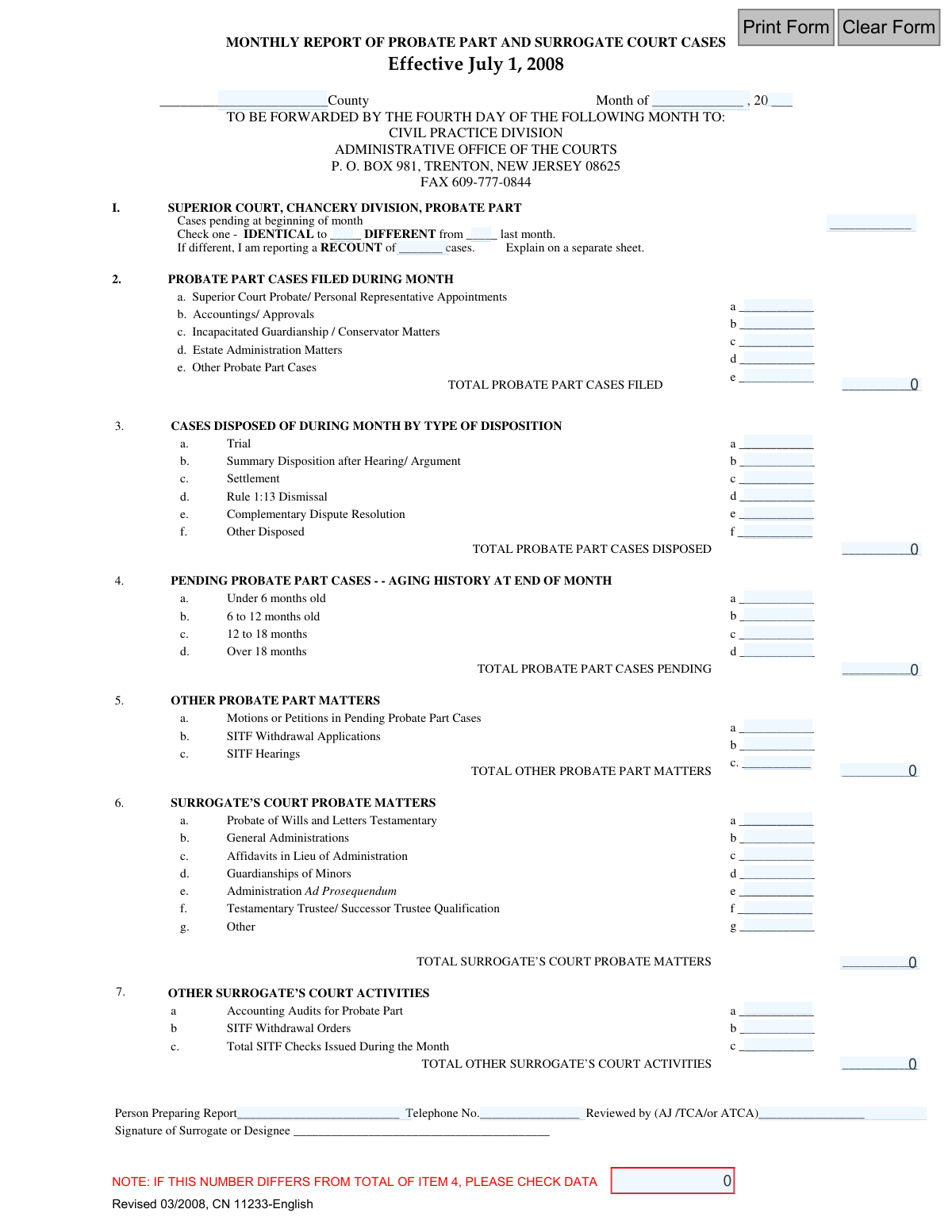
| 1. | Monthly Report of Probate Part and Surrogate Court Cases - Effective July 1, 2008 | 1 | Basic 43 |
| 2. | Petition for Letters of Administration (New York Surrogate's Court) | 4 | Moderate 60 |
| 3. | Surrogates' Judiciary Records Request Form | 1 | Basic 34 |
- Enterprise-grade security & data encryption
- 99%+ accuracy powered by AI
- 1,000+ forms from all industries
- Complete forms in under 60 seconds
How to Choose the Right Form
Navigating the New York Surrogate’s Court system requires choosing the specific form that matches the legal status of the deceased person’s estate. While there are many types of estate administration forms, the correct choice depends on whether a will exists and the total value of the assets involved.
When to Use the Petition for Letters of Administration
The Petition for Letters of Administration (New York Surrogate's Court) is the primary document used when a New York resident dies "intestate," meaning they did not leave a valid last will and testament.
You should choose this form if:
- No Valid Will: You have confirmed that the decedent did not leave a will, or the will they left was declared invalid by the court.
- Asset Threshold: The decedent owned assets in their name alone that exceed $50,000. For estates valued at less than $50,000, you might instead look for a "Small Estate" or Voluntary Administration affidavit.
- Seeking Authority: You are a distributee (legal heir)—such as a surviving spouse, child, or parent—seeking the legal authority to collect assets, settle debts, and distribute the remaining estate according to New York state law.
Administration vs. Probate Forms
It is common to confuse probate forms with administration forms. To ensure you are filling out the right paperwork, identify the following:
- Select Probate Forms if there is a valid will. In this case, the court appoints an "Executor."
- Select the Petition for Letters of Administration if there is no will. In this case, the court appoints an "Administrator."
Completing Your Surrogate Court Filing
Filing the Petition for Letters of Administration (New York Surrogate's Court) is the first step in the estate administration process. Because New York court forms require precise legal language and specific family tree information, using Instafill.ai can help you accurately populate the fields. Our AI-powered tools simplify the process of turning complex PDF court forms into manageable, fillable documents, ensuring your petition meets the court's standards for filing.
Form Comparison
| Form | Primary Purpose | Who Files It | When to Use |
|---|---|---|---|
| Petition for Letters of Administration (New York Surrogate's Court) | Requests the court to appoint an administrator to manage an estate without a will. | The decedent's closest living relative, such as a spouse, child, or parent. | When a New York resident dies intestate (without a valid last will and testament). |
Tips for surrogate court forms
One of the most frequent causes for delay in Surrogate's Court is failing to list all legal distributees, even if you are not in regular contact with them. Ensure you have the full names and current addresses of all family members entitled to notice under state law to avoid court rejections.
Filing estate paperwork can be time-consuming, but AI-powered tools like Instafill.ai can complete these forms in under 30 seconds with high accuracy. Your data stays secure during the process, providing a fast and reliable way to manage complex Surrogate's Court filings.
The court requires an original certified death certificate to process your petition. Because banks, utility companies, and insurance providers also require originals, it is a best practice to order several copies at once to prevent administrative bottlenecks.
Surrogate's Court forms often require a preliminary estimate of the estate's gross value to determine filing fees and potential bond requirements. Organizing bank statements and property records beforehand allows you to provide accurate figures without interrupting your workflow.
If other heirs agree to your appointment as administrator, have them sign a Waiver and Consent form. This allows the court to process your petition immediately without the need for a formal citation or a scheduled hearing date, significantly speeding up the process.
Many estate administration forms must be signed in the presence of a notary public to be legally valid. Review each document carefully to ensure all signatures are properly notarized, as missing seals or improper formatting will lead to the court returning your paperwork.
Frequently Asked Questions
Surrogate's Court forms are used to handle matters involving the estates of deceased individuals, including the distribution of assets and the payment of debts. These documents allow the court to oversee the legal appointment of representatives, such as executors or administrators, who manage a decedent's affairs.
You typically use probate forms if the deceased person left a valid will, which names an executor to handle the estate. Administration forms, such as the Petition for Letters of Administration, are required when someone dies without a will, requiring the court to appoint an administrator based on state law.
Generally, the closest living relatives, such as a surviving spouse, children, or parents, have the right to file for administration. If a will exists, the person named as the executor usually files the petition; if no will exists, state law determines the order of priority for who can serve as the administrator.
Forms must be filed in the Surrogate's Court located in the specific county where the deceased person resided at the time of their death. Each New York county has its own Surrogate's Court, and filing in the incorrect jurisdiction may lead to delays or the dismissal of the petition.
Most petitions require a certified copy of the death certificate and, if applicable, the original will. You may also need to provide a list of all known heirs, their relationship to the deceased, and their contact information to ensure the court can notify all interested parties.
Yes, AI tools like Instafill.ai can be used to fill out complex surrogate court forms by automatically extracting data from source documents and placing it into the correct fields. This technology helps ensure that names, addresses, and legal descriptions are consistent throughout the paperwork.
Using AI-powered services, users can often complete these forms in under 30 seconds. The system accurately parses information from uploaded documents, significantly reducing the time spent on manual data entry and minimizing the risk of clerical errors.
Once the petition is submitted, the court reviews the documents and may issue citations to notify any heirs who did not sign a waiver. If the court finds the petition in order and there are no successful challenges, it issues Letters of Administration, granting the administrator legal authority.
No, surrogate and probate procedures vary significantly by state. The forms provided in this category are specifically designed for the New York Surrogate's Court system and follow the procedural requirements of the New York Surrogate's Court Procedure Act (SCPA).
A distributee is a person who is entitled to a share of the deceased person's property under state law when there is no will. Identifying all distributees is a critical step in the administration process, as they must all be legally notified of the court proceedings.
Glossary
- Form Complexity Index
- Instafill’s 0–100 measure of how much effort a form takes to complete, calculated deterministically from the form’s own structure rather than estimated. It combines the number of fillable fields (the largest factor), how difficult those fields are to complete based on their type, the number of pages that contain fields, the amount of conditional “fill-only-if” logic, and how many sections the form is divided into, then adds modifiers for tables and repeating lists, bundled instruction pages, and dense page layouts. A higher score means the form is harder to fill out by hand. The forms in this category have a median Form Complexity Index of 43/100 (Basic). See exactly how it is calculated.
- Letters of Administration
- The official document issued by the Surrogate's Court that grants an administrator the legal authority to manage and distribute the estate of someone who died without a valid will.
- Intestate
- A legal status describing a person who dies without leaving a valid will, meaning their assets must be distributed according to state laws of succession.
- Administrator
- The person appointed by the court to manage and settle an estate when the deceased person did not name an executor in a will.
- Distributee
- A person entitled to a share of an estate under the laws of intestacy, typically the closest living relatives such as a spouse, child, or parent.
- Surrogate’s Court
- The specific court in New York that handles all matters related to wills, estates, and the affairs of deceased persons.
- Citation
- A formal notice issued by the court to notify interested parties, such as heirs or creditors, that a petition has been filed and providing them an opportunity to object.
- Fiduciary
- A person, such as an administrator or executor, who is legally obligated to act in the best interest of the estate and its beneficiaries.
- Affidavit of Heirship
- A sworn legal document used to identify the family members and legal heirs of a deceased person to prove who has a right to the estate assets.