Fill out travel expense forms
with AI.
Travel expense forms are essential for tracking costs incurred during business or service-related trips, ensuring that employees, contractors, and care providers are fairly compensated for out-of-pocket expenses. This category covers a range of documentation, from general expense reimbursement forms to specialized mileage logs used in Financial Management Services (FMS). Accurate record-keeping is the backbone of financial transparency, as these documents serve as the primary evidence for tax deductions, internal audits, and compliance with approved spending plans.
By continuing, you acknowledge Instafill's Privacy Policy and agree to get occasional product update and promotional emails.
About travel expense forms
These forms are typically utilized by professionals who travel frequently for work, such as field agents, sales representatives, and healthcare providers who transport clients. In many cases, such as with mileage reimbursement request forms, drivers must meticulously log dates, odometer readings, and specific destinations to justify the miles driven. Because these forms often require precise calculations and detailed trip logs, they are a critical part of the administrative workflow for anyone seeking timely reimbursement for their professional travel.
Managing these logs manually can be tedious and prone to errors, especially when dealing with multiple entries or complex FMS requirements. Tools like Instafill.ai use AI to fill these forms in under 30 seconds by extracting and placing data accurately and securely. This practical automation helps ensure that your reimbursement requests are consistent and professional, saving significant time on repetitive data entry.
Every form on this page can be completed without typing. Instafill is form filling software that reads a PDF and fills it for you — including flat and scanned documents that carry no fillable fields at all.
Forms in This Category
The forms in this category have a median Form Complexity Index of 73/100 (Complex), measured across 1 forms by field count, input difficulty, length, conditional logic and structure. See how it is calculated.
| Form Name | Pages | FCI | |
|---|---|---|---|
| 1. | Mileage Reimbursement Request for FMS | 1 | Complex 73 |
- Enterprise-grade security & data encryption
- 99%+ accuracy powered by AI
- 1,000+ forms from all industries
- Complete forms in under 60 seconds
How to Choose the Right Form
When navigating travel expense documentation, it is essential to distinguish between general corporate travel and specialized service-based reimbursements. Currently, this category focuses on specific documentation required for Financial Management Services (FMS) and specialized caregiving scenarios.
Specialized Mileage for Caregivers and Drivers
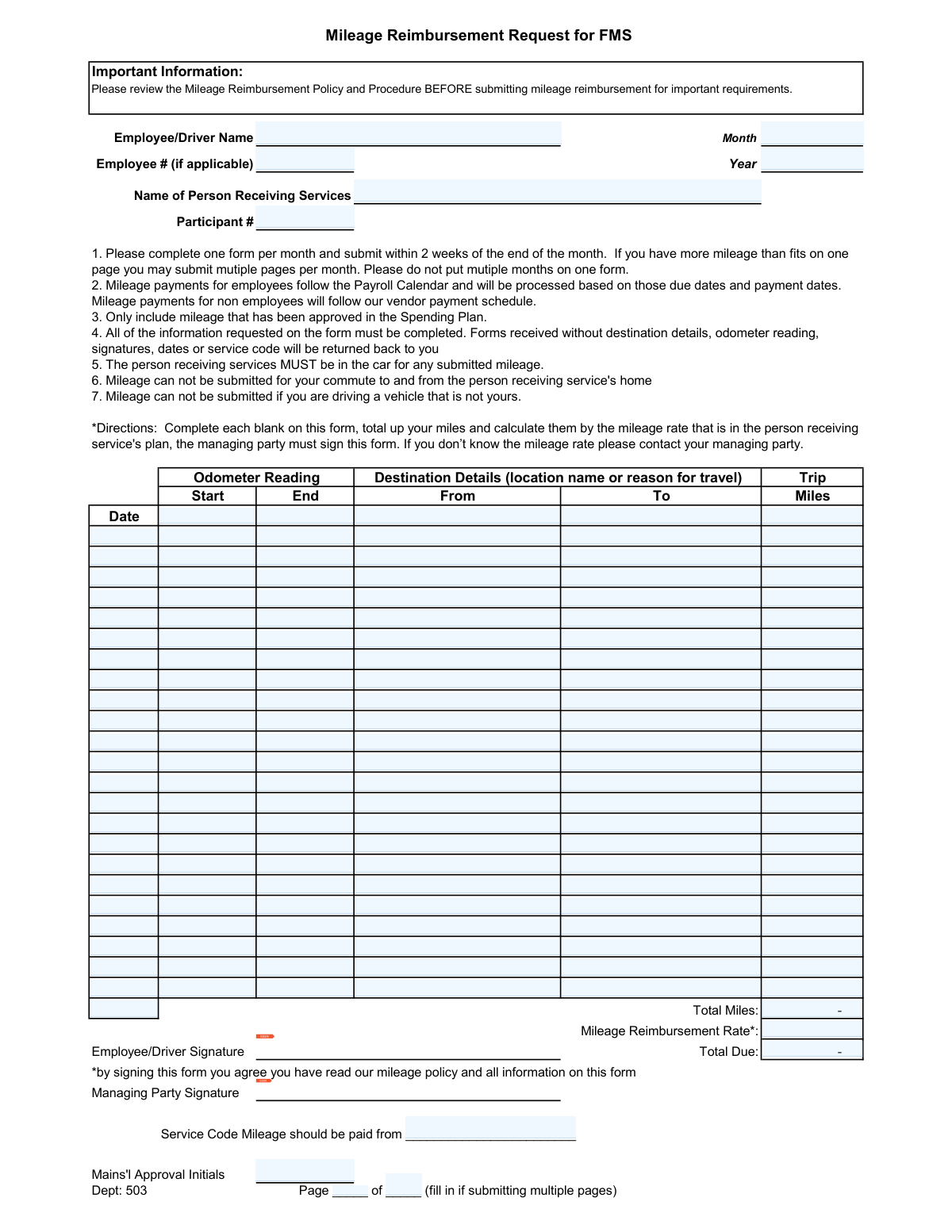
If you are an employee or a driver providing transportation for individuals receiving services, the Mileage Reimbursement Request for FMS is the primary document you will need. This form is not a standard business expense report; it is a specialized log designed to align with approved spending plans for person-centered services.
You should choose this form if:
- You are transporting a service recipient: This form is specifically tailored for those working within the FMS framework rather than general office environments.
- You have granular trip data: To complete the Mileage Reimbursement Request for FMS accurately, you must provide starting and ending odometer readings, specific destinations, and the exact dates of travel.
- Compliance is a priority: This form ensures that every mile tracked is accounted for according to an approved spending plan, which is vital for proper payment and auditing.
When to Use Other Expense Forms
While this category is currently centered on FMS-specific needs, you might be looking for a different type of reimbursement tool:
- General Business Travel: If you need to claim airfare, hotel stays, or meal per diems for corporate travel, you should look for a general "Expense Reimbursement Form."
- Standard Commuting: Note that the Mileage Reimbursement Request for FMS generally does not cover standard commutes from your home to a primary workplace, focusing instead on the transportation of the service recipient.
Streamlining Your Submission
Filling out the Mileage Reimbursement Request for FMS can be tedious due to the meticulous odometer tracking required. By using Instafill.ai, you can quickly convert non-fillable PDF versions of these logs into interactive documents, ensuring your calculations are accurate and your submission is professional.
Form Comparison
| Form | Primary Purpose | Who Files It | Key Information Required | Submission Frequency |
|---|---|---|---|---|
| Mileage Reimbursement Request for FMS | Requesting mileage reimbursement for transporting individuals who receive FMS services. | Employees or drivers authorized to provide transportation for service recipients. | Requires odometer readings, dates of travel, specific destinations, and total mileage. | Filed after travel occurs as per the approved individual spending plan. |
Tips for travel expense forms
A common mistake is having the ending odometer reading of one trip not match the starting reading of the next. Ensure your log follows a logical sequence to avoid red flags or form rejection during the review process.
FMS forms are strictly tied to an individual's authorized budget. Before submitting, verify that each trip category and the total mileage requested align with the specific services and limits outlined in the approved spending plan.
Relying on memory at the end of the month often leads to missing miles or incorrect destination details. Keep a log in your vehicle to record dates, locations, and odometer readings as they happen to make the final form completion much easier.
AI-powered tools like Instafill.ai can complete these complex mileage forms in under 30 seconds with high accuracy. Your data stays secure during the process, providing a practical and fast solution for those managing multiple reimbursement cycles.
Avoid using vague terms like 'driving' or 'transportation' in the purpose column. Providing clear descriptions of the destination and how the trip served the individual helps processors approve your request without asking for additional clarification.
Calculation errors in the 'Total Miles' column are a leading cause of delayed payments. Always use a calculator to sum up your daily entries and verify the final reimbursement amount matches your supporting documentation exactly.
Frequently Asked Questions
These forms are used by employees, contractors, or caregivers to document costs incurred during business-related travel. They ensure that individuals are fairly compensated for out-of-pocket expenses like fuel, tolls, and vehicle wear and tear.
Anyone who uses their personal vehicle for work-related duties, such as transporting clients or traveling between job sites, usually needs to file these forms. In the context of Financial Management Services (FMS), this often includes caregivers or drivers assisting individuals receiving specific services.
Most forms require the date of travel, the starting and ending odometer readings, the purpose of the trip, and the specific destination. Accurate documentation is essential to ensure the reimbursement aligns with the approved spending plan or company policy.
FMS forms are specifically designed for programs where individuals manage their own support budgets. These forms often require more detailed tracking to ensure that the travel is directly related to the care or services being provided to a specific participant.
Yes, AI tools like Instafill.ai can process travel expense forms by accurately extracting data from your logs or receipts and placing it into the correct fields. This technology minimizes manual entry errors and ensures that complex calculations, like total mileage, are handled correctly.
Using AI-powered services, you can complete a detailed travel expense or mileage form in under 30 seconds. The system quickly maps your data to the PDF, allowing you to review and sign the document without typing every line item manually.
Submission deadlines vary by organization, but it is standard practice to submit them monthly or immediately following the completion of a trip. Timely filing helps ensure that you are reimbursed quickly and that the organization’s budget tracking remains up to date.
It is wise to keep a backup of your trip logs, fuel receipts, or GPS records in case of an audit or internal review. Having these records organized makes it easier to verify the information provided on the official reimbursement form.
Completed forms are usually submitted to a supervisor, a human resources department, or a third-party Financial Management Service provider. Many organizations now accept digital submissions, which can be sent via email or uploaded through a secure portal.
Precision ensures that the reimbursement amount is calculated correctly based on the approved per-mile rate. Inaccurate readings can lead to delays in payment or potential issues during financial audits of the spending plan.
Glossary
- Form Complexity Index
- Instafill’s 0–100 measure of how much effort a form takes to complete, calculated deterministically from the form’s own structure rather than estimated. It combines the number of fillable fields (the largest factor), how difficult those fields are to complete based on their type, the number of pages that contain fields, the amount of conditional “fill-only-if” logic, and how many sections the form is divided into, then adds modifiers for tables and repeating lists, bundled instruction pages, and dense page layouts. A higher score means the form is harder to fill out by hand. The forms in this category have a median Form Complexity Index of 73/100 (Complex). See exactly how it is calculated.
- FMS (Financial Management Services)
- An organization that assists individuals in managing their self-directed care budgets, including processing payroll and reimbursements for service providers.
- Spending Plan
- A pre-approved budget that specifies the maximum amount of funds allocated for different services, such as transportation or mileage, during a specific period.
- IRS Standard Mileage Rate
- The fixed price per mile set by the federal government that organizations use to calculate the tax-deductible or reimbursable cost of operating a vehicle for business or service purposes.
- Fiscal Intermediary
- An entity that acts as the employer of record or financial agent to process claims and payments on behalf of a person receiving self-directed services.
- Commuting Miles
- The distance traveled from a driver's home to the first service location, which is generally considered a personal expense and is not eligible for reimbursement.
- Odometer Log
- A detailed record of a vehicle's total mileage readings at the beginning and end of each trip, used to verify the exact distance claimed on reimbursement forms.
- Self-Directed Services
- A service model where the individual receiving care has the authority to manage their own budget and choose the people who provide their support and transportation.