Fill out U.S. Bancorp forms
with AI.
U.S. Bancorp forms are essential for managing financial assets and investment portfolios within one of the largest banking institutions in the United States. These documents serve as the formal bridge between different financial entities, ensuring that assets like stocks, bonds, and mutual funds are moved securely and in compliance with regulatory standards. Whether you are moving funds between internal accounts or consolidating your wealth from external firms, having the correct documentation is vital for maintaining clear financial records and avoiding delays in asset availability.
By continuing, you acknowledge Instafill's Privacy Policy and agree to get occasional product update and promotional emails.
About U.S. Bancorp forms
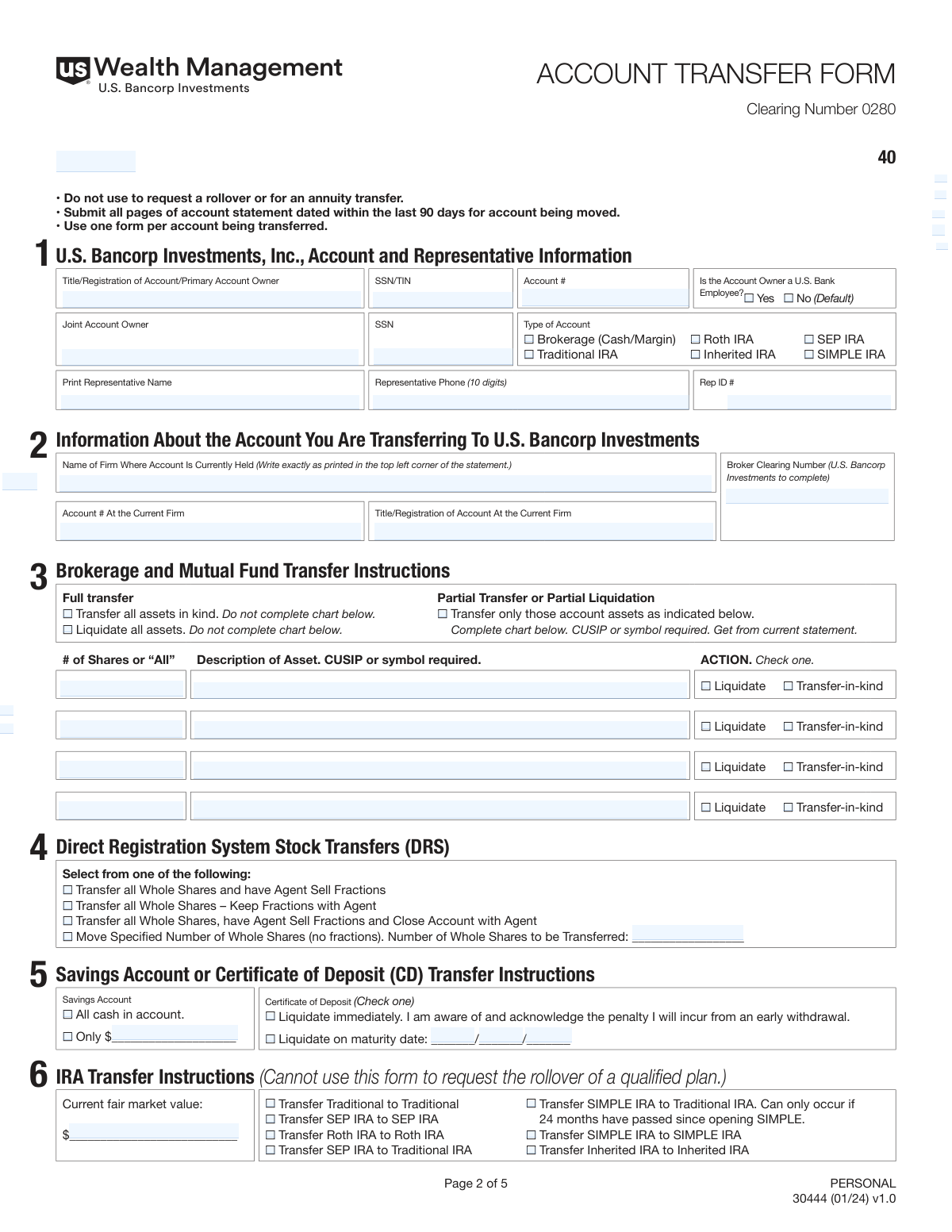
Typically, these forms are used by individual investors, financial advisors, and corporate clients who are looking to streamline their investment strategies. Common scenarios include rolling over a retirement account, transferring brokerage assets to a new management team, or simply centralizing multiple accounts to gain a better overview of one's financial health. For example, the U.S. Bancorp Investments Account Transfer Form is a primary requirement for anyone looking to migrate their portfolio into the U.S. Bancorp ecosystem, requiring precise data entry to match existing account details across institutions.
Completing these forms manually can be a tedious process that demands high attention to detail to prevent processing errors. Tools like Instafill.ai use AI to fill these forms in under 30 seconds, ensuring that sensitive data is handled accurately and securely while saving significant time. This approach allows users to focus on their financial goals rather than the administrative hurdles of paperwork.
Every form on this page can be completed without typing. Instafill is form filling software that reads a PDF and fills it for you — including flat and scanned documents that carry no fillable fields at all.
Forms in This Category
The forms in this category have a median Form Complexity Index of 59/100 (Moderate), measured across 1 forms by field count, input difficulty, length, conditional logic and structure. See how it is calculated.
| Form Name | Pages | FCI | |
|---|---|---|---|
| 1. | U.S. Bancorp Investments Account Transfer Form | 1 | Moderate 59 |
- Enterprise-grade security & data encryption
- 99%+ accuracy powered by AI
- 1,000+ forms from all industries
- Complete forms in under 60 seconds
How to Choose the Right Form
Consolidating Your Investment Portfolio
Managing your financial assets becomes significantly easier when your investments are consolidated. If you are looking to move your holdings into the U.S. Bancorp ecosystem, selecting the correct documentation is the first step toward a successful transition.
The Primary Transfer Document
Currently, the main document in this category is the U.S. Bancorp Investments Account Transfer Form. This document is essential for anyone looking to migrate wealth from an external brokerage firm into a U.S. Bancorp Investments account.
You should choose this form if your goal is to:
- Move Stocks or Bonds: Transfer individual securities without selling them (often referred to as an "In-Kind" transfer).
- Consolidate Mutual Funds: Bring various fund holdings into a single portfolio for easier tracking and management.
- Transfer Cash Balances: Move liquidated funds from a closing account at another firm into your investment account.
- Complete a Full Account Migration: Close an external account entirely and move all contents to U.S. Bancorp.
Preparing to Fill Out the Form
Before you begin the digital filling process on Instafill.ai, gather the following information to ensure the U.S. Bancorp Investments Account Transfer Form is processed without rejection by the back-office teams:
- External Account Statement: You will need the exact account title and account number from the firm currently holding the assets.
- U.S. Bancorp Account Details: Ensure your receiving account is already open and have your account number ready.
- Transfer Instructions: Decide if you are performing a "Total Transfer" (closing the old account) or a "Partial Transfer" (moving only specific assets).
Using AI for Financial Accuracy
Financial forms require high precision to satisfy regulatory requirements. Using Instafill.ai to complete the U.S. Bancorp Investments Account Transfer Form allows you to leverage AI to identify required fields and ensure that your data is entered clearly. This reduces the risk of the receiving firm rejecting the transfer due to illegible handwriting or missing account details, helping your assets move faster and more securely.
Form Comparison
| Form | Primary Purpose | Assets Covered | Required Information |
|---|---|---|---|
| U.S. Bancorp Investments Account Transfer Form | Consolidate assets by moving them from external firms to U.S. Bancorp. | Includes stocks, mutual funds, cash, and other financial investment assets. | Details for both sending and receiving accounts and specific transfer instructions. |
Tips for U.S. Bancorp forms
Using AI-powered tools like Instafill.ai allows you to complete complex U.S. Bancorp forms in under 30 seconds with high accuracy. Your financial data remains secure throughout the process, making it a safe and efficient way to handle investment paperwork.
One of the most common reasons for transfer delays is a name mismatch between the delivering firm and U.S. Bancorp. Double-check that the names, suffixes, and designations are identical on both ends of the transaction to avoid rejection.
Attaching a copy of your most recent statement from the sending firm helps verify account numbers and specific holdings. This documentation reduces the risk of manual entry errors and provides the receiving firm with the data needed to track the transfer.
Clearly indicate whether you want your assets moved 'in-kind' or liquidated into cash before the transfer. Choosing the wrong option can result in unwanted tax consequences or the inability to move specific proprietary mutual funds.
Large transfers or specific account types often require a Medallion Signature Guarantee rather than a standard notary seal. Review the form instructions carefully to see if you need to visit a physical bank branch to obtain this specialized validation.
If you only intend to move specific stocks or a portion of your cash, ensure you list the exact quantities on the form. Selecting a 'Full Transfer' will typically close your account at the sending firm and may trigger exit fees.
Frequently Asked Questions
These forms are primarily designed to facilitate the management and movement of financial assets within U.S. Bancorp Investments. They allow clients to consolidate their holdings by transferring cash, stocks, or mutual funds from external brokerage firms into their U.S. Bancorp accounts.
This form is intended for individuals or entities who wish to move existing investment accounts from another financial institution to U.S. Bancorp Investments. It is used by new clients looking to centralize their portfolio or existing clients adding funds from outside sources.
You will generally need your account numbers for both the sending and receiving institutions, the name of the firm currently holding your assets, and a recent account statement. Specific instructions regarding whether you are performing a full or partial transfer are also necessary.
Yes, you can use AI tools like Instafill.ai to complete these forms efficiently. These tools can accurately extract data from your existing documents and place it into the correct fields on the PDF form, ensuring high accuracy and reducing manual entry errors.
Using AI-powered services, you can typically fill out complex financial forms in under 30 seconds. The technology streamlines the process by automatically identifying required fields and populating them with information from your source documents.
Yes, most transfer forms allow you to choose between a full transfer of all assets or a partial transfer. If you select a partial transfer, you will need to specify exactly which securities or cash amounts you wish to move to your U.S. Bancorp account.
Completed forms are typically submitted directly to U.S. Bancorp Investments via secure online upload, mail, or by visiting a local branch. It is important to follow the specific submission instructions provided on the form or by your financial advisor to ensure timely processing.
While the form itself can be filled out quickly, the actual transfer of assets between firms generally takes between five to ten business days. This timeline depends on the complexity of the assets being moved and the processing speed of the delivering institution.
In most cases, the receiving firm (U.S. Bancorp) initiates the request on your behalf once you submit the signed transfer form. However, it is often helpful to check with your current firm to see if they have specific requirements or fees for outgoing transfers.
During the transfer process, your assets are usually 'in-flight,' meaning you may be unable to trade them for a few days. Once the assets arrive and are reconciled at U.S. Bancorp, you will regain full access to manage them within your new account.
Glossary
- Form Complexity Index
- Instafill’s 0–100 measure of how much effort a form takes to complete, calculated deterministically from the form’s own structure rather than estimated. It combines the number of fillable fields (the largest factor), how difficult those fields are to complete based on their type, the number of pages that contain fields, the amount of conditional “fill-only-if” logic, and how many sections the form is divided into, then adds modifiers for tables and repeating lists, bundled instruction pages, and dense page layouts. A higher score means the form is harder to fill out by hand. The forms in this category have a median Form Complexity Index of 59/100 (Moderate). See exactly how it is calculated.
- ACATS (Automated Customer Account Transfer Service)
- A standardized system used by the financial industry to automate the transfer of assets from one brokerage firm or bank to another.
- Medallion Signature Guarantee
- A special certification stamp used by financial institutions to verify that a signature is authentic. It provides a higher level of security than a standard notary and is often required for transferring high-value securities.
- Contra Firm
- The external financial institution from which you are moving your assets. This is the 'delivering' firm that currently holds your investments before they arrive at U.S. Bancorp.
- In-Kind Transfer
- A method of moving investments, such as stocks or mutual funds, exactly as they are without selling them. This allows the assets to be moved without triggering a taxable event or capital gains tax.
- DTC Number
- A four-digit identification number assigned to financial institutions by the Depository Trust Company. It is used to identify which firm is sending or receiving electronic securities during a transfer.
- Residual Credits
- Dividends, interest, or other small cash amounts that arrive in your old account after the main transfer has already been completed. These are typically swept over to the new account automatically in follow-up cycles.
- Proprietary Fund
- An investment product, such as a mutual fund, that is managed and owned exclusively by a specific firm. These funds sometimes cannot be moved 'in-kind' and may need to be liquidated before the cash can be transferred.
- Full vs. Partial Transfer
- A full transfer moves the entire balance and all assets out of an account, usually resulting in the old account being closed, while a partial transfer moves only specific assets or a set dollar amount.