Fill out university promotion forms
with AI.
University promotion forms are essential administrative documents designed to manage the career progression and tenure track of academic faculty. These forms standardize the evaluation process, ensuring that decisions regarding appointments and promotions are based on consistent criteria such as research achievements, teaching effectiveness, and institutional service. By providing a structured framework for review committees, these documents serve as the formal record of a candidate’s professional impact and readiness for higher academic rank.
By continuing, you acknowledge Instafill's Privacy Policy and agree to get occasional product update and promotional emails.
About university promotion forms
Typically, these forms are utilized by department administrators, faculty affairs coordinators, and the candidates themselves during annual performance reviews or formal promotion cycles. For instance, checklists for referee grids and trainee feedback are frequently used to compile peer evaluations, which are critical components of a faculty member's dossier. Navigating these requirements often involves tight deadlines and a high degree of precision to ensure that all solicitation letters and comparison data are accurately presented to the review board.
Handling the extensive documentation required for academic promotion can be a significant administrative burden, but tools like Instafill.ai use AI to fill these forms in under 30 seconds while ensuring data accuracy and security. This streamlined approach helps administrative teams manage complex faculty files more efficiently, allowing them to focus on supporting the academic mission of their institution.
Every form on this page can be completed without typing. Instafill is form filling software that reads a PDF and fills it for you — including flat and scanned documents that carry no fillable fields at all.
Forms in This Category
The forms in this category have a median Form Complexity Index of 22/100 (Simple), measured across 1 forms by field count, input difficulty, length, conditional logic and structure. See how it is calculated.
| Form Name | Pages | FCI | |
|---|---|---|---|
| 1. | Professoriate Checklist for Referee Grid, Trainee Grid, and Comparison Peers | 1 | Simple 22 |
- Enterprise-grade security & data encryption
- 99%+ accuracy powered by AI
- 1,000+ forms from all industries
- Complete forms in under 60 seconds
How to Choose the Right Form
Selecting the correct documentation is critical when navigating the complex academic promotion process. While "university promotion forms" can cover a wide range of departmental needs, the forms provided here are specifically designed for administrative oversight and rigorous candidate evaluation preparation.
For Department Administrators and HR Coordinators
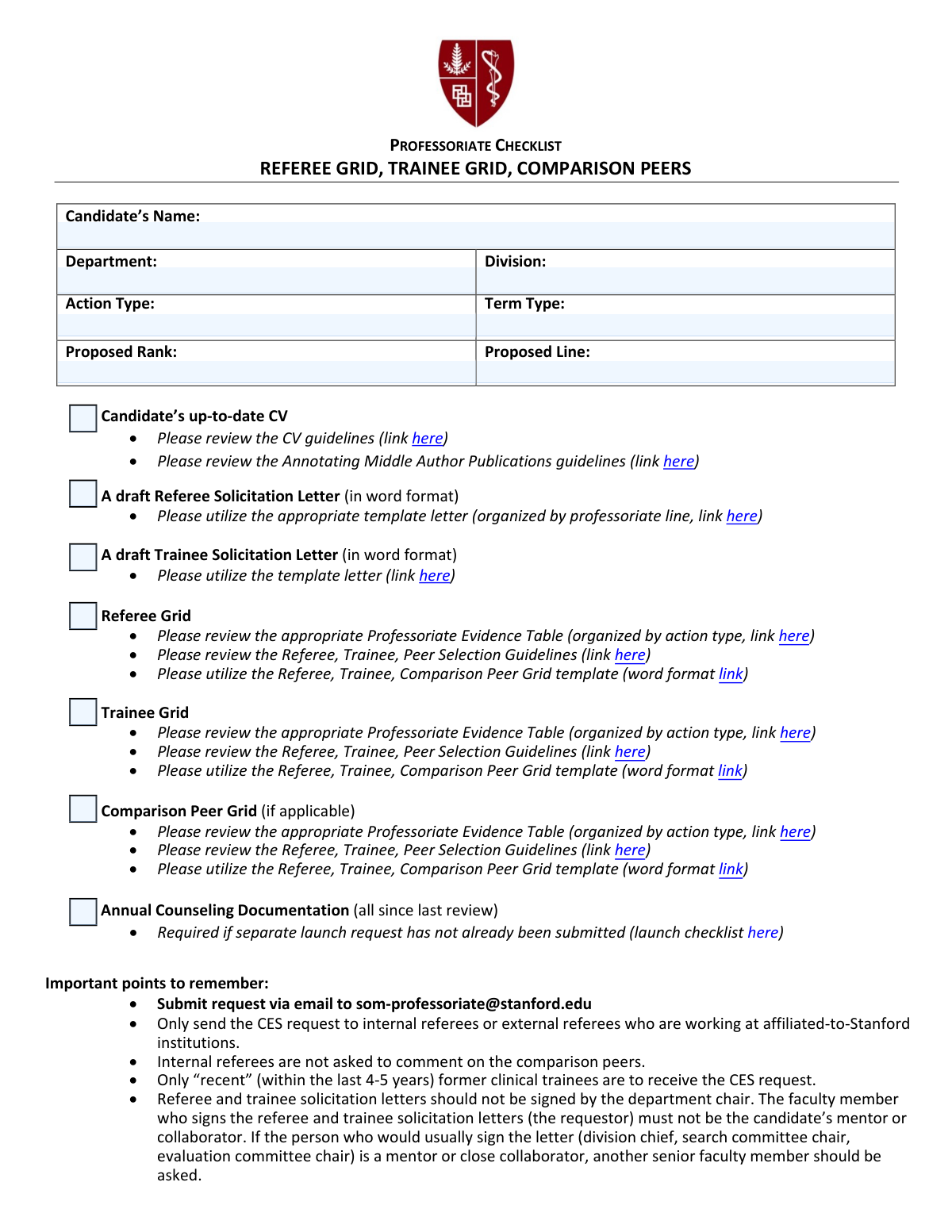
If you are responsible for preparing a faculty member's promotion or appointment file, the Professoriate Checklist for Referee Grid, Trainee Grid, and Comparison Peers is your primary tool. This form acts as a comprehensive roadmap for the internal review process, ensuring that no critical piece of evidence is missing before the file reaches the review committee. It is particularly useful for departments following the standards of major research institutions, such as the Stanford School of Medicine.
Key Components of the Checklist
Use this form if your workflow involves organizing the following high-level documentation:
- Referee and Trainee Grids: Essential for tracking which external experts and former students have been contacted for letters of recommendation.
- Peer Comparison Data: Used to benchmark the candidate against other scholars in their field at similar career stages to justify the promotion.
- Documentation Verification: Ensuring the candidate’s CV, draft solicitation letters, and internal evaluation forms meet university-wide standards.
When to Use This Specific Form
This checklist is most effective during the "preparation phase" of a faculty review. It is not the final promotion application submitted by the candidate, but rather the administrative backbone that ensures the file is complete and audit-ready. If you are an administrative professional tasked with compiling a candidate's dossier, this is the correct starting point.
By using Instafill.ai, you can quickly populate these complex grids and checklists from existing faculty records and CVs, saving hours of manual data entry and ensuring total accuracy for high-stakes academic reviews.
Form Comparison
| Form | Primary Purpose | Primary User | Key Components |
|---|---|---|---|
| Professoriate Checklist for Referee Grid, Trainee Grid, and Comparison Peers | Organizes required documentation for faculty review, promotion, and appointment processes. | Departmental administrators or academic staff managing faculty candidate files. | Referee grids, trainee grids, CVs, and peer comparison evaluations. |
Tips for university promotion forms
When filling out comparison peer grids, select individuals who hold similar ranks at institutions with comparable research or clinical profiles. This ensures that the evaluation committee has a relevant and fair baseline to measure the candidate's achievements against their industry equals.
A common mistake is having mismatched dates or titles between the referee grid and the candidate’s official CV. Carefully verify every entry to ensure that the documentation is internally consistent, which prevents administrative flags during the review process.
Managing detailed academic grids for multiple candidates is labor-intensive. AI-powered tools like Instafill.ai can complete these forms in under 30 seconds with high accuracy, ensuring your data stays secure while significantly reducing the administrative burden on department staff.
Before submitting the solicitation grid, confirm that all listed referees have current contact information and updated institutional titles. Using outdated data can lead to undelivered solicitation letters, which often results in significant delays in the faculty promotion timeline.
When completing the trainee grid, clearly specify the timeframes for each mentorship relationship. Distinguishing between long-term doctoral supervision and short-term clinical rotations helps the review board better understand the candidate’s commitment to teaching and development.
To save time, draft the referee and trainee solicitation letters as you compile the checklist. Having these documents ready for attachment ensures that once the checklist is approved, the department can immediately proceed with gathering external evaluations.
Frequently Asked Questions
These forms are typically a joint effort between the faculty candidate and the department's administrative staff. While the candidate provides the raw data and CV, administrators often use checklists to ensure all institutional requirements and external referee documentation are correctly formatted.
Most packets require a comprehensive curriculum vitae, a statement of research or teaching goals, and lists of external referees who can speak to the candidate's impact. Additionally, grids documenting trainee mentorship and peer comparisons are often mandatory to demonstrate the candidate's standing in their field.
It is advisable to begin the preparation process several months before the official submission deadline. This allows ample time to solicit letters from external referees and to verify that all trainee and peer data is accurate and up to date.
Yes, modern AI tools like Instafill.ai can automate the process of filling out complex academic forms. These tools can extract data from a candidate's CV or previous records and accurately place it into the required fields in under 30 seconds.
Peer comparison grids help review committees evaluate a candidate's performance relative to others at similar career stages in the same discipline. This provides an objective benchmark for the university to assess whether the candidate meets the standard for the proposed rank.
Completed forms and supporting documentation are usually submitted to the Department Chair or the Office of Faculty Affairs within the specific school or college. From there, the packet moves through various levels of committee review, including the Dean’s office and university-wide boards.
Filling out university promotion forms manually can take hours of data entry, but using AI-powered services like Instafill.ai reduces this time significantly. These platforms can process and populate the forms in under 30 seconds by extracting information directly from source documents.
Yes, universities often have distinct forms and checklists for different academic tracks to reflect the specific priorities of each role. Clinical tracks may focus more on patient care and service, while research-heavy tracks will emphasize grant funding and publication records.
External referees provide independent evaluations of the candidate's scholarly contributions and national or international reputation. The forms used in the promotion process help administrators track which referees have been contacted and whether their responses meet the university's criteria for rank and expertise.
Missing documentation can lead to significant delays in the review process or may result in the packet being returned to the department for completion. Using standardized checklists ensures that all necessary grids, letters, and evaluations are present before the file reaches the review committee.
Glossary
- Form Complexity Index
- Instafill’s 0–100 measure of how much effort a form takes to complete, calculated deterministically from the form’s own structure rather than estimated. It combines the number of fillable fields (the largest factor), how difficult those fields are to complete based on their type, the number of pages that contain fields, the amount of conditional “fill-only-if” logic, and how many sections the form is divided into, then adds modifiers for tables and repeating lists, bundled instruction pages, and dense page layouts. A higher score means the form is harder to fill out by hand. The forms in this category have a median Form Complexity Index of 22/100 (Simple). See exactly how it is calculated.
- Referee Grid
- A structured list used to track external experts who have been asked to provide letters of recommendation or formal evaluations for a candidate’s promotion.
- Comparison Peers
- A list of individuals at other institutions who are at a similar career stage, used by review committees to benchmark a candidate’s academic standing and achievements.
- Trainee Grid
- A document that lists students, residents, or fellows mentored by the candidate, detailing their current professional positions and the nature of the mentorship received.
- Solicitation Letter
- A formal request sent by a department chair or dean to external experts, asking them to provide a confidential evaluation of a faculty member’s research and teaching.
- Professoriate
- The collective body of faculty members within a university system, often divided into different ranks such as Assistant, Associate, and Full Professor.
- Dossier
- The complete collection of documents, including the CV, teaching evaluations, and research statements, submitted for a formal academic promotion or tenure review.
- External Evaluator
- A recognized expert in the candidate’s field from a different university who provides an objective assessment of the candidate’s professional contributions.