Fill out Utah state forms
with AI.
Utah state forms encompass the essential documentation required for residents and businesses to interact with state agencies, particularly regarding financial and legal obligations. Among these, state income tax forms are the most frequently utilized, as they serve as the primary mechanism for reporting earnings and ensuring compliance with Utah's revenue laws. Whether you are a full-time resident, a part-year resident, or an individual earning income within the state, having access to accurate and up-to-date Utah tax forms is vital for managing your personal finances and avoiding potential penalties.
By continuing, you acknowledge Instafill's Privacy Policy and agree to get occasional product update and promotional emails.
About Utah state forms
Most individuals require these individual tax forms during the annual filing season to reconcile their tax liability. This process involves detailing various income sources, applying eligible deductions, and calculating credits that can reduce the overall tax burden. Navigating these requirements can be complex, especially when dealing with specific documents like the Form TC-40, which acts as the cornerstone of the state's individual tax system. Ensuring that every field is correctly populated is necessary to secure timely refunds and maintain an accurate record with the state government.
To simplify this administrative burden, tools like Instafill.ai use AI to fill these forms in under 30 seconds while maintaining data accuracy and security. By automating the data entry process, these services help taxpayers transition from static documents to interactive, completed forms with minimal effort. This technology allows you to focus on the accuracy of your financial data rather than the manual task of handwriting or typing into every individual box.
Every form on this page can be completed without typing. Instafill is form filling software that reads a PDF and fills it for you — including flat and scanned documents that carry no fillable fields at all.
Forms in This Category
The forms in this category have a median Form Complexity Index of 73/100 (Complex), measured across 1 forms by field count, input difficulty, length, conditional logic and structure. See how it is calculated.
| Form Name | Pages | FCI | |
|---|---|---|---|
| 1. | Form TC-40, Utah Individual Income Tax Return | 7 | Complex 73 |
- Enterprise-grade security & data encryption
- 99%+ accuracy powered by AI
- 1,000+ forms from all industries
- Complete forms in under 60 seconds
How to Choose the Right Form
Choosing the right Utah state form depends primarily on your residency status and the type of income you earned during the tax year. While the state offers various administrative documents, the most critical form for individual taxpayers is the income tax return.
For Individual Residents and Taxpayers
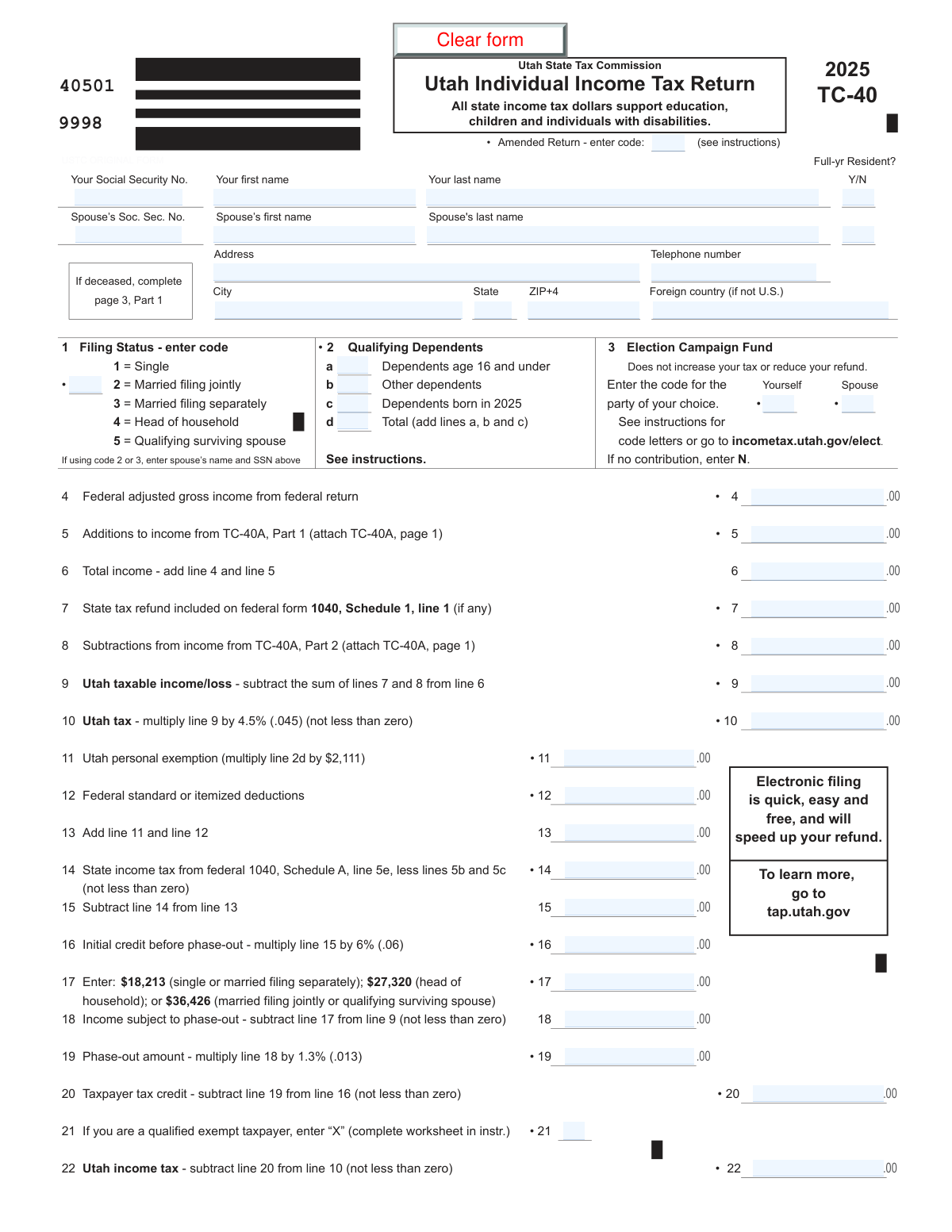
If you are a resident of Utah or earned income within the state, Form TC-40, Utah Individual Income Tax Return is the central document you will need. This form is the standard vehicle for reporting your financial activity to the Utah State Tax Commission. You should use this form to:
- Report Annual Income: Disclose your total earnings to determine your state tax base.
- Calculate Tax Liability: Determine exactly how much you owe based on the state's current tax regulations.
- Claim Exemptions and Deductions: Reduce your taxable income by applying for standard state exemptions or specific Utah-based deductions.
- Request a Refund: If you have overpaid through employer withholding or estimated payments, this form is required to claim your refund.
When to Select Form TC-40
You should choose Form TC-40 if you fall into any of these categories:
- Full-Year Residents: You maintained a permanent home in Utah for the entire year.
- Part-Year Residents: You moved into or out of the state and need to apportion your income.
- Non-residents with Utah Income: You live elsewhere but received income from Utah-based sources, such as labor performed in the state or Utah-located real estate.
Simplify Your Utah Filing
Navigating state tax requirements can be daunting, but Form TC-40 is designed to be comprehensive. By using Instafill.ai, you can transform the static PDF version of the Utah Individual Income Tax Return into a fillable, AI-assisted document. This helps ensure that every field—from your Social Security number to your final tax calculation—is completed accurately, reducing the risk of processing delays or audits from the state.
Form Comparison
| Form | Purpose | Who Files It | Frequency | Key Sections |
|---|---|---|---|---|
| Form TC-40, Utah Individual Income Tax Return | Report annual income and calculate state income tax liability. | Utah residents and part-year residents with taxable income. | Filed annually, generally due by April 15th. | Includes income totals, tax credits, and refund calculations. |
Tips for Utah state forms
Errors in SSNs or ITINs are among the most frequent causes of processing delays for Utah state tax forms. Double-check every digit for yourself, your spouse, and any dependents before finalizing the document to ensure the state can identify your account correctly.
AI-powered tools like Instafill.ai can complete these Utah state forms in under 30 seconds with high accuracy. Your data stays secure during the process, providing a massive time-saving advantage for those managing multiple tax documents or schedules.
Ensure you correctly identify as a full-year, part-year, or non-resident on Form TC-40 to avoid incorrect tax calculations. This status determines which portions of the state income tax return you must complete and how your out-of-state income is treated.
A common mistake is submitting a completed form without the necessary signatures, especially when filing jointly with a spouse. An unsigned return is considered invalid by the state, which can significantly delay your refund or the processing of your tax liability.
Before you begin, have your W-2s, 1099s, and any specific Utah tax credit documentation organized and ready. Having these figures on hand prevents manual entry errors and ensures you are claiming all eligible state-specific deductions for which you have proof.
Utah state tax forms generally require you to round cents to the nearest whole dollar for all line items. Consistent rounding prevents small mathematical discrepancies that can trigger automated system flags or manual reviews by the tax commission.
Frequently Asked Questions
Generally, any resident who is required to file a federal income tax return must also file a Utah state return. This requirement also applies to part-year residents and non-residents who earned income from Utah-based sources during the tax year.
Form TC-40 is the standard document for individual income tax returns in Utah. It is used by residents and non-residents alike to report income, calculate state tax liability, and claim relevant deductions or credits.
The filing deadline for Utah individual income tax returns usually coincides with the federal tax deadline, which is typically April 15th. If this date falls on a weekend or a legal holiday, the deadline is generally moved to the next business day.
Yes, AI tools like Instafill.ai can fill out Utah state forms in under 30 seconds. The technology accurately extracts data from your source documents, such as W-2s or federal returns, and places it into the correct fields on the state form.
While manual data entry can be time-consuming, using an AI-powered platform allows you to complete these forms almost instantly. The AI automates the extraction and placement of data, ensuring the process is finished in a fraction of the time it takes to do it by hand.
Completed forms are submitted to the Utah State Tax Commission. Most taxpayers choose to file electronically for faster confirmation, but paper forms can also be mailed to the specific address provided in the form instructions.
You will generally need your completed federal tax return, wage statements like W-2s, and any 1099 forms for miscellaneous income. If you are claiming specific state credits, you may also need documentation related to those expenses or contributions.
Part-year residents are still required to file Form TC-40 to report income earned while living in the state. You will typically use additional schedules to apportion your income and ensure you are only paying Utah tax on the appropriate amount.
Utah offers various state-specific credits, including those for retirement, education savings, and taxes paid to other states. You should review the instructions for Form TC-40 to determine which schedules are necessary to claim these benefits.
Yes, non-residents who earned income from Utah sources, such as business operations or property sales within the state, must file a Utah return. The TC-40 form is used to calculate the tax owed on that specific Utah-sourced income.
AI services like Instafill.ai can convert non-fillable PDF versions of Utah state forms into interactive, fillable documents. This allows you to type your information directly into the digital file rather than printing and writing by hand.
Accuracy is best maintained by verifying that all personal identification numbers and financial figures match your official records. Using AI to populate forms helps eliminate human transcription errors, which are a common cause of processing delays or audits.
Glossary
- Form Complexity Index
- Instafill’s 0–100 measure of how much effort a form takes to complete, calculated deterministically from the form’s own structure rather than estimated. It combines the number of fillable fields (the largest factor), how difficult those fields are to complete based on their type, the number of pages that contain fields, the amount of conditional “fill-only-if” logic, and how many sections the form is divided into, then adds modifiers for tables and repeating lists, bundled instruction pages, and dense page layouts. A higher score means the form is harder to fill out by hand. The forms in this category have a median Form Complexity Index of 73/100 (Complex). See exactly how it is calculated.
- Utah State Tax Commission (USTC)
- The government agency responsible for administering tax laws and collecting state taxes, including individual income tax, in the state of Utah.
- TC-40
- The standard form used by Utah residents and part-year residents to file their annual individual income tax return with the state.
- TC-40W
- A supplemental schedule used to list and verify all Utah income tax withheld from your wages, as reported on your W-2 or 1099 forms.
- Full-Year Resident
- An individual who was domiciled in Utah for the entire calendar year, regardless of whether they spent time outside the state for temporary purposes.
- Part-Year Resident
- An individual who moved into or out of Utah during the tax year and is required to report income earned while living in the state.
- Utah Adjusted Gross Income
- The amount of income used to calculate state tax, which starts with your federal adjusted gross income and is adjusted by specific Utah additions and subtractions.
- Non-Refundable Credit
- A type of tax credit that can reduce the amount of tax you owe to zero, but will not be paid out to you as a refund if the credit amount exceeds your tax liability.
- Apportionable Income
- Income that is allocated between Utah and another state for tax purposes, typically used by non-residents or part-year residents to ensure they only pay Utah tax on money earned within the state.