Fill out utilization review forms
with AI.
Utilization review forms are essential components of the healthcare management process, used to evaluate the necessity, appropriateness, and efficiency of medical services. These forms bridge the gap between healthcare providers and insurance companies or review organizations, ensuring that the care provided aligns with established clinical guidelines. By documenting the medical rationale for specific treatments, procedures, or hospital stays, these forms help manage healthcare costs while maintaining high standards of patient care and safety.
By continuing, you acknowledge Instafill's Privacy Policy and agree to get occasional product update and promotional emails.
About utilization review forms
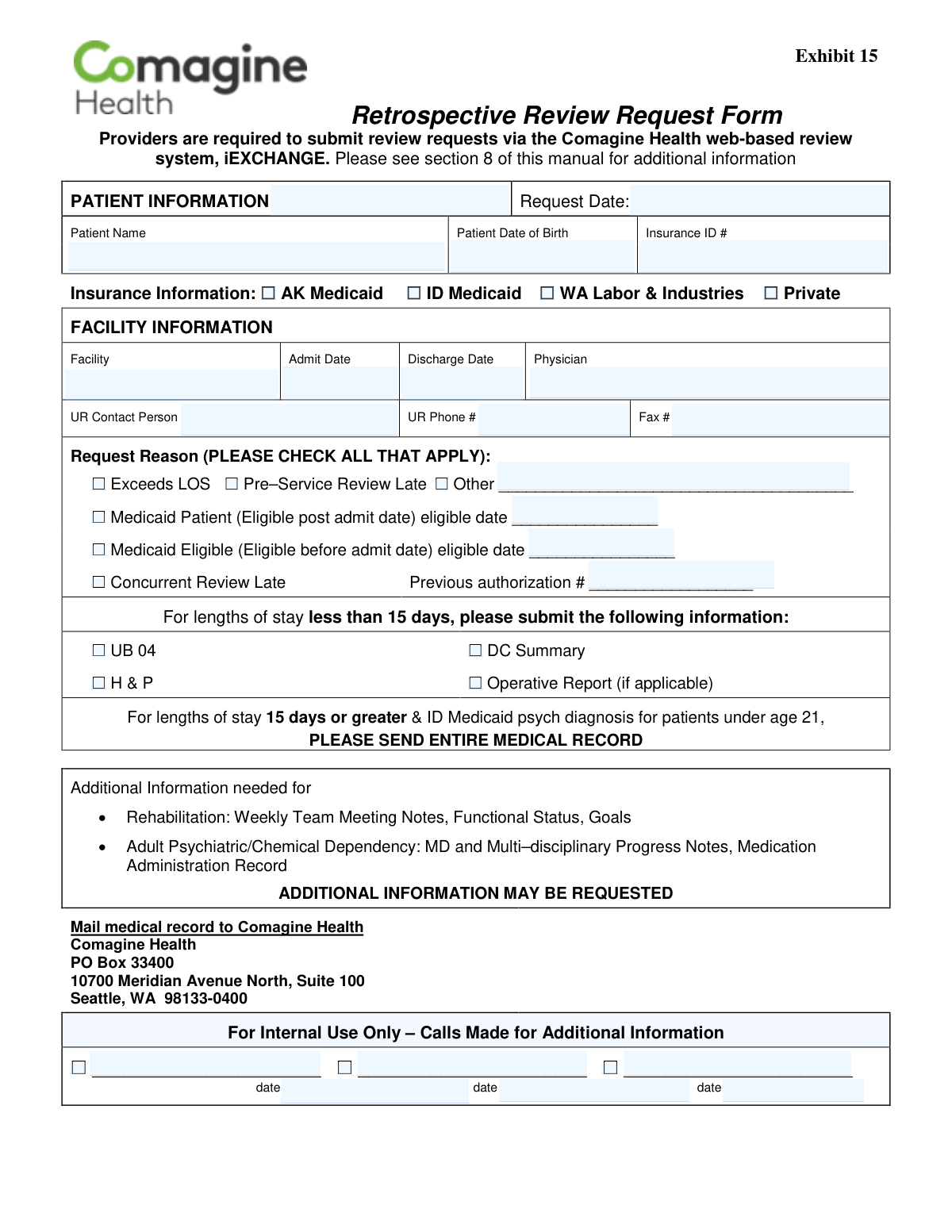
Healthcare administrators, medical billing specialists, and clinical staff typically use these documents when seeking authorization or reimbursement for medical services. For instance, a Retrospective Review Request Form is necessary when a provider needs to justify services after they have already been rendered, often due to emergency situations or a lack of prior authorization. Navigating these regulatory requirements is critical for ensuring that medical facilities are compensated for their work and that patients receive the coverage they are entitled to under their specific health plans.
Completing these detailed forms manually can be a significant administrative burden that pulls focus away from patient care. Tools like Instafill.ai use AI to fill these forms in under 30 seconds, handling complex data accurately and securely to streamline the submission process. This allows medical teams to process reviews more efficiently, reducing the likelihood of manual entry errors that could lead to claim denials or long delays in reimbursement.
Every form on this page can be completed without typing. Instafill is form filling software that reads a PDF and fills it for you — including flat and scanned documents that carry no fillable fields at all.
Forms in This Category
The forms in this category have a median Form Complexity Index of 44/100 (Basic), measured across 1 forms by field count, input difficulty, length, conditional logic and structure. See how it is calculated.
| Form Name | Pages | FCI | |
|---|---|---|---|
| 1. | Retrospective Review Request Form | 1 | Basic 44 |
- Enterprise-grade security & data encryption
- 99%+ accuracy powered by AI
- 1,000+ forms from all industries
- Complete forms in under 60 seconds
How to Choose the Right Form
Navigating the utilization review process is essential for healthcare providers to ensure medical necessity is documented and reimbursement is secured. While utilization management typically involves prospective, concurrent, and retrospective stages, this category focuses on post-service documentation.
When to Use the Retrospective Review Request Form
Currently, the primary document in this category is the Retrospective Review Request Form. This form is specifically designed for cases where medical services have already been completed, but formal authorization or a necessity determination is still required by Comagine Health.
You should choose the Retrospective Review Request Form if your clinical scenario matches one of the following:
- Emergency Admissions: Use this form when a patient was admitted under emergency circumstances that precluded the ability to obtain pre-authorization.
- Retroactive Insurance Coverage: This is the correct choice if a patient was granted insurance eligibility that covers a period in the past during which they received care.
- Missed Authorizations: If a provider failed to obtain a required prior authorization due to administrative error, this form is the vehicle used to request a medical necessity review after the fact to avoid a permanent claim denial.
- Post-Discharge Clinical Reviews: Use this when a payer requires a full clinical audit of the medical record after the patient has been discharged to validate the level of care provided.
Streamlining Your Submission
Because retrospective reviews are often subject to high levels of scrutiny, the quality of the information provided is critical. The Retrospective Review Request Form requires detailed provider information, patient demographics, and specific clinical justifications.
To expedite this process, you can use Instafill.ai to convert the standard PDF into a smart, fillable form. Our AI-powered tools help ensure that every field is completed accurately, allowing you to focus on the clinical data rather than the manual data entry, ultimately speeding up the decision-making process from the review organization.
Form Comparison
| Form | Purpose | Who Files It | Filing Timeline |
|---|---|---|---|
| Retrospective Review Request Form | Request medical necessity review for services already rendered to secure payment. | Healthcare providers or medical billing departments. | After services are provided without obtaining prior authorization. |
Tips for utilization review forms
The most common reason for a retrospective review denial is missing clinical evidence. Ensure all physician notes, diagnostic results, and treatment plans are attached to the form to prove the medical necessity of the services already rendered.
Small typos in NPI numbers, member IDs, or dates of birth can lead to immediate administrative rejections. Always cross-reference these identifiers with the patient's insurance card and your internal records before finalizing the submission.
Managing multiple review requests is time-consuming, but AI-powered tools like Instafill.ai can complete these forms in under 30 seconds with high accuracy. Your sensitive data stays secure during the process, making it a reliable way to handle high volumes of paperwork.
Ensure that the ICD-10 diagnosis codes and CPT procedure codes on the form match the clinical documentation exactly. Discrepancies between the requested review and the patient’s medical record are frequent red flags for reviewers.
Since retrospective reviews are conducted after-the-fact, clearly state why a pre-authorization was not obtained. Whether it was an emergency situation or a change in patient status, providing this context helps the reviewer understand the necessity of the request.
When uploading or attaching clinical records, organize them in chronological order to help the reviewer follow the patient's care path. A well-organized submission reduces the time it takes for Comagine Health or other entities to reach a determination.
Frequently Asked Questions
Utilization review forms are used to evaluate the medical necessity and appropriateness of healthcare services. They help insurers and review organizations like Comagine Health determine if a treatment plan meets established clinical guidelines for coverage and reimbursement.
This form is used when medical services have already been provided but did not receive prior authorization. It is often necessary in emergency situations or when clinical circumstances prevented a standard pre-service review from occurring, requiring a review after the fact to secure payment.
Yes, AI tools like Instafill.ai can automatically fill these forms by extracting data from medical records and provider notes. This ensures that clinical details are accurately transcribed into the form fields, reducing the risk of manual entry errors that could lead to denials.
Most requests require comprehensive clinical documentation, including physician notes, lab results, and discharge summaries. These documents provide the evidence needed for the reviewer to assess the medical necessity of the services rendered.
Usually, the healthcare provider’s billing department or clinical staff handles the submission of utilization review forms. They coordinate between the treating physician and the review organization to ensure all medical justifications are clearly documented.
Using AI-powered services, these forms can be filled in under 30 seconds. The technology accurately extracts the necessary data from source documents and places it directly into the PDF, significantly reducing administrative time for busy medical offices.
Completed forms should be submitted to the designated review organization, such as Comagine Health, via their specified portal, fax, or secure email. Submission instructions are typically found on the form itself or on the organization's official provider website.
If a review results in a denial, the provider usually has the right to appeal the decision by providing additional clinical evidence. The denial notice will typically outline the specific reasons for the decision and the steps required to initiate a formal appeal.
Requirements vary significantly depending on the specific insurance plan and the state regulations governing healthcare reviews. It is important to verify the specific criteria for the patient's plan and the reviewing body before submitting a request.
A retrospective review determines medical necessity, which is a prerequisite for payment, but it does not guarantee reimbursement. Final payment also depends on other factors like member eligibility at the time of service, plan benefits, and adherence to standard billing guidelines.
Glossary
- Form Complexity Index
- Instafill’s 0–100 measure of how much effort a form takes to complete, calculated deterministically from the form’s own structure rather than estimated. It combines the number of fillable fields (the largest factor), how difficult those fields are to complete based on their type, the number of pages that contain fields, the amount of conditional “fill-only-if” logic, and how many sections the form is divided into, then adds modifiers for tables and repeating lists, bundled instruction pages, and dense page layouts. A higher score means the form is harder to fill out by hand. The forms in this category have a median Form Complexity Index of 44/100 (Basic). See exactly how it is calculated.
- Utilization Review (UR)
- The process used by health plans and healthcare providers to evaluate whether medical services are necessary and appropriate based on established clinical guidelines.
- Retrospective Review
- An evaluation of medical services conducted after the care has been delivered to determine if the treatment met medical necessity and coverage standards for payment.
- Medical Necessity
- A determination that a specific medical service or supply is essential for treating a patient's condition and meets accepted standards of medical practice.
- Pre-authorization
- Advance approval from a health plan that is required before a service is provided; a retrospective review is often required if this step was missed.
- Clinical Documentation
- The medical records, physician notes, and test results submitted alongside a review request to prove that the services provided were justified.
- Adverse Determination
- A formal decision by a review organization or insurance company that a service does not meet the criteria for coverage or medical necessity.
- Comagine Health
- A non-profit organization that provides healthcare consulting and utilization review services to ensure quality and appropriateness of care for state and federal programs.
- ICD-10 Codes
- A standardized system of alphanumeric codes used by healthcare providers to classify and report every diagnosis and procedure on medical forms.