Fill out vehicle lease forms
with AI.
Vehicle lease forms are essential documents used to manage the financial and legal obligations associated with leasing motor vehicles. These forms facilitate the transfer of possession while ensuring that tax liabilities, registration requirements, and ownership details are accurately recorded with state authorities. In particular, motor vehicle forms like those used in Colorado help bridge the gap between dealerships, lessors, and the Department of Revenue, ensuring that sales tax is correctly accounted for and that the vehicle is properly titled. Without these standardized documents, the complex transition between a sale and a long-term lease could lead to significant bureaucratic delays and potential tax discrepancies.
By continuing, you acknowledge Instafill's Privacy Policy and agree to get occasional product update and promotional emails.
About vehicle lease forms
These forms are primarily utilized by auto dealers, fleet management companies, and individual lessors who are involved in the commercial or private leasing of vehicles. For instance, when a dealer sells a vehicle to a lessor who will then collect lease payments from a third party, specific tax statements—such as Colorado’s DR series forms—are required to clarify who is responsible for tax collection. These documents are necessary during the initial lease signing and when presenting paperwork to county clerks for title and registration issuance. Navigating these requirements can be tedious, but using tools like Instafill.ai allows you to complete these forms using AI in under 30 seconds, ensuring data accuracy and security while handling the paperwork efficiently.
Every form on this page can be completed without typing. Instafill is form filling software that reads a PDF and fills it for you — including flat and scanned documents that carry no fillable fields at all.
Forms in This Category
The forms in this category have a median Form Complexity Index of 52/100 (Moderate), measured across 1 forms by field count, input difficulty, length, conditional logic and structure. See how it is calculated.
| Form Name | Pages | FCI | |
|---|---|---|---|
| 1. | Colorado Form DR 0026, Tax Statement for Leased Motor Vehicle | 1 | Moderate 52 |
- Enterprise-grade security & data encryption
- 99%+ accuracy powered by AI
- 1,000+ forms from all industries
- Complete forms in under 60 seconds
How to Choose the Right Form
Navigating vehicle lease documentation in Colorado requires specific tax forms to ensure that sales tax is correctly handled between the dealer, the lessor, and the state. While leasing involves various contracts, the regulatory side focuses on tax accountability and registration.
For Auto Dealers and Lessors
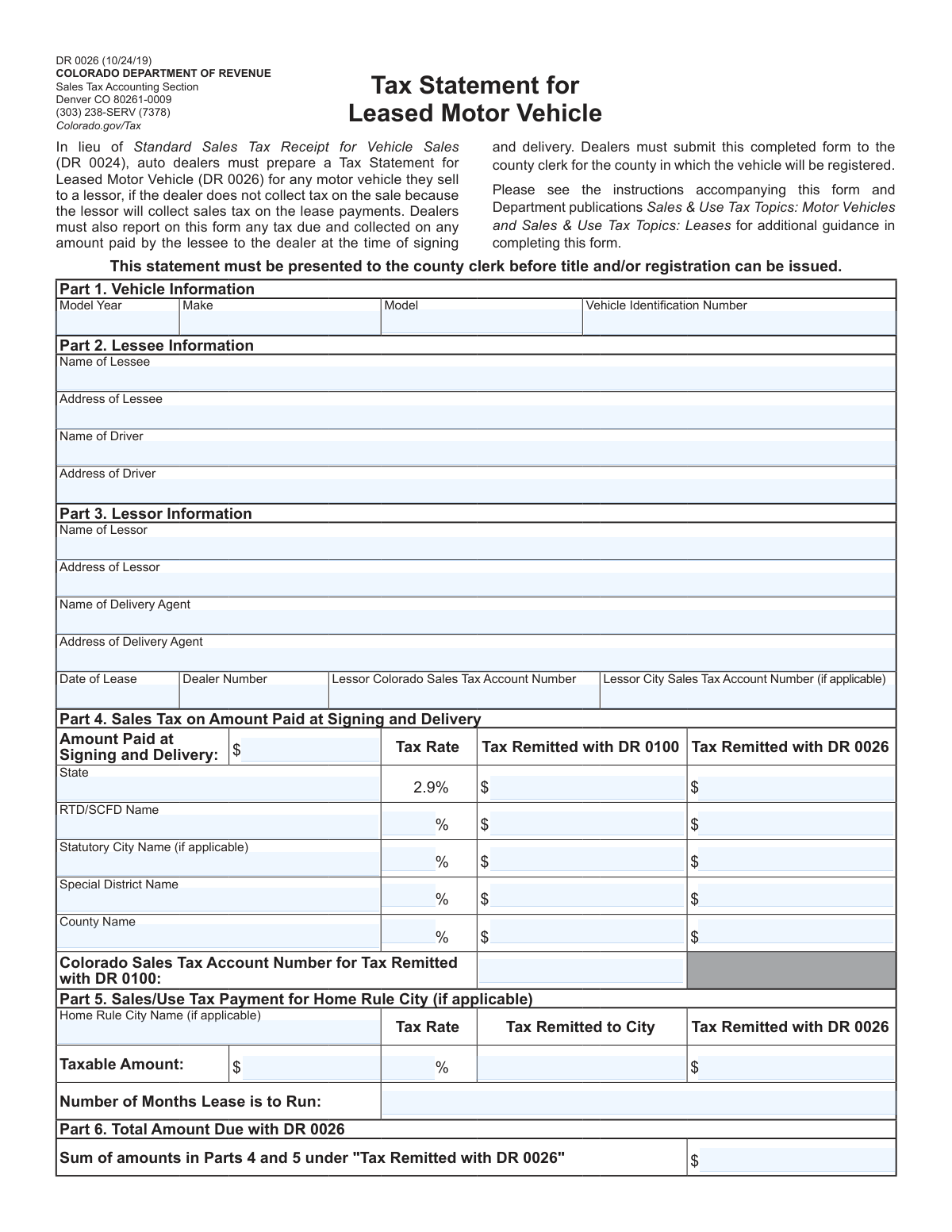
If you are an auto dealer selling a vehicle to a leasing company (the lessor), the primary document you need is the Colorado Form DR 0026 (Tax Statement for Leased Motor Vehicle). This form is essential when the lessor—rather than the dealer—is responsible for collecting sales tax on subsequent lease payments.
You should choose this form if:
- Selling to a Lessor: You are transferring a vehicle to a leasing entity that will manage the consumer lease.
- Title and Registration: You need to provide proof of tax responsibility to the county clerk to secure a title and registration for the new owner (the lessor).
- Tax Accountability: The transaction involves state, county, or local sales tax considerations specific to Colorado motor vehicle laws.
Compliance and Registration
The DR 0026 acts as a bridge between the sale and the ongoing lease. Without this properly filed tax statement, the county clerk cannot issue the necessary title or registration for the vehicle. It ensures that the state has a clear record of who is responsible for tax collection over the life of the lease, preventing double taxation or missed revenue at the local level.
Using Digital Tools for DMV and DR Forms
Since motor vehicle and tax forms like the DR 0026 require precise data entry to avoid delays at the DMV, using an AI-powered filler can prevent common errors. Whether you are dealing with a standard PDF or a non-fillable scan, tools like Instafill.ai allow you to complete these Colorado Department of Revenue forms quickly, ensuring all tax jurisdictions and dealer information are correctly identified before submission.
Form Comparison
| Form | Primary Purpose | Who Files It | Key Information Included |
|---|---|---|---|
| Colorado Form DR 0026, Tax Statement for Leased Motor Vehicle | Documents sales tax responsibility for motor vehicles sold to a lessor. | Auto dealers selling a vehicle to a third-party leasing company. | State, county, and local sales tax breakdown for lease payments. |
Tips for vehicle lease forms
Double-check the specific city and county tax rates based on the lessee's primary address. Incorrect tax calculations or selecting the wrong jurisdiction are common reasons for registration delays at the County Clerk's office.
The information on your tax statement must mirror the details on the title application and lease agreement exactly. Any discrepancies in names, addresses, or the VIN can result in the DMV rejecting the filing.
AI-powered tools like Instafill.ai can complete these complex vehicle forms in under 30 seconds with high accuracy. The data stays secure during the process, providing a massive time-saving advantage for dealers and lessors handling multiple filings.
Clearly identify whether the dealer or the lessor is responsible for tax collection before filling out the form. Form DR 0026 is specifically required when the lessor, rather than the dealer, is responsible for collecting sales tax on lease payments.
Always save a digital copy of the completed tax statement for your dealership or leasing company records. These documents are essential for state tax audits and serve as proof of tax accounting for the vehicle's registration history.
A single digit error in the Vehicle Identification Number (VIN) or an incorrect purchase price can invalidate the document. Always verify these fields against the physical vehicle and the final lease contract before finalizing the form.
Frequently Asked Questions
These forms are used to document the tax responsibilities associated with leasing a vehicle. They ensure that sales tax is correctly accounted for at the state, county, and municipal levels when a lessor takes over the tax collection duties from a dealer.
Typically, auto dealers complete this form when selling a vehicle to a lessor. It is required in scenarios where the lessor, rather than the dealer, will be responsible for collecting and remitting sales tax on the subsequent lease payments.
The form should be prepared at the time of the sale from the dealer to the leasing company. It must be completed and signed before the vehicle can be properly titled and registered in the state of Colorado.
Once the form is filled out, it is generally presented to the local County Clerk and Recorder's office. This submission is a mandatory step for the lessor to secure the vehicle's title and registration.
This form acts as official proof of how sales tax will be managed over the life of the lease. Without it, the county clerk cannot verify that tax requirements are being met, which prevents the issuance of a valid title or license plates.
In many lease scenarios, the lessor collects sales tax on each monthly payment rather than the dealer collecting the full amount upfront. These forms document this specific arrangement so state authorities know which party is responsible for the tax revenue.
Yes, it is standard practice for dealers and lessors to maintain records of all motor vehicle tax statements for several years. These documents are essential for internal audits and for verifying that the transaction complied with Colorado Department of Revenue regulations.
If the required tax statement is missing, the registration process will likely be delayed at the DMV. The lessee or lessor may need to contact the original selling dealer to obtain a duplicate or corrected version of the form to proceed.
Colorado motor vehicle forms are designed to capture data for various jurisdictions simultaneously. This ensures that the appropriate tax percentages are correctly allocated to the state, the specific county, and any local special districts or municipalities.
Yes, you can use AI tools to streamline the process of filling out complex vehicle lease forms. AI-powered services like Instafill.ai can accurately extract data from your source documents and place it into the correct fields automatically.
Using AI technology, you can complete these forms in under 30 seconds. The system extracts relevant information from your purchase or lease agreements and populates the PDF instantly, ensuring high accuracy and saving significant time.
Glossary
- Form Complexity Index
- Instafill’s 0–100 measure of how much effort a form takes to complete, calculated deterministically from the form’s own structure rather than estimated. It combines the number of fillable fields (the largest factor), how difficult those fields are to complete based on their type, the number of pages that contain fields, the amount of conditional “fill-only-if” logic, and how many sections the form is divided into, then adds modifiers for tables and repeating lists, bundled instruction pages, and dense page layouts. A higher score means the form is harder to fill out by hand. The forms in this category have a median Form Complexity Index of 52/100 (Moderate). See exactly how it is calculated.
- Lessor
- The legal owner of the vehicle, typically a leasing company or financial institution, that grants use of the vehicle to another party in exchange for payments.
- Lessee
- The individual or business entity that pays for the right to use the vehicle for a specific period of time under a lease agreement.
- DR 0026
- The specific Colorado Department of Revenue form used to certify that sales tax will be collected on monthly lease payments rather than paid in full at the time of purchase.
- Situs
- The specific geographic location where the vehicle is primarily stored or used, which determines the local and county tax rates applied to the lease.
- County Clerk and Recorder
- The local government official responsible for processing vehicle titles and registrations once the proper tax forms have been submitted.
- Use Tax
- A tax imposed on the use or storage of a vehicle in Colorado when sales tax was not previously paid to a dealer or at the time of purchase.
- Lienholder
- An entity that holds a legal interest in the vehicle as collateral until the lease terms or financing obligations are fully satisfied.
- Vendor
- In the context of vehicle leasing forms, this refers to the motor vehicle dealer who sells the car to the lessor to facilitate the lease for the customer.