Fill out vehicle sales forms
with AI.
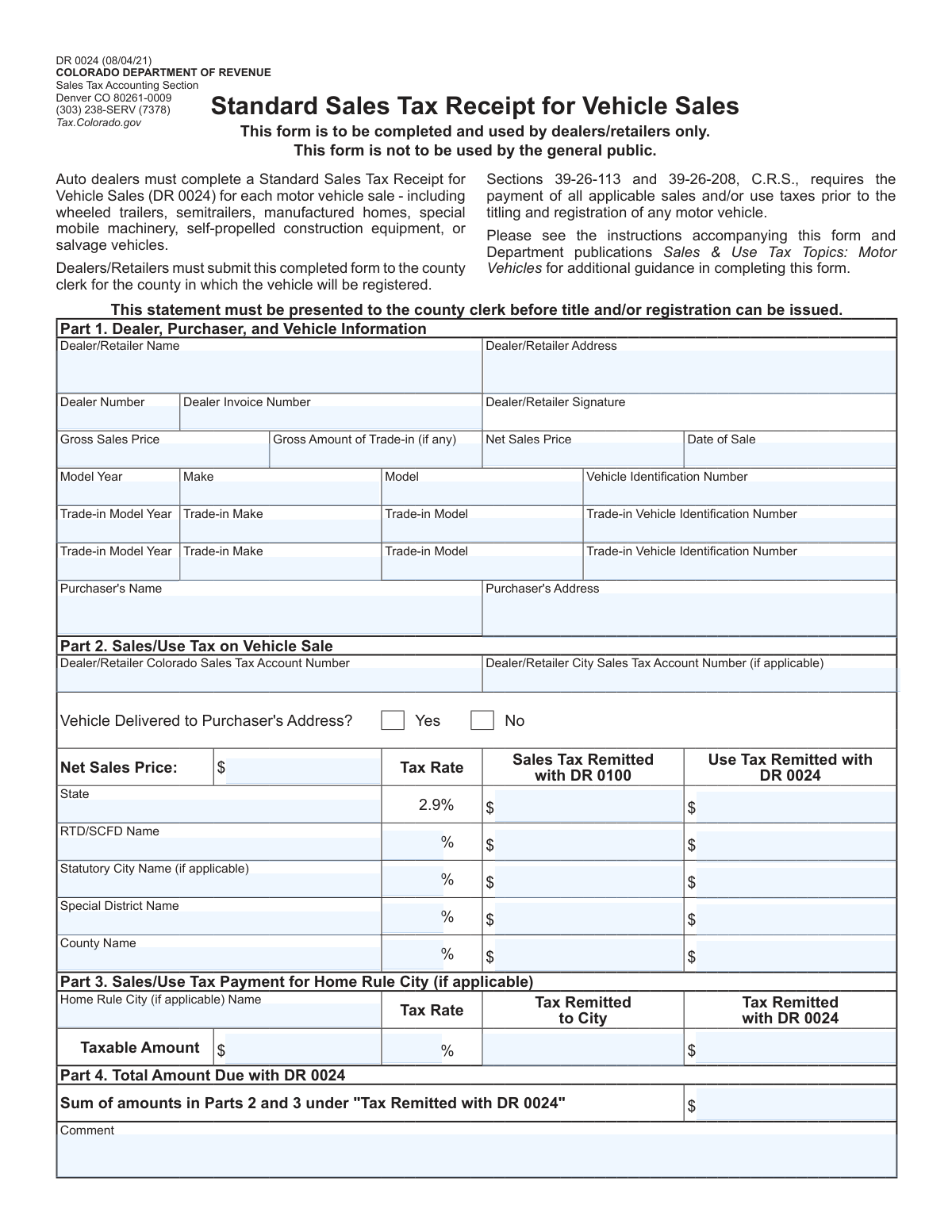
Vehicle sales forms are essential for documenting the transfer of ownership and ensuring all legal and tax obligations are met. In states like Colorado, specific documentation such as the Standard Sales Tax Receipt for Vehicle Sales (DR 0024) is required to calculate and verify state, county, and local taxes. These forms serve as the official record for both the buyer and the Department of Revenue, making them a critical component of the title and registration process. Without accurate motor vehicle forms, buyers may face significant delays when attempting to register their vehicle or secure a title.
By continuing, you acknowledge Instafill's Privacy Policy and agree to get occasional product update and promotional emails.
About vehicle sales forms
Dealerships, private sellers, and buyers all interact with these documents during a transaction. Whether you are an auto dealer processing a high volume of sales or an individual selling a car privately, having the correct Colorado tax forms is necessary to ensure the transaction is compliant with state law. These sales tax forms are typically needed at the point of sale to ensure that all municipal taxes are accurately reported, providing a clear audit trail for the DMV.
Completing these detailed Colorado DMV forms manually can be time-consuming and prone to clerical errors. Tools like Instafill.ai use AI to fill these forms in under 30 seconds, handling data accurately and securely to streamline the administrative side of vehicle sales. This technology provides a practical way to manage paperwork, ensuring that every field is addressed correctly before submission.
Every form on this page can be completed without typing. Instafill is form filling software that reads a PDF and fills it for you — including flat and scanned documents that carry no fillable fields at all.
Forms in This Category
The forms in this category have a median Form Complexity Index of 56/100 (Moderate), measured across 1 forms by field count, input difficulty, length, conditional logic and structure. See how it is calculated.
| Form Name | Pages | FCI | |
|---|---|---|---|
| 1. | Form DR 0024, Standard Sales Tax Receipt for Vehicle Sales | 1 | Moderate 56 |
- Enterprise-grade security & data encryption
- 99%+ accuracy powered by AI
- 1,000+ forms from all industries
- Complete forms in under 60 seconds
How to Choose the Right Form
Determining Your Colorado Vehicle Tax Needs
When processing a motor vehicle sale in Colorado, the primary concern is ensuring that the Department of Revenue receives the correct tax documentation. This is essential for the buyer to successfully title and register the vehicle at the DMV. While different states have different requirements, Colorado relies on a specific standardized receipt for dealership transactions.
For Licensed Auto Dealers
If you are a licensed motor vehicle dealer in the state of Colorado, you are required to provide the buyer with a completed Form DR 0024, Standard Sales Tax Receipt for Vehicle Sales. This form is the industry standard for documenting the financial specifics of a sale. It serves several critical purposes:
- Tax Calculation: It provides a detailed breakdown of state, county, and local sales or use taxes.
- Proof of Payment: It acts as the official receipt that the DMV requires before they will issue a title or registration to the new owner.
- Regulatory Compliance: It ensures the transaction meets Colorado Department of Revenue standards for reporting.
When to Use Form DR 0024
You should select and fill out this form if your transaction meets the following criteria:
- The sale involves a motor vehicle, trailer, or semi-trailer.
- The sale occurred within Colorado or involves a Colorado resident buyer.
- You need to document the exact breakdown of municipal and special district taxes, such as RTD or Scientific and Cultural Facilities District (CD) taxes.
Using a digital version of Form DR 0024 via Instafill.ai allows you to automate these complex tax calculations, reducing the risk of mathematical errors that could lead to the DMV rejecting the buyer's registration application. Please note that if you are a private seller (non-dealer), you typically do not use this specific receipt form; instead, the buyer usually pays the applicable taxes directly to the county clerk at the time of registration.
Form Comparison
| Form | Purpose | Who Files It | When to Use |
|---|---|---|---|
| Form DR 0024, Standard Sales Tax Receipt for Vehicle Sales | Documents motor vehicle sales and calculates state, county, and local sales taxes. | Licensed Colorado motor vehicle dealers and leasing companies. | When a vehicle is sold to ensure proper tax collection for registration. |
Tips for vehicle sales forms
Ensure the Vehicle Identification Number (VIN) and current mileage are recorded exactly as they appear on the vehicle. Even a single digit error can cause significant delays in title processing or registration at the DMV.
Sales tax for vehicles often includes varying state, county, and municipal rates based on the buyer's residence. Use current tax rate charts to ensure the calculations are correct before finalizing the receipt to avoid underpayment issues.
AI-powered tools like Instafill.ai can complete these forms in under 30 seconds with high accuracy, acting as a major time-saver for dealers handling multiple transactions. Your data stays secure during the process, ensuring privacy while streamlining your administrative workload.
Ensure the buyer's name on the form matches their legal identification exactly to avoid issues during the title transfer. Discrepancies between the sales receipt and the title application can result in the DMV rejecting the documentation.
If a trade-in is part of the transaction, make sure the allowance is clearly subtracted before calculating the final taxable amount. This ensures the buyer is only taxed on the net purchase price as permitted by state regulations.
DMV and Department of Revenue officials often reject forms that contain white-out or obvious manual alterations. If a mistake is made on a physical form, it is best to generate a fresh digital copy to ensure document integrity.
It is essential for both the dealer and the buyer to keep a signed copy of the sales tax receipt for their permanent records. This documentation is necessary for the buyer to prove tax compliance and for the dealer during potential tax audits.
Frequently Asked Questions
These forms, such as Form DR 0024, are used to document the sale of a motor vehicle and calculate the necessary state, county, and local taxes. They serve as an official receipt that the buyer must present to the DMV to prove that taxes have been handled correctly before a title or registration can be issued.
For transactions involving a licensed dealership, the dealer is typically responsible for completing the sales tax receipt forms. In private party sales, while different documentation like a Bill of Sale is used, the buyer remains responsible for ensuring all tax information is accurately reported to the county clerk.
Yes, you can use AI-powered tools like Instafill.ai to complete these forms in under 30 seconds. The AI can accurately extract relevant data from your purchase agreements or invoices and place it directly into the official form fields, ensuring high accuracy and speed.
The DMV requires these forms to verify that the correct amount of tax was collected based on the vehicle's purchase price and the buyer's jurisdiction. Without this standardized documentation, the state cannot confirm that all local and state tax obligations have been met for the vehicle's registration.
While manual entry can take several minutes and requires careful calculation, using an automated service can reduce the process to less than a minute. AI tools can instantly map data from your source documents to the form, significantly speeding up the administrative side of a vehicle sale.
You will generally need the vehicle's identification number (VIN), the final purchase price, any trade-in credits, and the specific addresses for both the buyer and the seller. This information is critical for determining the correct tax rates for the specific municipality where the vehicle will be registered.
After the form is completed and signed by the appropriate parties, it is typically submitted to the County Clerk and Recorder’s office in the buyer's county of residence. This is usually done at the same time the buyer applies for the vehicle's title and license plates.
Errors on vehicle sales forms can lead to the rejection of the title application by the DMV. Incorrect tax calculations may result in the buyer being charged the wrong amount at the time of registration or facing future audits and penalties from the Department of Revenue.
Yes, standard Colorado vehicle sales forms are designed to account for multiple layers of taxation, including state, county, city, and special district taxes. This consolidation helps ensure that all applicable taxing authorities receive their portion of the sales or use tax from a single document.
Standard sales tax receipt forms are mandatory for sales made by licensed motor vehicle dealers. They ensure that the transaction is transparent and that the state has a clear record of the tax liability generated by the sale of the asset.
Glossary
- Form Complexity Index
- Instafill’s 0–100 measure of how much effort a form takes to complete, calculated deterministically from the form’s own structure rather than estimated. It combines the number of fillable fields (the largest factor), how difficult those fields are to complete based on their type, the number of pages that contain fields, the amount of conditional “fill-only-if” logic, and how many sections the form is divided into, then adds modifiers for tables and repeating lists, bundled instruction pages, and dense page layouts. A higher score means the form is harder to fill out by hand. The forms in this category have a median Form Complexity Index of 56/100 (Moderate). See exactly how it is calculated.
- VIN (Vehicle Identification Number)
- A unique 17-character code assigned to every motor vehicle that serves as its official identification for titling and registration.
- Sales and Use Tax
- Taxes applied to the purchase of a vehicle; sales tax is collected on local purchases, while use tax applies when a vehicle is bought in one jurisdiction but used in another.
- Trade-in Allowance
- The agreed-upon value of a buyer's old vehicle that is subtracted from the purchase price of the new vehicle, typically reducing the total amount of sales tax owed.
- Lienholder
- A bank or financial institution that has a legal interest in the vehicle until the buyer has fully paid off their auto loan.
- Special District Tax
- Localized taxes in Colorado, such as those for the Regional Transportation District (RTD), that may be added to the state and county sales tax rates.
- Odometer Disclosure
- A formal statement where the seller declares the vehicle's current mileage to ensure the buyer and the state have an accurate record of the vehicle's use.
- DR 0024
- The specific Colorado Department of Revenue form used as a standard sales tax receipt, required for a buyer to title and register their vehicle.
- Certificate of Title
- The primary legal document that proves vehicle ownership, which can only be issued once all sales taxes and fees are documented and paid.