Fill out vehicle transfer forms
with AI.
Vehicle transfer forms are essential legal documents used during the sale or transfer of ownership of a motor vehicle. Whether you are selling a car privately, gifting a vehicle to a family member, or purchasing a used motorcycle, these forms ensure that the legal title and responsibility for the vehicle are correctly shifted from one party to another. Properly completed documentation protects both the buyer and the seller by establishing a clear timeline of ownership and liability, preventing future disputes over registration or insurance.
By continuing, you acknowledge Instafill's Privacy Policy and agree to get occasional product update and promotional emails.
About vehicle transfer forms
These forms are typically required by state motor vehicle departments, such as the Oregon DMV, to finalize registration and title updates. Common documents in this category include official vehicle bill of sale forms and various motor vehicle transfer notices. Sellers need them to release their liability for future tickets or accidents involving the vehicle, while buyers need them to prove legal ownership and pay the necessary taxes or fees. Navigating DMV requirements can be complex, but having the right paperwork ready is the first step toward a smooth and legal transaction.
Completing these documents accurately is crucial to avoid delays at the DMV or issues with the title transfer. Tools like Instafill.ai use AI to fill these forms in under 30 seconds, ensuring data is handled securely and precisely. This practical time-saver streamlines the administrative side of a sale, allowing you to focus on the transaction rather than the paperwork.
Every form on this page can be completed without typing. Instafill is form filling software that reads a PDF and fills it for you — including flat and scanned documents that carry no fillable fields at all.
Forms in This Category
The forms in this category have a median Form Complexity Index of 27/100 (Simple), measured across 1 forms by field count, input difficulty, length, conditional logic and structure. See how it is calculated.
| Form Name | Pages | FCI | |
|---|---|---|---|
| 1. | Form 735-501, Vehicle Bill of Sale | 1 | Simple 27 |
- Enterprise-grade security & data encryption
- 99%+ accuracy powered by AI
- 1,000+ forms from all industries
- Complete forms in under 60 seconds
How to Choose the Right Form
Navigating the paperwork for a vehicle transfer doesn't have to be complicated. When you are buying or selling a vehicle in Oregon, the primary document you need is the official DMV-issued Bill of Sale. This ensures that the transaction is legally recognized and that both parties are protected from future liability or title disputes.
The Essential Oregon Transfer Document
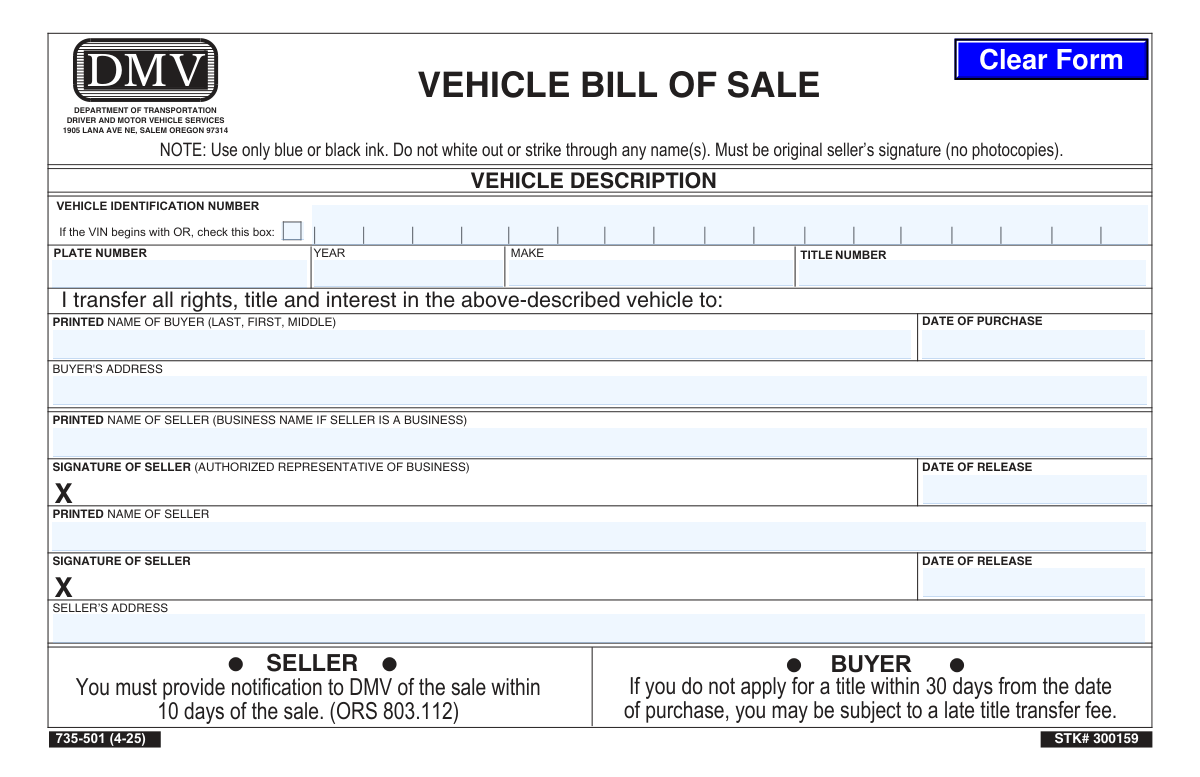
If you are conducting a private sale within the state of Oregon, you should use Form 735-501, Vehicle Bill of Sale. While some people use generic templates found online, this specific Oregon DMV form is the gold standard for state-specific motor vehicle forms. It is specifically designed to capture all the data required by the Driver and Motor Vehicle Services (DMV) to process a title transfer smoothly and update the state's registration records.
When to Choose Form 735-501
You should select this form if your transaction meets the following criteria:
- Private Party Sales: You are selling or purchasing a car, truck, or motorcycle from another individual rather than a licensed dealership.
- Title Applications: The buyer needs a formal, state-recognized record of purchase to apply for a new certificate of title in their name.
- Seller Liability Protection: The seller needs a signed record to notify the DMV that they have sold the vehicle, protecting them from future tickets or towing fees incurred by the new owner.
- Oregon-Based Transactions: The vehicle is registered in Oregon and the transaction is governed by Oregon state law.
Key Information for Your Form
When filling out Form 735-501, ensure you have the vehicle's Year, Make, and Vehicle Identification Number (VIN) ready. Both the buyer and seller must provide their full legal names and addresses. Using a digital tool like Instafill.ai to complete this form helps prevent errors in these critical fields, ensuring the Oregon DMV accepts your paperwork on the first try without requiring a trip back to the seller for corrections.
Form Comparison
| Form | Primary Purpose | Key Information Required | Typical Use Case |
|---|---|---|---|
| Form 735-501, Vehicle Bill of Sale | Legally records the transfer of vehicle ownership between a buyer and seller in Oregon. | Includes vehicle description, purchase price, transaction date, and buyer/seller contact details. | Essential for applying for a new title and notifying the DMV of a sale. |
Tips for vehicle transfer forms
A single incorrect digit in the VIN can result in the DMV rejecting your transfer application or title request. Always cross-reference the number on the physical vehicle dashboard or door jamb with the number written on the form to ensure a perfect match before submitting.
Both the buyer and the seller should keep a signed copy of the bill of sale for their personal records. This document serves as vital proof of the transaction date and can protect the seller from liability for future tickets, tolls, or accidents involving the vehicle.
Manually entering vehicle data can be tedious and prone to typos. AI-powered tools like Instafill.ai can complete these forms in under 30 seconds with high accuracy, and your data stays secure during the process, making it a major time-saver for those handling multiple transfers.
State laws typically require an accurate odometer disclosure at the exact moment of the transfer. Ensure the mileage is recorded exactly as it appears on the dashboard to prevent legal discrepancies or delays when the new owner applies for a title.
A vehicle transfer form is generally not legally binding until all registered owners and the buyer have signed the document. Missing a signature from a co-owner listed on the original title is a common mistake that can stall the entire registration process.
Completing the bill of sale is only the first step for the seller. In many jurisdictions, you must also file a separate notice of sale or transfer with the DMV to officially release your liability and stop the accrual of registration fees in your name.
Frequently Asked Questions
These forms are used to legally document the change of ownership for a motor vehicle from one party to another. They provide a record for both the buyer and the seller and are typically required by the DMV to update the vehicle's title and registration.
An official Bill of Sale serves as a legal receipt for the transaction, detailing the purchase price, vehicle identification number (VIN), and the date of sale. In many states like Oregon, it is a critical document for the buyer to obtain a new title and for the seller to officially report the sale to the DMV.
Both parties usually need to participate in completing the forms. The seller provides vehicle details and signs off on the release of interest, while the buyer provides their contact information and assumes responsibility for the vehicle's new registration.
Yes, AI tools like Instafill.ai can automatically fill these forms in under 30 seconds by extracting data from your existing documents. This ensures that complex details like the VIN and owner information are placed accurately into the correct fields without manual typing.
While manual entry can take several minutes and is prone to errors, using an AI-powered service can complete the process almost instantly. The AI accurately maps information from your source documents directly onto the official DMV PDF.
Once the forms are filled and signed, they are generally submitted to your local DMV office or mailed to the state's motor vehicle department. Some states also offer online portals for reporting a sale or starting the title transfer process.
No, a Bill of Sale is a record of the transaction, while a title is the legal document proving ownership. You usually need the Bill of Sale as supporting documentation to have the state issue a new title in the buyer's name.
If you fill your forms through an online platform, you can typically download and save a digital copy for your records. It is highly recommended to keep a copy of all signed documents in case of future disputes or issues with the vehicle registration.
Yes, most states require their specific official forms, such as Oregon's Form 735-501, to process a transfer. Using the correct state-issued form ensures that you meet all local legal requirements and that the DMV will accept your application without delays.
You will generally need the vehicle's make, model, year, VIN, and current odometer reading. Additionally, you will need the full legal names and addresses of both the buyer and the seller, along with the agreed-upon sale price.
Glossary
- Form Complexity Index
- Instafill’s 0–100 measure of how much effort a form takes to complete, calculated deterministically from the form’s own structure rather than estimated. It combines the number of fillable fields (the largest factor), how difficult those fields are to complete based on their type, the number of pages that contain fields, the amount of conditional “fill-only-if” logic, and how many sections the form is divided into, then adds modifiers for tables and repeating lists, bundled instruction pages, and dense page layouts. A higher score means the form is harder to fill out by hand. The forms in this category have a median Form Complexity Index of 27/100 (Simple). See exactly how it is calculated.
- VIN (Vehicle Identification Number)
- A unique 17-character code assigned to every motor vehicle that serves as its fingerprint for identification and history tracking.
- Certificate of Title
- A legal document issued by the DMV that establishes the official owner of a vehicle and records any active liens.
- Odometer Disclosure Statement
- A mandatory declaration of the vehicle's current mileage at the time of sale to ensure the buyer is aware of the true distance traveled.
- Lienholder
- A person or financial institution that has a legal claim to the vehicle because they provided a loan for its purchase.
- Notice of Sale
- A form submitted by the seller to the DMV to report that the vehicle has been sold, which protects the seller from future liability or parking tickets.
- Release of Interest
- A formal signature or document provided by a legal owner or lienholder to give up their rights to the vehicle so it can be transferred to someone else.
- Power of Attorney (Motor Vehicle)
- A legal document that allows a designated person to sign title and registration documents on behalf of the vehicle owner.
- DMV (Driver and Motor Vehicle Services)
- The state agency responsible for managing vehicle registrations, titles, and driver licensing.