Fill out wind mitigation forms
with AI.
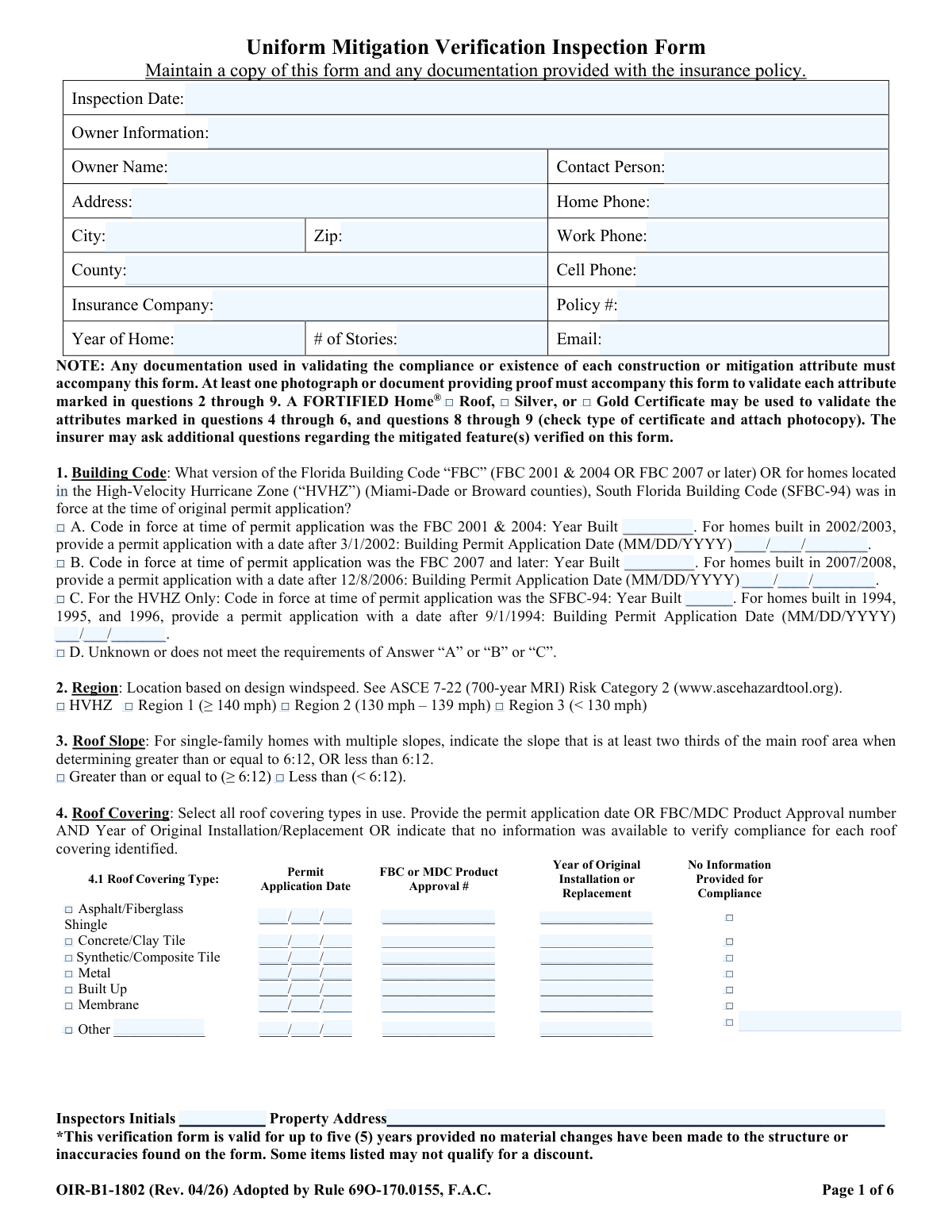
Wind mitigation forms are essential documents used to assess a property's ability to withstand high-velocity winds and hurricanes. These forms, such as the Uniform Mitigation Verification Inspection Form, document specific structural features like roof-to-wall attachments, secondary water barriers, and opening protections. They are critical because they serve as the official record for insurance companies to determine eligibility for premium discounts, particularly in regions prone to severe weather where windstorm insurance is a major expense.
By continuing, you acknowledge Instafill's Privacy Policy and agree to get occasional product update and promotional emails.
About wind mitigation forms
Licensed home inspectors, contractors, and professional engineers typically complete these forms after conducting a physical site assessment. Homeowners and property managers usually require these inspections when applying for new property insurance, renewing an existing policy, or after completing structural upgrades to a building. Because insurance companies rely on this data to calculate risk, accuracy in these reports is paramount to ensuring the homeowner receives the appropriate credits and protections.
Managing the administrative side of these inspections can be time-consuming for busy professionals. Instafill.ai uses AI to accurately fill these forms in under 30 seconds while ensuring data is handled securely. This helps inspectors and property owners streamline their documentation process, turning a complex paperwork requirement into a quick and efficient task.
Every form on this page can be completed without typing. Instafill is form filling software that reads a PDF and fills it for you — including flat and scanned documents that carry no fillable fields at all.
Forms in This Category
The forms in this category have a median Form Complexity Index of 73/100 (Complex), measured across 1 forms by field count, input difficulty, length, conditional logic and structure. See how it is calculated.
| Form Name | Pages | FCI | |
|---|---|---|---|
| 1. | Uniform Mitigation Verification Inspection Form | 6 | Complex 73 |
- Enterprise-grade security & data encryption
- 99%+ accuracy powered by AI
- 1,000+ forms from all industries
- Complete forms in under 60 seconds
How to Choose the Right Form
Navigating property insurance requirements often comes down to documenting how well your home can withstand severe weather. In Florida and other coastal regions, the right documentation can mean the difference between a high premium and significant annual savings.
The Primary Document: Uniform Mitigation Verification Inspection Form
For the vast majority of users in this category, the Uniform Mitigation Verification Inspection Form (specifically Form OIR-B1-1802) is the essential document. This is the standardized form used by certified inspectors to verify a property’s construction features.
You should choose this form if you are looking to:
- Secure Insurance Discounts: Most insurance companies require this specific document to apply "wind mitigation credits" to your policy.
- Verify Recent Upgrades: If you have recently installed a new roof, impact-resistant windows, or hurricane shutters, you must use this form to update your insurance provider.
- Complete a Real Estate Transaction: Buyers often request a wind mitigation inspection to estimate the future cost of homeownership.
Who Should Use This Form?
While homeowners often initiate the process, the Uniform Mitigation Verification Inspection Form must be completed by a qualified professional, such as a licensed building contractor, architect, engineer, or certified home inspector. If you are an inspector, using a digital version of this form allows you to quickly input data regarding:
- Roof covering and age
- Roof-to-wall attachments (clips, straps, or wraps)
- Roof deck attachment methods
- Opening protection (shutters and impact-rated glass)
Why Use Instafill.ai for Your Mitigation Forms?
Because the Uniform Mitigation Verification Inspection Form requires precise technical data and often involves multiple pages of checkboxes, manual entry can be tedious. Using Instafill.ai allows you to take even static PDF versions of this form and turn them into interactive, AI-assisted documents. This ensures that every field—from the roof geometry to the secondary water resistance—is filled out accurately and ready for submission to your insurance carrier.
Form Comparison
| Form | Purpose | Who Files It | Key Features Inspected | Benefit |
|---|---|---|---|---|
| Uniform Mitigation Verification Inspection Form | Documents a property's wind-resistant construction features for insurance rating purposes. | Licensed inspectors, engineers, architects, or certified building contractors. | Roof covering, deck attachment, roof-to-wall connections, and opening protection. | Provides homeowners with potential discounts on windstorm insurance premiums. |
Tips for wind mitigation forms
Collect all relevant permits, receipts, and manufacturer specifications for roof upgrades or impact-resistant windows. Having these documents ready allows you or your inspector to accurately verify the age and quality of construction materials, which is essential for premium discounts.
Insurance providers only accept forms completed by licensed professionals such as building contractors, architects, or certified home inspectors. Ensure the inspector’s license number is clearly recorded on the form to prevent the document from being rejected during the underwriting process.
Whenever you replace a roof, upgrade your garage door, or install hurricane shutters, you should file a new mitigation form immediately. This ensures your insurance premiums are adjusted to reflect the most current safety features and maximum possible savings for your property.
AI-powered tools like Instafill.ai can complete these complex forms in under 30 seconds with high accuracy, ensuring all data points align correctly. This technology handles the heavy lifting while keeping your data secure, making it a significant time-saver for homeowners and inspectors alike.
The section regarding windows, doors, and skylights often yields the highest insurance discounts. Double-check that every opening is accounted for and that the protection level meets the required standards to avoid losing out on potential credits.
A common mistake that delays processing is a missing signature or an incorrect date from either the homeowner or the inspector. Review the final page of the document to ensure all required parties have signed, as insurance companies will not process incomplete verification forms.
Frequently Asked Questions
A wind mitigation form is a document used to verify a property's ability to withstand strong winds and hurricane-force conditions. In states like Florida, these forms are used by insurance companies to determine if a home qualifies for premium discounts based on its specific construction features.
The primary reason is to potentially lower home insurance premiums by proving the home has features that reduce wind damage risk. Many insurance providers offer significant credits for features like hurricane-rated roof coverings, secondary water barriers, and reinforced roof-to-wall connections.
Wind mitigation forms must typically be completed by a licensed professional, such as a building inspector, architect, or engineer. The inspector must sign and certify that the data provided accurately reflects the current state of the property's structural features.
The inspection covers several key areas, including the age of the roof, the type of roof deck attachment, and the shape of the roof. It also evaluates opening protections like impact-resistant windows, doors, and shutters that prevent wind from entering the structure.
While requirements vary by insurance provider, wind mitigation inspections are generally valid for five years. However, if you make significant upgrades to your home—such as installing a new roof or impact windows—you should file a new form immediately to maximize your insurance credits.
No, a wind mitigation inspection is a specialized assessment focused solely on the structural integrity of the home against wind forces. A standard home inspection is broader and covers systems like plumbing, electrical, and HVAC, which are not included in a mitigation report.
Yes, AI-powered tools like Instafill.ai can process wind mitigation forms in under 30 seconds by extracting data from inspection reports or source documents. This technology ensures that the information is placed accurately into the standardized PDF fields, reducing manual data entry errors for inspectors.
When using automated platforms, the process is nearly instantaneous once the source data is uploaded. AI services can convert static PDF forms into interactive ones and populate them with verified data in a fraction of the time it takes to type them manually.
Once the form is signed by a qualified inspector, it should be submitted directly to your property insurance agent or provider. They will review the findings to apply any applicable credits or discounts to your policy renewal or current premium.
These forms are generally not required by law, but they are often highly recommended for homes in hurricane-prone areas. Without a certified mitigation form, insurance companies may charge higher rates because they cannot verify the home's protective features.
This is the standardized version of the wind mitigation form used specifically in Florida. It ensures consistency across all inspections and is recognized by all insurance companies operating within the state for premium credit calculations.
Glossary
- Form Complexity Index
- Instafill’s 0–100 measure of how much effort a form takes to complete, calculated deterministically from the form’s own structure rather than estimated. It combines the number of fillable fields (the largest factor), how difficult those fields are to complete based on their type, the number of pages that contain fields, the amount of conditional “fill-only-if” logic, and how many sections the form is divided into, then adds modifiers for tables and repeating lists, bundled instruction pages, and dense page layouts. A higher score means the form is harder to fill out by hand. The forms in this category have a median Form Complexity Index of 73/100 (Complex). See exactly how it is calculated.
- Wind Mitigation
- The implementation of specific construction features or enhancements designed to reduce the amount of damage a structure suffers during high-wind events like hurricanes.
- OIR-B1-1802
- The official form ID for the Uniform Mitigation Verification Inspection Form used in Florida to document a home's wind-resistant features for insurance purposes.
- Opening Protection
- Refers to impact-resistant windows, doors, and shutters that are rated to withstand debris and pressure during a storm.
- Roof-to-Wall Connection
- The mechanical hardware, such as metal clips, straps, or wraps, that secures the roof structure to the walls to prevent the roof from lifting off during high winds.
- Secondary Water Resistance (SWR)
- A layer of protection, such as a self-adhering polymer modified bitumen, installed under the roof shingles to prevent water from leaking into the home if the primary shingles are blown off.
- Roof Deck Attachment
- The method and materials used to fasten the roof sheathing to the rafters, categorized by the type of nails used and the spacing between them.
- Hip Roof
- A roof shape where all sides slope downward to the walls, which is more aerodynamic than a gable roof and typically results in lower insurance premiums.
- FBC (Florida Building Code)
- The set of construction standards used to determine if a property was built or retrofitted to modern safety requirements for wind resistance.