Yes! You can use AI to fill out Form APP-019, Stipulation to Waive Oral Argument/to Submit on the Briefs
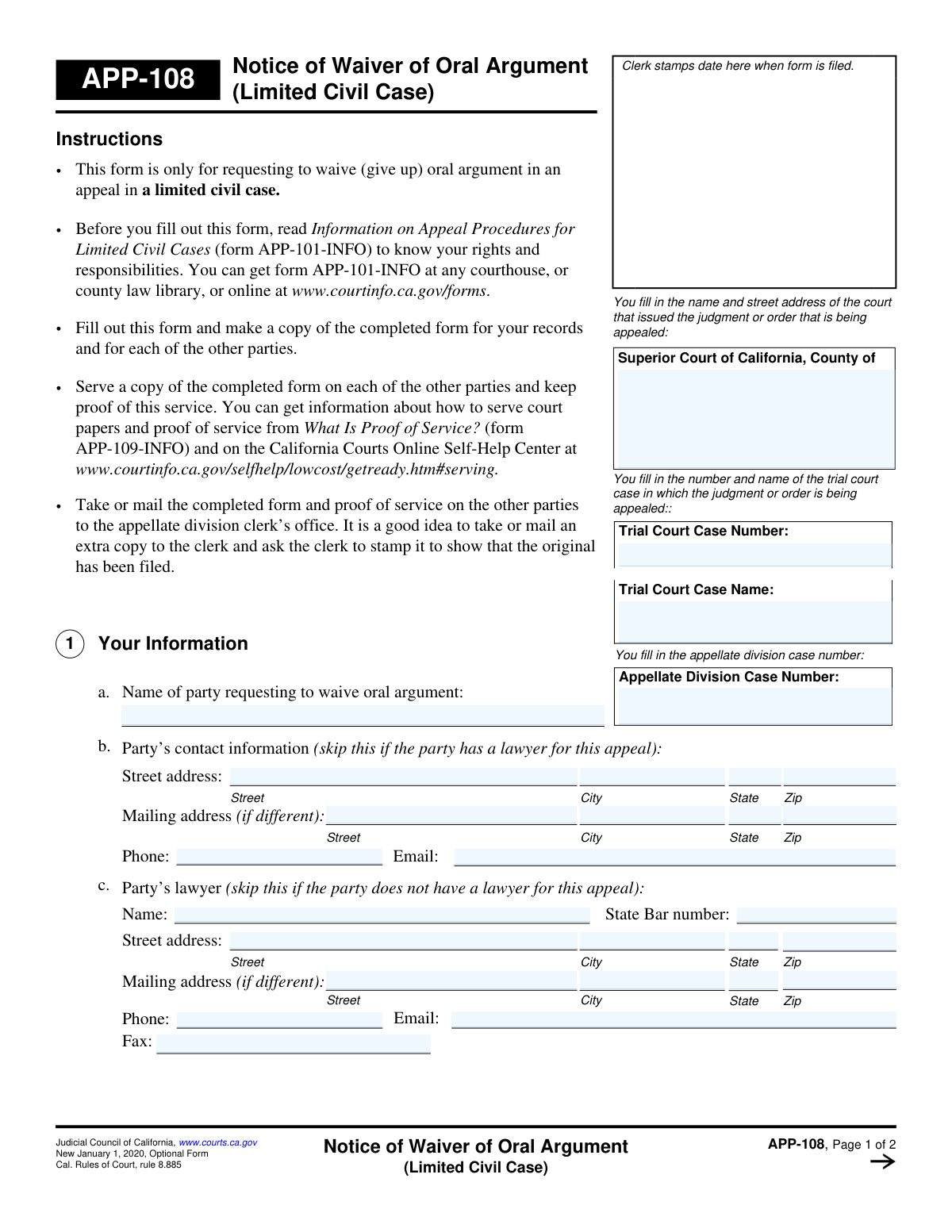
Form APP-019 is a Stipulation to Waive Oral Argument/to Submit on the Briefs, used within the California court system. It allows all parties in an appeal to formally agree to forego oral arguments, requesting the court to make its decision based on the written briefs already filed. This can streamline the appellate process, saving time and expense for everyone involved. Today, this form can be filled out quickly and accurately using AI-powered services like Instafill.ai, which can also convert non-fillable PDF versions into interactive fillable forms.
Our AI automatically handles information lookup, data retrieval, formatting, and form filling.
It takes less than a minute to fill out APP-019 using our AI form filling.
Securely upload your data. Information is encrypted in transit and deleted immediately after the form is filled out.
Form specifications
| Form name: | Form APP-019, Stipulation to Waive Oral Argument/to Submit on the Briefs |
| Number of fields: | 35 |
| Number of pages: | 2 |
| Language: | English |
Instafill Demo: How to fill out PDF forms in seconds with AI
How to Fill Out APP-019 Online for Free in 2026
Are you looking to fill out a APP-019 form online quickly and accurately? Instafill.ai offers the #1 AI-powered PDF filling software of 2026, allowing you to complete your APP-019 form in just 37 seconds or less.
Follow these steps to fill out your APP-019 form online using Instafill.ai:
- 1 Navigate to Instafill.ai and upload your Form APP-019, or select it from their library of official documents.
- 2 Enter the case details, including the court name, trial court case number and name, and the appellate division case number.
- 3 Identify the requesting party and their attorney, if applicable. Provide their full names, addresses, and contact information.
- 4 Use the AI assistant to accurately populate the fields for all parties involved in the stipulation, ensuring all contact and State Bar information is correct.
- 5 Carefully review all the entered information for accuracy. Electronically sign the document on the designated signature line, and enter the date.
- 6 Download the completed, signed Form APP-019 as a high-quality PDF, ready for filing with the appellate court.
Our AI-powered system ensures each field is filled out correctly, reducing errors and saving you time.
Why Choose Instafill.ai for Your Fillable APP-019 Form?
Speed
Complete your APP-019 in as little as 37 seconds.
Up-to-Date
Always use the latest 2026 APP-019 form version.
Cost-effective
No need to hire expensive lawyers.
Accuracy
Our AI performs 10 compliance checks to ensure your form is error-free.
Security
Your personal information is protected with bank-level encryption.
Frequently Asked Questions About Form APP-019
This form is used to formally request that the appellate court waive, or cancel, the oral argument for your case. By submitting it, you are asking the court to make its decision based solely on the written briefs and documents already filed.
Any party involved in an appeal who wishes to have the case decided without a live oral hearing should complete this form. This can be done by the party themselves (if self-represented) or by their attorney.
The 'Trial Court Case Number' is the case number from the original court where the case was first heard. The 'Appellate Division Case Number' is the new number assigned to your case by the court of appeals after the appeal was filed.
Your Appellate Division Case Number is typically found on notices and other documents you have received from the appellate court. It will be different from your original trial court case number.
No, if you are representing yourself (acting 'pro se'), you can leave the lawyer information sections blank. You only need to provide your own personal name, address, and contact information.
The form requests both in case you receive mail at a location different from where you physically reside, such as a P.O. Box. If your street and mailing addresses are the same, you only need to complete the street address section.
After you file the form with the court, the judges will review your request. The court has the final say and may still decide to hold an oral argument even if all parties agree to waive it.
Yes, you should enter the Appellate Division Case Name and Number on the second page as indicated. This ensures your pages are correctly associated with your case file if they become separated.
You will need your trial court and appellate court case names and numbers, as well as your personal contact information. If you have an attorney, you will also need their name, State Bar number, and contact details.
In this field, you should type or clearly print the full name of the person who is signing the form. This will be either your name (if you are self-represented) or your attorney's name.
Yes, services like Instafill.ai use AI to accurately auto-fill form fields from your saved profiles, which can save you time and help reduce errors.
You can upload the form to the Instafill.ai platform, and its AI will identify the fields. You can then click to fill them with your saved information or type directly into the interactive fields before printing.
You can use a service like Instafill.ai, which can convert flat, non-fillable PDFs into interactive, fillable forms online. This allows you to easily type your information into the correct fields.
Compliance APP-019
Validation Checks by Instafill.ai
1
Appellate Case Number Consistency
This check ensures that the 'Appellate Division Case Number' entered on the first page matches the 'Appellate Division Case Number' entered on the second page. This is critical for maintaining document integrity and ensuring that all pages correctly reference the same legal case. If the numbers do not match, the user will be prompted to correct the discrepancy to prevent filing errors.
2
Required Trial Court Case Information
Validates that both the 'Trial Court Case Number' and 'Trial Court Case Name' fields are not empty. This information is fundamental for identifying the specific judgment or order being appealed. Failure to provide this information would make the form incomplete and likely lead to its rejection by the court clerk.
3
Party Name Completeness
Ensures that the 'Party Name' field is filled out completely. The name of the party requesting to waive oral argument is a mandatory piece of information that identifies the filer. If this field is left blank, the form cannot be processed as the identity of the requesting party is unknown.
4
Party Primary Address Completeness
This validation verifies that all components of the 'Party's Street Address' (Street Address, City, State, Zip Code) are filled in. A complete and valid address is required for official notifications and correspondence from the court. An incomplete address will trigger an error, requiring the user to provide all necessary parts.
5
Zip Code Format Validation
Checks all zip code fields ('Party's Street Address', 'Party's Mailing Address', 'Lawyer's Street Address', 'Lawyer's Mailing Address') to ensure they contain either a 5-digit or 9-digit (ZIP+4) numeric value. Correctly formatted zip codes are essential for mail delivery. An invalid format will prevent form submission until corrected.
6
State Field Abbreviation Validation
This check validates that all 'State' fields contain a valid two-letter U.S. state or territory abbreviation. Using standardized abbreviations prevents ambiguity and ensures addresses are processed correctly by postal services and court systems. An invalid entry will result in an error message with a prompt to use a recognized abbreviation.
7
Email Address Format Validation
Verifies that the 'Party's Email Address' and 'Lawyer's Email Address' fields contain a value that conforms to the standard email format (e.g., '[email protected]'). This is crucial for electronic communication and service of documents. If the format is invalid, the user will be alerted to correct the entry.
8
Phone Number Format Validation
This check ensures that all phone number fields ('Party's Phone Number', 'Lawyer's Phone Number', 'Lawyer's Fax Number') follow a standard 10-digit format (e.g., XXX-XXX-XXXX or (XXX) XXX-XXXX). Consistent formatting is important for contact purposes and data integrity. An invalid number will trigger a validation error.
9
Conditional Lawyer Information Requirement
If the 'Lawyer's Name' field is filled out, this validation ensures that the 'Lawyer's State Bar Number', 'Lawyer Street Address', and 'Lawyer's Phone Number' are also provided. This rule ensures that when a party is represented, all necessary information for their legal counsel is captured completely. A failure will prompt the user to complete the lawyer's details.
10
State Bar Number Format
Validates that the 'Lawyer's State Bar Number' follows the expected format for the jurisdiction, which is typically a specific sequence of numbers or alphanumeric characters. This number uniquely identifies the lawyer and confirms their eligibility to practice. An incorrectly formatted number could lead to rejection of the filing.
11
Signature Date Validity
This check ensures the 'Date' field on page 2 contains a valid date in the expected format (e.g., MM/DD/YYYY) and is not a date in the future. The signature date authenticates when the document was signed and must be a real, current, or past date. A future date is logically impossible and will be flagged as an error.
12
Signatory Name Consistency Check
Verifies that the 'Typed/Printed Name' entered on page 2 matches either the 'Party Name' or the 'Lawyer's Name' from page 1. This check confirms that the person signing the form is one of the authorized individuals listed in the document. A mismatch will trigger a warning to ensure the correct person is signing.
13
Incomplete Mailing Address Logic
This validation checks the optional mailing address sections for both the party and the lawyer. If any field within a mailing address group (e.g., 'Mailing Address Street') is filled, it requires all other fields in that group ('City', 'State', 'Zip Code') to be completed as well. This prevents the submission of partial, unusable addresses.
Common Mistakes in Completing APP-019
Filers often mistakenly enter the trial court case number in the field for the appellate division case number, or vice versa. This happens due to the similarity of the fields and can cause significant processing delays or rejection of the filing as it gets routed to the wrong case file. To avoid this, carefully double-check that the number from the original trial court judgment is entered in the 'Trial Court Case Number' field and the number assigned by the appellate court is in the 'Appellate Division Case Number' field.
People frequently use abbreviations or partial names for the court, such as 'Superior Court' instead of the full, required name like 'Superior Court of California, County of San Francisco'. This ambiguity can lead to the document being misrouted or delayed until the correct court can be identified. Always write out the full, official name and address of the court that issued the original judgment to ensure proper and timely processing.
The form requires the full legal name of the party as it appears on official court documents, but individuals often use a nickname, an abbreviated version, or a slightly different spelling. This discrepancy can create confusion and may lead to the filing being rejected because the party cannot be officially matched to the case record. Always use the exact name listed on the original trial court case filings to prevent any identity-related issues.
It is a very common oversight to leave the case name and case number fields at the top of the second page blank. If the pages become separated, the second page, which contains the crucial signature and date, cannot be associated with the correct case. This can invalidate the entire filing, forcing a refiling. To prevent this, make it a habit to fill out the header on all subsequent pages as soon as you complete the first page.
Simple typos or transposing digits when entering the lawyer's state bar number are frequent errors. Since this number is used to verify the attorney's identity and standing, an incorrect number can halt the processing of the document and may lead to questions about representation. Attorneys should verify their bar number carefully before submission. Using a tool like Instafill.ai can help by saving and accurately auto-filling this information for recurring use.
A small typo in an email address, such as 'gmal.com' instead of 'gmail.com', is a critical error in legal filings where electronic service and communication are standard. This mistake means the party or their lawyer will not receive important case updates, notices, or documents from the court, potentially causing them to miss deadlines. Carefully proofread the email address character by character before saving or submitting the form.
Filers sometimes enter a P.O. Box in the 'Street Address' field, which is meant for a physical location, or they neglect to fill out the 'Mailing Address' section when their mail is delivered to a different location. This can result in important legal notices being returned as undeliverable, leading to missed deadlines or default judgments. Ensure a physical address is listed where required and always provide a separate mailing address if applicable.
An applicant might accidentally enter slightly different information in repeated fields, such as having a typo in the case number on page 2 that doesn't match page 1. Such inconsistencies create doubt and can cause clerks to reject the form for clarification, delaying the case. AI-powered tools like Instafill.ai can prevent this by automatically populating repeated fields with consistent data, ensuring accuracy throughout the document.
After signing the document, a person may forget to type or print their name in the designated field below the signature line. An illegible signature without a printed name makes it difficult for court clerks to identify the signatory, which can lead to the document being rejected for being improperly executed. Always ensure the name of the person signing is clearly typed or printed in the appropriate space.
When entering the date, people may use a format like '02/03/24', which could be interpreted as either February 3rd or March 2nd depending on regional conventions. This ambiguity can be problematic for legal deadlines. To avoid confusion, it is best practice to write out the month (e.g., 'February 3, 2024') or use the court's specified format. If the form is a non-fillable PDF, a tool like Instafill.ai can convert it to a fillable version and help standardize date formats.
Saved over 80 hours a year
“I was never sure if my IRS forms like W-9 were filled correctly. Now, I can complete the forms accurately without any external help.”
Kevin Martin Green
Your data stays secure with advanced protection from Instafill and our subprocessors
Robust compliance program
Transparent business model
You’re not the product. You always know where your data is and what it is processed for.
ISO 27001, HIPAA, and GDPR
Our subprocesses adhere to multiple compliance standards, including but not limited to ISO 27001, HIPAA, and GDPR.
Security & privacy by design
We consider security and privacy from the initial design phase of any new service or functionality. It’s not an afterthought, it’s built-in, including support for two-factor authentication (2FA) to further protect your account.
Fill out APP-019 with Instafill.ai
Worried about filling PDFs wrong? Instafill securely fills form-app-019-stipulation-to-waive-oral-argumentto-submit-on-the-briefs forms, ensuring each field is accurate.