Yes! You can use AI to fill out Form APP-031, Application for Extension of Time to File Brief (Limited Civil Case)
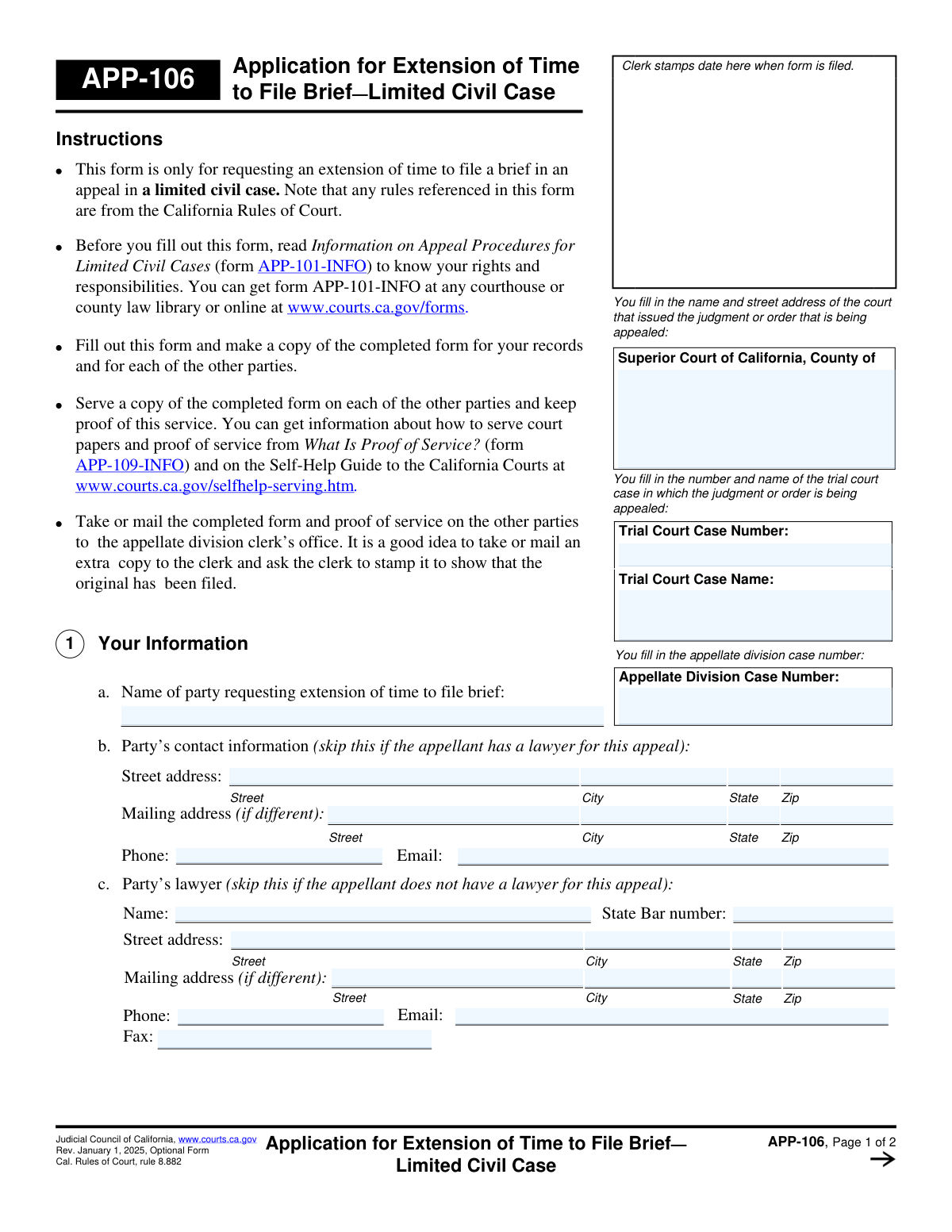
Form APP-031, Application for Extension of Time to File Brief (Limited Civil Case), is a legal document submitted to a California appellate court to formally request more time to file a required brief. It is crucial for parties in an appeal who cannot meet the original deadline due to valid reasons, as it prevents potential dismissal or negative consequences for late filing. Today, this form can be filled out quickly and accurately using AI-powered services like Instafill.ai, which can also convert non-fillable PDF versions into interactive fillable forms.
Our AI automatically handles information lookup, data retrieval, formatting, and form filling.
It takes less than a minute to fill out APP-031 using our AI form filling.
Securely upload your data. Information is encrypted in transit and deleted immediately after the form is filled out.
Form specifications
| Form name: | Form APP-031, Application for Extension of Time to File Brief (Limited Civil Case) |
| Number of fields: | 74 |
| Number of pages: | 2 |
| Language: | English |
Instafill Demo: How to fill out PDF forms in seconds with AI
How to Fill Out APP-031 Online for Free in 2026
Are you looking to fill out a APP-031 form online quickly and accurately? Instafill.ai offers the #1 AI-powered PDF filling software of 2026, allowing you to complete your APP-031 form in just 37 seconds or less.
Follow these steps to fill out your APP-031 form online using Instafill.ai:
- 1 Navigate to Instafill.ai and upload your Form APP-031, or select it from their library of templates.
- 2 Provide the court and case information, including the superior court name, trial court case number, and appellate division case number.
- 3 Enter the contact information for the party requesting the extension and their lawyer, if applicable.
- 4 Specify which brief requires an extension (e.g., appellant's opening brief, respondent's brief), its original due date, and the new requested due date.
- 5 Detail the history of any prior extensions, whether by stipulation between parties or by court order.
- 6 Provide a thorough explanation for why the extension is necessary, addressing the factors in rule 8.811(b) and attaching Form APP-031A if more space is needed.
- 7 Review all the information auto-filled by the AI, certify the application, and then date and sign the form before downloading it for filing with the court.
Our AI-powered system ensures each field is filled out correctly, reducing errors and saving you time.
Why Choose Instafill.ai for Your Fillable APP-031 Form?
Speed
Complete your APP-031 in as little as 37 seconds.
Up-to-Date
Always use the latest 2026 APP-031 form version.
Cost-effective
No need to hire expensive lawyers.
Accuracy
Our AI performs 10 compliance checks to ensure your form is error-free.
Security
Your personal information is protected with bank-level encryption.
Frequently Asked Questions About Form APP-031
This form is used to officially request an extension of time to file a brief in an appellate division court case. It is submitted when a party cannot meet the original filing deadline and needs more time.
This form should be completed by a party in an appeal, or their attorney, who needs to request a new deadline for filing an appellant's opening brief, respondent's brief, or reply brief.
The 'Trial Court Case Number' is the original case number from the superior court where the case was first heard. The 'Appellate Division Case Number' is the new number assigned specifically for the appeal.
An extension by stipulation means all parties involved in the case have mutually agreed to extend the filing deadline. This form is used when you cannot get a stipulation or have already used the maximum time allowed for stipulations.
You must provide a detailed explanation for why you need more time, such as the complexity of the case, personal emergencies, or delays in receiving court records. Be specific and explain why the extension will not harm the other party's case.
If your reason does not fit, check the box indicating there is not enough space. You can then attach your full explanation on a separate sheet of paper titled 'Attachment 8' or use form APP-031A.
A default notice is a formal warning from the court that your brief is overdue and must be filed within 15 days. You must indicate on the form whether or not you have received this notice, as it is critical information for the court.
Yes, you must report any previous extensions, whether they were by agreement (stipulation) or granted by a court order. You need to specify the number of prior extensions and the total number of days granted.
If the other party is unwilling to agree to an extension, you should check the box for 'The other party is not willing to stipulate to an extension'. This informs the court why you are filing this application instead of getting an agreement.
Yes, services like Instafill.ai use AI to help you accurately auto-fill form fields with your case and personal information, which saves time and reduces the chance of errors.
To fill this form out online, you can upload the PDF to Instafill.ai. The platform will make the document interactive, allowing you to easily type your information into the fields before downloading the completed form.
If you have a non-fillable or 'flat' PDF, you can use a service like Instafill.ai to convert it into an interactive, fillable form. Simply upload the document, and the tool will make the fields editable online.
If an attorney is filing the application on behalf of a client, the attorney signs the form. The attorney must also check the box certifying that they have delivered a copy of the application to their client.
Compliance APP-031
Validation Checks by Instafill.ai
Common Mistakes in Completing APP-031
Users often mistakenly enter the trial court case number in the appellate case number field, or vice versa. This happens due to oversight when dealing with multiple case documents from different court levels. An incorrect case number can lead to the application being misfiled, rejected, or significantly delayed, potentially jeopardizing the appeal. To avoid this, carefully cross-reference the numbers with official court notices for both the trial and appellate proceedings before entering them.
Filers frequently check the box for the type of brief for which they need an extension (e.g., 'Appellant's opening brief') but forget to enter the corresponding original due date in the adjacent field. This incomplete information prevents the court clerk from processing the request, as they cannot verify the current deadline. Always ensure that when you select a brief type, you also fill in its specific due date to create a complete and valid request.
The 'Reason for Extension Request' field is critical, yet many filers provide generic justifications like 'need more time' or 'busy schedule.' Courts require a detailed explanation showing good cause, often referencing specific rule factors (like the mentioned rule 8.811(b)) and explaining why the extension won't prejudice the other party. A weak reason is a primary cause for denial, so be specific about the circumstances (e.g., complexity of legal issues, delay in receiving the trial record) to build a strong case for your request.
The form requires detailed information about any previous extensions. A common mistake is to check a box indicating a prior extension was granted (e.g., 'Extended by Stipulation') but fail to provide the required follow-up details, such as the number of extensions and the total days granted. This omission forces the court to either deny the request or seek clarification, delaying the decision. To prevent this, gather all previous stipulation agreements and court orders to accurately report the history of extensions.
Individuals representing themselves (pro se litigants) often get confused and fill in their information in the 'Lawyer Information' section instead of the 'Party' section. This can cause confusion about who is making the request and how to contact the correct individual, leading to processing delays. If you are representing yourself, fill out the 'Party' sections and leave the 'Lawyer' sections blank; if you are an attorney, ensure both your information and your client's information are complete and in the correct fields.
The form contains several sets of mutually exclusive checkboxes, such as the status of a default notice ('Have received' vs. 'Have not received'). A frequent error is checking both boxes by mistake or, more commonly, leaving both unchecked. This ambiguity forces the court to guess the filer's situation, leading to delays or denial. Carefully read each set of options and select only the one that accurately reflects your case's status.
After carefully filling out the entire application, it is surprisingly common for filers to forget the final, crucial step: dating and signing the form in the 'Signature Details' section. An unsigned or undated application is legally invalid and will be immediately rejected by the court clerk, nullifying the entire effort and causing you to miss your deadline. Always perform a final review of the completed form, paying special attention to the signature and date fields before you submit it.
Often, court forms are only available as non-fillable PDFs, forcing users to print them and fill them out by hand. This frequently results in illegible handwriting, which can lead to critical information like case numbers or names being misread by court staff, causing filing errors and delays. To ensure clarity, use a tool like Instafill.ai, which can convert a flat PDF into an electronically fillable version, allowing you to type your answers cleanly and accurately.
Users often assume that if their mailing address is the same as their physical street address, they can leave the mailing address fields blank. However, this can be interpreted as incomplete information, potentially causing important court notices to be sent to the wrong place or returned as undeliverable. To avoid this, always complete the mailing address section, even if it means re-entering the same information, unless the form explicitly states 'if different'.
Attorneys sometimes enter their State Bar Number with a typo, an incorrect format, or forget it entirely, which can hinder the court's ability to verify their standing and eligibility to practice. This can lead to the application being flagged or rejected pending verification. Attorneys should double-check their bar number against their official record before submission. AI-powered form filling tools like Instafill.ai can help by storing and accurately auto-filling this information for repeat use.
Saved over 80 hours a year
“I was never sure if my IRS forms like W-9 were filled correctly. Now, I can complete the forms accurately without any external help.”
Kevin Martin Green
Your data stays secure with advanced protection from Instafill and our subprocessors




Robust compliance program
Transparent business model
You’re not the product. You always know where your data is and what it is processed for.
ISO 27001, HIPAA, and GDPR
Our subprocesses adhere to multiple compliance standards, including but not limited to ISO 27001, HIPAA, and GDPR.
Security & privacy by design
We consider security and privacy from the initial design phase of any new service or functionality. It’s not an afterthought, it’s built-in, including support for two-factor authentication (2FA) to further protect your account.
Fill out APP-031 with Instafill.ai
Worried about filling PDFs wrong? Instafill securely fills form-app-031-application-for-extension-of-time-to-file-brief-limited-civil-case forms, ensuring each field is accurate.
