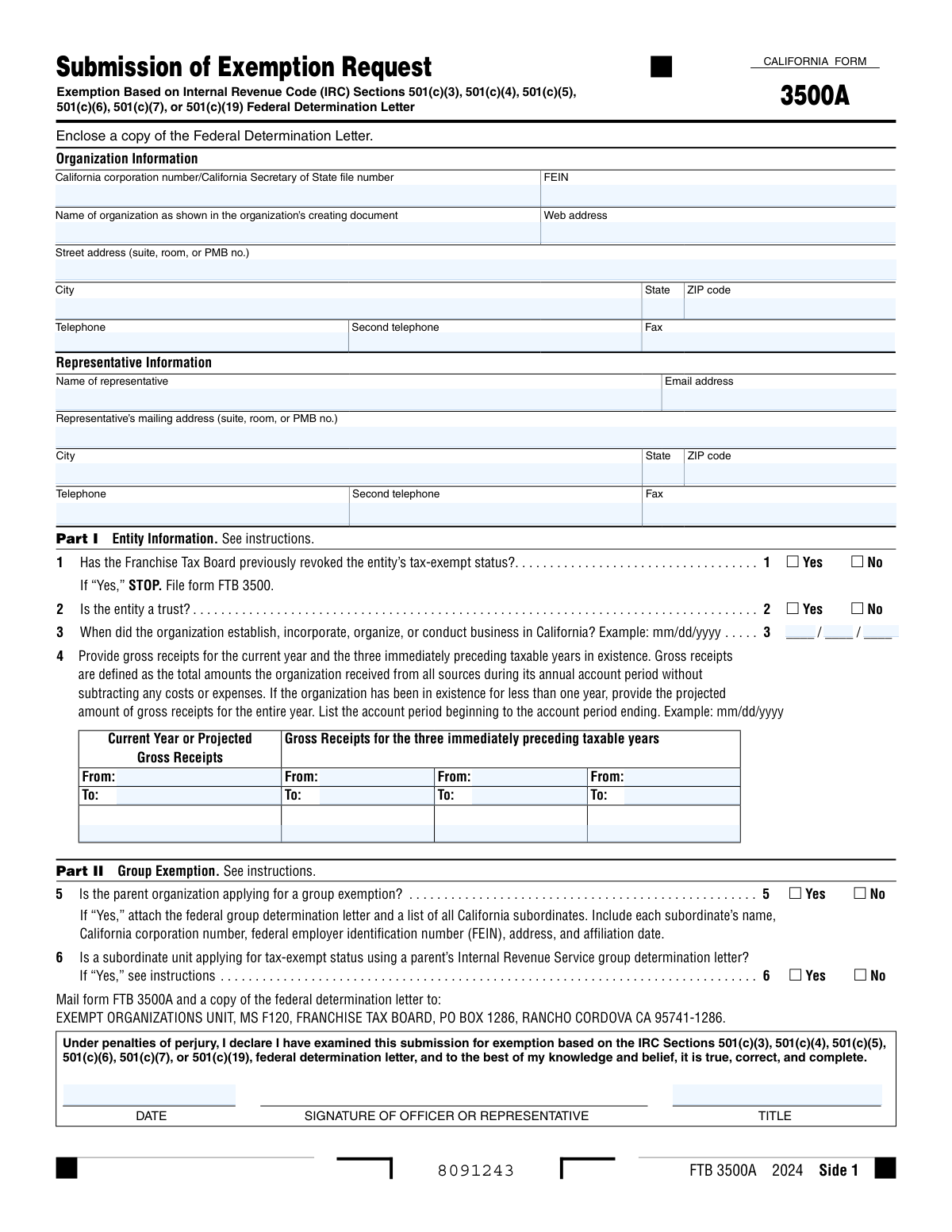
Yes! You can use AI to fill out Form FTB 3500A, Submission of Exemption Request
California Form FTB 3500A, Submission of Exemption Request, is a simplified application for organizations that have already obtained tax-exempt status from the IRS under specific sections of the Internal Revenue Code (e.g., 501(c)(3), 501(c)(4)). By submitting this form along with their federal determination letter, organizations can apply for state tax exemption in California without completing the more extensive Form FTB 3500. Today, this form can be filled out quickly and accurately using AI-powered services like Instafill.ai, which can also convert non-fillable PDF versions into interactive fillable forms.
Our AI automatically handles information lookup, data retrieval, formatting, and form filling.
It takes less than a minute to fill out FTB 3500A using our AI form filling.
Securely upload your data. Information is encrypted in transit and deleted immediately after the form is filled out.
Form specifications
| Form name: | Form FTB 3500A, Submission of Exemption Request |
| Number of fields: | 95 |
| Number of pages: | 2 |
| Language: | English |
Instafill Demo: How to fill out PDF forms in seconds with AI
How to Fill Out FTB 3500A Online for Free in 2026
Are you looking to fill out a FTB 3500A form online quickly and accurately? Instafill.ai offers the #1 AI-powered PDF filling software of 2026, allowing you to complete your FTB 3500A form in just 37 seconds or less.
Follow these steps to fill out your FTB 3500A form online using Instafill.ai:
- 1 Navigate to Instafill.ai and upload or select Form FTB 3500A.
- 2 Use the AI assistant to automatically fill in the Organization Information section, including the legal name, FEIN, California corporation number, and address.
- 3 Provide the contact details for the organization's authorized representative.
- 4 Answer the questions in Part I regarding the entity's history, trust status, and date of establishment in California.
- 5 Enter the gross receipts for the current year and the three immediately preceding taxable years as required in Part I, Line 4.
- 6 Complete Part II if applying for or as part of a group exemption, and check the appropriate box in Part III that describes the organization's primary purpose and IRC section.
- 7 Review all the information for accuracy, then have an authorized officer sign and date the form before mailing it with a copy of the federal determination letter to the Franchise Tax Board.
Our AI-powered system ensures each field is filled out correctly, reducing errors and saving you time.
Why Choose Instafill.ai for Your Fillable FTB 3500A Form?
Speed
Complete your FTB 3500A in as little as 37 seconds.
Up-to-Date
Always use the latest 2026 FTB 3500A form version.
Cost-effective
No need to hire expensive lawyers.
Accuracy
Our AI performs 10 compliance checks to ensure your form is error-free.
Security
Your personal information is protected with bank-level encryption.
Frequently Asked Questions About Form FTB 3500A
Form FTB 3500A is a simplified application for organizations to request state tax-exempt status in California. It is intended for organizations that have already received a federal tax-exempt determination letter from the IRS under specific Internal Revenue Code sections.
Organizations that have a federal determination letter for exemption under IRC Sections 501(c)(3), 501(c)(4), 501(c)(5), 501(c)(6), 501(c)(7), or 501(c)(19) are eligible. However, if the Franchise Tax Board has previously revoked your organization's exempt status, you cannot use this form.
You must enclose a complete copy of your organization's federal determination letter from the IRS. Failure to include this letter will delay the processing of your request.
No. If your organization's tax-exempt status was previously revoked by the Franchise Tax Board, you must stop and file the more detailed Form FTB 3500 to re-establish your status.
If your organization has been in existence for less than one year, you should provide the projected amount of gross receipts for the entire first year. Gross receipts are the total amounts received from all sources without subtracting any costs or expenses.
Mail the signed form and a copy of your federal determination letter to: EXEMPT ORGANIZATIONS UNIT, MS F120, FRANCHISE TAX BOARD, PO BOX 1286, RANCHO CORDOVA CA 95741-1286.
Form FTB 3500A is a streamlined application for organizations that already have a federal exemption letter. Form FTB 3500 is a more comprehensive application for organizations that do not qualify for the 3500A process, such as those without a federal letter or whose status was previously revoked.
If you are a subordinate unit applying with a parent's IRS group determination letter, you should check 'Yes' for question 6 in Part Two. You will need to follow the specific instructions, which typically involve attaching the parent's group determination letter.
In Part Three, you must check the box that best describes your organization's main activity. Your choice should correspond to the IRC section under which you received your federal exemption (e.g., a 501(c)(3) organization would choose from the options in section 1).
Yes, services like Instafill.ai use AI to auto-fill form fields accurately and save time. This helps ensure consistency and reduces the chance of errors when entering your organization's information.
You can use a service like Instafill.ai to complete the form digitally. Simply upload the PDF, and the platform will make it fillable, allowing you to type your answers, sign electronically, and download the completed form for mailing.
If you have a non-fillable or 'flat' PDF, you can use a tool like Instafill.ai to instantly convert it into an interactive, fillable form. This allows you to easily type your information directly into the fields instead of printing and filling it out by hand.
The representative is a person authorized to communicate with the FTB about this application, such as an officer of the organization, a director, or a paid professional like an attorney or CPA. This is the primary contact for any questions regarding your submission.
Compliance FTB 3500A
Validation Checks by Instafill.ai
1
Previous Revocation Status Check
This validation checks if the 'Yes' box for Question 1, 'Has the Franchise Tax Board previously revoked the entity’s tax-exempt status?', is selected. If 'Yes' is selected, the submission is invalid for this form type, and the user must be instructed to stop and file form FTB 3500 instead. This is a critical gating rule to ensure the correct form is used for re-establishing exempt status.
2
FEIN Format Validation
This check ensures the Federal Employer Identification Number (FEIN) is entered in the correct XX-XXXXXXX format. The FEIN is a unique nine-digit number assigned by the IRS, and maintaining its proper format is crucial for accurate identification and data matching with federal records. A failure in this validation would prevent proper processing and require manual correction.
3
Organization Establishment Date Validity
This validation verifies that the date entered in Question 3 ('When did the organization establish...in California?') is a valid calendar date in MM/DD/YYYY format and is not a future date. An organization cannot be established on a future date, so this check prevents logical errors and ensures the provided timeline is accurate. An invalid or future date would cause the application to be rejected for correction.
4
Gross Receipts Period Logic
For each of the four columns in Question 4, this check ensures the 'From' date is on or before the 'To' date. An accounting period cannot end before it begins. This validation maintains the logical integrity of the financial data provided and prevents nonsensical date ranges from being submitted.
5
Gross Receipts Data Completeness
This validation ensures that for each accounting period where a 'From' and 'To' date is provided in Question 4, a corresponding numeric gross receipts amount is also entered. Leaving the amount blank for a specified period makes the financial disclosure incomplete. This check guarantees that all reported periods have associated financial figures, which is essential for assessing the organization's eligibility.
6
ZIP Code Format
This check validates that all ZIP code fields (for both the organization and the representative) contain either a 5-digit or 9-digit (ZIP+4) numeric format. Correctly formatted ZIP codes are essential for mail delivery and address verification systems. An incorrectly formatted ZIP code could lead to returned mail and significant delays in processing the exemption request.
7
State Abbreviation Format
This validation ensures that the state fields for both the organization and representative addresses use a valid 2-letter postal abbreviation. Using a standardized format is necessary for automated address processing and database consistency. Submitting a full state name or an incorrect abbreviation would cause a data entry failure and require manual intervention.
8
Representative Email Address Format
This check verifies that the representative's email address follows the standard '[email protected]' format. A valid email address is critical for the Franchise Tax Board to send official correspondence, notifications, and requests for more information. An invalid format would prevent communication, potentially jeopardizing the application's progress.
9
Primary Purpose and Activity Selection
This validation ensures that at least one checkbox is selected in Part Three ('Purpose and Activity'). The organization must declare its primary purpose to be classified under a specific IRC section. A submission without this information is incomplete and cannot be processed, as the basis for the exemption is missing.
10
Exclusive IRC Section Selection
This check verifies that checkboxes for the organization's purpose are selected within only one IRC Section group in Part Three (e.g., only within 501(c)(3) or only within 501(c)(4)). An organization applies for exemption under a single specific section. Selecting purposes across multiple IRC sections creates an ambiguity that prevents the FTB from determining the correct exemption type, leading to rejection.
11
Signature Block Completeness
This validation confirms that both the 'Signature Date' and 'Title' fields in the signature block are filled out. The signature, date, and title of the authorized officer or representative are required to attest to the accuracy of the submission under penalty of perjury. Missing either of these fields invalidates the declaration and will cause the form to be returned as incomplete.
12
Conditional Logic for Form Continuation
This check ensures that if Question 1 is answered 'Yes', no other fields on the form are filled out. The form instructions explicitly state to STOP if the answer is 'Yes'. This validation prevents the submission of a form that is fundamentally ineligible and guides the user to the correct process immediately.
13
Organization Name and FEIN Presence
This validation verifies that the 'Name of organization' and 'FEIN' fields are not empty. These two fields are the primary identifiers for the entity applying for exemption. A submission without this fundamental information cannot be processed, as it's impossible to know which organization is making the request.
14
Mutually Exclusive Group Exemption Status
This check ensures that an organization does not select 'Yes' for both Question 5 ('Is the parent organization applying for a group exemption?') and Question 6 ('Is a subordinate unit applying...?'). An entity is either a parent creating a group or a subordinate joining one; it cannot be both in the same application. This logical check prevents contradictory and nonsensical submissions.
Common Mistakes in Completing FTB 3500A
The form instructions explicitly require a copy of the organization's federal determination letter from the IRS. Applicants often overlook this critical attachment, assuming the form itself is sufficient. Submitting the application without this letter will result in an incomplete filing, causing significant processing delays or outright rejection until the required document is provided. To avoid this, create a checklist of all required documents before mailing and ensure the letter is included in the envelope.
Question 1 asks if the entity's tax-exempt status was previously revoked by the Franchise Tax Board. If the answer is 'Yes,' the form clearly instructs the applicant to STOP and file form FTB 3500 instead. Many people miss this instruction and continue filling out Form 3500A, which is the wrong form for their situation. This mistake leads to an automatic rejection of the application, wasting time and effort. Always read conditional instructions carefully before proceeding.
Line 4 requires detailed gross receipts for the current year (or a projection) and the three preceding years, including specific 'From' and 'To' dates for each period. Common errors include reporting net income instead of gross receipts, using incorrect accounting periods, or leaving the section blank. For new organizations, failing to provide a projection for the first year is a frequent mistake. These errors can lead to requests for clarification and delay the exemption approval.
The form requires the organization's name exactly as it appears on its creating document (e.g., articles of incorporation). Applicants sometimes use a DBA ('doing business as'), a common abbreviation, or a slightly different version of the legal name. This discrepancy causes mismatches with records at the California Secretary of State and the IRS, leading to processing delays while the FTB tries to verify the entity's identity. Always use the full, official legal name.
Questions 5 and 6 relate to group exemptions for parent or subordinate organizations. If an applicant answers 'Yes' to either question, they must attach additional documentation, such as a list of all California subordinates or the parent's federal group determination letter. A common mistake is checking 'Yes' but failing to include these mandatory attachments. This renders the application incomplete and will halt the review process until the missing information is supplied.
An unsigned or undated form is legally invalid. Applicants, especially when rushing, can easily forget to sign the declaration, enter the date, or provide the title of the signing officer or representative. This simple oversight is one of the most common reasons for a form to be immediately returned, invalidating the entire submission. To prevent this, make the signature block the final review step before mailing the form.
Part Three asks the applicant to check the box that describes the organization's primary purpose, based on its IRC section. A frequent error is checking multiple boxes in a single section or selecting a purpose that does not align with the activities described in the federal determination letter. This inconsistency can raise questions about the organization's eligibility for exemption under California law and may trigger further scrutiny. The selection should be singular and directly reflect the basis for the federal exemption.
The form requires a Federal Employer Identification Number (FEIN) and a California corporation number or Secretary of State file number. Manual data entry often leads to errors like transposing digits or accidentally omitting a number. An incorrect ID number will prevent the FTB from locating the organization's records or matching the application to the correct entity, causing significant delays or rejection. AI-powered tools like Instafill.ai can help prevent this by validating number formats and auto-filling from a secure profile to ensure accuracy.
Government forms are often provided as non-fillable PDFs, forcing users to print and fill them out by hand. This can result in illegible handwriting, smudges, and transcription errors, making it difficult for the FTB to process the information correctly. An unreadable form may be returned with a request for a clearer submission, delaying the exemption process. Tools like Instafill.ai can convert these flat PDFs into fillable forms, allowing for clean, typed entries that eliminate legibility issues and ensure the application is processed smoothly.
Saved over 80 hours a year
“I was never sure if my IRS forms like W-9 were filled correctly. Now, I can complete the forms accurately without any external help.”
Kevin Martin Green
Your data stays secure with advanced protection from Instafill and our subprocessors

Robust compliance program
Transparent business model
You’re not the product. You always know where your data is and what it is processed for.
ISO 27001, HIPAA, and GDPR
Our subprocesses adhere to multiple compliance standards, including but not limited to ISO 27001, HIPAA, and GDPR.
Security & privacy by design
We consider security and privacy from the initial design phase of any new service or functionality. It’s not an afterthought, it’s built-in, including support for two-factor authentication (2FA) to further protect your account.
Fill out FTB 3500A with Instafill.ai
Worried about filling PDFs wrong? Instafill securely fills form-ftb-3500a-submission-of-exemption-request forms, ensuring each field is accurate.