Yes! You can use AI to fill out Form N349, Application for Third Party Debt Order

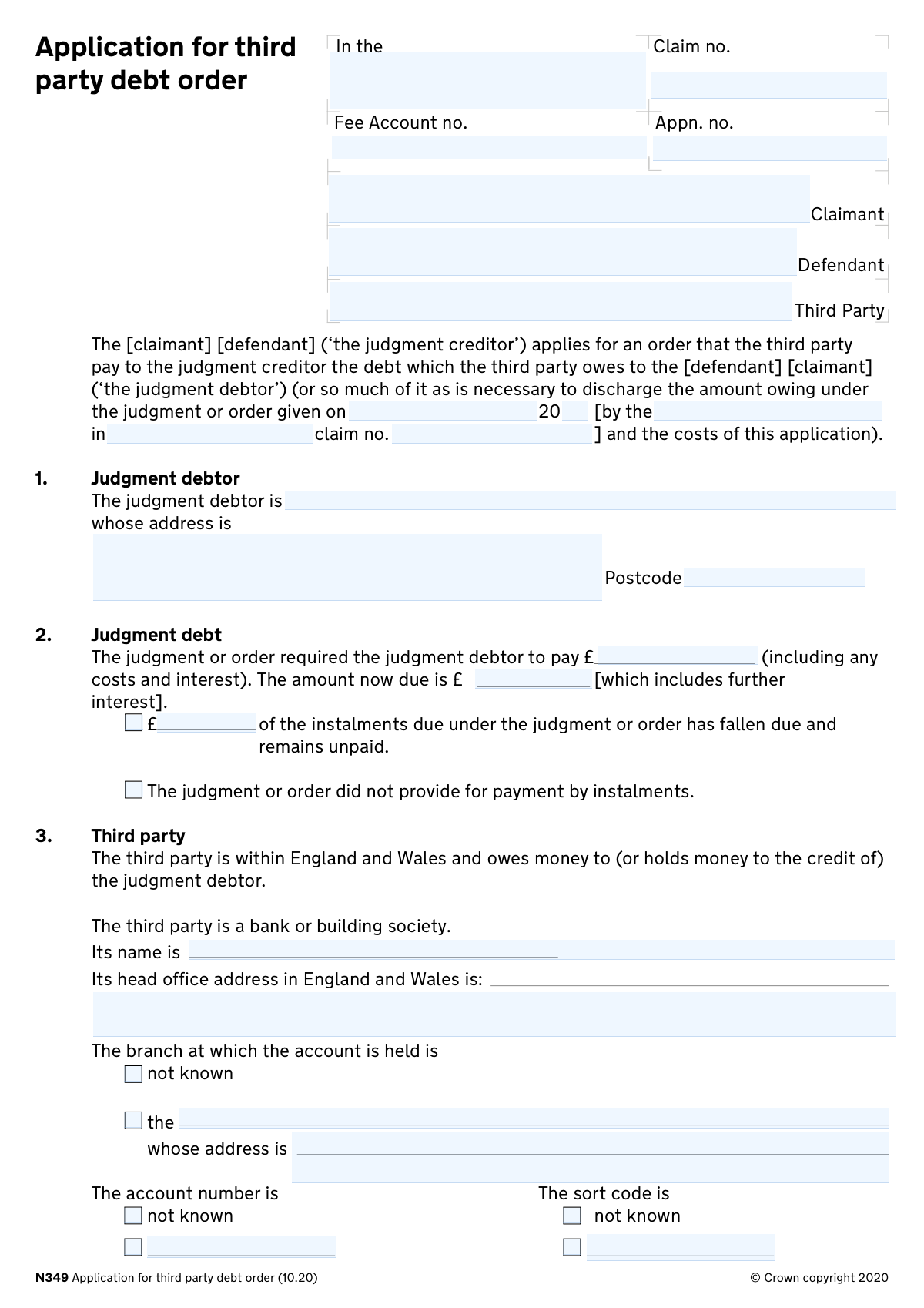
Form N349, Application for Third Party Debt Order, is an official UK court form (Crown copyright 2020) that enables a judgment creditor to apply to the court for an order requiring a third party — typically a bank or building society — to pay money it holds on behalf of the judgment debtor directly to the judgment creditor, up to the amount owed under a court judgment or order. The form requires details about the judgment debtor, the outstanding debt, the third party's account information, any other interested parties, and the grounds for the application, all verified by a Statement of Truth. It is an important enforcement tool in civil litigation, allowing creditors to recover debts without relying on the debtor's voluntary compliance. Today, Form N349 can be filled out quickly and accurately using AI-powered services like Instafill.ai, which can also convert non-fillable PDF versions into interactive fillable forms.
Our AI automatically handles information lookup, data retrieval, formatting, and form filling.
It takes less than a minute to fill out N349 using our AI form filling.
Securely upload your data. Information is encrypted in transit and deleted immediately after the form is filled out.

Form specifications

Form name: Form N349, Application for Third Party Debt Order
Number of pages: 4
Language: English
main-image

Instafill Demo: filling out a legal form in seconds

How to Fill Out N349 Online for Free in 2026

Are you looking to fill out a N349 form online quickly and accurately? Instafill.ai offers the #1 AI-powered PDF filling software of 2026, allowing you to complete your N349 form in just 37 seconds or less.
Follow these steps to fill out your N349 form online using Instafill.ai:
  1. 1 Navigate to Instafill.ai and upload the N349 PDF or select it from the available form library to begin filling it out online.
  2. 2 Enter the court details, including the court name or location, claim number, fee account number, and application number, along with the names of the claimant, defendant, and third party.
  3. 3 Complete the judgment debt section by providing the judgment debtor's full name and address, the total amount originally ordered, the amount currently due, and any instalment details or confirmation that no instalment arrangement exists.
  4. 4 Fill in the third party section with the bank or building society's name, head office address, branch details (or indicate if not known), and the account number and sort code (or indicate if not known); if the third party is not a bank, provide their name and address in England and Wales.
  5. 5 Declare any other persons with a claim to the money held by the third party, or confirm there are none, and provide the sources and grounds for the information given in sections 3 and 4.
  6. 6 Indicate whether any previous applications for third party debt orders have been made in respect of this judgment debt, and if so, provide details of those applications including the third party's name and address.
  7. 7 Complete the Statement of Truth by signing and dating the form, entering your full name, firm name, position, and the address to which documents should be sent, along with any applicable phone, fax, DX, reference, or email details, then submit the completed form to the appropriate court.

Our AI-powered system ensures each field is filled out correctly, reducing errors and saving you time.

Why Choose Instafill.ai for Your Fillable N349 Form?

Speed

Complete your N349 in as little as 37 seconds.

Up-to-Date

Always use the latest 2026 N349 form version.

Cost-effective

No need to hire expensive lawyers.

Accuracy

Our AI performs 10 compliance checks to ensure your form is error-free.

Security

Your personal information is protected with bank-level encryption.

Frequently Asked Questions About Form N349

Form N349 is an Application for a Third Party Debt Order, used by a judgment creditor to recover money owed to them under a court judgment. It instructs a third party (such as a bank or building society) that holds money belonging to the judgment debtor to pay that money directly to the judgment creditor instead.

This form should be completed by the judgment creditor — the person or organisation who has already obtained a court judgment or order requiring the judgment debtor to pay them money. It can also be completed by the judgment creditor's legal representative on their behalf.

You will need the original claim number and court details, the date and amount of the judgment or order, the judgment debtor's full name and address, and details about the third party (such as the bank's name, head office address, branch details, account number, and sort code). You should also be prepared to explain the sources and grounds for your belief that the third party holds money for the judgment debtor.

The form allows you to indicate that the account number or sort code is 'not known' by checking the relevant boxes. However, providing as much detail as possible — including the bank name, head office address, and branch — will help the court process your application more efficiently.

Yes. If the third party is not a bank or building society, you should complete the section of the form that asks for the third party's name and their address in England and Wales. The third party must be located within England and Wales and must owe money to, or hold money to the credit of, the judgment debtor.

In Section 5, you should explain why you believe the information provided in Sections 3 and 4 is accurate. This might include bank statements you have seen, information provided by the judgment debtor, correspondence, or other evidence that confirms the third party holds money for the judgment debtor.

In Section 4, you must disclose any other persons (besides the judgment debtor) who have a claim to the money held by the third party, along with their names, addresses, and details of their claims. If no other persons have a claim, simply check the 'None' box.

The Statement of Truth is a declaration that the facts stated in the application are true to the best of your knowledge and belief. Signing it carries serious legal weight — making a false statement in a document verified by a Statement of Truth can result in contempt of court proceedings.

The Statement of Truth can be signed by the judgment creditor themselves, a litigation friend (if the judgment creditor is a child or a patient), or the judgment creditor's legal representative as defined by CPR 2.3(1). The appropriate box must be checked to indicate who is signing.

Yes. Section 6 requires you to declare whether you have made any previous applications for third party debt orders in respect of the same judgment debt. If you have, you must provide details of those applications, including the third party's name and address.

Yes — services like Instafill.ai use AI to auto-fill form fields accurately, saving you time and reducing the risk of errors. You can upload the N349 form to Instafill.ai and it will help you complete the required fields based on the information you provide.

Simply visit Instafill.ai, upload your N349 PDF form, and follow the guided prompts to enter your case details. The AI will auto-populate the relevant fields, and you can review, edit, and download the completed form ready for submission to the court.

If your copy of the N349 is a flat, non-fillable PDF, Instafill.ai can convert it into an interactive fillable form so you can complete it digitally. This saves you from having to print and handwrite the form, making the process faster and more accurate.

The completed form should be submitted to the court where the original judgment or order was made, along with the appropriate court fee. You should check with the relevant court for specific submission instructions, as requirements may vary by court location.

The original judgment amount is the total the court ordered the judgment debtor to pay, including costs and interest at the time of the judgment. The 'amount now due' is the current outstanding balance, which may be higher if further interest has accrued since the judgment was made, or lower if partial payments have already been received.

Compliance N349
Validation Checks by Instafill.ai

1
Claim Number Format and Consistency Across Sections
Validates that the claim number entered in the court header section matches the claim number entered in the 'Order and claim details' section, and that both conform to the standard UK court claim number format (e.g., A1BC2345 or a numeric sequence). Discrepancies between the two claim number fields could indicate a clerical error or that the application references the wrong case. If the claim numbers do not match or are improperly formatted, the application may be rejected or processed against the wrong judgment.
2
Judgment Order Date is Valid and Not in the Future
Checks that the day, month, and year fields for the date the judgment or order was given combine to form a valid calendar date (e.g., not 31 February or 00/00/0000) and that the resulting date is not in the future. A future-dated judgment would be legally impossible and would indicate a data entry error. The year field must also be a plausible four-digit year when combined with the '20' prefix, falling within a reasonable historical range.
3
Judgment Amount and Amount Now Due Are Positive and Logically Consistent
Validates that both the original judgment amount (including costs and interest) and the amount now due are positive numeric values greater than zero, and that the amount now due does not exceed the original judgment amount unless further interest has been explicitly indicated. If the amount now due is greater than the original judgment amount without the further interest checkbox being selected, this represents a logical inconsistency that could undermine the application. Both fields must be present and formatted as valid currency amounts in pounds sterling.
4
Instalment Fields Completeness and Mutual Exclusivity
Ensures that exactly one of the two instalment options is selected: either the 'judgment did not provide for payment by instalments' checkbox is checked, or the instalment amount fields (amount of instalments fallen due and unpaid) are completed with a valid positive monetary value. If the instalment option is selected, the corresponding monetary amount must be provided and must not exceed the amount now due. Selecting both options simultaneously or leaving both blank creates an ambiguous and incomplete application.
5
Third Party Identification: Bank/Building Society vs. Non-Bank Mutual Exclusivity
Validates that the form clearly identifies the third party as either a bank or building society (with the corresponding bank-specific fields completed) or as a non-bank/building society entity (with the alternative name and England and Wales address fields completed), but not both simultaneously. Each path requires its own mandatory fields: the bank path requires at minimum the institution name and head office address, while the non-bank path requires the third party's name and address in England and Wales. Failure to clearly distinguish the type of third party will prevent the court from properly serving the interim order.
6
Bank Account Number and Sort Code Consistency
Checks that if the account number 'not known' checkbox is unchecked, a valid account number is provided in the adjacent field, and similarly that if the sort code 'not known' checkbox is unchecked, a valid sort code in the standard UK format (XX-XX-XX or six consecutive digits) is entered. Providing a sort code without an account number, or vice versa, reduces the utility of the information and may prevent the bank from identifying the correct account. Both fields must be internally consistent with their respective 'not known' checkbox states.
7
Branch Information Completeness When Branch is Known
Validates that when the 'branch known' option is selected (i.e., the 'branch not known' checkbox is not checked), both the branch name and the branch address fields are populated with non-empty values. Selecting that the branch is known but failing to provide the branch name or address renders the selection meaningless and may delay service of the order on the correct branch. The branch address should include sufficient detail (street and town/city at minimum) to identify the specific branch location.
8
Judgment Debtor Address and Postcode Format Validation
Ensures that the judgment debtor's address field is not left blank and that the postcode field conforms to the standard UK postcode format (e.g., SW1A 1AA or EC1A 1BB), including the correct use of letters and numbers in the appropriate positions. An incomplete or incorrectly formatted postcode may cause issues with court correspondence and service of documents. The address must be within a jurisdiction recognisable for the purposes of the application.
9
Other Persons' Interests: Mutual Exclusivity and Completeness of Details
Validates that exactly one of the two 'Other persons' interests' options is selected — either 'None' or 'The following' — and that if 'The following' is selected, at least one person's name, address, and details of their claim are provided in the corresponding fields. Selecting 'The following' without supplying any names or claim details leaves the section incomplete and may affect how the court handles competing claims to the funds. Selecting both 'None' and 'The following' simultaneously is a logical contradiction that must be flagged.
10
Sources and Grounds of Information Field Must Not Be Empty
Checks that the 'Sources and grounds of information' field (Section 5) contains a substantive, non-blank entry explaining why the judgment creditor believes the information in Sections 3 and 4 is correct. This field is critical because it provides the evidential basis for the application and supports the Statement of Truth. An empty or placeholder entry (e.g., a single space or generic text) should be flagged, as the court requires genuine grounds to be stated to assess the credibility of the application.
11
Previous Applications Mutual Exclusivity and Detail Completeness
Ensures that exactly one of the two 'Other applications' options is selected — either 'no other applications' or 'already made the following application(s)' — and that if the latter is selected, the details of the previous application(s), the third party's name, address, and postcode are all completed. Selecting that previous applications have been made without providing their details prevents the court from assessing whether a further order is appropriate. Both options being selected simultaneously is a logical error that must be rejected.
12
Statement of Truth Signatory Role Selection and Consistency
Validates that exactly one signatory role is selected from the three available options (Judgment creditor, Litigation friend, or Judgment creditor's legal representative), and that the selection is consistent with other fields completed on the form. If 'Judgment creditor's legal representative' is selected, the firm name and position/office fields must also be completed. If 'Litigation friend' is selected, this implies the judgment creditor is a child or patient, which should be consistent with any other contextual information provided on the form.
13
Statement of Truth Date is Valid and Not in the Future
Checks that the day, month, and year fields for the Statement of Truth signature date combine to form a valid calendar date and that the date is not in the future, as a future-dated signature would be legally invalid. The signature date should also not predate the judgment or order date, since an application cannot logically be signed before the underlying judgment exists. An invalid or missing signature date may render the Statement of Truth defective and expose the applicant to procedural challenges.
14
Full Name of Signatory is Provided and Not a Placeholder
Validates that the 'Full name' field in the Statement of Truth section is populated with a non-empty string that appears to represent a genuine personal name (i.e., contains at least two words and does not consist solely of numbers, special characters, or generic placeholder text). The full name is required to identify the individual who is verifying the truth of the application and who may be subject to contempt of court proceedings if the statement is false. An absent or clearly invalid name entry must be flagged as an error.
15
Contact Address for Documents: Mandatory Fields Completeness and Postcode Format
Ensures that the judgment creditor's or legal representative's address for service of documents includes at minimum the building and street field, the town or city field, and a correctly formatted UK postcode, as these are essential for the court to send documents to the correct location. The postcode must conform to the standard UK postcode format and must not be left blank. If a phone number or email address is provided in the optional fields, they should conform to standard UK phone number formats and valid email address syntax respectively.
16
Claimant, Defendant, and Judgment Debtor Name Consistency
Validates that the name entered as the judgment debtor in Section 1 corresponds to either the claimant or the defendant named in the parties section at the top of the form, consistent with the bracketed selection of '[claimant]' or '[defendant]' as the judgment debtor in the application preamble. A mismatch between the judgment debtor's name and the named parties would suggest an error in identifying the correct party against whom the order is sought. This cross-field consistency check is important to ensure the application correctly identifies all parties in their respective roles.

Common Mistakes in Completing N349

Confusing the roles of claimant, defendant, and judgment creditor/debtor

Many applicants fail to correctly identify which party is the 'judgment creditor' and which is the 'judgment debtor,' especially when the defendant is the one seeking enforcement. The form requires selecting whether the claimant or defendant is the judgment creditor, and getting this wrong invalidates the application. Carefully read the bracketed options in the opening paragraph and cross out the inapplicable terms. AI-powered form filling tools like Instafill.ai can help by guiding you through these role selections based on your case details.

Entering incorrect or mismatched claim numbers

The form has two separate fields for claim numbers — one in the header section and one in the order details section — and applicants frequently enter different or inconsistent numbers across these fields, or confuse the original claim number with an application number. This can cause the court to be unable to locate the underlying judgment, delaying or invalidating the application. Always verify the exact claim number from the original court judgment or order and ensure it is entered identically in both locations. Tools like Instafill.ai can auto-populate repeated fields to prevent inconsistencies.

Providing inaccurate or outdated judgment debt amounts

Applicants often enter the original judgment amount rather than the current amount now due, failing to account for additional interest accrued since the judgment was made. The form requires two distinct figures: the original amount ordered and the current outstanding balance including further interest. Failing to update these figures can result in the order being made for the wrong amount, potentially prejudicing the judgment creditor. Always calculate the current balance including accrued interest up to the date of the application before completing these fields.

Incorrectly completing the instalment payment section

Many applicants either leave the instalment section blank when it applies, or fill it in when the judgment did not provide for instalments, creating a contradiction on the form. If the judgment was for a lump sum with no instalments, only the 'did not provide for payment by instalments' checkbox should be ticked; if instalments were ordered, the unpaid instalment amount must be specified. Completing both options simultaneously or leaving the section ambiguous can cause the application to be rejected. Read the conditional instructions carefully and only complete the fields that apply to your specific judgment.

Omitting or incorrectly entering third party bank account details

Applicants frequently leave the account number and sort code fields blank without ticking the 'not known' checkbox, or they enter incorrectly formatted sort codes (e.g., omitting hyphens or entering digits in the wrong order). Courts and banks require these details to freeze the correct account, and errors can result in the wrong account being targeted or the application being returned. If the details are genuinely unknown, always tick the 'not known' checkbox rather than leaving the field empty. Instafill.ai can validate sort code formats and flag missing mandatory selections automatically.

Failing to provide adequate sources and grounds of information in Section 5

Section 5 is frequently left vague or nearly blank, with applicants writing only 'personal knowledge' or 'bank statements' without explaining how they know the third party holds money for the judgment debtor. Courts require sufficient detail to satisfy themselves that the application is well-founded, and an inadequate explanation can lead to the application being dismissed. Applicants should specify the source (e.g., bank statements, correspondence, credit reference searches) and explain when and how the information was obtained. Providing clear, specific evidence-based reasoning in this section significantly strengthens the application.

Not disclosing other persons' interests in Section 4

Applicants often tick 'None' in Section 4 without properly considering whether any other person — such as a joint account holder, trustee, or secured creditor — may have a claim to the money held by the third party. Failing to disclose known third-party interests is a breach of the duty of candour and can constitute a false statement in the Statement of Truth, potentially leading to contempt of court proceedings. Carefully consider all parties who may have an interest in the funds before completing this section, and if in doubt, seek legal advice. Erring on the side of disclosure is always safer than omitting relevant information.

Failing to disclose previous third party debt order applications in Section 6

Judgment creditors who have previously applied for third party debt orders against the same debt sometimes forget to disclose these prior applications, either because they were unsuccessful or because they occurred some time ago. The form requires full disclosure of all previous applications, and omitting them constitutes a false statement verified by the Statement of Truth. Always check your records for any prior enforcement applications before completing Section 6, and if previous applications were made, provide full details including the third party's name, address, and relevant dates.

Signing the Statement of Truth in the wrong capacity

Applicants frequently tick the wrong signatory category — for example, ticking 'judgment creditor' when they are actually signing as a legal representative, or failing to tick any category at all. The Statement of Truth must be signed by the correct person in the correct capacity, and an incorrectly attributed signature can render the document invalid. If signing as a legal representative, the firm name and position held must also be completed. Carefully read all three signatory options and select only the one that accurately reflects your role before signing.

Entering an incomplete or incorrectly formatted contact address for correspondence

The address section at the bottom of the form — to which court documents will be sent — is often completed with missing fields such as the town/city or postcode, or applicants enter a personal address when a solicitor's address should be used. An incomplete address means the court cannot serve documents, causing significant delays in the proceedings. Ensure all mandatory address fields (building and street, town or city, and postcode) are fully completed, and use the legal representative's address if one is acting. Instafill.ai can validate address completeness and postcode formats to prevent these errors.

Omitting the date or entering an incomplete date on the Statement of Truth

The date field on the Statement of Truth is split into three separate boxes (day, month, year) and applicants frequently leave one or more boxes blank, enter only the year, or write the date in the wrong format. An undated Statement of Truth may be treated as defective by the court, potentially requiring the application to be resubmitted. Ensure all three date components are completed in full using numeric values (e.g., Day: 15, Month: 03, Year: 2024). AI-powered tools like Instafill.ai can automatically populate and validate date fields to prevent this common oversight.

Incorrectly completing the third party section when the third party is not a bank

When the third party is not a bank or building society, applicants sometimes still complete the bank-specific fields (account number, sort code, branch details) or fail to use the alternative non-bank section of the form, creating confusion about the nature of the debt. The form has distinct sections for bank/building society third parties and non-bank third parties, and only the relevant section should be completed. If the third party is not a financial institution, complete only the non-bank section with the third party's name and England and Wales address. Carefully read the conditional instructions at the start of Section 3 to determine which fields apply to your situation.
Saved over 80 hours a year

“I was never sure if my IRS forms like W-9 were filled correctly. Now, I can complete the forms accurately without any external help.”

Kevin Martin Green

Your data stays secure with advanced protection from Instafill and our subprocessors

Robust compliance program

Transparent business model

You’re not the product. You always know where your data is and what it is processed for.

ISO 27001, HIPAA, and GDPR

Our subprocesses adhere to multiple compliance standards, including but not limited to ISO 27001, HIPAA, and GDPR.

Security & privacy by design

We consider security and privacy from the initial design phase of any new service or functionality. It’s not an afterthought, it’s built-in, including support for two-factor authentication (2FA) to further protect your account.

Fill out N349 with Instafill.ai

Worried about filling PDFs wrong? Instafill securely fills form-n349-application-for-third-party-debt-order forms, ensuring each field is accurate.



