Yes! You can use AI to fill out R.I.S. Auto Insurance Questionnaire
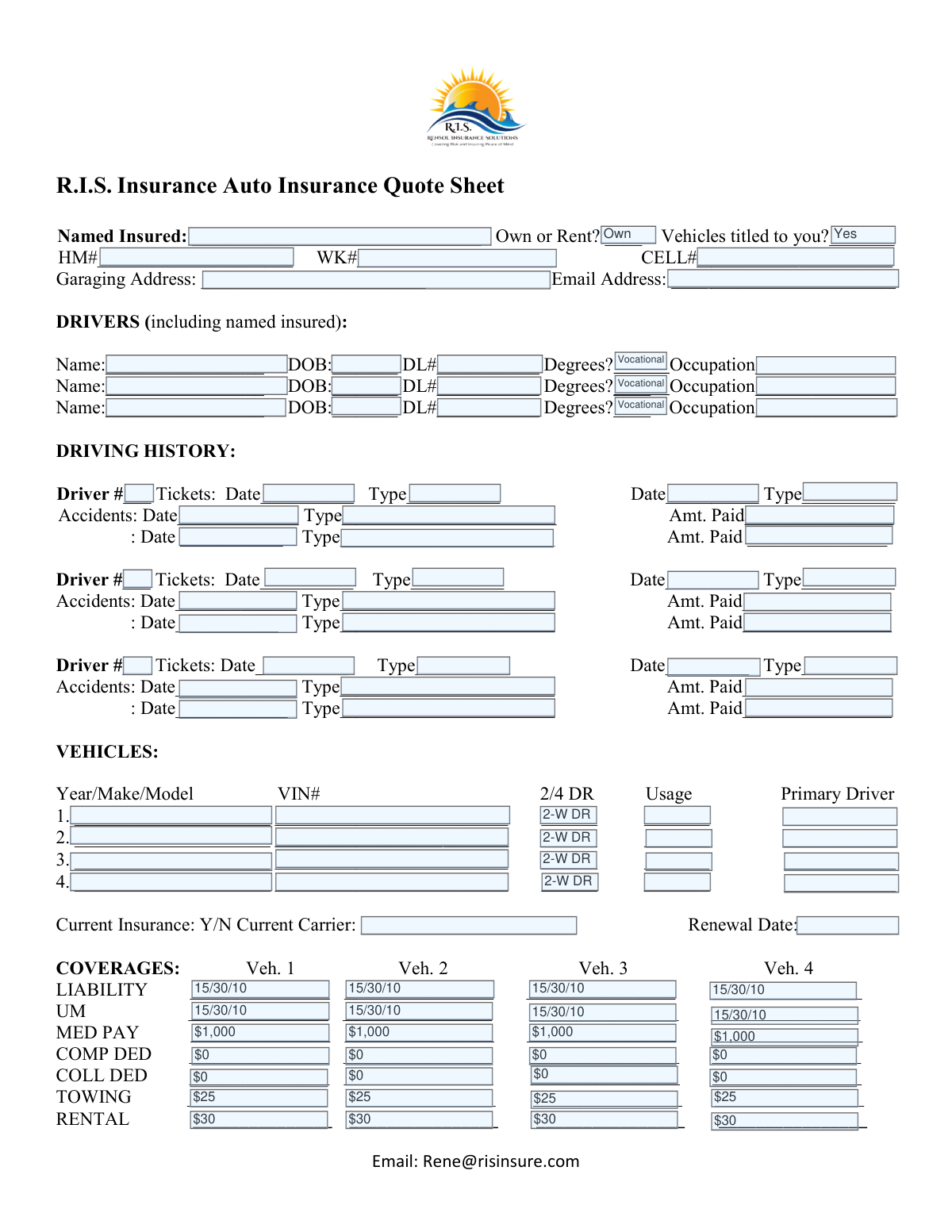
The R.I.S. Auto Insurance Questionnaire is a document used by R.I.S. Insurance to gather essential details from potential clients seeking an auto insurance quote. It collects information about the named insured, other drivers, vehicle specifics, driving history, and desired coverage levels to provide an accurate premium estimate. Today, this form can be filled out quickly and accurately using AI-powered services like Instafill.ai, which can also convert non-fillable PDF versions into interactive fillable forms.
Our AI automatically handles information lookup, data retrieval, formatting, and form filling.
It takes less than a minute to fill out R.I.S. Auto Insurance Questionnaire using our AI form filling.
Securely upload your data. Information is encrypted in transit and deleted immediately after the form is filled out.
Form specifications
| Form name: | R.I.S. Auto Insurance Questionnaire |
| Number of fields: | 106 |
| Number of pages: | 1 |
| Language: | English |
Instafill Demo: How to fill out PDF forms in seconds with AI
How to Fill Out R.I.S. Auto Insurance Questionnaire Online for Free in 2026
Are you looking to fill out a R.I.S. AUTO INSURANCE QUESTIONNAIRE form online quickly and accurately? Instafill.ai offers the #1 AI-powered PDF filling software of 2026, allowing you to complete your R.I.S. AUTO INSURANCE QUESTIONNAIRE form in just 37 seconds or less.
Follow these steps to fill out your R.I.S. AUTO INSURANCE QUESTIONNAIRE form online using Instafill.ai:
- 1 Navigate to Instafill.ai and upload or select the R.I.S. Auto Insurance Questionnaire.
- 2 Use the AI assistant to input the named insured's personal details, contact information, and garaging address.
- 3 List all drivers who will be on the policy, providing their full names, dates of birth, and driver's license numbers.
- 4 Detail the driving history for each driver, including any tickets or accidents with relevant dates and types.
- 5 Enter the year, make, model, and VIN for each vehicle that needs to be insured.
- 6 Specify the desired coverage limits for liability, uninsured motorist, medical payments, comprehensive, collision, towing, and rental reimbursement.
- 7 Review all entered information for accuracy, make any necessary corrections, and then submit or save the completed questionnaire.
Our AI-powered system ensures each field is filled out correctly, reducing errors and saving you time.
Why Choose Instafill.ai for Your Fillable R.I.S. Auto Insurance Questionnaire Form?
Speed
Complete your R.I.S. Auto Insurance Questionnaire in as little as 37 seconds.
Up-to-Date
Always use the latest 2026 R.I.S. Auto Insurance Questionnaire form version.
Cost-effective
No need to hire expensive lawyers.
Accuracy
Our AI performs 10 compliance checks to ensure your form is error-free.
Security
Your personal information is protected with bank-level encryption.
Frequently Asked Questions About Form R.I.S. Auto Insurance Questionnaire
This form is designed to gather all the necessary information about you, your vehicles, and other drivers in your household. R.I.S. Insurance uses these details to create an accurate and personalized auto insurance quote for you.
You should list yourself as the named insured, along with all other licensed drivers who live in your household or will regularly operate your vehicles. This ensures everyone is properly accounted for in the quote.
To fill out this form, you will need the full name, date of birth, and driver's license number for each driver. You will also need the Year, Make, Model, and Vehicle Identification Number (VIN) for each car you want to insure.
The garaging address is the primary physical location where your vehicle is parked when not in use, which is usually your home address. This is a key factor that insurance companies use to calculate your rates.
Provide your best estimate, such as the month and year of the incident. This information helps the agent find the most accurate rates, and it will be verified during the official quoting process.
'COMP DED' is the Comprehensive Deductible for non-collision damage like theft or hail, while 'COLL DED' is the Collision Deductible for damage from an accident. This is the amount you pay out-of-pocket before insurance coverage begins.
Many insurance carriers offer special discounts based on a person's profession or level of education. Providing this information could help you qualify for a lower insurance premium.
After completing the form, you can typically submit it by emailing it to the agent at the address provided, which appears to be [email protected]. Be sure to confirm the submission method with your agent.
An agent from R.I.S. Insurance will review your information and generate one or more auto insurance quotes. The agent will then contact you via phone or email to discuss your coverage options and pricing.
If you have more drivers or vehicles than the form has space for, you can attach a separate page with the additional information. Alternatively, you can contact the insurance agent directly for instructions on how to provide the extra details.
Yes, services like Instafill.ai use AI to accurately auto-fill form fields from your saved profile. This can save you significant time and help prevent errors when completing the questionnaire.
You can use a service like Instafill.ai to fill out this form online. Simply upload a scan or photo of the form, and the platform will make it interactive so you can type your answers directly into the fields.
If you have a non-fillable PDF, you can upload it to a platform like Instafill.ai. It will automatically convert the flat PDF into an interactive, fillable form that you can easily complete, save, and send digitally.
Compliance R.I.S. Auto Insurance Questionnaire
Validation Checks by Instafill.ai
1
Named Insured Completeness
This check ensures the 'Named Insured' field is not empty. The Named Insured is the primary policyholder and a required field for creating a quote or policy. If this field is left blank, the submission will be rejected and the user will be prompted to enter the full name of the primary person to be insured.
2
At Least One Contact Number Required
Validates that at least one of the phone number fields (Home, Work, or Cell) is filled out. It is critical to have a contact method for follow-up questions and to deliver the quote. A failure will result in a message asking the user to provide at least one valid phone number.
3
Phone Number Format Validation
This check verifies that all entered phone numbers adhere to a standard 10-digit format (e.g., XXX-XXX-XXXX or (XXX) XXX-XXXX). Incorrectly formatted numbers can lead to communication failures. If the format is invalid, the system will highlight the field and request a correction.
4
Driver Date of Birth (DOB) and Age Verification
Ensures that the 'DOB' for each driver is a valid date and that the calculated age is over the legal minimum driving age (e.g., 16 years). This is crucial for determining eligibility and calculating risk premiums. An invalid date or an underage driver will trigger an error and prevent submission until corrected.
5
Vehicle Identification Number (VIN) Format
This validation confirms that each 'VIN#' is exactly 17 characters long and contains only alphanumeric characters (excluding I, O, and Q). A valid VIN is essential for accurately identifying the vehicle and its history for rating purposes. An invalid VIN will block the form submission and require the user to enter a correct 17-character VIN.
6
Driver's License Number Presence
Verifies that the Driver's License Number (DL#) field is filled for every driver listed on the form. The DL# is necessary to pull a Motor Vehicle Report (MVR), which is a key component of underwriting and pricing. If a DL# is missing for a listed driver, the form will be considered incomplete.
7
Email Address Format Validation
Checks if the provided 'Email Address' follows the standard '[email protected]' format. A valid email is necessary for sending the quote and other electronic correspondence. If the format is incorrect, the user will be notified to correct the entry before proceeding.
8
Conditional Requirement for Current Carrier
This rule checks that if the 'Current Insurance' field is answered 'Y' (Yes), then the 'Current Carrier' field must not be empty. This information is important for determining prior insurance discounts and understanding the client's history. If 'Current Carrier' is empty when required, a validation error will appear.
9
Conditional Requirement for Renewal Date
If 'Current Insurance' is marked 'Y' (Yes), this check ensures the 'Renewal Date' field is filled with a valid date. The renewal date helps the agent prioritize the quote and understand the client's timeline. A missing or invalid date in this scenario will prompt the user for a correction.
10
Driving History Date Chronology
Validates that any dates entered for 'Tickets' or 'Accidents' are in the past and not a future date. Reporting future events is not possible and indicates a data entry error. The system will reject any future dates and ask the user to provide a valid historical date.
11
Logical Consistency of Driver History
This check ensures that the 'Driver #' specified in the 'DRIVING HISTORY' section corresponds to a driver actually listed in the 'DRIVERS' section. For example, if there are only two drivers listed, a 'Driver #3' in the history section is invalid. This prevents orphaned data and ensures records are tied to the correct individual.
12
Vehicle Year Validity
Ensures the 'Year' for each vehicle is a valid 4-digit number within a reasonable range (e.g., 1950 to the current year plus one). This prevents typos and ensures the vehicle data is accurate for quoting. An invalid year will trigger an error message requesting a valid 4-digit year.
13
Primary Driver Assignment Check
Verifies that each vehicle listed has a 'Primary Driver' assigned to it from the list of available drivers. Assigning a primary driver is a fundamental requirement for rating the policy correctly. If a vehicle is missing a primary driver, the form will be flagged as incomplete.
14
Accident Details Completeness
If a date is entered for an 'Accident', this rule ensures that the corresponding 'Type' and 'Amt. Paid' fields are also filled out. Incomplete accident information is not useful for underwriting. The system will prompt the user to complete all related fields for the specified accident.
Common Mistakes in Completing R.I.S. Auto Insurance Questionnaire
The 17-digit Vehicle Identification Number (VIN) is prone to transcription errors, such as mistaking the letter 'O' for '0' or 'I' for '1'. An incorrect VIN leads to a quote for the wrong vehicle or an invalid quote, causing significant delays and pricing errors. To avoid this, carefully double-check the VIN on your vehicle's registration card or the driver's side doorjamb. Using a tool like Instafill.ai can also help by validating the VIN's format and checksum digit.
Applicants often list only the primary driver, forgetting to include themselves (the named insured) or other licensed drivers in the household who have access to the vehicles. Insurers require information on all potential drivers to accurately assess risk. Failing to disclose all drivers can lead to claim denial or policy cancellation for misrepresentation, so be sure to list every licensed individual at the garaging address.
When asked for current coverage, many people write 'Full Coverage' or leave the fields blank, as they don't know their specific limits. This is not a technical term and forces the agent to guess, leading to an inaccurate comparison quote. To avoid this, refer to your current policy's declarations page for the exact liability limits (e.g., 100/300/50) and deductible amounts (e.g., $500) for each vehicle.
Applicants may forget minor tickets or accidents, or intentionally omit them to get a lower quote. However, insurance companies will verify this information by running Motor Vehicle Reports (MVRs). Any discrepancies will result in a revised, higher premium after the initial quote is provided, causing frustration. Always provide an honest and complete history of all incidents for all drivers.
The 'Garaging Address' is where the vehicle is primarily parked overnight, and it directly impacts insurance rates. People sometimes mistakenly enter a P.O. Box or a different mailing address, which can be considered misrepresentation. This can lead to incorrect rates or even claim denial. Ensure you provide the physical address where the car is kept most of the time.
The form requests dates for DOBs and incidents with a simple blank line, leading to ambiguous formats (e.g., MM/DD/YY vs. DD/MM/YYYY). This can cause data entry errors, and an incorrect date of birth can significantly alter a premium. To prevent confusion, always use a standard, four-digit year format like MM/DD/YYYY. AI form-filling tools can help by standardizing date formats automatically.
This form appears to be a non-fillable PDF, requiring it to be filled out by hand. Illegible handwriting, especially for critical data like VINs and driver's license numbers, is a major source of errors and delays. This forces the agent to follow up for clarification, slowing down the entire quote process. Using a tool like Instafill.ai can convert the flat PDF into a digitally fillable form, ensuring all entries are perfectly clear.
The form requires assigning a 'Primary Driver' to each vehicle, but this is often overlooked. This information is crucial for calculating risk, as the driving record of the primary user heavily influences the rate for that specific vehicle. Forgetting this step results in an incomplete application and requires a follow-up from the agent. Ensure each vehicle is correctly matched with the person who drives it most frequently.
The 'Occupation' field can affect rates and discounts, but applicants often provide generic titles like 'Manager' or 'Sales'. This ambiguity prevents the insurer from applying all eligible discounts, potentially resulting in a higher quote. Be as specific as possible with your job title and industry (e.g., 'High School Teacher' instead of 'Teacher') to ensure you get the most accurate rate.
Simply writing 'Honda Accord' is often insufficient, as insurers need the specific trim level (e.g., LX, Sport, EX-L) to determine the vehicle's value, features, and repair costs. Incomplete information leads to an estimated quote that will likely change. Check your vehicle registration or owner's manual for the precise sub-model to ensure quote accuracy.
Saved over 80 hours a year
“I was never sure if my IRS forms like W-9 were filled correctly. Now, I can complete the forms accurately without any external help.”
Kevin Martin Green
Your data stays secure with advanced protection from Instafill and our subprocessors




Robust compliance program
Transparent business model
You’re not the product. You always know where your data is and what it is processed for.
ISO 27001, HIPAA, and GDPR
Our subprocesses adhere to multiple compliance standards, including but not limited to ISO 27001, HIPAA, and GDPR.
Security & privacy by design
We consider security and privacy from the initial design phase of any new service or functionality. It’s not an afterthought, it’s built-in, including support for two-factor authentication (2FA) to further protect your account.
Fill out R.I.S. Auto Insurance Questionnaire with Instafill.ai
Worried about filling PDFs wrong? Instafill securely fills ris-auto-insurance-questionnaire forms, ensuring each field is accurate.
