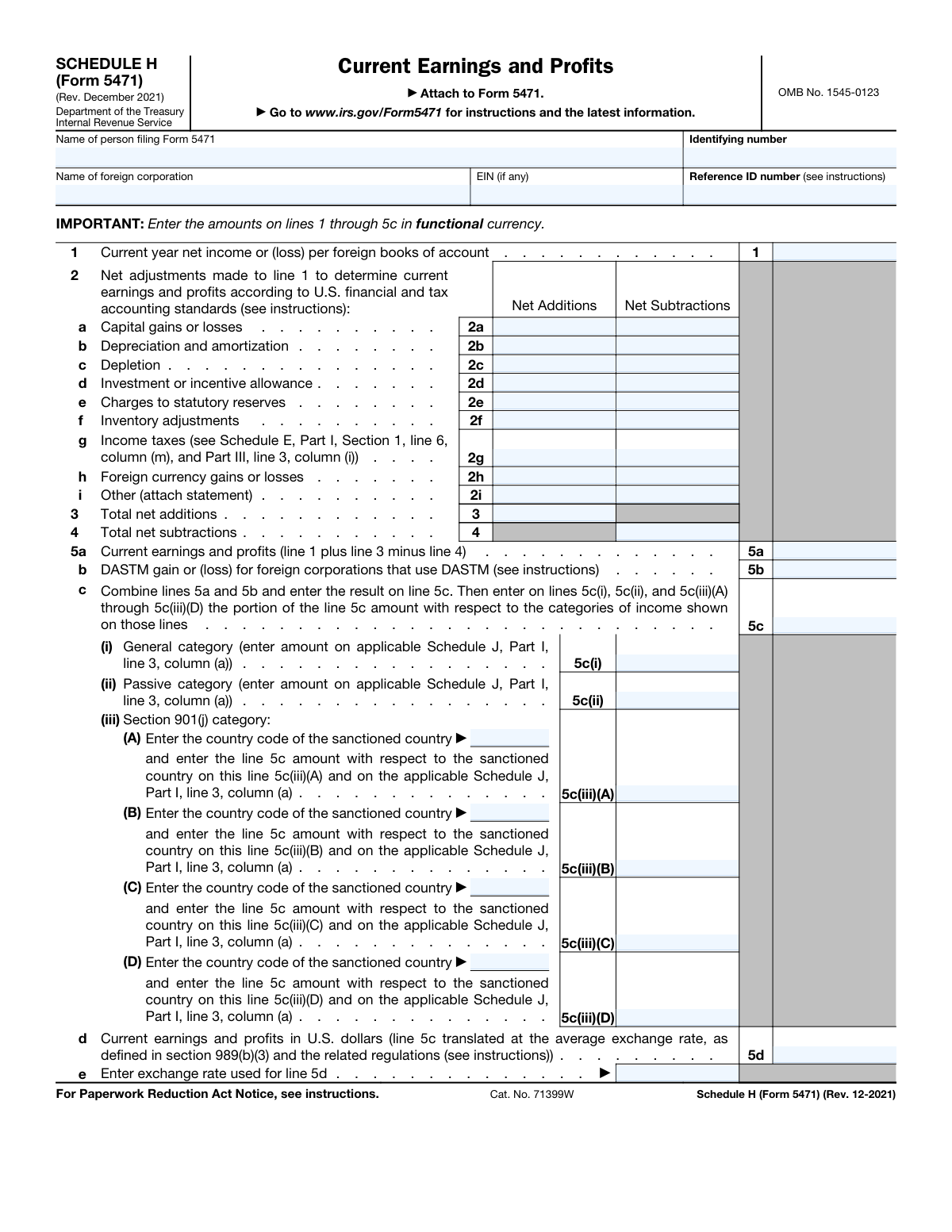
Yes! You can use AI to fill out Schedule H (Form 5471), Current Earnings and Profits
Schedule H (Form 5471), Current Earnings and Profits, is a mandatory attachment to Form 5471 filed with the IRS. It is used to calculate a foreign corporation's earnings and profits (E&P) for the current year by making specific adjustments to the corporation's book income to conform to U.S. tax accounting standards. This calculation is crucial for determining the taxability of distributions and understanding the financial performance from a U.S. tax perspective. Today, this form can be filled out quickly and accurately using AI-powered services like Instafill.ai, which can also convert non-fillable PDF versions into interactive fillable forms.
Our AI automatically handles information lookup, data retrieval, formatting, and form filling.
It takes less than a minute to fill out Schedule H (Form 5471) using our AI form filling.
Securely upload your data. Information is encrypted in transit and deleted immediately after the form is filled out.
Form specifications
| Form name: | Schedule H (Form 5471), Current Earnings and Profits |
| Number of fields: | 41 |
| Number of pages: | 1 |
| Language: | English |
Instafill Demo: How to fill out PDF forms in seconds with AI
How to Fill Out Schedule H (Form 5471) Online for Free in 2026
Are you looking to fill out a SCHEDULE H (FORM 5471) form online quickly and accurately? Instafill.ai offers the #1 AI-powered PDF filling software of 2026, allowing you to complete your SCHEDULE H (FORM 5471) form in just 37 seconds or less.
Follow these steps to fill out your SCHEDULE H (FORM 5471) form online using Instafill.ai:
- 1 Navigate to Instafill.ai and upload or select Schedule H (Form 5471) from the form library.
- 2 Use the AI assistant to enter the filer's name and identifying number, along with the foreign corporation's name, EIN, and reference ID in the header section.
- 3 Input the current year's net income or loss from the foreign corporation's books of account onto line 1.
- 4 Complete the 'Net Additions' and 'Net Subtractions' columns for lines 2a through 2i, detailing adjustments for items like depreciation, taxes, and foreign currency gains/losses.
- 5 Allow the AI to automatically calculate the total net additions (line 3), total net subtractions (line 4), and the resulting current earnings and profits in the functional currency (line 5a).
- 6 Allocate the earnings and profits on line 5c into the appropriate income categories (General, Passive, Section 901(j)) and then convert the final amount to U.S. dollars on line 5d, providing the exchange rate used.
- 7 Review all auto-filled information for accuracy, make any necessary edits, and then download the completed form to attach to your main Form 5471 filing.
Our AI-powered system ensures each field is filled out correctly, reducing errors and saving you time.
Why Choose Instafill.ai for Your Fillable Schedule H (Form 5471) Form?
Speed
Complete your Schedule H (Form 5471) in as little as 37 seconds.
Up-to-Date
Always use the latest 2026 Schedule H (Form 5471) form version.
Cost-effective
No need to hire expensive lawyers.
Accuracy
Our AI performs 10 compliance checks to ensure your form is error-free.
Security
Your personal information is protected with bank-level encryption.
Frequently Asked Questions About Form Schedule H (Form 5471)
Schedule H is used to calculate the current earnings and profits (E&P) of a foreign corporation according to U.S. tax principles. It must be attached to Form 5471, the Information Return of U.S. Persons With Respect to Certain Foreign Corporations.
Any U.S. person required to file Form 5471 must also complete and attach Schedule H. This form helps determine the taxable income implications of the foreign corporation's activities.
You must enter the amounts on lines 1 through 5c in the foreign corporation's functional currency. The final amount on line 5d must be translated into U.S. dollars.
The adjustments on line 2 are necessary to convert the net income from the foreign corporation's books to earnings and profits calculated under U.S. tax and accounting standards. These adjustments account for differences in rules for items like depreciation, capital gains, and taxes.
The Reference ID number is an optional field for your own record-keeping. You can use it to assign a unique tracking number to the form, but it is not required by the IRS.
DASTM stands for the Dollar Approximate Separate Transactions Method of accounting. This line is for reporting any gain or loss for foreign corporations that use this specific accounting method, typically in hyperinflationary economies.
To calculate line 5d, you must translate the total current earnings and profits from line 5c (which is in functional currency) into U.S. dollars. This conversion should be done using the average exchange rate for the tax year, which you then report on line 5e.
Line 2i is for any adjustments to earnings and profits that are not specifically listed in lines 2a through 2h. If you enter an amount on this line, you must attach a separate statement explaining the nature of the adjustment.
This section is for reporting the portion of the foreign corporation's earnings that are attributable to activities in sanctioned countries. You must enter the specific country code and the corresponding amount of earnings for each applicable sanctioned country.
Yes, services like Instafill.ai use AI to help fill out forms like Schedule H accurately and efficiently. These tools can auto-fill form fields based on your data, which saves time and helps prevent errors.
To fill out the form online, you can upload the Schedule H PDF to Instafill.ai. The platform will convert it into a web-based fillable form, allowing you to enter your information, sign, and download the completed document.
If you have a non-fillable or 'flat' PDF, you can use a service like Instafill.ai to instantly convert it into an interactive, fillable form. This allows you to type your information directly into the fields without needing to print and fill it out by hand.
The official instructions for Schedule H are part of the general instructions for Form 5471. You can find the latest version of these instructions on the IRS website at www.irs.gov/Form5471.
No, Schedule H is not a standalone form. It is a schedule that must be completed and attached to your main Form 5471 filing.
Compliance Schedule H (Form 5471)
Validation Checks by Instafill.ai
1
Header Information Completeness
This check verifies that the 'Name of person filing Form 5471', 'Identifying number', and 'Name of foreign corporation' fields are all populated. These fields are essential for identifying the filer and the subject corporation for the tax return. A failure in this validation would render the form unidentifiable and lead to rejection by the IRS.
2
Filer Identifying Number Format
This validation ensures the 'Identifying number' is in a valid format, such as a Social Security Number (SSN) or Individual Taxpayer Identification Number (ITIN). An incorrectly formatted number can cause processing delays or misidentification of the filer. If the number does not match the required format, the submission should be flagged for correction before filing.
3
Foreign Corporation EIN Format
This check validates that if a value is entered in the 'EIN (if any)' field, it conforms to the standard 9-digit format (XX-XXXXXXX). While the field is optional, providing an incorrectly formatted EIN can lead to processing errors and mismatches in IRS records. The validation prevents the submission of malformed data.
4
Line 3 Total Net Additions Calculation
This validation verifies that the value on Line 3, 'Total net additions', is the correct sum of all 'Net Additions' amounts from lines 2a through 2i. This is a critical arithmetic check to ensure the accuracy of the earnings and profits calculation. A mismatch indicates a calculation error that will lead to incorrect values on subsequent lines and an inaccurate return.
5
Line 4 Total Net Subtractions Calculation
This validation confirms that the value on Line 4, 'Total net subtractions', correctly equals the sum of all 'Net Subtractions' amounts from lines 2a through 2i. Accurate calculation is crucial for determining the correct current earnings and profits. If the sum does not match the total on Line 4, the form is arithmetically incorrect and must be corrected.
6
Line 5a Current E&P Calculation
This check ensures the amount on Line 5a is correctly calculated as 'Line 1 + Line 3 - Line 4'. Line 5a is a key summary figure, and an error here invalidates the entire earnings and profits calculation for the period. The system should flag this as a critical error requiring immediate correction.
7
Line 5c Combined Amount Calculation
This validation verifies that the amount on Line 5c is the sum of the amounts on Line 5a and Line 5b. Line 5c serves as the basis for allocation into different income categories. An incorrect total will result in erroneous allocations and an inaccurate tax filing.
8
Line 5c Allocation Summation Check
This check ensures that the sum of the amounts entered in lines 5c(i), 5c(ii), and 5c(iii)(A) through 5c(iii)(D) equals the total amount on line 5c. This confirms that the total current earnings and profits have been fully and correctly allocated across the required income categories. A discrepancy would mean the allocation is incomplete or incorrect, leading to filing errors.
9
Conditional Attachment for Line 2i 'Other'
This validation checks that if any amount is entered in the 'Net Additions' or 'Net Subtractions' fields for Line 2i ('Other'), an accompanying statement is attached or indicated. The form explicitly requires an attached statement to explain these 'Other' adjustments. Failure to provide this statement can result in inquiries from the IRS or rejection of the adjustment.
10
Conditional Country Code for Sanctioned Income
For each of the lines 5c(iii)(A) through 5c(iii)(D), this check verifies that if an amount is entered, the corresponding 'country code' field is also populated. The country code is required to identify the source of section 901(j) income. Submitting an amount without the corresponding code makes the entry incomplete and non-compliant.
11
Line 5d USD Conversion Calculation
This validation verifies that the U.S. dollar amount on Line 5d is the result of multiplying the functional currency amount on Line 5c by the exchange rate on Line 5e. Allowing for minor rounding differences, this check ensures the currency conversion was performed correctly. An incorrect conversion leads to an erroneous reporting of earnings in U.S. dollars.
12
Conditional Exchange Rate on Line 5e
This check ensures that if an amount is entered on Line 5d ('Current earnings and profits in U.S. dollars'), then the exchange rate on Line 5e must also be provided and must be a positive number. The exchange rate is necessary to validate the currency conversion calculation. Without it, the value on Line 5d is unverifiable and the form is incomplete.
13
Line 2g Cross-Schedule Consistency
This validation checks that the income tax adjustments on Line 2g are consistent with the amounts reported on Schedule E, Part I, Section 1, line 6, column (m), and Part III, line 3, column (i), as referenced in the form's instructions. This ensures logical consistency across different parts of the overall Form 5471 filing. Inconsistencies can trigger an audit or require amendments.
14
Sanctioned Country Code Format
This check validates that any country code entered in the fields for lines 5c(iii)(A) through 5c(iii)(D) is a valid, recognized two-letter country code. Using an invalid or non-standard code can cause data processing failures and misclassification of income. The validation ensures data integrity and compliance with IRS specifications.
Common Mistakes in Completing Schedule H (Form 5471)
A primary instruction on Schedule H is to report all amounts on lines 1 through 5c in the foreign corporation's functional currency. Filers often mistakenly use U.S. dollars from the start, which invalidates all subsequent calculations. This error leads to incorrect Earnings and Profits (E&P) figures, misstated tax attributes, and potential IRS scrutiny. To avoid this, confirm the corporation's functional currency and use it for all initial calculations before the specified conversion to USD on line 5d.
Line 2 requires filers to separate U.S. accounting and tax adjustments into 'Net Additions' and 'Net Subtractions'. A frequent error is placing an amount in the wrong column, such as listing a depreciation subtraction in the additions column, which reverses its intended effect. This mistake directly leads to a significantly misstated E&P total on line 5a. Filers must carefully analyze if each adjustment increases or decreases book income to ensure it is placed in the correct column.
Simple arithmetic errors are common when manually calculating the totals for lines 3 (Total net additions), 4 (Total net subtractions), and 5a (Current E&P). A miscalculation on any of these lines will cascade through the rest of the form, affecting the final USD amount and the allocation to different income categories. These errors can lead to an incorrect tax liability and may require filing an amended return. Using automated calculation tools or double-checking all totals can prevent these mistakes.
After calculating total E&P on line 5c, the amount must be correctly allocated among the General, Passive, and Section 901(j) categories. Filers often make mistakes where the sum of the allocated parts on lines 5c(i) through 5c(iii) does not equal the total on line 5c. This error directly impacts the calculation of foreign tax credits on Schedule J and can result in an incorrect tax assessment. Careful tracing of income sources is essential for proper allocation.
Line 5d requires converting the functional currency E&P into U.S. dollars using the 'average exchange rate' reported on line 5e. A common mistake is using a year-end rate, a spot rate, or an otherwise unsupported rate instead of the appropriate average rate defined in tax regulations. This results in an incorrect U.S. dollar E&P amount, which can understate or overstate income and associated tax. Filers must source the correct average exchange rate for the period.
Line 2i allows for 'Other' adjustments to E&P but explicitly requires an attached statement detailing the nature and amount of these items. Filers often enter a value on this line but forget to include the required supporting documentation. An incomplete filing can be rejected or trigger an IRS notice, delaying processing and potentially leading to penalties. Always prepare and attach a clear statement explaining any amount reported on line 2i.
Several lines on the form, such as line 1 for a net loss, can be negative. Filers sometimes drop the negative sign or fail to use parentheses as instructed, which inadvertently turns a loss into a profit. This simple data entry error fundamentally skews the entire E&P calculation and can drastically overstate the corporation's income. It is crucial to clearly and correctly indicate all negative values to ensure the form reflects the true financial performance.
Line 5c(iii) is for reporting E&P attributable to activities in countries sanctioned under Section 901(j), and it requires both a country code and an amount. Common errors include using an outdated or incorrect country code, failing to properly segregate the income from that jurisdiction, or overlooking the requirement entirely. Mistakes here are critical as they can result in the denial of foreign tax credits. Filers must stay updated on the official list of sanctioned countries.
Line 5b is for reporting gain or loss for corporations using the Dollar-Value Approximate Separate Transactions Method (DASTM), which is required in hyperinflationary economies. Many filers are unfamiliar with this complex rule and either omit a required adjustment or, less commonly, apply it when not warranted. This leads to an incorrect E&P calculation on line 5c and a misrepresentation of the corporation's financial results. Filers must determine if the foreign corporation is subject to DASTM rules.
This complex schedule is often available as a non-fillable PDF, forcing manual entry that is prone to transposition errors, illegible handwriting, and calculation mistakes. Such simple errors can lead to IRS processing delays or incorrect tax assessments. To mitigate this, AI-powered tools like Instafill.ai can convert flat, non-fillable PDFs into interactive forms. This allows for clean, typed entries and can help validate data formats, significantly reducing the risk of manual errors.
Saved over 80 hours a year
“I was never sure if my IRS forms like W-9 were filled correctly. Now, I can complete the forms accurately without any external help.”
Kevin Martin Green
Your data stays secure with advanced protection from Instafill and our subprocessors

Robust compliance program
Transparent business model
You’re not the product. You always know where your data is and what it is processed for.
ISO 27001, HIPAA, and GDPR
Our subprocesses adhere to multiple compliance standards, including but not limited to ISO 27001, HIPAA, and GDPR.
Security & privacy by design
We consider security and privacy from the initial design phase of any new service or functionality. It’s not an afterthought, it’s built-in, including support for two-factor authentication (2FA) to further protect your account.
Fill out Schedule H (Form 5471) with Instafill.ai
Worried about filling PDFs wrong? Instafill securely fills schedule-h-form-5471-current-earnings-and-profits forms, ensuring each field is accurate.