Yes! You can use AI to fill out Selbstauskunft (Form 194 252.001 D0)
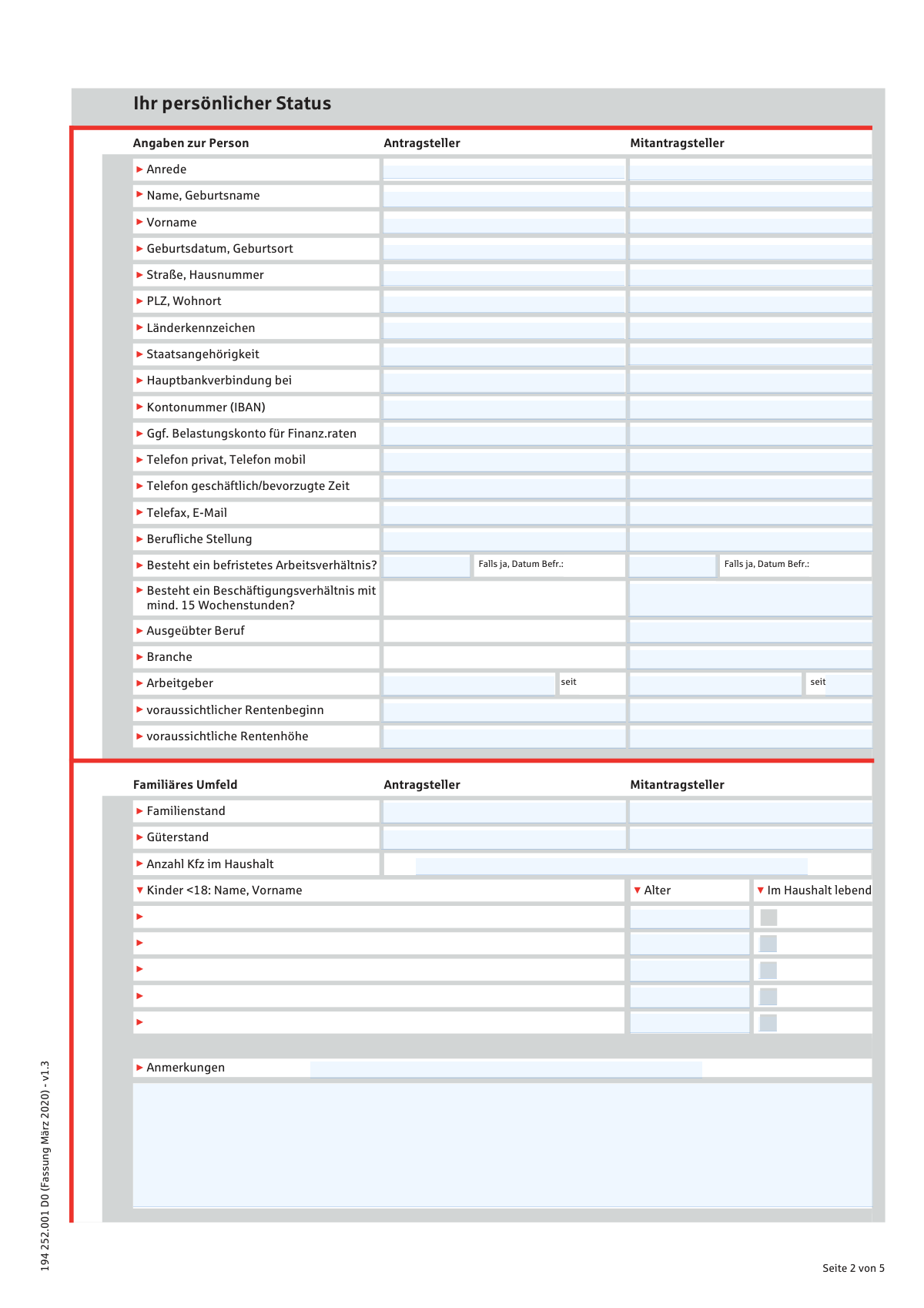
The Selbstauskunft (Self-Disclosure) is a comprehensive financial statement required by German banks, such as Sparkasse, when applying for a loan or mortgage. It collects detailed information about an applicant's personal status, income, expenses, assets, and liabilities to assess their financial situation and creditworthiness. This form is crucial for the bank's mandatory credit check (BonitĂ€tsprĂŒfung) before approving a loan. Today, this form can be filled out quickly and accurately using AI-powered services like Instafill.ai, which can also convert non-fillable PDF versions into interactive fillable forms.
Our AI automatically handles information lookup, data retrieval, formatting, and form filling.
It takes less than a minute to fill out 194 252.001 D0 using our AI form filling.
Securely upload your data. Information is encrypted in transit and deleted immediately after the form is filled out.
Form specifications
| Form name: | Selbstauskunft (Form 194 252.001 D0) |
| Number of pages: | 5 |
| Language: | English |
Instafill Demo: How to fill out PDF forms in seconds with AI
How to Fill Out 194 252.001 D0 Online for Free in 2026
Are you looking to fill out a 194 252.001 D0 form online quickly and accurately? Instafill.ai offers the #1 AI-powered PDF filling software of 2026, allowing you to complete your 194 252.001 D0 form in just 37 seconds or less.
Follow these steps to fill out your 194 252.001 D0 form online using Instafill.ai:
- 1 Navigate to Instafill.ai and upload or select the Selbstauskunft form.
- 2 Let the AI scan the document to identify all required fields for personal details, income, expenses, and assets.
- 3 Answer the AI's guided questions about your personal and professional status, including details for both the main applicant and any co-applicant.
- 4 Provide figures for your monthly income and expenses, such as salary, rental income, insurance premiums, and existing loan payments.
- 5 Detail your assets, including savings accounts, investments, and real estate, as well as any existing liabilities or financing agreements.
- 6 Review all the information automatically populated by the AI across the form's sections to ensure accuracy and completeness.
- 7 Download the completed Selbstauskunft form, sign it, and submit it to the financial institution as instructed.
Our AI-powered system ensures each field is filled out correctly, reducing errors and saving you time.
Why Choose Instafill.ai for Your Fillable 194 252.001 D0 Form?
Speed
Complete your 194 252.001 D0 in as little as 37 seconds.
Up-to-Date
Always use the latest 2026 194 252.001 D0 form version.
Cost-effective
No need to hire expensive lawyers.
Accuracy
Our AI performs 10 compliance checks to ensure your form is error-free.
Security
Your personal information is protected with bank-level encryption.
Frequently Asked Questions About Form 194 252.001 D0
This self-disclosure form is used by Sparkasse to collect your detailed personal and financial information. It is essential for the bank to conduct a legally required creditworthiness assessment ('BonitĂ€tsprĂŒfung') before approving a loan.
The primary applicant must complete the form. If you are applying with a partner or another person for financing, they must also fill out the 'Mitantragsteller' (co-applicant) sections.
Yes, you must submit the completed form along with supporting documents ('zugehörigen Nachweisen') like pay stubs, bank statements, and existing loan agreements to verify your information.
The form and all supporting documents should be handed over to the Sparkasse no later than your consultation meeting ('BeratungsgesprÀch'). If this is not possible, you should contact the bank in advance.
All financial figures for income ('Einnahmen') and expenses ('Ausgaben') must be entered as monthly amounts, as specified in the respective sections.
You must check the box indicating you have a fixed-term contract ('befristetes ArbeitsverhÀltnis') and enter the date the contract ends. This is important for the bank's assessment of your income stability.
This field refers to your matrimonial property regime, which governs how assets are handled in a marriage. Common German statuses include 'Zugewinngemeinschaft' (community of accrued gains) or 'GĂŒtertrennung' (separation of property).
Providing a complete overview of your assets and liabilities allows the bank to accurately assess your overall financial situation, net worth, and ability to take on new debt.
After submission, Sparkasse will use the information and your documents to perform a credit check. Please note that a successful credit check does not automatically guarantee the approval of a loan contract.
Yes, services like Instafill.ai use AI to auto-fill form fields accurately and save time. You can store your information once and reuse it for this and other forms.
To complete this form online, you can upload the PDF to a platform like Instafill.ai. The service will make the document interactive, allowing you to type in your information, save, and download the completed file.
If you have a flat, non-fillable PDF, you can use a service like Instafill.ai. It can convert the document into an interactive, fillable form automatically, so you can easily complete it on your computer.
Yes, the form requires the signature of the main applicant ('Hauptantragsteller') and the co-applicant ('Mitantragsteller'), if applicable. The signatures confirm that all the information provided is correct.
Compliance 194 252.001 D0
Validation Checks by Instafill.ai
1
IBAN Format and Validity
This check verifies that the 'Applicant IBAN' and 'Co-applicant IBAN' fields contain a structurally valid International Bank Account Number. The validation includes checking the country code, check digits, and length according to the ISO 13616 standard. This is crucial for processing direct debits and ensuring payments are routed correctly, and failure to provide a valid IBAN will prevent the setup of automated payments.
2
Applicant Age Verification
This validation confirms that the applicant, based on the 'Applicant Date and Place of Birth' field, is of legal age to enter into a contract (typically 18 years or older). It calculates the age from the date of birth against the submission date. This is a fundamental legal requirement for a loan application; if the applicant is underage, the submission must be rejected.
3
Conditional Fixed-Term Employment Date
This check ensures that if 'Fixed-Term Employment (Yes/No)' is answered with 'Yes', the corresponding 'Fixed-Term Contract End Date' field is populated with a valid, future date. This is critical for assessing income stability and repayment ability over the loan term. An empty or past date for a declared fixed-term contract would flag the entry as incomplete or inconsistent, requiring user correction.
4
Logical Retirement Start Date
This validation verifies that the 'Expected Retirement Start Date' is a future date and occurs after the applicant's date of birth. It ensures the data is logical and can be used for long-term financial planning and risk assessment. An illogical date, such as one in the past or before the applicant could plausibly work, would indicate a data entry error and must be corrected.
5
Child Age Constraint
This check validates that any age entered in the 'First Child Age', 'Second Child Age', etc., fields is a numeric value less than 18. The form section is explicitly for children under 18 ('Kinder <18'), and this data is used to calculate child-related expenses and benefits like 'Kindergeld'. An entry of 18 or older would be a logical contradiction and would be flagged for review.
6
Income and Expense Summation Accuracy
This validation recalculates the 'Summe monatlicher Einnahmen' (Sum of monthly income) and 'Summe monatlicher Ausgaben' (Sum of monthly expenses) based on the individual line items provided. This ensures the totals used to calculate disposable income are accurate and not the result of manual miscalculation. If the sums do not match, the form is considered to have a calculation error and will require correction before the financial assessment can proceed.
7
Disposable Income Calculation Consistency
This check verifies that the 'Freies Einkommen' (Disposable Income) field correctly equals the 'Gesamtsumme' of Einnahmen (Total Income) minus the 'Gesamtsumme' of Ausgaben (Total Expenses). This final figure is the most critical indicator of an applicant's ability to afford a new loan payment. A discrepancy indicates a fundamental error in the financial summary, and the application cannot be processed until it is resolved.
8
Asset Maturity Date Sequence
For each entry in the 'Ansparen und Vermögen' (Savings and Assets) section, this check ensures the 'FÀlligkeit/voraussichtl. Zuteilung' (Maturity/Expected Allocation Date) is on or after the 'Vertragsbeginn' (Contract Start Date). A maturity date that precedes the start date is logically impossible and indicates a significant data entry error. This validation maintains data integrity for asset evaluation, and a failure would require the user to correct the dates.
9
Conditional Rental Income Requirement
This validation checks that if a property's usage ('Nutzung') is marked as 'fremd' (rented out), then at least one of the corresponding monthly rental income fields contains a numeric value. Declaring a property as rented implies it generates income, which is essential for a complete financial picture. If the usage is 'fremd' but no income is listed, the entry is flagged as incomplete.
10
Financing Chronological Date Validation
For each existing loan in the 'Finanzierungen' section, this check ensures the dates follow a logical sequence: 'Vertragsbeginn' (Contract Start) must be before or on 'Ablauf Zinsbindungsfrist' (End of Fixed-Interest Period), which must be before or on 'Ende der Laufzeit' (End of Term). This logic is fundamental to understanding the structure and timeline of existing debts. An illogical sequence points to a data error that could misrepresent the applicant's financial obligations.
11
Financing Balance Plausibility
This check verifies that for each financing entry, the 'Aktueller Saldo' (Current Balance) is less than or equal to the 'Ursprungsbetrag' (Original Amount). A current balance cannot exceed the original loan amount, so any violation of this rule indicates a clear data entry mistake. This is important for accurately assessing the applicant's total liabilities.
12
Email Address Format
This validation ensures that if a value is entered into the 'Applicant Fax and Email' or 'Co-applicant Fax or Email' fields, it conforms to the standard email address format (e.g., [email protected]). While not always mandatory, a valid email is a primary channel for communication, document exchange, and notifications. An invalid format would prevent communication and should be flagged for correction.
13
Plausible Employment Start Date
This check validates that the 'seit' (Employed Since) date for both the applicant and co-applicant is a date in the past and occurs after a plausible age, such as their 16th birthday. This prevents impossible entries, like an employment start date before the person was born or during early childhood. Ensuring a plausible date is important for correctly calculating the length of employment, a key factor in assessing stability.
14
Property Area Logic Check
This validation ensures that for any property listed, the 'WohnflĂ€che m2' (Living Area) is not greater than the 'GrundstĂŒcksflĂ€che m2' (Plot Area). The living space of a building cannot exceed the total area of the land it sits on. This simple logical check helps catch data entry errors or typos in the property details section, ensuring the asset information is plausible.
Common Mistakes in Completing 194 252.001 D0
Applicants frequently enter their gross (Brutto) salary in the 'Lohn und Gehalt (netto)' field, which specifically asks for net income. This happens because gross salary is a more commonly discussed figure, but it significantly inflates their perceived disposable income. This error leads to an inaccurate credit assessment and almost certain queries or rejection once the bank reviews the actual pay stubs. To avoid this, always refer to the net amount ('Netto-Verdienst') on your most recent payslip.
In the 'Finanzierungen' section, people often forget to list all their financial liabilities, such as car leasing, small installment loans, or 'buy now, pay later' plans. This omission, whether intentional or not, creates an incomplete picture of their monthly expenses and can be viewed as misleading. Since these debts are typically registered with credit bureaus, they will be discovered during the bank's credit check, which can damage the applicant's credibility and jeopardize the loan approval.
The IBAN is a long, complex number, making it highly susceptible to typos. An incorrect IBAN will cause significant delays, as it prevents the bank from verifying account details and can block the setup of direct debits or the disbursement of the loan. This simple data entry error can bring the entire application process to a halt. AI-powered form filling tools like Instafill.ai can help prevent this by automatically validating the IBAN's structure and checksum to ensure it is a valid number.
When an applicant checks 'yes' for having a fixed-term employment contract ('befristetes ArbeitsverhÀltnis'), they often neglect to enter the contract's expiration date. This date is a critical piece of information for the lender, as it directly relates to the applicant's future income stability. Leaving this field blank forces the bank to request more information, delaying the application, or to make a negative assumption about long-term repayment ability.
The term 'GĂŒterstand' is a specific legal concept regarding marital assets that many applicants are not familiar with, causing them to leave the field blank or guess incorrectly. The property regime (e.g., community of property, separation of property) has significant legal implications for liability and ownership, making it essential for the loan contract. Misstating it can lead to legal complications later on, so applicants should clarify their status before filling out the form.
In the 'Ansparen und Vermögen' (Savings and Assets) section, applicants often list the total insured sum ('Versicherungssumme') of a life insurance policy instead of its current cash surrender value ('RĂŒckkaufswert'). The insured sum is a future payout upon death, not a current asset, so this error dramatically overstates the applicant's actual liquid net worth. Banks are interested in the current value, and this mistake leads to a flawed financial assessment.
Applicants often provide an unrealistically low estimate for their 'Lebenshaltungskosten' (living costs), forgetting to account for irregular expenses like vacations, subscriptions, or hobbies. This results in an inflated 'Freies Einkommen' (disposable income) figure. Banks often use their own standardized household cost rates for assessment, and if the applicant's figure is too low, it will be adjusted, which could result in the loan being denied for lack of affordability.
The 'Finanzierungen' section requires both the 'Ablauf Zinsbindungsfrist' (end of fixed-interest period) and 'Ende der Laufzeit' (end of loan term). Applicants frequently confuse these two dates or only provide one. The fixed-interest end date is crucial for the bank to assess future interest rate risk and its impact on the applicant's monthly payments. Providing incorrect or incomplete date information misrepresents the true nature of the liability.
The form explicitly asks about income fluctuations within the last five years, such as periods of unemployment, parental leave, or a switch to self-employment. Applicants may downplay or omit this information to present a history of stable income. However, this information is easily verifiable through bank statements and tax records, and a lack of transparency can lead to a loss of trust and immediate rejection of the application.
This form is a flat, non-fillable PDF, which forces applicants to print it and fill it out by hand. This often leads to illegible handwriting, crossed-out information, and calculation errors in the income and expense tables, making it difficult for the bank to process. To avoid this, applicants can use tools like Instafill.ai, which can convert non-fillable PDFs into interactive forms, allowing for clean, typed entries and reducing the chance of manual errors.
Saved over 80 hours a year
âI was never sure if my IRS forms like W-9 were filled correctly. Now, I can complete the forms accurately without any external help.â
Kevin Martin Green
Your data stays secure with advanced protection from Instafill and our subprocessors
Robust compliance program
Transparent business model
Youâre not the product. You always know where your data is and what it is processed for.
ISO 27001, HIPAA, and GDPR
Our subprocesses adhere to multiple compliance standards, including but not limited to ISO 27001, HIPAA, and GDPR.
Security & privacy by design
We consider security and privacy from the initial design phase of any new service or functionality. Itâs not an afterthought, itâs built-in, including support for two-factor authentication (2FA) to further protect your account.
Fill out 194 252.001 D0 with Instafill.ai
Worried about filling PDFs wrong? Instafill securely fills selbstauskunft-form-194-252001-d0 forms, ensuring each field is accurate.