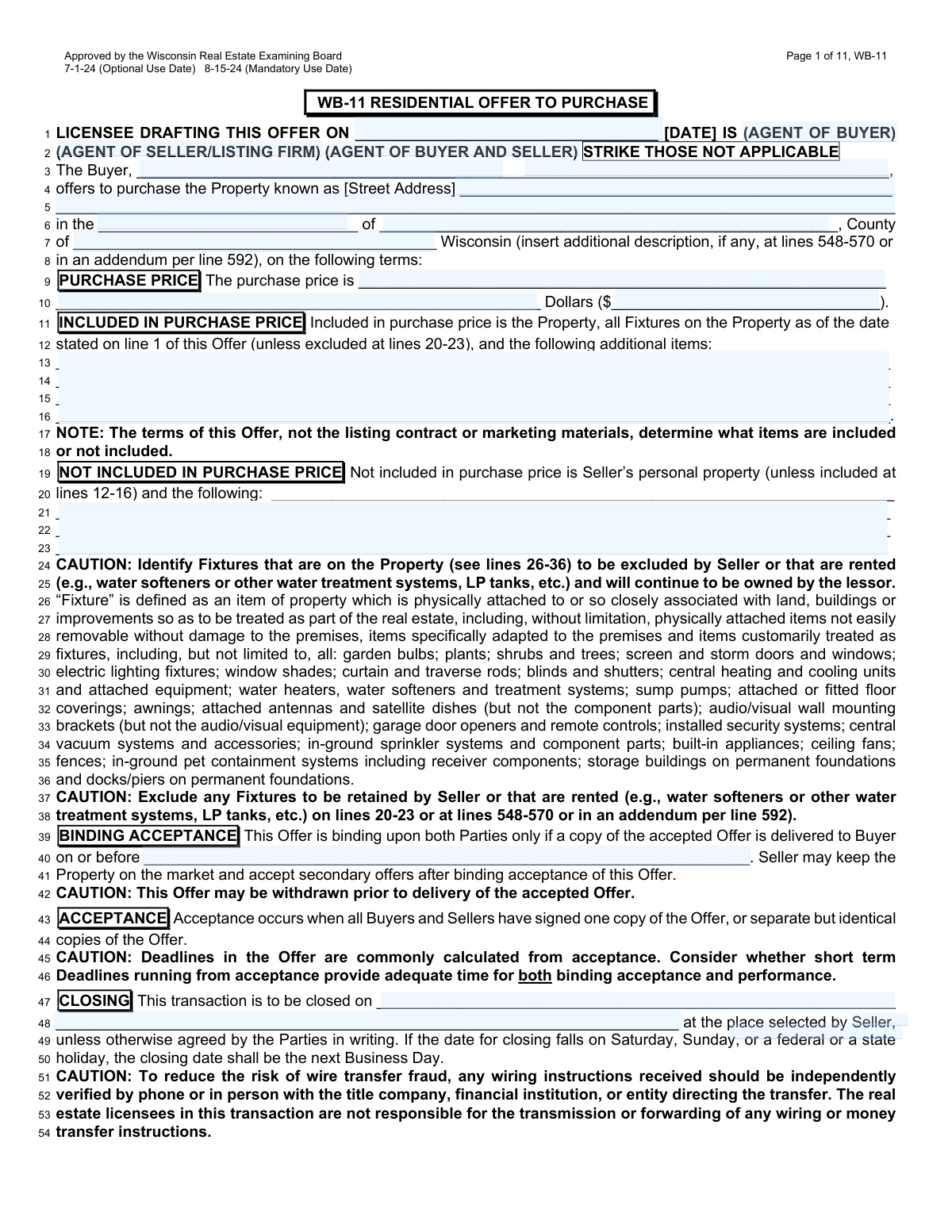
Yes! You can use AI to fill out WB-11 Residential Offer to Purchase
Form WB-11, the Residential Offer to Purchase, is a state-approved contract used throughout Wisconsin for buying and selling residential real estate. It outlines all terms and conditions of the proposed transaction, including purchase price, contingencies, deadlines, and property details, becoming a legally binding agreement upon acceptance by both buyer and seller. Today, this form can be filled out quickly and accurately using AI-powered services like Instafill.ai, which can also convert non-fillable PDF versions into interactive fillable forms.
Our AI automatically handles information lookup, data retrieval, formatting, and form filling.
It takes less than a minute to fill out WB-11 using our AI form filling.
Securely upload your data. Information is encrypted in transit and deleted immediately after the form is filled out.
Form specifications
| Form name: | WB-11 Residential Offer to Purchase |
| Number of fields: | 161 |
| Number of pages: | 11 |
| Language: | English |
Instafill Demo: How to fill out PDF forms in seconds with AI
How to Fill Out WB-11 Online for Free in 2026
Are you looking to fill out a WB-11 form online quickly and accurately? Instafill.ai offers the #1 AI-powered PDF filling software of 2026, allowing you to complete your WB-11 form in just 37 seconds or less.
Follow these steps to fill out your WB-11 form online using Instafill.ai:
- 1 Navigate to Instafill.ai and upload or select the WB-11 Residential Offer to Purchase form.
- 2 Use the AI assistant to input the buyer's and seller's information, along with the complete property address and legal description.
- 3 Enter the financial details of the offer, including the purchase price, earnest money amount, and financing terms.
- 4 Specify all applicable contingencies, such as inspection, appraisal, and financing, and set the deadlines for each.
- 5 Detail what items are included or excluded from the sale, define the closing date, and add any special provisions or addenda.
- 6 Review all the information populated by the AI for accuracy, make any necessary corrections, and then have the buyer(s) electronically sign the document.
- 7 Securely download, print, or share the completed and signed offer for delivery to the seller or their agent.
Our AI-powered system ensures each field is filled out correctly, reducing errors and saving you time.
Why Choose Instafill.ai for Your Fillable WB-11 Form?
Speed
Complete your WB-11 in as little as 37 seconds.
Up-to-Date
Always use the latest 2026 WB-11 form version.
Cost-effective
No need to hire expensive lawyers.
Accuracy
Our AI performs 10 compliance checks to ensure your form is error-free.
Security
Your personal information is protected with bank-level encryption.
Frequently Asked Questions About Form WB-11
This is a legally binding contract used in Wisconsin for a buyer to make an offer to purchase a residential property. When signed by both the buyer and seller, it outlines all the terms and conditions of the sale.
The buyer, typically with the assistance of their real estate agent, fills out this form to present their offer to the seller. The seller then reviews it and can accept, reject, or counter the offer.
Fixtures are items physically attached to the property, like light fixtures or built-in appliances, and are automatically included in the sale unless specifically excluded on lines 20-23. Personal property, like furniture, is not included unless you list it in the 'Included in Purchase Price' section.
If the offer is not accepted or if the deal is terminated per a contingency, the earnest money is typically returned to the person who paid it. If the offer doesn't close for other reasons, disbursement is determined by a written agreement or legal proceedings.
The offer becomes a binding contract only when a copy of the offer, signed by all parties, is delivered to the buyer by the deadline specified on line 39. Until that delivery occurs, the buyer may withdraw the offer.
This contingency allows the buyer to have the property inspected by a professional. If the inspection reveals 'Defects' the buyer objects to, they can provide a 'Notice of Defects' to the seller, which may lead to repairs, price negotiations, or the termination of the offer.
If the seller has the 'Right to Cure,' they can choose to repair the defects you identified in your Notice of Defects. If they elect to cure and complete the repairs as agreed, the offer remains valid; otherwise, the offer may become null and void.
Delivering your signed loan commitment to the seller satisfies the financing contingency and removes it from the offer. This shifts the risk to you, the buyer, if the loan ultimately does not get funded for any reason.
If the appraisal is low, you must provide the seller with the appraisal report and a written notice objecting to the value. Depending on the terms, the seller may have the right to lower the price, or the offer could become null and void.
In most cases for properties with one-to-four dwelling units, Wisconsin law requires the seller to provide you with a Real Estate Condition Report. If you don't receive it within 10 days of acceptance, you may have the right to rescind the contract.
When 'Time is of the Essence' applies to a date, failure to perform by that exact deadline is a breach of contract. If it does not apply, performance within a reasonable time of the deadline is allowed before a breach occurs.
Yes, AI-powered services like Instafill.ai can help you accurately auto-fill form fields, which saves time and reduces the chance of errors. However, you should always review the completed form with your real estate agent or attorney.
Simply upload the WB-11 form to Instafill.ai, and its AI will identify the fields. You can then enter your information once, and the tool will populate it across all relevant sections, making the process faster and more efficient.
You can use a service like Instafill.ai, which can convert flat, non-fillable PDFs into interactive, fillable forms. This allows you to easily type your information directly into the document online without needing to print and write by hand.
Compliance WB-11
Validation Checks by Instafill.ai
1
Purchase Price Numeric and Written Consistency
This check ensures that the purchase price entered in numeric format (e.g., '$500,000') on line 9 is identical to the amount written out in words (e.g., 'Five Hundred Thousand Dollars') on lines 8-9. This is critical for preventing ambiguity and legal disputes over the agreed-upon price. If the values do not match, the submission should be flagged for manual review and correction to ensure the contract reflects the true intent of the parties.
2
Binding Acceptance Deadline Chronology
Validates that the 'Binding Acceptance' deadline on line 39 is a future date and occurs after the offer's draft date on line 1. A deadline that has already passed is invalid and makes the offer immediately voidable. This check prevents the creation of contracts with impossible or illogical deadlines, ensuring the seller has a valid timeframe to consider the offer.
3
Closing Date Sequence Validation
Verifies that the 'Closing' date on line 47 is set for a date after the 'Binding Acceptance' deadline on line 39. A closing cannot be scheduled before the offer is officially accepted and becomes a binding contract. This validation maintains the logical sequence of events in the real estate transaction and prevents scheduling conflicts and contractual impossibilities.
4
Buyer Name Completeness
Ensures that the Buyer's full legal name is provided on line 2. As a legally binding contract, the offer must clearly identify all parties involved. Failure to provide a buyer's name makes the offer incomplete and unenforceable, so this field must not be left blank.
5
Property Address Completeness
This check confirms that the full property address, including Street Address (line 3), Municipality (line 5), and County (line 6), is completely filled out. The property is the subject of the contract, and an incomplete or missing address creates fatal ambiguity. A failed validation requires the user to provide the full address to ensure the correct property is being offered upon.
6
Financing Contingency Completeness
If the 'Financing Commitment Contingency' checkbox on line 248 is marked, this validation ensures that all related financial details are provided, including loan amount, term, and amortization years (lines 250-251). Leaving these terms blank would make the contingency vague and potentially unenforceable. This check guarantees that the conditions under which the buyer must secure financing are clearly defined.
7
Loan Amount vs. Purchase Price Logic
This validation compares the loan amount specified in the 'Financing Commitment Contingency' (line 250) against the total purchase price (line 9). The loan amount should logically be less than or equal to the purchase price. A loan amount greater than the purchase price is highly unusual and likely an error, which could cause significant issues with lenders and closing.
8
Exclusive 'Strike One' Selection
Applies to all clauses with a '(shall)(shall not) STRIKE ONE' instruction, such as the 'Right to Cure' on lines 216, 235, and 315. The validation ensures that exactly one of the two options has been stricken (or selected), leaving a single clear choice. If both or neither are selected (and no default is specified), the contract term is ambiguous, which can lead to disputes; this check forces a clear decision.
9
Earnest Money Option Exclusivity
Verifies that only one of the two earnest money options is completed: either the amount 'accompanies this Offer' (line 55) or the amount 'will be mailed...within X days' (line 58). Filling out both fields creates a contradiction regarding the amount and timing of the earnest money payment. This check ensures the earnest money obligation is clearly and singularly defined.
10
Contingency Deadline Validity
Checks that any deadline expressed as a number of days, such as for the Inspection Contingency (line 206) or Appraisal Contingency (line 312), is a positive integer. A zero, negative, or non-numeric value is invalid and would make the contingency period nonsensical. This ensures that all time-bound contingencies have a clear and actionable timeframe.
11
Tax Proration Formula Selection
This validation ensures that exactly one of the checkboxes for the real estate tax proration formula (lines 366-372) is selected. The method of prorating taxes has a direct financial impact on both buyer and seller at closing. Failing to select a method, or selecting multiple, creates uncertainty that must be resolved before closing.
12
Seller Acceptance Date Compliance
Validates that the date of the Seller's signature for acceptance (lines 614, 616) is on or before the 'Binding Acceptance' deadline specified on line 39. If the seller signs after the deadline, the buyer's offer has expired, and no contract is formed. This check is crucial to confirm that the acceptance was timely and the contract is legally binding.
13
Closing of Buyer's Property Contingency Details
If the 'Closing of Buyer's Property Contingency' checkbox on line 328 is marked, this check verifies that the location of the buyer's property (line 329) and the deadline for its closing (line 330) are both filled in. This contingency is material to the offer, and without these details, it is incomplete and unenforceable. The validation ensures all necessary information for this specific condition is present.
14
Agent Role Selection
Ensures that on line 1, the drafting licensee has clearly indicated their role by striking out the inapplicable options (e.g., 'AGENT OF BUYER', 'AGENT OF SELLER/LISTING FIRM'). Agency relationships carry significant legal duties and responsibilities. This validation confirms that the agent's role is explicitly defined to avoid confusion and potential conflicts of interest.
Common Mistakes in Completing WB-11
This error occurs when the purchase price written in words (lines 8-9) does not match the numeric value in the parentheses. This often happens due to a simple typo or last-minute change that isn't updated in both places. A discrepancy creates ambiguity and can lead to legal disputes over the true contract price, potentially voiding the offer or requiring an amendment to clarify, which delays the process.
Buyers or sellers often provide generic descriptions like 'appliances' or 'drapes' in the 'Included' (lines 12-16) or 'Not Included' (lines 20-23) sections. This ambiguity leads to disputes at the final walk-through when the specific high-end refrigerator has been swapped for a different one. To avoid this, list items with specific details like brand, model, and color, ensuring there is no confusion about what stays and what goes.
The form contains several 'STRIKE ONE' clauses, such as the Seller's 'Right to Cure' for inspections (line 216) and appraisals (line 315). Parties often overlook these, and the contract defaults to a specific outcome (e.g., Seller 'shall' have the right to cure). This can unintentionally lock a buyer into a situation they wished to avoid, such as allowing the seller to perform repairs instead of being able to terminate the offer.
Buyers may leave blanks or enter vague terms in the Financing Commitment Contingency section (lines 248-255), such as the loan amount, term, or maximum interest rate. This can render the contingency unenforceable, putting the buyer's earnest money at risk if they cannot secure a loan. It is crucial to fill in specific, realistic figures to create a valid contingency that protects the buyer.
A common mistake is misunderstanding the strict procedure for delivering a Notice of Defects (line 207). A buyer might send an amendment proposing repairs instead of the required formal notice, believing this satisfies the contingency deadline. This fails to meet the contract's requirements, causing the contingency to be deemed satisfied and forcing the buyer to accept the property with its defects or risk default.
On lines 365-371, parties often neglect to check a box for how real estate taxes will be prorated, causing it to default to the previous year's net taxes. In cases of new construction, recent reassessments, or rising mill rates, this can result in a significant financial surprise for the buyer after closing when the actual tax bill arrives. Selecting the appropriate method or agreeing to re-prorate post-closing (line 377) prevents these disputes.
An offer may be written with an incomplete or incorrect street address, or it may omit the municipality and county (lines 3-7). While a street address is common, a full legal description is what defines the property being transferred. Errors or omissions can cause significant delays with title insurance, financing, and recording the deed, potentially jeopardizing the entire transaction.
Parties often fail to properly manage the 'Time is of the Essence' clause (lines 88-93) by either striking or not striking applicable deadlines. If a deadline is 'of the essence,' missing it by even a minute constitutes a breach of contract. If it is not, performance within a 'reasonable time' is allowed. This misunderstanding can lead to a party unintentionally defaulting on the contract or losing the right to enforce a strict deadline.
The 'Additional Provisions/Contingencies' section (lines 548-570) is frequently used to add custom terms, but these are often written in a way that is ambiguous, contradictory to other parts of the offer, or legally unenforceable. This creates significant risk and is a common source of litigation when parties disagree on the interpretation of the poorly drafted clause. It is always best to use state-approved forms or have an attorney draft any custom language.
Failing to provide a complete and correct email, fax, or mailing address in the 'Delivery of Documents' section (lines 571-589) is a critical oversight. All official notices, such as a Notice of Defects or a bump clause activation, are sent to these contacts. An incorrect address can mean a party never receives a time-sensitive notice, causing them to miss a deadline and lose contractual rights or even default on the offer.
Saved over 80 hours a year
“I was never sure if my IRS forms like W-9 were filled correctly. Now, I can complete the forms accurately without any external help.”
Kevin Martin Green
Your data stays secure with advanced protection from Instafill and our subprocessors

Robust compliance program
Transparent business model
You’re not the product. You always know where your data is and what it is processed for.
ISO 27001, HIPAA, and GDPR
Our subprocesses adhere to multiple compliance standards, including but not limited to ISO 27001, HIPAA, and GDPR.
Security & privacy by design
We consider security and privacy from the initial design phase of any new service or functionality. It’s not an afterthought, it’s built-in, including support for two-factor authentication (2FA) to further protect your account.
Fill out WB-11 with Instafill.ai
Worried about filling PDFs wrong? Instafill securely fills wb-11-residential-offer-to-purchase forms, ensuring each field is accurate.