Fill out 529 college savings forms
with AI.
529 college savings forms are essential documents for managing tax-advantaged education accounts. These forms facilitate critical actions such as initiating withdrawals for tuition, rolling over funds between different plans, or updating account details to reflect changing family needs. Because 529 plans are governed by specific IRS regulations, completing this paperwork accurately is vital to maintaining the tax-exempt status of your savings and avoiding unnecessary penalties.
By continuing, you acknowledge Instafill's Privacy Policy and agree to get occasional product update and promotional emails.
About 529 college savings forms
Typically, these forms are required by parents, grandparents, or legal guardians who serve as account owners. You might find yourself needing them when a beneficiary is ready to start college and you need to request a distribution, or when you decide to transfer the remaining balance to a different family member using a Beneficiary Change Form. Other common scenarios include consolidating accounts through a Rollover Request or designating a Power of Attorney to help manage the investments. Whether you are dealing with plans from Vanguard, Fidelity, or Merrill Lynch, having the right documentation ensures that your educational savings are used effectively and legally.
Managing these administrative tasks doesn't have to be a burden on your schedule. Tools like Instafill.ai use AI to fill these forms in under 30 seconds, ensuring your data is handled accurately and securely so you can focus on planning for the future.
Every form on this page can be completed without typing. Instafill is form filling software that reads a PDF and fills it for you — including flat and scanned documents that carry no fillable fields at all.
Forms in This Category
The forms in this category have a median Form Complexity Index of 41/100 (Basic), measured across 13 forms by field count, input difficulty, length, conditional logic and structure. See how it is calculated.
- Enterprise-grade security & data encryption
- 99%+ accuracy powered by AI
- 1,000+ forms from all industries
- Complete forms in under 60 seconds
How to Choose the Right Form
Selecting the right 529 form depends primarily on your specific plan provider (such as Vanguard, Fidelity, or Merrill Lynch) and the specific administrative action you need to take regarding the account.
Updating the Student or Beneficiary
If you need to transfer the account balance to a different family member to avoid tax penalties, select the form that matches your financial institution:
- Fidelity Institutional 529 College Savings Plan Beneficiary Change
- CollegeAdvantage Direct 529 Savings Plan Beneficiary Change Form (specifically for Ohio’s plan)
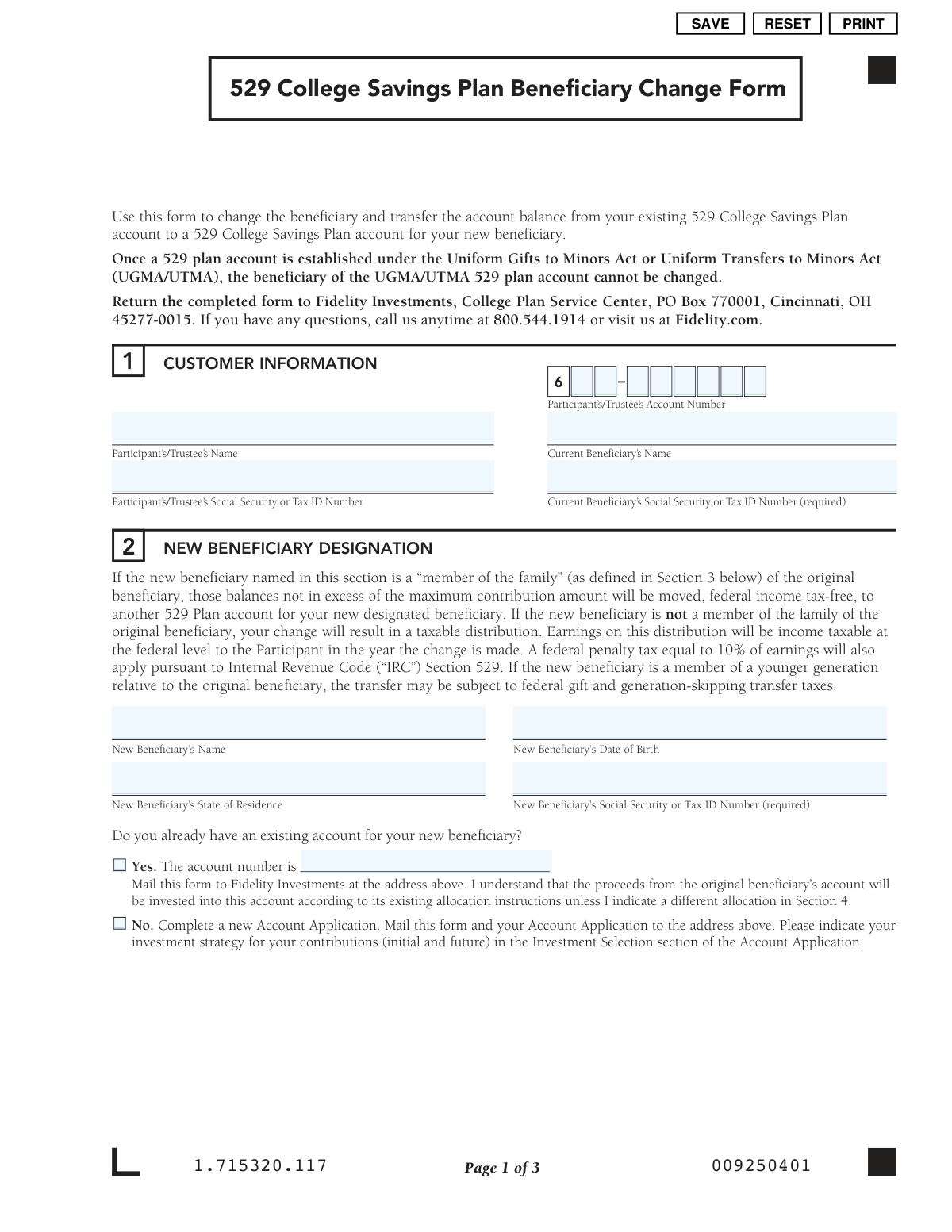
- 529 College Savings Plan Beneficiary Change Form (a general legal document for other plan types)
Withdrawing Funds for Education
To access your savings for qualified education expenses, apprenticeship costs, or K-12 tuition, use the withdrawal request form specific to your provider:
- The Vanguard 529 College Savings Plan: Withdrawal Request Form
- Fidelity Investments Withdrawals—529 College Savings Plan
- Merrill Lynch 529 College Savings Plan Withdrawal Request Form
Rolling Over or Moving Assets
If you are consolidating accounts or moving money between different types of savings vehicles, look for rollover-specific documentation:
- The Vanguard 529 College Savings Plan Incoming Direct Rollover Form: Use this to move funds from another 529 plan into Vanguard.
- The Vanguard 529 College Savings Plan Direct Rollover Out to Roth IRA Form: Use this for the specific purpose of moving unused 529 funds into a beneficiary's Roth IRA.
- Rollover Request — 529 College Savings Plan: The standard form for consolidating assets into a Fidelity-managed plan.
Managing Account Authority
For legal management and estate transitions, Vanguard offers several specialized forms:
- The Vanguard 529 College Savings Plan: Power of Attorney: Grants broad management powers to an agent.
- Agent Authorization/Limited Power of Attorney: Grants restricted, specific powers to an agent.
- Form 529TCF Trustee Certification: Required for accounts owned by a trust.
- Transfer Due to Death of Account Owner Form: Necessary for transitioning an account to a successor owner after a death.
Tips for 529 college savings forms
When submitting a beneficiary change form, ensure the new beneficiary's Social Security number and date of birth are perfectly accurate. Even a single digit error can lead to a rejected form or significant delays in transferring the account balance.
Carefully select the correct withdrawal category on your request form to avoid unintended tax consequences. Qualified withdrawals for tuition or books are handled differently than non-qualified ones, and mislabeling them can trigger IRS penalties on the earnings portion.
AI-powered tools like Instafill.ai can complete these complex financial forms in under 30 seconds with high accuracy. Your sensitive financial data stays secure during the process, providing a practical and fast solution for managing multiple 529 accounts.
Before initiating a rollover request, confirm that you haven't performed a 529-to-529 rollover for the same beneficiary within the last 12 months. Exceeding this limit can result in the transfer being treated as a taxable distribution rather than a tax-free rollover.
While withdrawal forms authorize the release of funds, they do not serve as proof of purchase to the IRS. Keep a dedicated digital or physical folder with all tuition, room, and board receipts to justify the withdrawals you make from your 529 plan.
Don't wait for a change in circumstances to designate a successor owner for your account. Filing the appropriate transfer or successor forms early ensures that the college savings remain accessible and managed according to your wishes without legal delays.
Frequently Asked Questions
These forms are administrative documents used to manage, update, or withdraw funds from a tax-advantaged 529 education savings plan. They allow account owners to perform essential tasks such as changing beneficiaries, requesting distributions for tuition, or rolling over funds between different financial institutions.
You should use this form if the original student no longer needs the funds—perhaps they have graduated or received a scholarship—and you want to transfer the balance to another eligible family member. This process helps maintain the tax-advantaged status of the account while directing the savings toward a new student's education.
To access your savings, you must complete a Withdrawal Request Form specific to your plan provider, such as Vanguard, Fidelity, or Merrill Lynch. These forms generally require you to specify whether the funds should be sent to the account owner, the beneficiary, or directly to the educational institution to cover qualified costs.
Yes, current IRS regulations allow for certain unused 529 funds to be rolled over into a Roth IRA for the beneficiary using a specific rollover form. This process is subject to specific requirements, including how long the account has been open and lifetime contribution limits for the beneficiary.
A Power of Attorney (POA) usually grants broad authority to an agent to manage the account, whereas an Agent Authorization or Limited POA restricts that authority to specific tasks like making inquiries or contributions. You should choose the form that reflects the exact level of control you wish to grant to a third party, such as a financial advisor.
The account owner, often referred to as the participant, is typically the individual required to sign and submit these documents. In specific cases involving the death of an owner or a trust-owned account, a designated successor or a certified trustee may be required to sign instead.
Yes, you can use AI tools like Instafill.ai to complete these documents quickly and accurately. The AI can extract data from your existing records and place it into the correct fields, ensuring that complex forms like rollover requests or beneficiary changes are handled without manual entry errors.
While manual completion can be time-consuming and prone to errors, AI-powered services like Instafill.ai can fill these forms in under 30 seconds. This allows you to generate a ready-to-sign PDF almost instantly, which you can then submit to your plan administrator.
If an account owner dies, a Transfer Due to Death form is used to transition the account to a successor owner. This ensures a seamless transition of the educational funds to a new individual who will then have the authority to manage the account for the beneficiary.
Rollovers between plans are generally tax-free if they are completed within 60 days and follow the IRS rule of one rollover per 12-month period for the same beneficiary. Using a formal Rollover Request form ensures that the breakdown of principal and earnings is properly documented for tax reporting purposes.
Completed forms should be submitted directly to the financial institution or state agency that manages your specific 529 plan. Most providers, such as Fidelity or Vanguard, offer options to submit these documents via secure online portals, fax, or traditional mail.
Glossary
- Form Complexity Index
- Instafill’s 0–100 measure of how much effort a form takes to complete, calculated deterministically from the form’s own structure rather than estimated. It combines the number of fillable fields (the largest factor), how difficult those fields are to complete based on their type, the number of pages that contain fields, the amount of conditional “fill-only-if” logic, and how many sections the form is divided into, then adds modifiers for tables and repeating lists, bundled instruction pages, and dense page layouts. A higher score means the form is harder to fill out by hand. The forms in this category have a median Form Complexity Index of 41/100 (Basic). See exactly how it is calculated.
- Qualified Higher Education Expenses (QHEE)
- Specific costs required for enrollment or attendance at an eligible school, such as tuition, fees, books, and room and board, which allow for tax-free withdrawals.
- Beneficiary
- The individual designated by the account owner to use the funds for educational expenses; this person can typically be changed to another family member.
- Rollover
- The tax-free transfer of funds from one 529 plan to another, or from a 529 plan to a Roth IRA, provided it follows IRS rules regarding frequency and timing.
- Successor Account Owner
- A person named on the account who will take over management and ownership of the 529 plan if the original account owner passes away.
- Non-qualified Withdrawal
- Any distribution of funds used for purposes other than education, which typically triggers federal income tax and a 10% penalty on the earnings portion.
- Limited Power of Attorney (LPOA)
- A legal designation that allows a third party, such as a financial advisor, to perform specific tasks like making inquiries or trades without full ownership of the account.
- Trustee Certification
- A document used to verify the legal authority and identity of individuals acting as trustees for a 529 account owned by a trust.
- Direct Rollover to Roth IRA
- A specific transfer of unused 529 funds into the beneficiary's Roth IRA, subject to lifetime limits and a requirement that the 529 account has been open for at least 15 years.