Fill out ACH authorization forms
with AI.
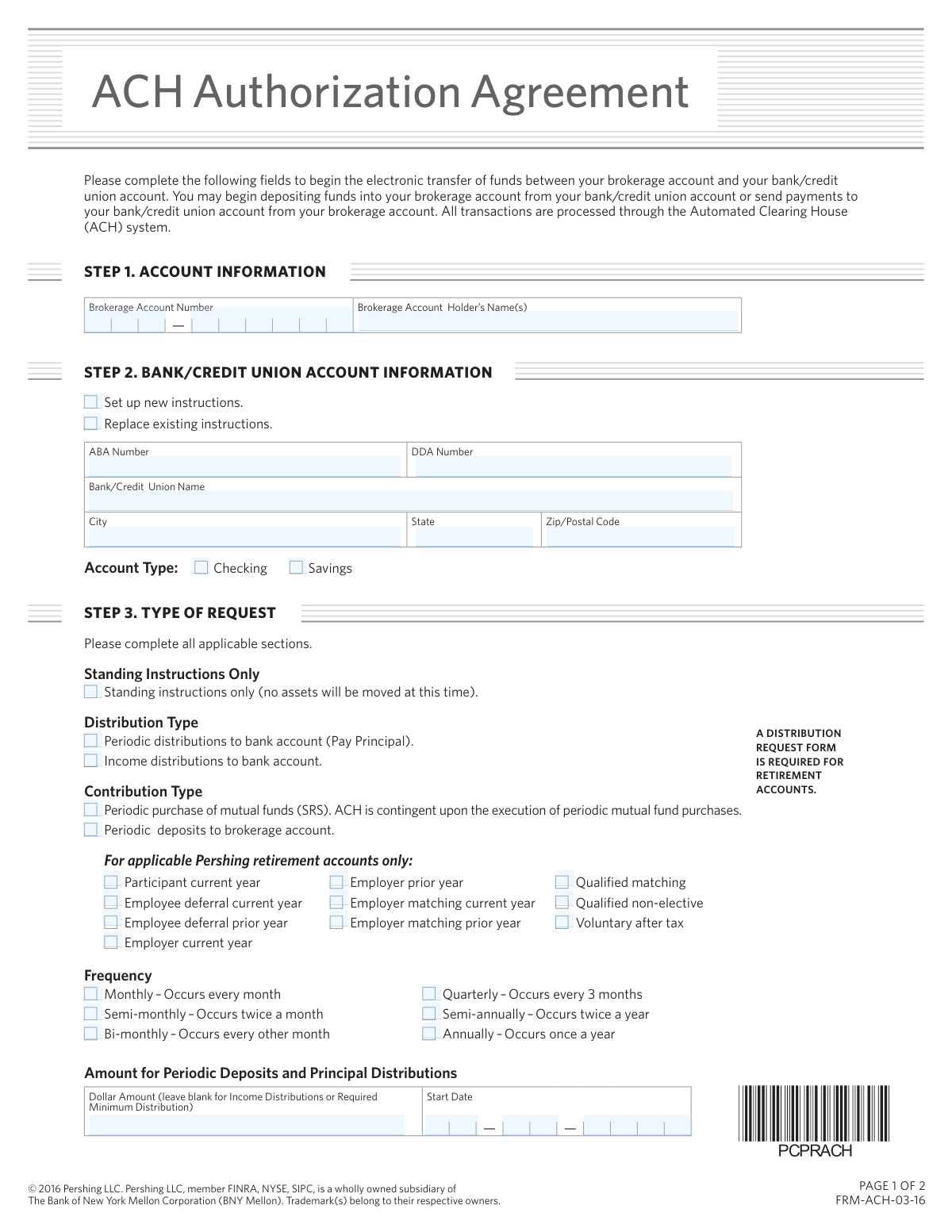
ACH authorization forms are legal documents that grant a financial institution, company, or government agency permission to electronically transfer funds into or out of a designated bank account through the Automated Clearing House network. These forms are a cornerstone of modern financial operations, enabling recurring payments, direct deposits, retirement plan contributions, and one-time transfers without the need for paper checks or manual processing. Whether it's linking a brokerage account for investment contributions or authorizing the government to collect fees electronically, these agreements create a secure, documented record of consent for electronic fund movement.
By continuing, you acknowledge Instafill's Privacy Policy and agree to get occasional product update and promotional emails.
About ACH authorization forms
A wide range of individuals and organizations rely on ACH authorization forms. Investors and brokerage clients use them to link bank accounts for seamless fund transfers — forms from Pershing LLC and Pershing Advisor Solutions are common examples. Employers and plan sponsors use them to fund retirement plan contributions, while immigration applicants may encounter Form G-1650 when paying USCIS fees electronically. In short, anyone setting up automated or recurring financial transactions is likely to need one of these forms at some point.
Because these forms require precise banking details and legal language, accuracy is essential — errors can delay transactions or result in unauthorized charges. Tools like Instafill.ai use AI to fill these forms in under 30 seconds, handling the data accurately and securely, which makes the process far less tedious whether you're completing one form or several.
Every form on this page can be completed without typing. Instafill is form filling software that reads a PDF and fills it for you — including flat and scanned documents that carry no fillable fields at all.
Forms in This Category
The forms in this category have a median Form Complexity Index of 38/100 (Basic), measured across 7 forms by field count, input difficulty, length, conditional logic and structure. See how it is calculated.
| Form Name | Pages | FCI | |
|---|---|---|---|
| 1. | ACH Authorization Agreement | 1 | Basic 38 |
| 2. | ACH Authorization Agreement (FRM-ACH-02-20) | 1 | – |
| 3. | ACH Funding Authorization Form | 1 | – |
| 4. | Form G-1650, Authorization for ACH Transactions | 1 | Basic 30 |
| 5. | Massachusetts Collaborative — CT/CTA/MRI/MRA Prior Authorization Form | 2 | Complex 64 |
| 6. | Pershing Advisor Solutions LLC ACH Authorization Agreement | 1 | – |
| 7. | TANN Corporation ACH/EFT Payment Authorization Form | 1 | Basic 34 |
- Enterprise-grade security & data encryption
- 99%+ accuracy powered by AI
- 1,000+ forms from all industries
- Complete forms in under 60 seconds
How to Choose the Right Form
Not all ACH authorization forms serve the same purpose — the right one depends on who you're authorizing, what account is involved, and why you need the transfer. Here's a quick breakdown to help you choose.
For Brokerage & Investment Account Transfers
If you need to link a bank account to a Pershing LLC brokerage account, you have three closely related options:
- ACH Authorization Agreement (FRM-ACH-02-20) — Best for setting up standing instructions or recurring transfers with Pershing LLC.
- Pershing Advisor Solutions LLC ACH Authorization Agreement — Use this if your account is managed through a Pershing *Advisor Solutions* relationship, such as for contributions or distributions.
- ACH Authorization Agreement (the general Pershing form) — A straightforward option for linking a personal or business bank account to a Pershing brokerage account for bidirectional transfers.
If you're unsure which Pershing form applies, check whether your account is held directly with Pershing LLC or through an advisor solutions platform.
For Retirement Plan Funding
- ACH Funding Authorization Form — Choose this if you're a Plan Sponsor authorizing FASCore (on behalf of MetLife) to withdraw funds for retirement plan contributions. This is a business-facing form, not for individual investors.
For USCIS Immigration Payments
- Form G-1650, Authorization for ACH Transactions — This is specifically for authorizing electronic payments to USCIS for immigration applications, petitions, or requests. It has nothing to do with brokerage or retirement accounts.
Not Sure You're in the Right Category?
- The Massachusetts Collaborative CT/CTA/MRI/MRA Prior Authorization Form is a *medical* prior authorization form, not a banking form. If you landed here looking for insurance or imaging approvals, that form is included but serves a different purpose entirely.
Bottom line: Start by identifying who you're authorizing — USCIS, a Pershing brokerage, or a retirement plan administrator — and the right form will be clear.
Form Comparison
| Form | Purpose | Who Files It | When to Use |
|---|---|---|---|
| Form G-1650, Authorization for ACH Transactions | Authorize electronic payments to USCIS for immigration fees | Immigration applicants or petitioners | When paying USCIS application or petition fees electronically |
| ACH Funding Authorization Form | Authorize ACH debits to fund retirement plan contributions | Plan Sponsor on behalf of company | When setting up retirement plan funding via MetLife/FASCore |
| Massachusetts Collaborative — CT/CTA/MRI/MRA Prior Authorization Form | Request prior authorization for advanced imaging procedures | Healthcare providers or ordering physicians | Before scheduling CT, MRI, CTA, or MRA for insured patients |
| ACH Authorization Agreement (FRM-ACH-02-20) | Grant Pershing LLC permission for ACH credits and debits | Brokerage account holders | When linking bank account to Pershing brokerage for transfers |
| Pershing Advisor Solutions LLC ACH Authorization Agreement | Authorize Pershing Advisor Solutions for ACH fund transfers | Brokerage clients of Pershing Advisor Solutions | When setting up contributions, distributions, or periodic investments |
| ACH Authorization Agreement | Link Pershing LLC brokerage to bank for recurring transfers | Personal or business brokerage account holders | When establishing standing instructions for bidirectional fund transfers |
Tips for ACH authorization forms
Errors in your routing number or account number are the most common reason ACH authorizations fail or send funds to the wrong account. Always verify these numbers directly from a voided check or your bank's official portal — not from memory. A single transposed digit can cause payment delays or rejected transactions.
ACH authorization forms grant permission for recurring or one-time debits and credits, sometimes indefinitely until revoked. Read the terms carefully to understand whether you're authorizing a one-time payment, periodic transfers, or standing instructions. Knowing the scope of your authorization helps you avoid unexpected withdrawals from your account.
Many ACH authorization forms — especially for brokerage or retirement plan accounts — require a voided check to verify your banking information. Prepare this in advance to avoid holding up the approval process. Never use a deposit slip in place of a voided check, as deposit slips sometimes carry different routing numbers.
If you're setting up ACH authorizations across multiple accounts or institutions, AI-powered tools like Instafill.ai can complete these forms in under 30 seconds with high accuracy, pulling your banking and personal details consistently across forms. Your data stays secure throughout the process, making it a practical time-saver when you're juggling several financial agreements at once.
Always save a copy of your completed and signed ACH authorization form before submitting it. If a dispute arises over an unauthorized transaction, having your original authorization on hand helps you resolve the issue quickly with your bank or the receiving institution.
ACH authorizations typically remain active until you formally revoke them in writing, so it's important to understand the cancellation process before you sign. Contact the authorizing institution directly and allow adequate processing time — simply closing your bank account does not automatically cancel an ACH agreement.
ACH forms require you to specify whether the account is a checking or savings account, and selecting the wrong type can cause transactions to be rejected. Confirm the account type with your bank if you're unsure, especially for money market or specialty accounts that may be classified differently than expected.
For business or retirement plan ACH forms, the person signing must be an authorized signer on the bank account being linked. Submitting a form signed by someone without account authority can result in rejection or compliance issues. Check with your bank or plan administrator if you're unsure who qualifies as an authorized signatory.
Frequently Asked Questions
An ACH authorization form is a document that grants a financial institution, government agency, or service provider permission to electronically transfer funds to or from your bank account through the Automated Clearing House (ACH) network. These forms establish the legal basis for recurring or one-time electronic debits and credits, replacing the need for paper checks or manual wire transfers.
ACH authorization forms are used by a wide range of individuals and organizations, including individuals paying government fees (such as USCIS application fees), business owners setting up retirement plan contributions, and investors linking a bank account to a brokerage account. Essentially, anyone who wants to automate or authorize electronic fund transfers needs to complete the appropriate ACH authorization form.
The right form depends on your specific purpose and the institution involved. For example, Form G-1650 is specifically for authorizing payments to USCIS, the ACH Funding Authorization Form is for retirement plan contributions through FASCore/MetLife, and the Pershing LLC or Pershing Advisor Solutions forms are for linking bank accounts to brokerage accounts. Review the description of each form in this category to identify the one that matches your institution and transaction type.
Most ACH authorization forms require your bank account number, routing number, account type (checking or savings), and the name of your financial institution. You will also generally need to provide your personal or business identifying information, the purpose of the transfer, and your signature authorizing the transactions.
In most cases, ACH authorization forms establish standing instructions that remain in effect until you revoke them or close the account, making them a one-time setup for ongoing or recurring transfers. However, some institutions may require updated authorization if your bank account details change or if the agreement expires under their specific terms.
Submission depends on the form and the institution. For example, Form G-1650 is submitted to USCIS as part of your immigration application, while Pershing-related forms are submitted directly to your brokerage or financial advisor. Retirement plan ACH forms are typically sent to the plan administrator or record-keeper. Always follow the specific submission instructions provided by the requesting institution.
Yes, submitting ACH authorization forms electronically is generally safe when using secure, encrypted platforms provided by or approved by the receiving institution. Many financial institutions and government agencies now accept digital submissions, and reputable online form services use encryption to protect your sensitive banking information during transmission.
Yes, AI-powered tools like Instafill.ai can fill out ACH authorization forms in under 30 seconds by accurately extracting and placing your data from source documents. These tools can also convert non-fillable PDF versions into interactive forms, making the process faster and reducing the risk of errors.
Manually filling out an ACH authorization form typically takes just a few minutes since they are relatively straightforward documents. However, using an AI-powered service like Instafill.ai can reduce that time to under 30 seconds by automatically populating fields with information extracted from your existing documents.
Errors on ACH authorization forms — such as incorrect routing or account numbers — can result in failed transactions, delayed payments, or misdirected funds. It is important to double-check all banking details before submitting. If you discover an error after submission, contact the receiving institution promptly to correct or cancel the authorization.
This category primarily focuses on ACH (electronic banking) authorization forms, but it also includes the Massachusetts Collaborative CT/CTA/MRI/MRA Prior Authorization Form, which is a medical prior authorization form for advanced imaging studies. If you are looking for that specific healthcare form, you can find it listed alongside the banking-related ACH forms in this category.
ACH authorization forms are used by both individuals and businesses. For example, businesses commonly use them to set up payroll, fund retirement plans, or manage recurring vendor payments, while individuals use them to link personal bank accounts to brokerage or government payment systems. Several forms in this category, such as the ACH Funding Authorization Form for retirement plan contributions, are specifically designed for business or plan sponsor use.
Glossary
- Form Complexity Index
- Instafill’s 0–100 measure of how much effort a form takes to complete, calculated deterministically from the form’s own structure rather than estimated. It combines the number of fillable fields (the largest factor), how difficult those fields are to complete based on their type, the number of pages that contain fields, the amount of conditional “fill-only-if” logic, and how many sections the form is divided into, then adds modifiers for tables and repeating lists, bundled instruction pages, and dense page layouts. A higher score means the form is harder to fill out by hand. The forms in this category have a median Form Complexity Index of 38/100 (Basic). See exactly how it is calculated.
- ACH (Automated Clearing House)
- A U.S. electronic network that processes batch financial transactions, including direct deposits and bank-to-bank transfers, between financial institutions. It is the underlying system that ACH authorization forms give permission to use.
- ACH Debit
- An electronic transaction that pulls or withdraws funds from your bank account, initiated by an authorized third party such as a brokerage firm or plan administrator. On ACH authorization forms, you are typically granting permission for these withdrawals to occur.
- ACH Credit
- An electronic transaction that pushes or deposits funds into your bank account from an authorized third party. Many ACH authorization agreements cover both credit and debit entries, allowing money to flow in either direction.
- Standing Instructions
- Pre-approved, recurring directions you set up once that authorize a financial institution to execute future transfers automatically without requiring a separate authorization each time. ACH authorization agreements often establish standing instructions for periodic payments or deposits.
- Plan Sponsor
- A company or employer that establishes and maintains a retirement plan on behalf of its employees. On ACH funding authorization forms for retirement plans, the Plan Sponsor is the party that initiates fund withdrawal requests.
- Originating Depository Financial Institution (ODFI)
- The bank or financial institution that initiates an ACH transaction on behalf of the authorizing party. This term may appear in ACH agreements to identify which institution is sending the debit or credit entry.
- Receiving Depository Financial Institution (RDFI)
- The bank or financial institution that receives an ACH transaction and credits or debits the account holder's account accordingly. Your personal or business bank account is typically held at the RDFI.
- ABA Routing Number
- A nine-digit number assigned to a U.S. bank or credit union that identifies the financial institution for the purpose of electronic transfers. This number is required on all ACH authorization forms to direct funds to or from the correct bank.
- Prenote
- A zero-dollar test transaction sent through the ACH network before live transfers begin, used to verify that the bank account information provided is accurate. Some financial institutions require a prenote period before processing actual debits or credits.
- Brokerage Account
- An investment account held at a financial firm like Pershing LLC that allows you to buy, sell, and hold securities. ACH authorization agreements are used to link this account to a personal or business bank account for funding or withdrawals.