Fill out beneficial ownership forms
with AI.
Beneficial ownership forms are essential components of modern financial regulation, designed to provide transparency regarding who actually controls a legal entity. Whether you are operating a corporation, a limited liability company, or a trust, financial institutions are required by law to identify the individuals behind the scenes. These KYC (Know Your Customer) forms help prevent financial crimes like money laundering and tax evasion by ensuring that the ultimate beneficial owners are clearly documented. Completing these documents correctly is vital for maintaining regulatory compliance and ensuring that your business can access necessary financial services without delays.
By continuing, you acknowledge Instafill's Privacy Policy and agree to get occasional product update and promotional emails.
About beneficial ownership forms
Typically, these forms are required when opening a new commercial bank account, establishing an investment portfolio, or undergoing a periodic due diligence review. For example, entities might need to submit a Legal Entity Beneficial Ownership Certification or a declaration for a Personal Investment Company (PIC) to satisfy institutional requirements. Because these forms often require sensitive data and detailed descriptions of ownership structures, precision is paramount. Tools like Instafill.ai use AI to fill these forms in under 30 seconds, handling the data accurately and securely to streamline the administrative process for business owners and legal professionals.
Every form on this page can be completed without typing. Instafill is form filling software that reads a PDF and fills it for you — including flat and scanned documents that carry no fillable fields at all.
Forms in This Category
The forms in this category have a median Form Complexity Index of 58/100 (Moderate), measured across 2 forms by field count, input difficulty, length, conditional logic and structure. See how it is calculated.
| Form Name | Pages | FCI | |
|---|---|---|---|
| 1. | Legal Entity Beneficial Ownership/Trust Certification Form | 1 | Moderate 58 |
| 2. | Template 1-1, Beneficial Ownership Declaration (PIC) | 1 | Basic 34 |
- Enterprise-grade security & data encryption
- 99%+ accuracy powered by AI
- 1,000+ forms from all industries
- Complete forms in under 60 seconds
How to Choose the Right Form
Beneficial ownership forms are essential components of the Know Your Customer (KYC) process, designed to prevent money laundering and financial fraud by identifying the individuals who truly control a legal entity. When selecting a form from this category, your choice will primarily depend on the financial institution you are working with and the specific type of entity you represent.
Choosing by Financial Institution
Most major financial institutions have proprietary documents for documenting beneficial owners to ensure they meet federal regulatory standards.
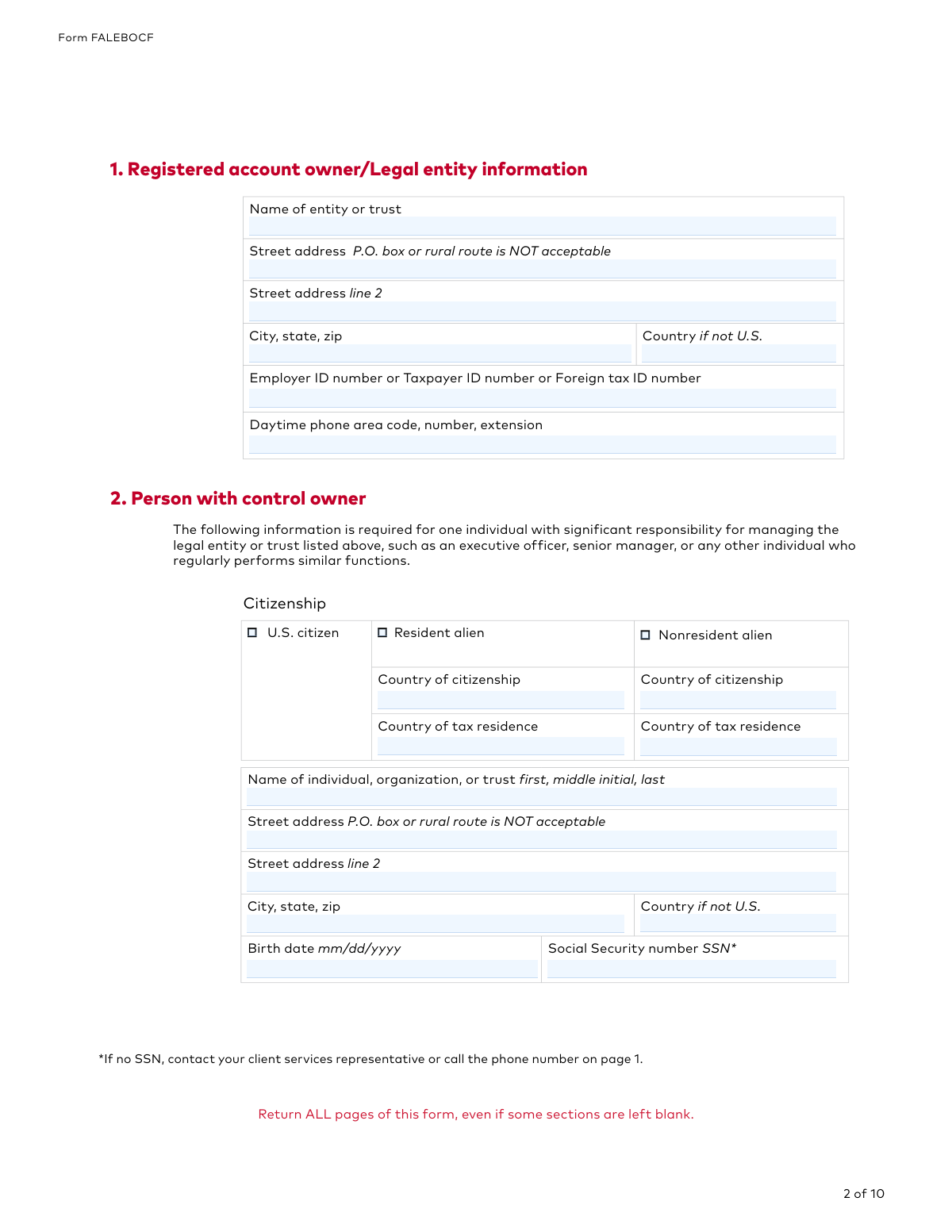
- Vanguard Accounts: If you are establishing an account for a corporation, LLC, or trust with Vanguard, you must use the Legal Entity Beneficial Ownership/Trust Certification Form. This form (also known as FALEBOCF) is mandated by federal law to verify the identities of significant owners and those with controlling influence over the entity.
- Citibank Private Bank: If you are opening an account for a Personal Investment Company (PIC) through Citibank’s private banking division, you will likely require Template 1-1, Beneficial Ownership Declaration (PIC). This specific declaration is tailored to meet Citibank’s internal anti-money laundering (AML) standards and regulatory compliance for private investment vehicles.
Choosing by Entity Type and Purpose
If you are unsure which form applies, consider the structure of your organization:
- General Legal Entities & Trusts: Use the Legal Entity Beneficial Ownership/Trust Certification Form for standard business entities like LLCs or corporations, as well as complex trust structures. It is designed to capture data on anyone with 25% or more ownership and those with significant managerial control.
- Personal Investment Companies (PICs): Use Template 1-1, Beneficial Ownership Declaration (PIC) specifically for private investment structures. This form focuses on identifying the Individual Beneficial Owners (IBOs) within a private banking context rather than a general commercial business.
Using Instafill.ai, you can quickly complete these forms by uploading your data or using our AI to guide you through the required fields, ensuring that your KYC documentation is accurate and ready for submission.
Form Comparison
| Form | Primary Purpose | Target Entity | Institution | Compliance Focus |
|---|---|---|---|---|
| Legal Entity Beneficial Ownership/Trust Certification Form | Identifies individuals who ultimately own or control a legal entity | Corporations, LLCs, and various types of legal trusts | Vanguard Group | Federal law requirements for preventing illicit financial activities |
| Template 1-1, Beneficial Ownership Declaration (PIC) | Documents ultimate individual beneficial owners for private investment accounts | Personal Investment Companies (PICs) opening private bank accounts | Citibank Private Bank | AML standards and specific private banking regulatory compliance |
Tips for beneficial ownership forms
Ensure you list every individual who owns 25% or more of the equity or exerts significant control over the legal entity. Omitting key personnel or miscalculating ownership percentages can lead to application rejections or extensive compliance delays.
Have copies of government-issued IDs, Social Security numbers, and legal formation documents ready. Most beneficial ownership forms require specific personal details for each owner, such as legal residential addresses, that are difficult to recall accurately from memory.
AI-powered tools like Instafill.ai can complete these complex KYC forms in under 30 seconds with high accuracy. This is a major time-saver when managing multiple entity accounts, and your sensitive data stays secure during the entire automated process.
If you are filing ownership declarations for both Vanguard and Citibank, ensure the data provided is identical on both forms. Discrepancies in entity names or owner details between different banks can trigger red flags and additional audit requirements.
Most Know Your Customer (KYC) regulations require a physical place of business for the legal entity rather than a P.O. box. Providing a residential address for individual owners and a physical office address for the company prevents common administrative processing errors.
Carefully distinguish between those with ownership interest and those with significant managerial control. Even if one individual fulfills both roles, their information must typically be entered in both sections of the form to meet federal certification standards.
Frequently Asked Questions
These forms are used by financial institutions to identify the actual individuals who own or control a legal entity, such as a corporation or trust. This process helps prevent financial crimes like money laundering and fraud by ensuring transparency regarding who is behind an account.
Generally, a beneficial owner is any individual who directly or indirectly owns 25% or more of the equity interests of a legal entity. It also includes at least one individual with significant responsibility to control or manage the entity, such as a CEO, CFO, or managing member.
The form you need depends on the financial institution where you are opening an account. For example, if you are establishing an account with Vanguard, you would use their specific Certification Form (FALEBOCF), whereas Citibank Private Bank requires their own Template 1-1 for Personal Investment Companies.
Yes, beneficial ownership forms are a critical component of KYC and Anti-Money Laundering (AML) regulations. Financial institutions are legally required to verify the identity of their clients' owners to comply with federal transparency standards.
You will typically need the full legal name, date of birth, residential or business address, and a social security number or passport number for each identified owner. Some forms may also require documentation proving the entity's legal status, such as articles of incorporation.
Yes, AI tools like Instafill.ai can streamline the process by automatically extracting data from your source documents and placing it accurately into the required fields. This ensures that complex entity details are captured correctly without manual data entry errors.
Using traditional manual methods, these forms can take significant time to complete due to the detailed nature of ownership structures. However, using an AI-powered service like Instafill.ai, you can often fill these forms in under 30 seconds by uploading your entity documents.
Entities are generally required to provide updated information whenever there is a significant change in ownership or control, such as a new partner joining or a change in executive leadership. Financial institutions may also request periodic updates during regular account maintenance.
Most legal entities, including corporations, LLCs, and certain trusts, must submit these forms when opening new accounts. Some exemptions may apply to publicly traded companies or government entities, depending on specific regulatory requirements.
A PIC is a private entity often used by individuals to hold and manage personal assets and investments. Forms like Citibank’s Template 1-1 are specifically designed to trace the ultimate individual owners behind these private structures for regulatory compliance.
For individuals who are not U.S. citizens or residents, most forms allow for alternative identification such as a passport number or an alien identification card number. The goal is to provide a unique identifier that allows the financial institution to verify the person's identity.
Many financial institutions now accept electronic submissions of beneficial ownership forms. AI-powered platforms can help by converting static PDF versions into interactive, fillable forms that can be signed and submitted digitally, speeding up the account opening process.
Glossary
- Form Complexity Index
- Instafill’s 0–100 measure of how much effort a form takes to complete, calculated deterministically from the form’s own structure rather than estimated. It combines the number of fillable fields (the largest factor), how difficult those fields are to complete based on their type, the number of pages that contain fields, the amount of conditional “fill-only-if” logic, and how many sections the form is divided into, then adds modifiers for tables and repeating lists, bundled instruction pages, and dense page layouts. A higher score means the form is harder to fill out by hand. The forms in this category have a median Form Complexity Index of 58/100 (Moderate). See exactly how it is calculated.
- Beneficial Owner
- An individual who, directly or indirectly, owns 25% or more of the equity interests of a legal entity or exercises significant control over it.
- KYC (Know Your Customer)
- A mandatory process used by financial institutions to verify the identity of their clients and assess potential risks associated with the business relationship.
- AML (Anti-Money Laundering)
- A framework of laws and regulations designed to prevent the practice of generating income through illegal actions and disguising it as legitimate wealth.
- Control Person
- An individual with significant responsibility to manage or direct a legal entity, such as a Chief Executive Officer, Chief Financial Officer, or Managing Member.
- Ultimate Beneficial Owner (UBO)
- The natural person who ultimately benefits from or exercises final control over a legal entity, even if they are hidden behind multiple corporate layers.
- Legal Entity
- A corporation, limited liability company, partnership, or similar business structure formed by filing a document with a government office.
- PIC (Personal Investment Company)
- A private company established by an individual or family to hold and manage their personal investments and assets rather than active business operations.
- FinCEN (Financial Crimes Enforcement Network)
- A bureau of the U.S. Treasury Department that collects and analyzes financial transaction data to combat domestic and international financial crimes.