Fill out broker of record forms
with AI.
Broker of Record (BOR) forms are essential legal documents in the insurance and financial services industries. They serve as a formal notification from a policyholder to an insurance carrier that they wish to change the professional representing them. This change is significant because it legally transfers the authority to manage the account, access sensitive policy data, and receive commissions to a new agent or firm. Without a properly executed BOR form, a new broker cannot legally act on behalf of a client or negotiate renewals with underwriters, making these documents the cornerstone of any agency transition.
By continuing, you acknowledge Instafill's Privacy Policy and agree to get occasional product update and promotional emails.
About broker of record forms
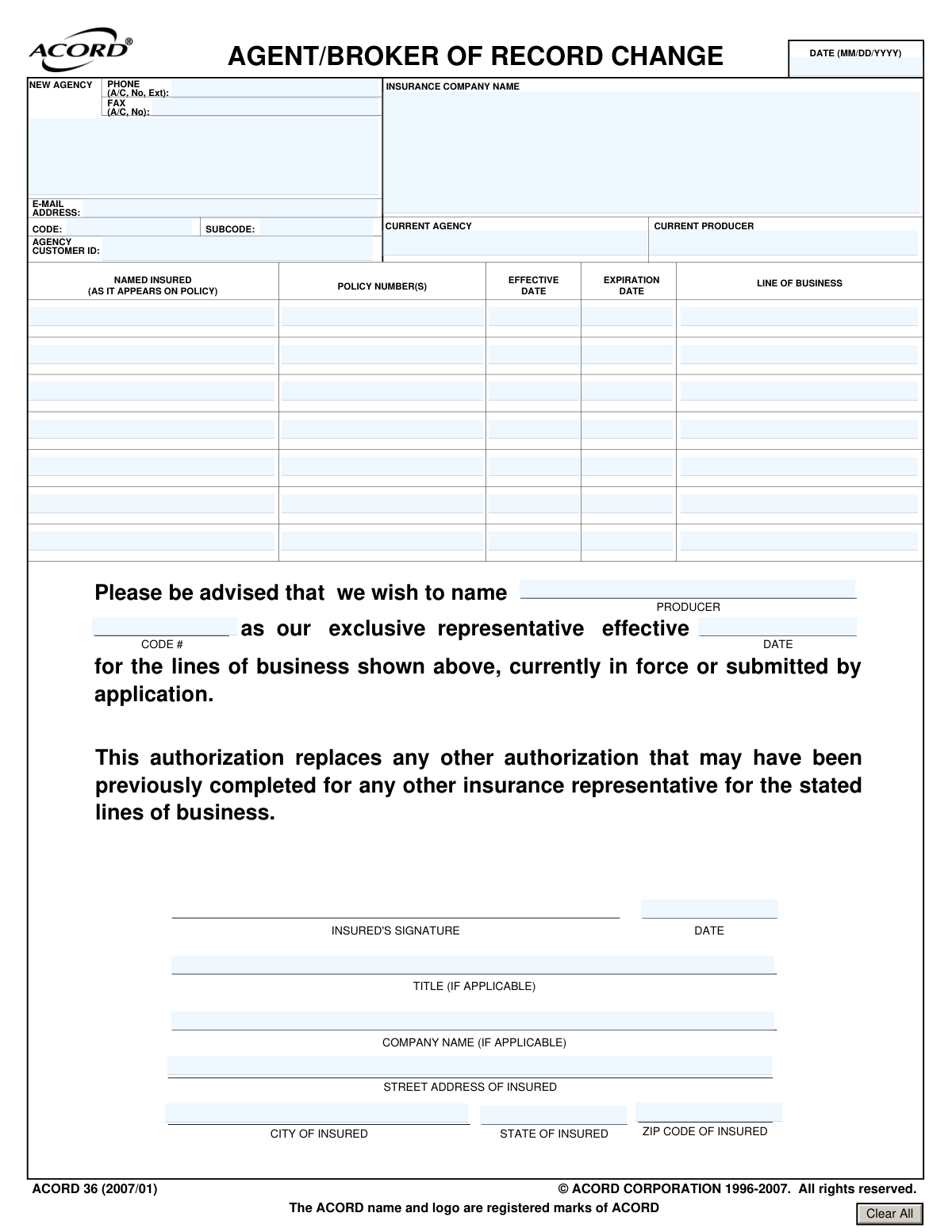
These forms are typically needed by business owners, HR managers, or individual policyholders who are moving their business to a new representative with better expertise or access to specialized markets. A common example is the ACORD 36, which is the industry standard for authorizing an Agent/Broker of Record Change. In many cases, these forms are filed during a mid-term transition or in the weeks leading up to a policy renewal to ensure a seamless handoff between agencies without a lapse in coverage or service.
Managing the administrative side of an agency change can be time-consuming, but tools like Instafill.ai use AI to fill these forms in under 30 seconds while handling the data accurately and securely. This allows both policyholders and brokers to focus on the transition itself rather than manual data entry.
Every form on this page can be completed without typing. Instafill is form filling software that reads a PDF and fills it for you — including flat and scanned documents that carry no fillable fields at all.
Forms in This Category
The forms in this category have a median Form Complexity Index of 60/100 (Moderate), measured across 1 forms by field count, input difficulty, length, conditional logic and structure. See how it is calculated.
| Form Name | Pages | FCI | |
|---|---|---|---|
| 1. | ACORD 36, Agent/Broker of Record Change | 1 | Moderate 60 |
- Enterprise-grade security & data encryption
- 99%+ accuracy powered by AI
- 1,000+ forms from all industries
- Complete forms in under 60 seconds
How to Choose the Right Form
Choosing the right form in this category is straightforward because the insurance industry relies on a singular, primary standard for changing representation: the ACORD 36, Agent/Broker of Record Change. Whether you are a business owner or an individual policyholder, this document is the legal instrument required to switch your insurance representation.
The Industry Standard: ACORD 36
The ACORD 36, Agent/Broker of Record Change is used across almost all commercial and personal insurance lines. You should select this form if you intend to:
- Transfer Authority: Move the management of your existing policies from one agency to another without needing to cancel and rewrite the coverage.
- Redirect Commissions: Ensure that the new broker receives the compensation for servicing your account moving forward.
- Grant Data Access: Allow your new agent to view your claims history, policy limits, and renewal dates directly from the insurance carrier.
When to Initiate the Change
You do not need to wait for your policy renewal to use the ACORD 36. Most policyholders choose to file this form when they have found a new broker who offers better service, specialized expertise, or more competitive market access.
It is important to note that once the insurance company receives the signed ACORD 36, Agent/Broker of Record Change, there is typically a 5-to-10-day "waiting period." During this time, the carrier notifies the current broker, giving them a chance to retain the business before the change becomes official.
Streamlining the Process with AI
Because the ACORD 36 requires precise policy numbers, carrier names, and effective dates, manual entry can lead to processing delays. Using Instafill.ai allows you to quickly map your data onto the form. If you have a non-fillable version of the ACORD 36, Agent/Broker of Record Change, our AI tools can convert it into an interactive format, ensuring your transition between brokers is professional and error-free.
Form Comparison
| Form | Primary Purpose | What it Replaces | Authority Transferred |
|---|---|---|---|
| ACORD 36, Agent/Broker of Record Change | Notifies insurance carriers to officially change the designated agent or broker. | The authority of the previous agent to service the policyholder's account. | Grants the new agent access to policy information and future commissions. |
| ACORD 36, Agent/Broker of Record Change | Appoints a new exclusive representative to manage specified insurance policies. | Any prior agreements or authorizations held by the previous representative. | Transfers exclusive responsibility for policy management to the newly appointed broker. |
Tips for broker of record forms
Ensure the policy numbers and insurance carrier names exactly match your current documentation. Even minor discrepancies in these fields can lead to processing delays or the carrier rejecting the transfer request.
Clearly state the date you want the new broker to take over management of your account. Be aware that many insurance carriers have a standard 5-to-10-day waiting period before the change officially takes effect.
The form must be signed by an individual with the legal authority to bind the organization, such as a company officer or owner. Unauthorized signatures are a primary reason why Broker of Record forms are flagged or invalidated by carriers.
AI-powered tools like Instafill.ai can complete these forms in under 30 seconds with high accuracy, and your data stays secure during the process. This is a significant time-saver if you are transitioning a large portfolio of policies across different carriers simultaneously.
Most insurance companies notify the current broker of the requested change, allowing them a short window to try and retain the account. Understanding this 'cooling-off' period helps you manage expectations during the transition between representatives.
Maintain a copy of the signed ACORD 36 for your own files after sending it to the new broker and the carrier. Having a timestamped record is essential for resolving any future disputes regarding service responsibilities or commission payments.
Frequently Asked Questions
A Broker of Record form is a legal document used by a policyholder to designate a specific insurance agent or broker as their official representative to an insurance company. This form authorizes the new broker to manage the policy, access account information, and receive commissions on behalf of the client.
You need an ACORD 36 form when you decide to switch insurance agents or brokers but want to keep your current insurance carrier and policy. It is the industry standard for formally notifying an insurer that you are transferring the management of your account to a different professional.
The form must be signed by the policyholder or an authorized representative of the insured entity, such as a business owner or an officer. The insurance company requires this signature to verify that the client has explicitly granted authority to the new broker.
Generally, filing a BOR form does not change the terms, coverage limits, or premiums of your existing insurance policy. Its primary purpose is to change who services the policy, though a new broker may later recommend changes to your coverage based on their assessment.
Yes, you can use AI tools like Instafill.ai to complete these forms by automatically extracting data from your existing insurance documents or previous letters. AI ensures that policy numbers, carrier details, and agent information are accurately placed into the ACORD 36 form without manual data entry.
Once the form is submitted to the insurance company, there is often a waiting period of five to ten days during which the insurer notifies the prior broker. If the prior broker does not provide a valid rescinding letter from the client, the new broker officially takes over at the end of that period.
No, most insurance companies only recognize one Broker of Record per policy or account at any given time. Submitting a new ACORD 36 form automatically supersedes and replaces any previous broker appointments for the specified policies.
Using traditional methods can take several minutes to find and type all the necessary policy details, but AI-powered services like Instafill.ai can fill these forms in under 30 seconds. The system accurately extracts data from source documents and populates the fields instantly.
After the change is finalized and the waiting period expires, the insurance company redirects future commission payments to the new broker. In some cases, commissions may only transfer at the next policy renewal depending on the carrier's specific internal rules.
While they serve the same purpose, the ACORD 36 is a standardized industry form, whereas a BOR letter is often a custom document on the client's letterhead. Many insurance carriers prefer the ACORD 36 because it contains all the standardized fields required for quick processing.
The completed and signed form is usually submitted by the new broker to the insurance company's underwriting or agency relations department. Most carriers allow for digital submission through their agent portals or via secure email to speed up the transition.
Glossary
- Form Complexity Index
- Instafill’s 0–100 measure of how much effort a form takes to complete, calculated deterministically from the form’s own structure rather than estimated. It combines the number of fillable fields (the largest factor), how difficult those fields are to complete based on their type, the number of pages that contain fields, the amount of conditional “fill-only-if” logic, and how many sections the form is divided into, then adds modifiers for tables and repeating lists, bundled instruction pages, and dense page layouts. A higher score means the form is harder to fill out by hand. The forms in this category have a median Form Complexity Index of 60/100 (Moderate). See exactly how it is calculated.
- Broker of Record (BOR)
- The legal representative designated by a policyholder to manage their insurance policies, access account information, and receive commissions from the insurance carrier.
- ACORD
- The Association for Cooperative Operations Research and Development, a global nonprofit organization that provides standardized forms used throughout the insurance industry.
- Agent of Record (AOR)
- An individual or agency authorized by an insured party to represent them in dealings with an insurance company, often used interchangeably with Broker of Record.
- Insurance Carrier
- The insurance company that issues the policy and provides the actual coverage, to whom the Broker of Record form must be submitted for processing.
- Commission
- The payment made by the insurance carrier to the broker or agent as compensation for selling and servicing the insurance policy.
- Rescission Period
- A short timeframe, typically 5 to 10 days, during which the current broker is notified of the change and has the opportunity to attempt to retain the client's business.
- Letter of Authorization (LOA)
- A document signed by the policyholder that grants a specific broker the right to request and receive confidential policy information from an insurance carrier.
- Effective Date
- The specific date on which the new broker officially takes over the management of the policy and begins receiving commissions.