Fill out builders risk forms
with AI.
Builders risk forms are specialized insurance documents designed to protect buildings and structures while they are under construction or undergoing significant renovation. Often referred to as "course of construction" insurance, these forms are essential for securing coverage against unique risks such as fire, wind, theft, and vandalism that can occur before a project is completed. Because construction sites are inherently vulnerable, these forms ensure that the substantial financial investment in materials, labor, and equipment is properly documented and protected during every phase of development.
By continuing, you acknowledge Instafill's Privacy Policy and agree to get occasional product update and promotional emails.
About builders risk forms
General contractors, property owners, and developers typically need to complete these forms when initiating new builds or major structural improvements. Insurance agents and underwriters rely on the detailed information provided—such as project values, job site security measures, and specific environmental perils—to accurately assess risk and determine policy premiums. Standard industry documents, such as the ACORD 147 Installation/Builders Risk Section, are frequently used to capture critical data regarding project scope, transportation risks, and desired coverage limits for events like floods or earthquakes.
Managing the technical documentation for complex construction projects can be a time-intensive process for busy professionals. Tools like Instafill.ai use AI to fill these forms in under 30 seconds, ensuring data is handled accurately and securely while eliminating the need for manual entry. This allows project managers and insurance producers to focus on site safety and project milestones rather than administrative paperwork.
Every form on this page can be completed without typing. Instafill is form filling software that reads a PDF and fills it for you — including flat and scanned documents that carry no fillable fields at all.
Forms in This Category
The forms in this category have a median Form Complexity Index of 66/100 (Complex), measured across 3 forms by field count, input difficulty, length, conditional logic and structure. See how it is calculated.
| Form Name | Pages | FCI | |
|---|---|---|---|
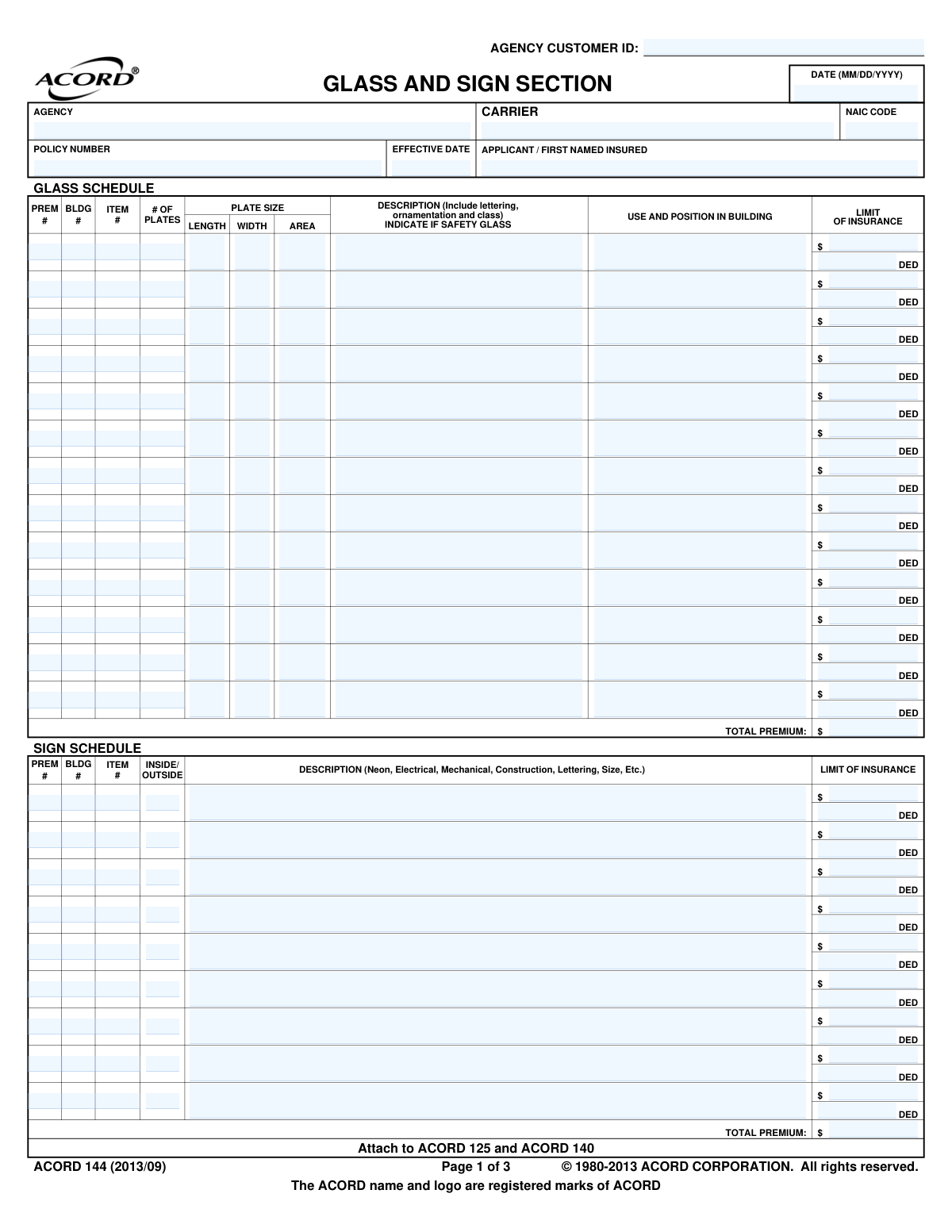
| 1. | ACORD 144, Glass and Sign Section | 3 | Complex 66 |
| 2. | ACORD 147 (2001/02), Installation/Builders Risk Section | 2 | Complex 76 |
| 3. | ACORD 147, Installation / Builders Risk Section | 3 | Complex 64 |
- Enterprise-grade security & data encryption
- 99%+ accuracy powered by AI
- 1,000+ forms from all industries
- Complete forms in under 60 seconds
How to Choose the Right Form
Selecting the right documentation for construction insurance is critical for protecting physical assets during a project. In this category, the primary document used by agents, contractors, and developers is the ACORD 147, Installation/Builders Risk Section.
Identifying Your Coverage Needs
The ACORD 147 is designed as a supplemental application. You should use this form if you are seeking coverage for the following scenarios:
- New Construction: Protecting a building from the ground up against perils like fire, wind, or theft while it is under construction.
- Renovations and Remodeling: Covering existing structures that are undergoing significant improvements where standard property insurance may not apply.
- Installation Floaters: Specifically for specialized contractors (such as HVAC, plumbing, or electrical teams) who need to cover high-value equipment while it is in transit or being installed at a job site.
Key Details Required for ACORD 147
To fill out this form accurately on Instafill.ai, you should have the following project details ready to ensure a smooth underwriting process:
- Project Valuation: The total completed value of the project, including labor and materials.
- Site Security: Information regarding fencing, lighting, and security personnel, which significantly influences underwriting risk and premiums.
- Construction Type: Specifics on whether the structure is frame, masonry, or fire-resistive.
- Specific Perils: Determine if you need additional endorsements for flood, earthquake, or specialized testing of machinery and equipment.
When to Use This Form
The ACORD 147 is typically used in conjunction with a general liability application (such as ACORD 125). If your project involves expensive materials that are susceptible to damage before they are fully integrated into the building, this is the essential section to complete. By using Instafill’s AI tools, you can quickly map data from your project bids directly into the ACORD 147, ensuring that limits for "Property in Transit" or "Property at Temporary Locations" are captured accurately without the risk of manual entry errors.
Form Comparison
| Form | Primary Purpose | Target Coverage | Key Information Captured | Common Applicants |
|---|---|---|---|---|
| ACORD 147, Installation/Builders Risk Section | Supplements insurance applications for property under construction or installation projects. | Covers materials, fixtures, and equipment during the construction or installation process. | Project values, job site security measures, transportation risks, and catastrophe limits. | Insurance agents and contractors seeking specialized property coverage for specific projects. |
Tips for builders risk forms
Ensure the project value includes not just the cost of materials, but also labor and overhead. Underestimating this figure can lead to significant coverage gaps if a loss occurs near the end of the project.
Underwriters pay close attention to how a site is protected from theft and vandalism. Clearly documenting the presence of fencing, lighting, or motion sensors can lead to more favorable terms and faster policy approval.
AI-powered tools like Instafill.ai can complete these complex insurance forms in under 30 seconds with high accuracy. This process saves significant time for contractors and producers, while ensuring your sensitive project data stays secure.
Don't forget to account for 'soft costs' like architectural fees, interest, and legal expenses if they are part of your coverage needs. Many first-time filers only list physical construction costs, leaving these administrative expenses uninsured.
Builders risk policies often extend to materials stored away from the job site or while they are in transit. To ensure coverage, provide the specific addresses of warehouses or storage yards where project materials are kept.
Check that the start and end dates on your ACORD 147 match the timelines in your construction agreement. Discrepancies in these dates can lead to a lack of coverage during the critical mobilization or cleanup phases of a project.
Gather your site plans, budget breakdowns, and security details into one digital folder before you begin. Having this information ready allows you to breeze through the application without having to stop and search for specific figures.
Frequently Asked Questions
Builders risk forms are specialized insurance documents used to apply for coverage on buildings or structures currently under construction or undergoing significant renovation. These forms provide insurers with essential details about the project scope, materials, and job site risks to determine appropriate premium rates and coverage limits.
Generally, property owners, real estate developers, or general contractors are the parties responsible for filling out these forms. They ensure that the financial interests of everyone involved in the project are protected against physical loss or damage from perils like fire, theft, and natural disasters.
Yes, AI tools like Instafill.ai can fill these forms in under 30 seconds by accurately extracting and placing data from your source documents. This technology significantly reduces the manual effort required to transfer technical project specifications into the application fields.
It is recommended to submit these forms during the project's planning phase or just before construction begins. Securing coverage before materials are delivered to the site ensures that the project is protected from the moment the first risk is present.
While manual entry for complex construction data can be time-consuming, using an AI-powered service can complete these forms in less than 30 seconds. These tools automatically identify relevant project data from your files and populate the PDF fields accurately.
While builders risk forms typically cover the entire structure, installation sections like the ACORD 147 are often used for specific high-value items being installed, such as HVAC units or elevators. This is particularly useful for subcontractors who only need to insure their specific portion of a larger project.
You will likely need to provide the total estimated value of the completed project, the construction type, and the expected duration of the job. Forms also frequently ask for information regarding site security, such as whether the site is fenced or has active surveillance.
Completed builders risk forms are typically submitted to your insurance agent, broker, or directly to an insurance carrier's underwriting department. They will use the information provided to assess the risk and issue a formal quote for the policy.
Yes, many insurers require a builders risk or renovation form for significant home improvements that go beyond standard maintenance. This helps clarify the value of the existing structure versus the value of the new improvements being added during the construction process.
If your project timeline exceeds the original estimate provided on the form, you should contact your insurance provider to update the information. You may need to file an extension or a supplemental form to ensure coverage remains active until the project is fully completed.
Many builders risk forms, such as the ACORD 147, include sections to request coverage for materials while they are in transit or stored at a temporary off-site location. This ensures that expensive building components are protected even before they arrive at the main job site.
Insurers use site security details to determine the likelihood of theft or vandalism claims. Providing accurate information about fencing, lighting, and monitoring can influence the underwriting process and may affect the overall cost of the insurance policy.
Glossary
- Form Complexity Index
- Instafill’s 0–100 measure of how much effort a form takes to complete, calculated deterministically from the form’s own structure rather than estimated. It combines the number of fillable fields (the largest factor), how difficult those fields are to complete based on their type, the number of pages that contain fields, the amount of conditional “fill-only-if” logic, and how many sections the form is divided into, then adds modifiers for tables and repeating lists, bundled instruction pages, and dense page layouts. A higher score means the form is harder to fill out by hand. The forms in this category have a median Form Complexity Index of 66/100 (Complex). See exactly how it is calculated.
- Builders Risk Insurance
- A specialized type of property insurance that covers a building or structure while it is under construction, including materials, equipment, and supplies on-site or in transit.
- Hard Costs
- The tangible, physical costs of a construction project, such as labor, lumber, concrete, and mechanical systems.
- Soft Costs
- Indirect expenses associated with construction that are not physical materials, including architectural fees, legal costs, interest on loans, and property taxes.
- Installation Floater
- A specific type of coverage, often included in ACORD 147, that protects materials and equipment intended for installation by a contractor before they become a permanent part of the structure.
- Course of Construction (COC)
- A common industry term used interchangeably with builders risk, referring to the period during which a structure is being built or renovated.
- Reporting Form
- An insurance arrangement where the policyholder provides periodic updates (usually monthly) on the project's current value so that coverage limits and premiums can be adjusted accordingly.
- Permission to Occupy
- A policy provision that requires the insurer's consent before a building can be used for its intended purpose, as occupancy typically triggers the end of builders risk coverage.
- Inland Marine
- The broad category of property insurance that covers items in transit or mobile equipment; builders risk and installation forms fall under this category because the property is not yet a fixed, permanent building.