Fill out capital management forms
with AI.
Capital management forms are essential documents used to oversee, move, and grow financial assets within various investment and business frameworks. They provide the legal and operational structure needed for activities like opening business investor accounts, requesting asset transfers between portfolios, or increasing existing subscriptions. Proper documentation ensures that capital is allocated according to the investor's intent while maintaining compliance with financial regulations and internal institutional policies. These forms serve as the primary record for capital allocation, ensuring that both the institution and the investor have a clear agreement on how funds are managed and protected.
By continuing, you acknowledge Instafill's Privacy Policy and agree to get occasional product update and promotional emails.
About capital management forms
These forms are typically utilized by business owners, corporate treasurers, and individual investors who work with major financial institutions or specialized capital management firms. Whether you are a sole proprietor opening a Working Capital Management Account (WCMA) to handle daily cash flows or an institutional investor submitting an Additional Subscription Form to increase your market exposure, these documents are the gatekeepers to liquidity and growth. They are most commonly needed during account onboarding, portfolio rebalancing, or when executing strategic transfers of cash and securities between brokerage accounts.
Completing these detailed applications and request forms often requires precise data entry regarding financial status and legal entity details. Tools like Instafill.ai use AI to fill these forms in under 30 seconds, handling the data accurately and securely to save you time. This allows you to focus on managing your capital and strategic growth rather than navigating the complexities of manual paperwork.
Every form on this page can be completed without typing. Instafill is form filling software that reads a PDF and fills it for you — including flat and scanned documents that carry no fillable fields at all.
Forms in This Category
The forms in this category have a median Form Complexity Index of 57/100 (Moderate), measured across 3 forms by field count, input difficulty, length, conditional logic and structure. See how it is calculated.
- Enterprise-grade security & data encryption
- 99%+ accuracy powered by AI
- 1,000+ forms from all industries
- Complete forms in under 60 seconds
How to Choose the Right Form
Choosing the right capital management form depends on whether you are establishing a new financial relationship, moving existing assets, or increasing your current investment position.
Opening a New Business Account
If you represent a U.S.-based corporation, LLC, or sole proprietorship and need to open a primary investment or cash management account, select the Merrill Business Investor Account (BIA) and Working Capital Management Account (WCMA) Account Application Booklet and Agreements. This is a comprehensive document designed to gather essential details about your business entity, its principals, and your specific investment objectives to establish a new account foundation.
Moving Assets Between Accounts
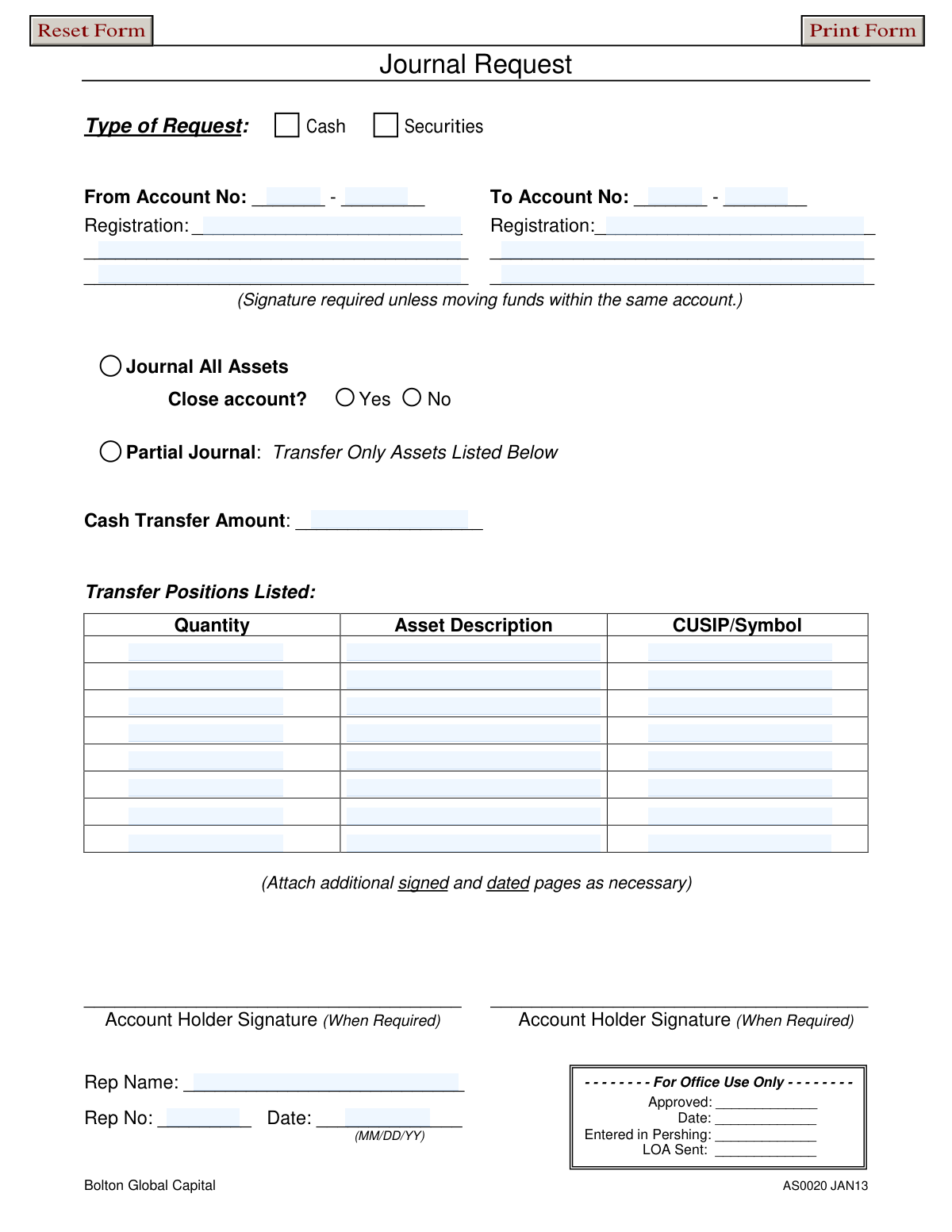
To instruct a firm to move cash or securities from one brokerage account to another, use the Bolton Global Capital Journal Request (Form AS0020). This "journaling" form is the correct choice if you are transferring specific assets, moving cash, or closing one account to consolidate all holdings into another account within the Bolton Global Capital network.
Increasing an Existing Investment
For current investors who already have a portfolio managed by FundRock and wish to contribute more capital, the Additional Subscription Form - Protea Capital Management is the required document. This form is specifically for existing clients who want to increase their stake via a lump sum or a recurring monthly debit, and it includes the necessary declarations for the source of funds to ensure compliance.
Quick Selection Tips
- Starting Fresh? Use the Merrill Application Booklet.
- Moving Assets? Use the Bolton Journal Request (Form AS0020).
- Adding Funds? Use the Protea Additional Subscription Form.
Using Instafill.ai, you can quickly complete these complex financial documents. Our AI tools help ensure that multi-page applications and precise transfer requests are filled out accurately to prevent processing delays or administrative errors.
Form Comparison
| Form | Primary Purpose | Who Files It | Key Action |
|---|---|---|---|
| Additional Subscription Form - Protea Capital Management | Increase investment in existing managed portfolios | Existing individual or institutional investors | Allocating additional lump sum or monthly capital |
| Bolton Global Capital Journal Request (Form AS0020) | Transfer assets between internal brokerage accounts | Bolton Global Capital account holders | Journaling cash or securities between accounts |
| Merrill Business Investor Account (BIA) and Working Capital Management Account (WCMA) Account Application Booklet and Agreements | Establish new business investment or cash management accounts | U.S. business entities and sole proprietors | Opening accounts and defining investment objectives |
Tips for capital management forms
Ensure the business name and Tax Identification Number (TIN) match your official formation documents exactly. Discrepancies in these fields are common mistakes that can lead to significant delays in account opening or asset transfers.
When requesting asset transfers between accounts, provide specific CUSIP numbers or ticker symbols rather than just general descriptions. This precision prevents the wrong securities from being moved and ensures the journaling process is handled correctly by the firm.
For subscription forms, clearly document where the investment capital originated to satisfy anti-money laundering (AML) requirements. Providing comprehensive details upfront reduces the likelihood of tedious follow-up inquiries from compliance departments.
AI-powered tools like Instafill.ai can complete these capital management forms in under 30 seconds with high accuracy. Your sensitive financial data stays secure during the process, making it a highly efficient solution for handling multi-page applications and subscription documents.
Always double-check that the individuals signing the forms have the legal authority to bind the entity according to your corporate resolution. For corporations or LLCs, this usually requires referencing your specific operating agreement to avoid rejection.
Carefully select your investment objectives on account application booklets to ensure they reflect your firm's actual risk tolerance and liquidity needs. Accurate selections help the brokerage firm provide appropriate services and maintain necessary regulatory compliance.
Many capital management forms require additional attachments like articles of incorporation, partnership agreements, or proof of identity. Having digital copies of these documents ready to upload alongside your filled PDF will streamline the entire submission process.
Frequently Asked Questions
Capital management forms are essential documents used by investors and businesses to manage their financial assets within investment firms. They facilitate various actions such as opening new working capital accounts, transferring assets between brokerage accounts, or increasing an investment in a specific portfolio.
These forms are generally required by individual investors, corporate officers, or business owners who are responsible for managing company finances. Depending on the document, the user may be a new client establishing an account or an existing client modifying their current holdings.
An account application is used to establish a brand-new financial relationship or account type, requiring comprehensive details about the business entity and its principals. A subscription form is typically used by existing investors to add more capital to a fund or portfolio they already participate in.
A journal request form authorizes a financial firm to move cash or securities from one brokerage account to another internally. This process, known as 'journaling,' allows for the efficient transfer of assets without the need to withdraw funds to an external bank account.
Yes, AI tools like Instafill.ai can fill out complex capital management forms in under 30 seconds. These services accurately extract data from your source documents and place it directly into the required fields, even if the original PDF was not designed to be fillable.
Most applications require the business's legal name, Tax Identification Number (TIN) or Employer Identification Number (EIN), and details about the company's structure. You will also likely need to provide information regarding the business's financial status and primary investment objectives.
Manually completing multi-section applications can take significant time, often thirty minutes or more. However, using AI-powered automation can reduce this to a matter of seconds by instantly mapping your existing data into the form's structure.
These forms are designed to accommodate a variety of legal structures, including corporations, Limited Liability Companies (LLCs), partnerships, and sole proprietorships. Each entity type may have specific sections to complete regarding its authorized signers and ownership structure.
Financial institutions are often required by law to verify where investment capital is coming from to prevent money laundering. A source of funds declaration is a standard part of additional subscription forms to ensure the transparency and legality of the transaction.
Once the form is filled out and signed, it must be submitted to the specific financial institution or fund manager via their preferred method, such as a secure portal, email, or physical mail. The firm will then review the document for compliance before processing the requested account opening or asset transfer.
Glossary
- Form Complexity Index
- Instafill’s 0–100 measure of how much effort a form takes to complete, calculated deterministically from the form’s own structure rather than estimated. It combines the number of fillable fields (the largest factor), how difficult those fields are to complete based on their type, the number of pages that contain fields, the amount of conditional “fill-only-if” logic, and how many sections the form is divided into, then adds modifiers for tables and repeating lists, bundled instruction pages, and dense page layouts. A higher score means the form is harder to fill out by hand. The forms in this category have a median Form Complexity Index of 57/100 (Moderate). See exactly how it is calculated.
- Working Capital Management Account (WCMA)
- A specialized financial account that combines business brokerage services with cash management tools like checking and electronic funds transfers.
- Journaling
- The process of moving cash, stocks, or other assets between two different brokerage accounts held at the same financial institution.
- Additional Subscription
- A transaction where an existing investor chooses to increase their total investment in a fund or portfolio by purchasing more shares.
- Source of Funds (SOF)
- A mandatory disclosure where the investor explains the origin of the capital being invested, typically required for anti-money laundering compliance.
- Principal
- An individual with significant ownership or high-level executive authority within a business entity, such as an owner, officer, or director.
- Business Investor Account (BIA)
- A brokerage account specifically designed for corporations, LLCs, and partnerships to manage and invest their business capital.
- Investment Objectives
- The stated goals for an account, such as capital preservation, aggressive growth, or income generation, which guide how the assets are managed.
- Securities
- Tradable financial instruments such as stocks, bonds, or mutual fund units that represent an ownership interest or a debt obligation.