Fill out cash management forms
with AI.
Cash management forms are essential documents used to establish, modify, or manage accounts that handle liquid assets and investment portfolios. These forms act as the legal bridge between an individual or entity and a financial institution, ensuring that ownership, tax responsibilities, and authorized access are clearly defined. Whether you are setting up a new brokerage account or adjusting the registration of an existing one, precision is vital to prevent delays in asset movement or errors in financial reporting.
By continuing, you acknowledge Instafill's Privacy Policy and agree to get occasional product update and promotional emails.
About cash management forms
This category is particularly relevant for individual investors, plan sponsors, and legal trustees who need to manage funds through major institutions like Merrill Edge or Fidelity. For example, a trustee might use these documents to open a Trust and Estate Cash Management Account to oversee an entity's assets, while a business owner might need to establish a Retirement Cash Management Account for plan participants. These forms are also frequently used during major life transitions, such as when converting a single account into a joint account or updating registration to reflect a new legal structure. Many of these Merrill Edge forms and Fidelity documents involve multi-page booklets that require detailed input to remain compliant with federal regulations.
Navigating these lengthy booklets and registration updates can be time-consuming due to the high volume of personal and financial data required. Tools like Instafill.ai use AI to fill these forms in under 30 seconds, ensuring that data is handled accurately and securely while saving you the hassle of manual entry. This streamlined approach allows you to focus on managing your investments rather than the administrative burden of paperwork.
Every form on this page can be completed without typing. Instafill is form filling software that reads a PDF and fills it for you — including flat and scanned documents that carry no fillable fields at all.
Forms in This Category
The forms in this category have a median Form Complexity Index of 66/100 (Complex), measured across 4 forms by field count, input difficulty, length, conditional logic and structure. See how it is calculated.
- Enterprise-grade security & data encryption
- 99%+ accuracy powered by AI
- 1,000+ forms from all industries
- Complete forms in under 60 seconds
How to Choose the Right Form
Choosing the correct cash management form depends primarily on two factors: which financial institution you are working with and the specific legal structure of the account you intend to open or modify. These forms are designed to handle high-liquidity investment accounts for individuals, trusts, and retirement plan sponsors.
Modifying an Existing Fidelity Account
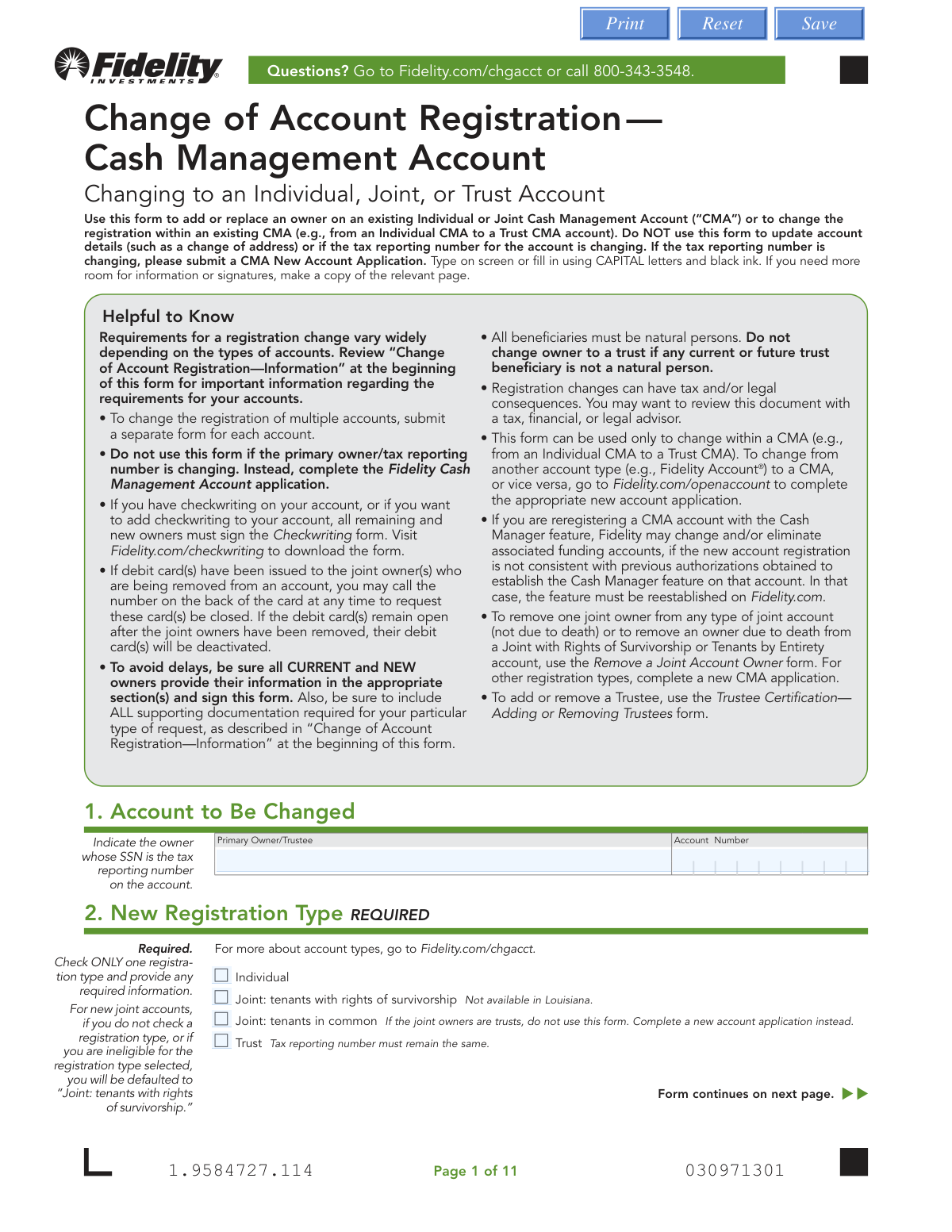
If you already hold a Fidelity account and need to update its ownership structure, you should use the Fidelity Change of Account Registration — Cash Management Account. This form is specifically for existing account holders who need to:
- Convert an individual account to a joint account.
- Add or remove account owners.
- Transfer ownership to a trust.
Opening a Merrill Edge Retirement Account
For plan sponsors or administrators looking to manage retirement plan assets, the Merrill Edge® Self-Directed Retirement Cash Management Account (RCMA Account) Account Application Booklet and Agreements is the appropriate choice. This is an investment-only brokerage account used to:
- Manage trustee-directed or participant-directed retirement funds.
- Define authorized individuals for the plan.
- Select cash sweep options for plan liquidity.
Managing Merrill Edge Trusts and Estates
If you are managing assets for a legal entity such as a trust or an estate, you will choose between two similar booklets based on the specific entity type:
- Merrill Edge Self-Directed Trust and Estate Cash Management Account (CMA Account) Account Application Booklet and Agreements: Select this version if you are managing a combined trust and estate or specifically an estate account for a deceased individual.
- Merrill Edge® Self-Directed Trust Cash Management Account® (CMA® Account) Account Application Booklet and Agreements: Use this version if the account is strictly for a U.S.-based trust. It focuses on collecting details regarding grantors and trustees to ensure regulatory compliance.
Using Instafill.ai, these lengthy application booklets can be completed efficiently by using AI to guide you through the required fields, ensuring that complex legal and tax information is captured accurately.
Tips for cash management forms
When filling out forms for trusts or estates, match the account name exactly as it appears on your legal deeds or letters testamentary. Even minor discrepancies in suffixes or middle initials can cause financial institutions like Merrill Edge or Fidelity to reject the application.
Double-check that you are using the correct Social Security Number or Employer Identification Number for the specific account type. For trust and estate cash management accounts, using an individual’s SSN instead of the entity's EIN is a frequent error that leads to significant tax reporting issues.
Ensure every trustee or authorized individual listed in your legal documents is included on the application form. Leaving out a required signer will often require you to restart the entire application process or submit additional notarized amendments later.
Pay close attention to sections regarding 'sweep' options, which determine where uninvested funds are held. Choosing the right money market fund or bank deposit option ensures your liquidity remains accessible while potentially earning interest according to your plan's goals.
Most cash management applications for specialized entities require a Certificate of Trust or proof of identity for all signers. Having digital copies of these documents ready to submit alongside your completed forms will significantly speed up the account approval process.
Manually completing multi-page booklets for Merrill Edge or Fidelity can be tedious and prone to errors. AI-powered tools like Instafill.ai can complete these forms in under 30 seconds with high accuracy, ensuring your data stays secure during the process while saving you hours of manual entry.
Frequently Asked Questions
Cash management forms are used to open, maintain, or update brokerage accounts that offer banking-like features alongside investment capabilities. They allow entities such as trusts, estates, and retirement plans to manage liquidity, trade securities, and define authorized signers for the account.
These applications are designed for specific legal entities like U.S.-based trusts, estates, or retirement plan sponsors looking to manage assets through a self-directed brokerage platform. Trustees, executors, or authorized corporate officers are generally the ones responsible for completing and signing these booklets.
The choice depends on the legal structure of the assets you are managing. A Retirement CMA is intended for plan sponsors managing retirement plan funds, while a Trust CMA is specifically for managing the assets of a formal trust or estate.
Yes, AI tools like Instafill.ai can simplify the process by automatically extracting data from your source documents and populating the fields in these complex forms. This technology can handle large application booklets, ensuring that repetitive information is accurately placed across multiple pages.
While manual entry for these lengthy booklets can take an hour or more, AI-powered tools can fill these forms in under 30 seconds. This significantly reduces the time spent on administrative tasks and minimizes the risk of manual entry errors.
This form is used when an existing Fidelity Cash Management Account needs a legal ownership update, such as adding a spouse or moving the account into a trust. It ensures that the account's title matches current legal requirements, which is vital for tax reporting and inheritance purposes.
These booklets collect comprehensive data including the entity's tax identification number, the personal details of all trustees or grantors, and investment preferences. They also include legal agreements that govern how the account will be managed and how trades will be executed.
Completed forms are typically submitted directly to the financial institution, such as Merrill Edge or Fidelity, either through their secure online portal, by mail to a processing center, or in person at a branch office. Always check the specific instructions on the form or the institution's website for the most current submission address.
The cash sweep option determines where uninvested cash in the account is held, such as in a money market fund or a bank deposit program, to earn interest. Selecting this option during the application process ensures your liquid assets are working for you while awaiting investment.
In addition to the application booklet, you may need to provide supporting documentation such as the trust agreement, letters of testamentary for an estate, or corporate resolutions for retirement plans. These documents verify the authority of the individuals signing the forms and provide the legal basis for the account.
Glossary
- Form Complexity Index
- Instafill’s 0–100 measure of how much effort a form takes to complete, calculated deterministically from the form’s own structure rather than estimated. It combines the number of fillable fields (the largest factor), how difficult those fields are to complete based on their type, the number of pages that contain fields, the amount of conditional “fill-only-if” logic, and how many sections the form is divided into, then adds modifiers for tables and repeating lists, bundled instruction pages, and dense page layouts. A higher score means the form is harder to fill out by hand. The forms in this category have a median Form Complexity Index of 66/100 (Complex). See exactly how it is calculated.
- Cash Management Account (CMA)
- A brokerage account that combines investment services with traditional banking features like check-writing, debit cards, and electronic bill payments.
- Account Registration
- The legal title or ownership structure of an account, which determines who has control over the assets and how they are taxed.
- Self-Directed
- An account type where the account holder is responsible for making all investment decisions and managing the portfolio without the assistance of a professional advisor.
- Cash Sweep
- An automated feature that moves uninvested cash into a specific interest-bearing account or money market fund to ensure idle funds are earning a return.
- RCMA (Retirement Cash Management Account)
- A specialized brokerage account used by retirement plan sponsors to manage and invest funds belonging to a company-sponsored retirement plan.
- Grantor
- The person who creates a trust and provides the assets that will be held and managed within that trust.
- Plan Sponsor
- A legal entity, typically an employer or labor union, that establishes and maintains a retirement or benefit plan for its members or employees.
- Trustee
- An individual or organization legally appointed to manage assets and make financial decisions on behalf of a trust or retirement plan.